
What if the most sophisticated element of your luxury interior was defined by what you didn’t see? In the high-stakes world of Dubai’s architectural sector, you’re likely aware that even a minor technical flaw, such as visible LED “spotting” on a polished marble surface, can undermine an entire design. It’s a recurring challenge for project managers who must balance aesthetic perfection with the practical realities of heat damage to bespoke joinery and the logistical nightmare of maintaining fixtures in soaring villa foyers.
This precision guide provides the technical framework to master architectural detail lighting Dubai by leveraging the unique properties of fibre optic technology. We’ll show you how to achieve perfectly uniform light lines and zero-maintenance solutions that remain safe for underwater and sensory applications. You’ll learn how to implement Mitsubishi ESKA Plastic Optical Fibre and high-output LED illuminators to meet the strict 2026 Al Sa’fat Green Building requirements. From protecting delicate materials to ensuring total reliability in hard-to-reach areas, we’re outlining the exact specifications needed to elevate your next luxury project to elite standards.
Key Takeaways
- Master the technical application of architectural detail lighting Dubai to highlight structural forms while eliminating visible “spotting” on high-end finishes.
- Explore the benefits of fibre optic lights over standard LEDs, specifically the remote source principle that protects luxury joinery from heat damage.
- Gain insights into specifying Mitsubishi ESKA Plastic Optical Fibre to ensure long-term system reliability in the unique Middle Eastern climate.
- Learn to integrate side-glow and end-glow solutions for seamless, maintenance-free illumination in hard-to-reach areas like high ceilings and staircases.
- Understand the logistics of sourcing precision components and bespoke design support for large-scale infrastructure projects across the GCC.
What is Architectural Detail Lighting in the Dubai Context?
Architectural detail lighting Dubai isn’t just a tool for basic visibility; it’s a strategic technical discipline focused on highlighting the specific structural forms and textures of a building. While general illumination provides the base level of light needed for a space to function, precision detailing uses light as a finishing material. It defines edges, reveals hidden textures, and emphasizes the original intent of the architect. In the high-end UAE market, the “Dubai Standard” for 2026 has transitioned toward a “Light, Not Lamps” approach. This philosophy prioritizes the effect of the light over the fixture itself, making the source virtually invisible to the naked eye.
Architectural lighting design in this specialized context requires a deep understanding of how light interacts with luxury finishes like polished marble, brushed metals, and bespoke joinery. By moving away from bulky, visible fixtures, designers can create a futuristic aesthetic that feels integrated rather than added on. This level of precision is what separates a standard residential project from a world-class luxury villa in the current market.
The Evolution of Lighting in UAE Architecture
The UAE has seen a rapid shift from basic LED facade displays to sophisticated, integrated systems. Modern projects now demand smart-controlled detail lighting that can be tuned to match the time of day or the specific function of a room. This evolution is driven by several factors:
- Sustainability: Mandatory regulations like the Al Sa’fat Green Building Rating System now require energy-efficient decorative solutions for all new construction.
- Property Value: High-quality architectural detailing is a proven differentiator in the Dubai luxury market, directly increasing the valuation of premium properties.
- Smart Integration: Systems must now support advanced protocols for seamless control within a wider home automation ecosystem, moving beyond simple on-off switches.
Key Objectives of Precision Detailing
Achieving a high-standard finish in the Middle East requires solving for both aesthetics and physics. One primary objective is accentuating architectural lines without any visible hardware. Using fibre optic technology allows for perfectly uniform light lines that follow the architecture’s geometry precisely. Another goal is creating depth through layered lighting, which is especially effective in restricted spaces like walk-in wardrobes or recessed wall niches. Finally, ensuring longevity in Dubai’s high-ambient-temperature environment is paramount. By utilizing a remote source principle, heat and electricity stay away from the delicate architectural details, preventing the yellowing or degradation often seen with standard LED strips in the region.
Fibre Optics vs. Standard LED for Detail Lighting
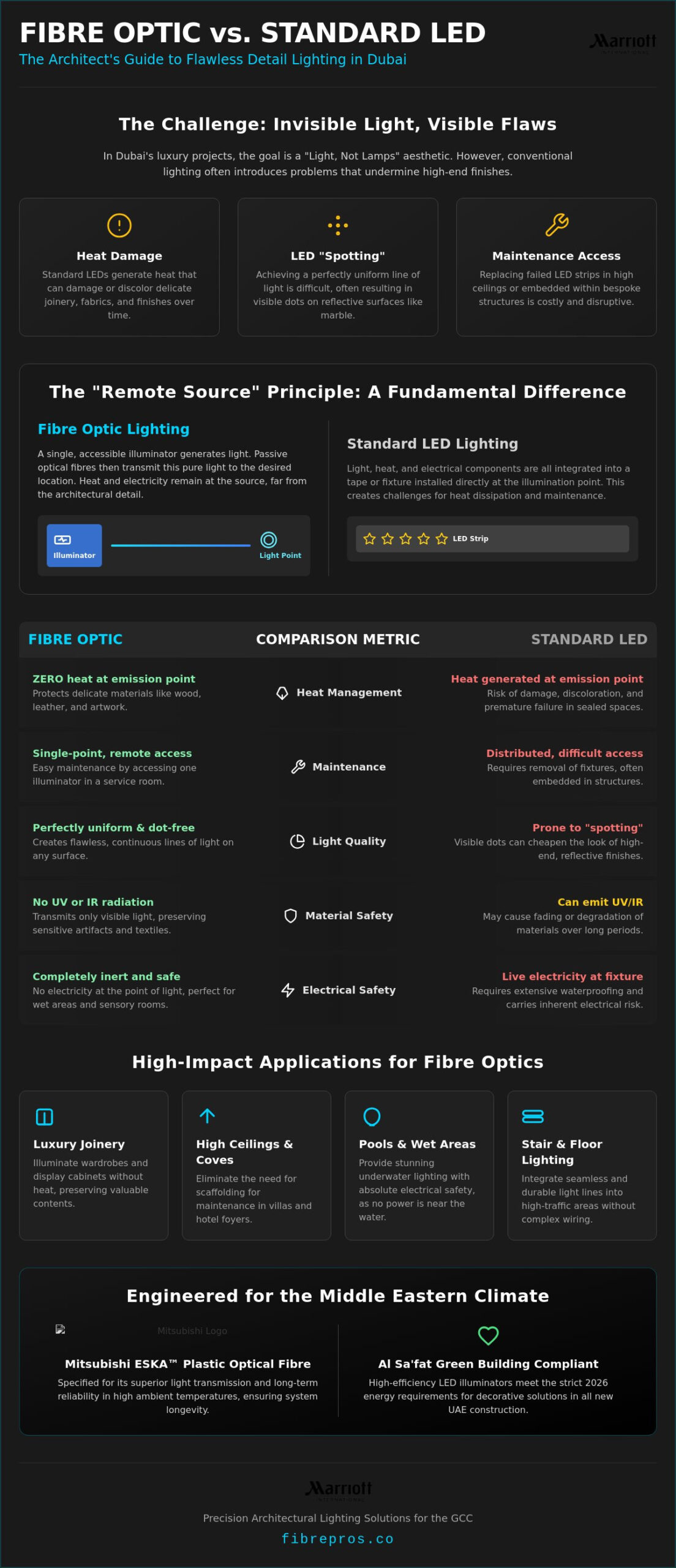
Choosing between light sources for architectural detail lighting Dubai requires understanding the “Remote Source” principle. Standard LED systems place the light source, heat, and electrical components directly at the point of illumination, which often complicates thermal management in restricted architectural niches. In contrast, fiber optic lights separate the light-generating LED illuminator from the emission point. Only the light travels through the fibre. This means no electricity or heat reaches the architectural detail, making it a critical distinction for projects where material integrity is a priority.
Maintenance efficiency is significantly higher with fibre systems. If a light source fails, you only need to access a single, remotely located LED illuminator. This avoids the need to strip out metres of failed LED tape embedded in bespoke joinery or high-ceiling coves. Additionally, fibre optics transmit only visible light. They filter out UV and IR radiation at the source, preventing the fading of expensive fabrics or the drying out of delicate timber finishes. This level of technical control is why fibre remains the preferred medium for high-end architectural detail lighting Dubai projects.
Heat Management in Restricted Spaces
Standard LEDs often struggle in sealed joinery because they can’t dissipate heat effectively. This leads to premature failure and potential damage to luxury finishes. Fibre optics act as a “cool” light source. They allow for intricate detailing in tight spaces without risking fire hazards or material degradation. By removing the heat source from the room’s interior, you also reduce the thermal load on HVAC systems. This technical efficiency aligns with broader regional initiatives like the Abu Dhabi Dark Sky Policy, which emphasizes responsible and sustainable lighting practices across the UAE.
Visual Quality and Light Uniformity
Visual precision is non-negotiable in luxury sectors. Cheap LEDs frequently exhibit “spotting” or “pixelation,” where individual diodes are visible on reflective surfaces like polished marble. Fibre optic side-glow technology eliminates this issue. It provides a perfectly continuous, uniform line of light that follows architectural curves with total consistency. Because the light originates from a single source, you maintain absolute control over colour temperature and CRI across the entire run. If you’re designing a high-stakes interior, integrating specialized fibre solutions ensures a flawless finish that standard tape simply cannot replicate.
High-Impact Applications for Architectural Detailing
High-impact architectural detail lighting Dubai requires a transition from general illumination to specific, localized applications that enhance high-value features. In luxury joinery, such as bespoke walk-in wardrobes or wine cellars, the primary concern is material preservation. Because fibre optic systems carry no heat or electricity to the emission point, they provide a safe environment for delicate materials like fine leathers, exotic woods, and temperature-sensitive collections. This technical advantage allows designers to place light sources in direct contact with surfaces that would otherwise be damaged by the thermal output of standard LED tape.
Staircase and floor nosing applications benefit from the uniform output of side-glow fibre. In Dubai’s luxury villas, staircases often feature polished marble or glass. Standard LEDs create a distracting “pixelated” reflection on these surfaces. Side-glow fibre provides a sleek, continuous line of light that enhances safety while maintaining a minimalist aesthetic. For building silhouettes, end-glow precision allows for sharp, defined accents along facade edges. This ensures the architectural form remains striking after sunset without contributing to excessive light spill or glare.
Luxury Residential Interior Detailing
Residential cinema rooms and bedrooms are increasingly incorporating star ceiling kits to create immersive, sensory environments. These systems use hundreds of fine fibre points to mimic a natural night sky, providing a glare-free experience that traditional fixtures cannot achieve. For foyers and grand entrances, the addition of crystal end fittings transforms standard light points into custom chandelier effects, refracting light with specialized precision. These details are particularly vital in sensory room designs for private villas in the UAE, where controlled, heat-free lighting is essential for both comfort and safety.
Underwater and Landscape Accents
Safety is the non-negotiable priority for pool and water feature lighting. Fibre optics are the safest choice for underwater lighting fixtures because there is no electrical current present in the water itself. The light is delivered from a remote illuminator, eliminating the risk of electrical faults in saline infinity pool environments. In landscape applications, these systems withstand Dubai’s extreme humidity and sand ingress far better than conventional fixtures. Lighting a pathway or a water edge with fibre ensures long-term reliability and zero maintenance in areas that are traditionally difficult to service.
Specifying Components for the Middle Eastern Climate
Dubai’s environmental conditions present unique challenges for any electrical installation. High ambient temperatures, intense UV radiation, and pervasive dust can degrade standard plastic components within months. For architectural detail lighting Dubai, specifying components that meet ESMA (Emirates Authority for Standardization and Metrology) certifications is the baseline for operational success. While some industry professionals suggest that generic IP65 ratings suffice, luxury projects in the GCC require IP68-rated components for underwater and outdoor durability to ensure the system doesn’t yellow or become brittle over time.
Thermal stability is a non-negotiable requirement. In a region where outdoor temperatures frequently exceed 45°C, the light source must be protected from the elements. This is why the remote source principle is so effective. By housing the light engine in a climate-controlled interior space, you eliminate the risk of heat-induced failure that plagues standard outdoor LEDs. This approach ensures your architectural accents remain functional and vibrant regardless of the external weather conditions.
The Mitsubishi ESKA Advantage
In the high-stakes world of luxury construction, Mitsubishi ESKA Plastic Optical Fibre is the architect’s choice for a reason. Unlike glass fibre, which can be prone to breakage in vibration-heavy sites or complex architectural curves, ESKA POF offers superior flexibility and light transmission. It’s specifically noted for its resistance to yellowing and brittleness, even in constant air-conditioned environments where humidity fluctuates. Specifying the correct fibre diameter is essential; thinner fibres are ideal for delicate star effects, while thicker diameters provide the punch needed for side-glow architectural lines.
Illuminator Technology and Control
The performance of any fibre system depends on the quality of the LED illuminators used. Modern units must integrate seamlessly with home automation systems like Crestron, Control4, or Lutron via DMX, Bluetooth, or RF protocols. A single high-efficiency illuminator can power hundreds of light points, ensuring perfectly synchronized colour and brightness across a large installation. When calculating brightness requirements, it’s vital to ensure the detail stands out against Dubai’s high ambient city light. High-output illuminators allow for crisp, visible detailing that maintains its impact even in well-lit urban environments.
If you’re designing a project that requires absolute technical precision, you can source high-performance fibre optic components directly from our Dubai-based inventory to ensure your installation meets 2026 regulatory standards.
Partnering with Fibrepros for Precision GCC Projects
Successful architectural detail lighting Dubai relies on a combination of technical mastery and a robust supply chain. Since 1995, we’ve established a legacy of providing specialized lighting solutions across the Middle East, focusing on the high-stakes requirements of luxury infrastructure. We operate as a dedicated partner for architects and interior designers, providing the specialized components necessary to execute complex lighting designs with total accuracy. Our inventory is strictly curated to include only high-standard qualitative materials, ensuring that every installation reflects the elite craftsmanship expected in the region.
We maintain a steady focus on technical reliability. Unlike generalists, we don’t supply communications fibre; our expertise is entirely dedicated to the art and science of illumination. This specialization allows us to provide a level of service that addresses the specific technical anxieties of B2B clients, from thermal management in bespoke joinery to the logistical challenges of high-ceiling maintenance. By anchoring our operations in our Dubai-based hub, we provide responsive support and accountability across the GCC, including major project sites in Riyadh and Doha.
From Concept to Delivery
We assist B2B clients during the critical technical specification phase to ensure project feasibility. Our team provides bespoke design support, helping to translate architectural concepts into precise physical requirements. We streamline the procurement process by offering comprehensive kits for specialized applications, including:
- Star Ceiling Kits: Precision-engineered for luxury residential cinemas and bedrooms.
- Sensory Room Kits: Heat-free, safe lighting solutions for private villas and clinics.
- Pool Lighting Systems: IP68-rated underwater fixtures designed for saline infinity pool environments.
Our role extends beyond simple supply. We ensure that the components specified, such as Mitsubishi ESKA POF and high-efficiency LED illuminators, are perfectly matched to the project’s scale and environmental demands. This holistic approach minimizes installation errors and ensures long-term operational success for every project we touch.
The Fibrepros Commitment to Excellence
Our commitment to excellence is visible in the specialized hardware we provide. From crystal end fittings that create custom chandelier effects to durable stainless steel fixtures for landscape accents, every product is selected for its performance and aesthetic value. We take pride in the infrastructure we help build, viewing ourselves as an essential partner in the region’s architectural landscape. Our start-to-finish service packages are designed to provide peace of mind to project managers who value time and operational efficiency.
Precision is the hallmark of a luxury finish. To ensure your next installation meets the highest industry standards, consult with a Fibrepros specialist for your next Dubai project and access the expertise required for world-class architectural detailing.
Executing the Next Generation of Precision Lighting
Mastering the technical nuances of architectural detail lighting Dubai is essential for delivering the futuristic, high-performance interiors that define the city’s 2026 landscape. We’ve explored how the remote source principle protects luxury materials from heat while significantly reducing maintenance overhead in complex installations. By shifting from standard LED tape to high-fidelity fibre optic systems, project managers can achieve the “Light, Not Lamps” aesthetic without compromising on long-term reliability or regulatory compliance. Precision isn’t just an aesthetic choice; it’s a structural requirement for high-stakes infrastructure.
As an official supplier of Mitsubishi ESKA Plastic Optical Fibre, we provide the specialized hardware required for elite results. Our team has maintained a reputation for technical precision and specialist lighting expertise since 1995, with a proven track record across the GCC and Southeast Asia. We’re ready to assist you in translating these technical principles into your specific project requirements to ensure a flawless delivery on every architectural detail.
Request a Technical Consultation for Your Dubai Project to ensure your next development meets the highest standards of architectural excellence and operational success.
Frequently Asked Questions
Why is fibre optic lighting preferred over LED for Dubai luxury villas?
Fibre optic technology is preferred because it separates the light source from the emission point, eliminating heat at the architectural detail. This prevents the degradation of expensive wood, leather, and marble finishes common in luxury interiors. It also simplifies maintenance in villas with high ceilings. You only need to access a single remote illuminator rather than dozens of individual fixtures located in hard-to-reach areas.
Can architectural detail lighting be integrated into existing smart home systems?
Yes, modern systems are fully compatible with leading automation platforms like Crestron, Lutron, and Control4. Architectural detail lighting Dubai projects typically utilize DMX, RF, or Bluetooth-controlled LED illuminators to allow for precise dimming and colour tuning. This ensures your lighting integrates seamlessly into the wider smart home ecosystem for centralized, automated control.
How long does a Mitsubishi ESKA fibre optic system typically last in the UAE?
Mitsubishi ESKA Plastic Optical Fibre is engineered for extreme longevity, often lasting the lifetime of the building when installed correctly. Its advanced polymer construction resists the yellowing and brittleness that common plastics suffer from in the UAE’s high-ambient-temperature and air-conditioned environments. Only the LED illuminator requires periodic inspection, typically after 50,000 hours of operation, making it a highly reliable long-term investment.
Is fibre optic pool lighting safer than traditional 12V LED underwater lights?
Fibre optic systems are significantly safer because they carry no electrical current to the pool itself. Traditional 12V LED lights require electrical connections underwater, which presents a risk if seals fail or cables degrade. With fibre, only light enters the water through the fibre cable, while the electricity remains safely housed in a remote illuminator located away from the pool area.
What is the maintenance requirement for a star ceiling kit in Dubai?
Star ceiling kits require virtually zero maintenance at the ceiling level because there are no bulbs or electrical parts to replace behind the panels. The only component that needs attention is the remote LED illuminator, which is usually placed in a ventilated closet or service hatch for easy access. This eliminates the need for ladders or scaffolding in high-ceiling bedrooms or home cinemas when a light source needs checking.
Does Fibrepros provide installation services for architectural lighting in Riyadh?
We specialize in the expert supply and technical specification of precision lighting components across the GCC, including Riyadh. While our core business is the delivery of high-quality hardware like Mitsubishi ESKA POF and LED illuminators, we provide bespoke design support to ensure local teams execute the installation accurately. Our Dubai-based hub ensures responsive logistical support and accountability for large-scale infrastructure projects throughout Saudi Arabia.
What are the best IP ratings for outdoor lighting in the Middle East?
For the harsh Middle Eastern climate, IP68 is the gold standard for any lighting exposed to water or significant dust. While IP65 is often marketed as weatherproof, it may not withstand the fine sand and extreme humidity of the UAE over several years. High-standard installations specify IP68-rated stainless steel fixtures to ensure total protection against ingress in outdoor and landscape environments.
Can fibre optic lighting be used for facade detailing on high-rise buildings?
Fibre optics are highly effective for high-rise facade detailing, particularly for highlighting silhouettes with end-glow precision. This technology helps developers comply with Dubai’s Al Sa’fat Green Building regulations by minimizing light spill and preventing upward light emission. Maintenance is also easier for high-rise structures since the light source is kept inside the building, removing the need for external cradles or dangerous high-altitude work.