
In a climate where peak summer temperatures regularly exceed 50°C, traditional luxury lighting fixtures in the UAE often suffer from significant lumen depreciation or hardware failure within just 24 months. You’ve likely seen how the combination of intense heat and coastal humidity compromises the integrity of standard chandeliers; this is especially true in the high-ceilinged grand foyers of Palm Jumeirah or Emirates Hills. Designing a high-performance fibre optic chandelier Dubai requires a shift from decorative thinking to technical engineering. It’s about selecting components that isolate heat at the source while delivering pristine light through the most demanding environments.
We understand that for a B2B project manager or interior architect, the goal is a “fit and forget” solution that eliminates the need for scaffolding every time a bulb fails. This 2026 professional guide from the FibrePros team masters the technical requirements for heat-resistant installations, ensuring your bespoke designs maintain their brilliance for over 15,000 hours of operation. We’ll provide a step-by-step framework for specifying Plastic Optical Fibre (POF) systems, focusing on the integration of Mitsubishi ESKA fibre and high-output LED illuminators. You’ll gain a clear understanding of the essential components and learn how to secure reliable local supply chains for your next high-end project.
Key Takeaways
- Understand why lightweight fibre optics are superseding traditional glass fixtures in modern UAE architectural designs for enhanced structural versatility.
- Identify the critical technical specifications for illuminators and cable diameters required to achieve professional-grade, heat-resistant lighting effects.
- Master the step-by-step process for calculating precise drop lengths and tail densities to design a high-performance fibre optic chandelier Dubai luxury standards demand.
- Compare the significant structural and maintenance advantages of remote-source lighting systems over traditional high-maintenance alternatives.
- Ensure long-term project reliability by learning why industry specialists prioritize high-performance materials like genuine Mitsubishi ESKA optical fibre.
What is a Fibre Optic Chandelier and Why is it Trending in Dubai?
A fibre optic chandelier is a sophisticated lighting system that separates the light source from the decorative fixture. Unlike traditional chandeliers that rely on internal bulbs and complex internal wiring, these systems utilize a remote light engine, or illuminator, and high-grade optical fiber technology to transport light to various end points. This design allows for a fibre optic chandelier Dubai installation to be both lightweight and exceptionally durable, making it a preferred choice for the city’s most ambitious architectural projects in 2026.
Dubai’s architectural shift toward these systems is driven by the demand for scale and technical reliability. Traditional heavy glass fixtures often require significant structural reinforcement, whereas fibre optic systems can reduce the overhead load by as much as 75%. This weight reduction is critical for the 20-meter high-ceiling lobbies found in the DIFC and the expansive coastal villas on the Palm Jumeirah. By removing the electricity and heat from the fixture itself, engineers ensure that the decorative element remains cool to the touch and entirely safe from electrical faults.
The Aesthetic Versatility of Fibre Optics
Designers are no longer restricted by the physical limitations of copper wiring and bulky sockets. Fibre optics allow for “rainfall” effects, shimmering cascades, and intricate geometric light sculptures that seem to float in mid-air. These designs are becoming a staple in Dubai hotel lighting trends 2026, where the focus has moved toward immersive luxury and dynamic movement. Because the fibres are flexible and thin, they can be woven into patterns that would be impossible with traditional bulbs, creating a sense of fluid light that defines modern luxury interiors. It’s a level of creative freedom that traditional materials simply can’t match.
Safety and Climate Resilience in the UAE
In a climate where temperatures frequently exceed 45 degrees Celsius, managing internal heat is a priority for every building manager. Fibre optic systems eliminate heat at the fixture level, which directly supports AC efficiency and reduces cooling costs. This technology is the only viable choice for “wet area” chandeliers in luxury spas and indoor pools because there is no live electricity in the water-facing components. Data from a recent fibre optic lighting case study UAE demonstrates that these systems resist the corrosive effects of high-salinity coastal air, outlasting traditional metallic fixtures by over 36 months in extreme environments. Key benefits include:
- Zero heat emission: Protects delicate ceiling materials and maintains stable room temperatures.
- Electrical isolation: Eliminates the risk of short circuits in humid or wet environments like private spas.
- Simplified maintenance: The light source is located in an accessible wall cabinet, not 15 meters up on a high ceiling.
The transition to fibre isn’t just about style; it’s about building infrastructure that survives the specific environmental pressures of the Middle East while delivering a high-end visual experience.
Core Components: Specifying the Professional Fibre Optic System
Every bespoke fibre optic chandelier Dubai project relies on a technical three-pillar system: the LED illuminator, the optical fibre cable, and the end fittings. These elements must work in absolute synchronization to deliver a high-end aesthetic. The illuminator serves as the engine, generating light that travels through the fibre strands to the terminal points. Professional installations in the UAE often utilize crystal end fittings to refract this raw light, creating a sharp, luxurious brilliance that standard plastic terminals cannot replicate.
The choice of fibre diameter is a critical design decision that dictates the visual weight of the piece. A 0.75mm fibre creates a delicate, starry effect ideal for high-density “rainfall” designs in residential dining areas. Increasing the diameter to 1.5mm significantly increases the light output at the tip, providing a bolder point of light that stands out in expansive hotel lobbies or commercial atriums. Designers apply core lighting design principles to ensure the quantity of light matches the room’s function while maintaining the desired atmosphere.
Mitsubishi ESKA POF: The Gold Standard
Mitsubishi ESKA Plastic Optical Fibre (POF) is the primary specification for luxury chandeliers due to its 96% light transmission efficiency and superior flexibility. In chandelier design, the distinction between “End-Glow” and “Side-Glow” is vital; End-Glow focuses 100% of the light at the tip for a clean point-source, while Side-Glow allows light to leak along the strand for a linear effect. The eska pof specifications define the industry benchmark for durability and thermal resistance in demanding environments.
LED Illuminators and Control Systems
The illuminator determines the color and control capabilities of the entire system. You can specify RGBW engines for dynamic color-changing sequences or high-CRI white LEDs (CRI 95+) for a classic, sophisticated glow that accurately renders textures and fabrics. Integration with Dubai’s common smart home protocols, such as DMX, KNX, or Bluetooth, is essential for centralized dimming. We recommend placing the illuminator in a ventilated, accessible location like a service hatch or cupboard. This proactive step simplifies future maintenance without requiring scaffolding to reach the chandelier itself.
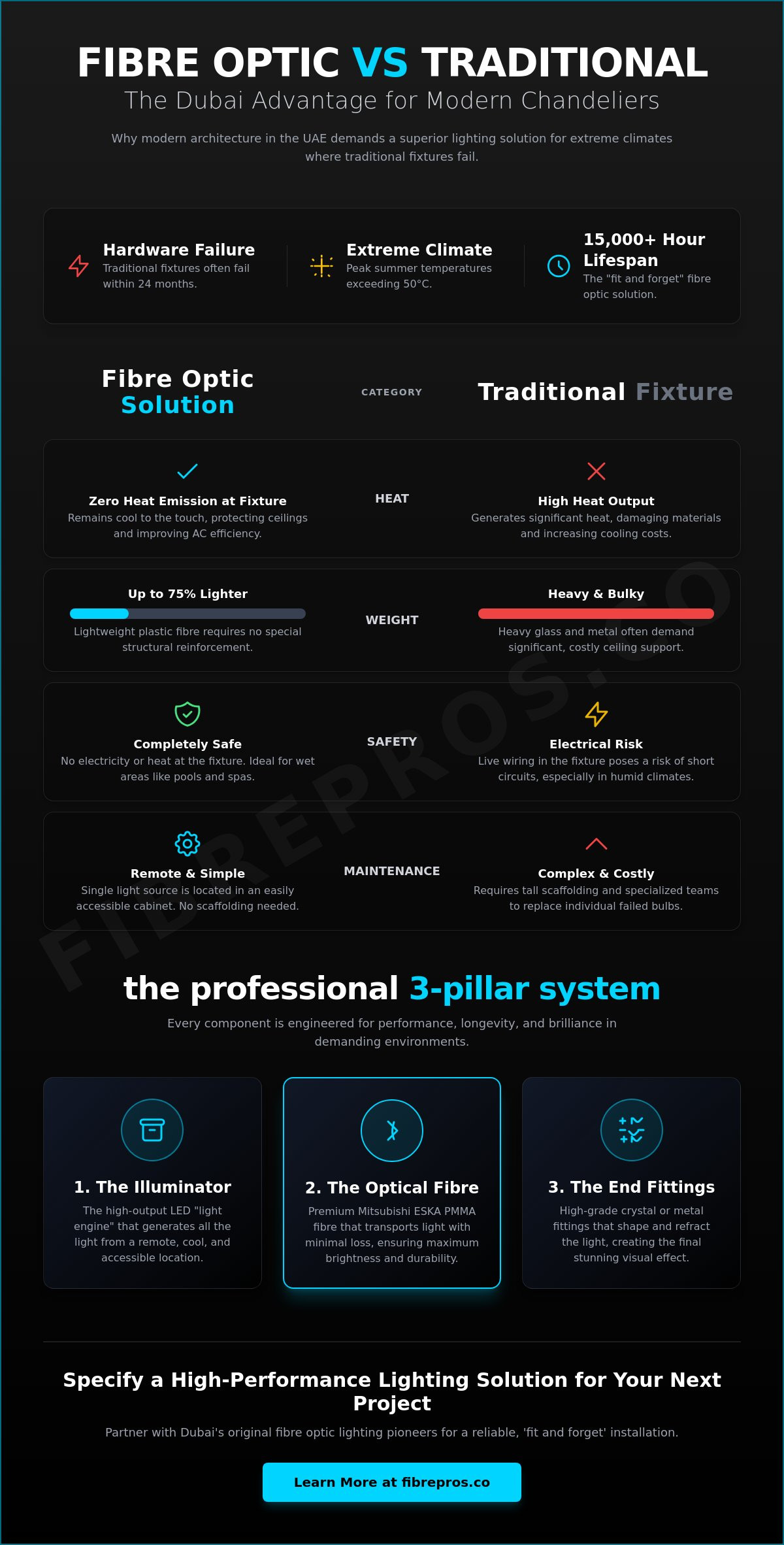
Fibre Optic vs. Traditional Chandeliers: A Comparison
Specifying a fibre optic chandelier Dubai project involves a fundamental shift in engineering compared to traditional lighting. While conventional fixtures require high-voltage electrical current to reach every bulb, fibre optic systems separate the light source from the output points. This decoupling offers technical advantages that traditional crystal or glass chandeliers cannot match, especially in high-performance architectural environments. A fibre optic chandelier Dubai installation prioritizes longevity and safety over outdated electrical configurations.
- Maintenance Efficiency: Traditional chandeliers with 50 or more bulbs require frequent, high-altitude maintenance. Fibre optics use a remote illuminator. You replace one 100W LED source in an accessible location instead of 50 individual bulbs on a ladder. This reduces maintenance cycles from quarterly bulb swaps to a single LED check every 50,000 hours.
- Energy Consumption: A single LED illuminator consumes significantly less power than a bank of high-wattage halogen bulbs. This reduces the cooling load on the villa’s HVAC system, which is a critical operational factor in the Dubai climate.
- Structural Integrity: Traditional fixtures often require reinforced steel supports to handle weights exceeding 100kg. Fibre systems use lightweight polymer strands, drastically reducing the structural load on suspended gypsum ceilings.
- Corrosion Resistance: In coastal regions like Jumeirah, high salinity levels accelerate the oxidation of standard copper wiring. Plastic Optical Fibre (POF) is non-conductive and immune to salt-air corrosion, ensuring the system maintains its integrity for decades.
The “No-Heat” Advantage for High-End Interiors
Traditional incandescent and halogen sources emit substantial thermal energy. This heat eventually causes the “browning” or degradation of delicate silk wallpapers, bespoke fabrics, and premium ceiling finishes. Fibre optics transport only visible light, leaving the heat at the remote illuminator. This makes light a dynamic tool for infusing personality into an interior without risking damage to expensive materials. The fixture remains cool to the touch, providing a safe environment in areas where guests or children might interact with the light strands. It’s a specialized solution for luxury spaces that demand both aesthetics and material preservation.
Installation Flexibility and Weight
The technical profile of fibre optics allows for design scales that are physically impossible with traditional glass. Designers can execute 5-metre drops using end glow fibre to create dense, shimmering curtains of light without needing heavy-duty structural modifications. This flexibility is ideal for retrofitting into existing Dubai villas where ceiling void space is limited. Because the light travels through flexible strands, the fixture can be woven into complex architectural shapes that rigid traditional wiring could never accommodate. This technical agility allows project managers to push the boundaries of scale and density without compromising the building’s structural health.
Step-by-Step: How to Design and Install Your Chandelier
Designing a high-end fibre optic chandelier Dubai project requires technical rigor. It’s not simply an aesthetic choice; it’s an engineering task that balances light output with structural integrity. Follow these five critical steps to ensure a professional result that meets international standards.
- Step 1: Define drop length and density. For a standard residential foyer, 50 tails per square metre provides a subtle glow. For commercial lobbies in Downtown Dubai, 120 to 150 tails per square metre creates the necessary visual impact.
- Step 2: Select fibre diameter. We specify Mitsubishi ESKA PMMA fibre for its 0.20 dB/m attenuation rate. Use 0.75mm for a “stardust” effect or 1.5mm for distinct, bolder light points.
- Step 3: Choose end fittings. Optical crystals provide 360-degree refraction for a classic look. Polished tips offer a sleek, modern finish suitable for minimalist penthouses and galleries.
- Step 4: Locate the illuminator. The LED light source generates heat. It requires a ventilated, accessible location within 15 metres of the furthest tail to prevent excessive light loss.
- Step 5: Harnessing. Group fibres into logical zones. Feed them through a CNC-machined ceiling plate to ensure precise spacing and alignment across the entire fixture.
Specifying for Professional MEP Contractors
Accurate length calculations are vital for multi-storey voids. Use the formula: Vertical Drop + Horizontal Run + 1.5 metres for the harness termination. You must respect a minimum bend radius of ten times the fibre diameter; a 1.0mm fibre requires a 10mm radius to prevent micro-fractures in the cladding. Light loss increases by approximately 0.5dB if these limits are ignored. For Dubai Municipality approvals, ensure all technical submittals include UL-rated fire retardancy data for the Mitsubishi ESKA polymer and detailed wiring diagrams for the illuminator’s power supply.
Installation Best Practices
The “hot knife” method is common but often results in uneven light distribution and charred ends. Professional installers prefer machine-polishing the fibre ends with 1200-grit film to maximize lumen output. This ensures a crisp, clean light point for your fibre optic chandelier Dubai installation. Secure fibres using loose-fit cable ties or specialized clips; over-tightening crushes the cladding and creates “hot spots” where light leaks prematurely. Final testing involves a 24-hour thermal soak to verify the illuminator’s fan performance and uniform light spread across every tail before the scaffolding is removed.
Partnering with Fibrepros: Dubai’s Original Lighting Pioneers
For three decades, Fibrepros has operated as the first dedicated fibre optic supplier Dubai architects and developers trust for high-stakes installations. We don’t settle for generic materials that yellow or degrade over time. Every project we undertake utilizes genuine Mitsubishi ESKA Plastic Optical Fibre. This Japanese-engineered material provides industry-leading light transmission stability for 20 years or more, even in demanding environments. Our local team provides direct support to designers and contractors across the UAE, ensuring that technical expertise is always available on-site.
The Middle Eastern climate presents unique challenges for decorative lighting. High ambient temperatures and humidity can cause standard fixtures to fail prematurely. We solve this by using custom end fittings specifically designed for regional conditions. By utilizing heat-resistant polymers and specialized seals, we ensure your fibre optic chandelier Dubai installation remains as vibrant on day 3,000 as it was on day one. Our 30-year history in the region gives us a database of local environmental performance that generalist suppliers simply cannot match.
From Concept to Commissioning
Technical feasibility is our priority during the design phase. We work alongside your team to verify that ceiling loads, cable run lengths, and illuminator placements are optimized for performance. Our hardware inventory includes specialized components designed for luxury aesthetics and structural integrity. We provide:
- Marine-grade 316 stainless steel fixtures for coastal properties.
- Precision-cut crystal end fittings for enhanced light refraction.
- Custom-engineered ceiling plates tailored to specific architectural dimensions.
Contact the Pros to discuss your technical requirements or to receive a bespoke chandelier quote for your next Dubai project.
Long-Term Support and Maintenance
Reliability is built into the architecture of our systems. Because we separate the light source from the decorative elements, our installations require minimal fibre optic lighting maintenance. There’s no electricity in the chandelier itself, which eliminates the risk of heat buildup or short circuits in the ceiling. We maintain a local inventory of replacement LED illuminators and 2026-spec upgrade kits. This allows clients to modernize their lighting technology without replacing the entire fibre optic infrastructure. We take pride in the invisible but vital infrastructure we build for Dubai’s most iconic interiors.
Secure Your Architectural Legacy with Precision Lighting
Designing a high-end lighting installation requires technical mastery and high-grade materials. A bespoke fibre optic chandelier Dubai offers superior safety and design flexibility compared to traditional fixtures. Success depends on selecting the right infrastructure. We recommend the exclusive use of Mitsubishi ESKA POF to ensure light transmission remains consistent over many years. Fibrepros has operated in the UAE since 1995, delivering specialized IP68 underwater and heat-resistant fittings for the region’s most demanding environments. We focus on technical precision to eliminate anxieties for project managers and designers alike. Whether you’re planning a residential feature or a commercial landmark, our specialized engineering makes the difference. Don’t settle for generic components when elite craftsmanship is available. We’re ready to translate your technical requirements into a functional masterpiece. Your project deserves the reliability of a seasoned specialist who understands the local landscape.
Request a Bespoke Chandelier Quote from Fibrepros
Frequently Asked Questions
How long does a fibre optic chandelier last in the Dubai climate?
Fibre optic chandeliers typically last 20 to 25 years in Dubai’s climate because the strands don’t carry heat or electricity. The light source, or illuminator, usually requires an LED replacement after 50,000 hours of operation. Since the cables consist of PMMA plastic, they resist the humidity levels that often reach 90 percent in coastal areas like Dubai Marina. This durability makes them a superior choice for luxury residential projects.
Can I change the colours of my fibre optic chandelier via my phone?
You can control your fibre optic chandelier Dubai system directly through a smartphone app using Bluetooth or Wi-Fi connectivity. Most modern illuminators integrate with DMX or Tuya smart home protocols. This allows you to select from 16 million colours or set automated schedules. We ensure every bespoke installation includes a dedicated controller compatible with iOS and Android devices for seamless user interaction.
Are fibre optic chandeliers safer for children and pets?
Fibre optic chandeliers are exceptionally safe for children and pets because the strands carry no electrical current and remain cool to the touch. Traditional fixtures use glass bulbs that can shatter or overheat. In contrast, fibre optics use polymer strands that eliminate the risk of electric shocks or fire hazards. This makes them ideal for low-hanging installations in nurseries or playrooms where safety is the priority.
How do I clean a fibre optic chandelier with hundreds of tails?
Clean your chandelier by using a microfiber cloth and a mild antistatic spray to wipe the individual strands. You should perform this maintenance every 6 months to prevent dust buildup from affecting light transmission. For fixtures with 500 or more tails, a pressurized air canister can quickly clear debris from the baseplate. Don’t use abrasive chemicals that could degrade the PMMA coating and dull the light output.
What is the maximum drop length for a fibre optic chandelier in a villa?
The maximum drop length for a fibre optic chandelier Dubai project can reach 20 meters without losing light intensity. High-performance illuminators use 100-watt LED engines to push light through extended cable runs. This capability is perfect for the triple-height entryways found in District One villas. We calculate the exact decibel loss per meter to ensure the tips remain bright at any distance from the light source.
Do I need to hire a specialist to install a fibre optic chandelier in Dubai?
Professional installation is required because these systems involve complex light engine calibration and precise cable termination. General electricians often lack the specialized tools needed for PMMA fibre splicing and polishing. A specialist ensures the illuminator sits in a ventilated housing to prevent the 50,000-hour LED life from shortening due to heat. Proper mounting also supports the weight of heavy crystal end-fittings safely.
Where can I find a fibre optic lighting faq for more technical details?
You can access our comprehensive fibre optic lighting faq for in-depth technical specifications and project planning advice. This resource covers advanced topics like light attenuation and DMX programming for large-scale installations. It’s designed to help architects and developers understand the infrastructure requirements for 2026 lighting standards. Our guide simplifies the technical path from initial design to final commissioning.