
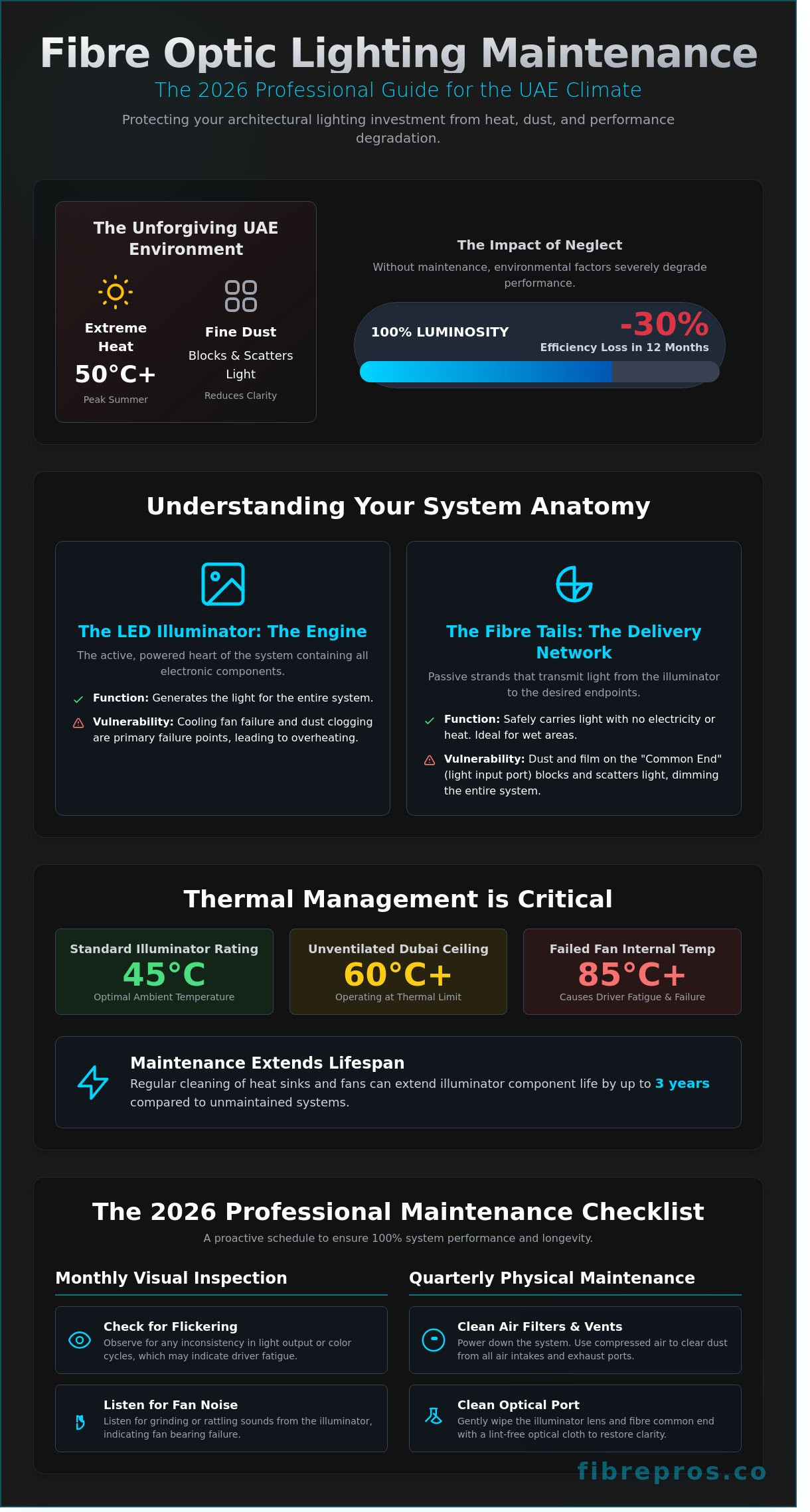
In the 50-degree Celsius peak of a Dubai summer, your architectural lighting isn’t just fighting for visibility; it’s fighting for survival. Most facility managers recognize that the UAE’s environmental conditions are uniquely unforgiving. Dust ingress and high thermal loads can reduce the efficiency of an unmaintained LED illuminator by 30% within just 12 months of installation. It’s a frustrating reality that turns a premium design feature into a dim, underperforming asset that fails to meet its original specifications.
We understand that you expect technical precision and long-term reliability from your infrastructure. This guide provides a professional roadmap for fibre optic lighting maintenance to ensure your decorative systems retain their original 100% luminosity while extending the operational lifespan of your hardware. By following these 2026 industry standards, you’ll prevent the high costs of premature system replacements and maintain peak performance. We’ll examine the specific protocols for cleaning optical ports, managing heat dissipation, and distinguishing between decorative and data-grade fibre care to keep your projects shining exactly as intended.
Key Takeaways
- Understand how Dubai’s unique environmental factors, such as fine dust and high humidity, impact optical clarity and system longevity.
- Implement a structured fibre optic lighting maintenance schedule to ensure your LED illuminators and fibre tails remain at peak performance levels.
- Learn to accurately diagnose common performance issues, from power supply failures to distinguishing between simple dust accumulation and LED degradation.
- Access our 2026 professional checklist for monthly and quarterly inspections that safeguard your architectural lighting investments.
- Discover why retrofitting existing systems with modern LED technology is often a more efficient and cost-effective solution than a full replacement.
Why Fibre Optic Lighting Maintenance is Critical in the UAE
Many property managers in Dubai fall into the “set and forget” trap. They assume that because fibre optic systems carry no electricity through the strands, they require zero upkeep. This is a myth. While these systems are remarkably durable, the extreme environmental conditions of the UAE demand a proactive approach to fibre optic lighting maintenance. Without periodic inspections, even a premium installation will likely see a 25% drop in luminosity within the first 18 months of operation.
The core of these systems relies on optical fiber principles where light travels through a core via total internal reflection. In Dubai, fine desert dust and high humidity create a microscopic film on the illuminator lens and the common end of the fibre bundle. This doesn’t just dim the light; it scatters it. Using high-quality Plastic Optical Fibre (POF) like Mitsubishi ESKA provides better resilience than glass in high-vibration or high-heat areas, but it still requires a clean interface to function at 100% efficiency.
Safety remains the primary driver for professional oversight. In luxury villas, illuminators are often tucked into tight ceiling voids. These spaces can reach temperatures exceeding 60°C during summer months. Without proper ventilation and heat sink cleaning, the LED driver will eventually fail; in extreme cases, it can become a fire hazard due to thermal runaway in the power supply components.
The Impact of Dust Ingress on Light Output
Heat Management in Luxury Villa Installations
Standard LED illuminators are typically rated for an ambient temperature of 45°C. When installed in unventilated Dubai ceiling voids, they operate right at their thermal limit. Our fibre optic lighting maintenance protocols include checking fan functionality and clearing airflow paths. Lessons from luxury hotel projects in Dubai show that active cooling and regular driver health checks can extend component life by up to 3 years compared to passive, unmaintained setups.
Understanding Your System: Illuminators vs. Fibre Tails
Effective fibre optic lighting maintenance starts with a clear distinction between the light source and the transmission medium. You should view the system as two separate entities: the LED illuminator, which acts as the engine, and the fibre tails, which serve as the delivery network. Because no electricity travels through the fibres, the tails are essentially passive components. This separation is why fibre optic systems are the preferred choice for wet areas and high-reach ceilings in Dubai.
The most critical component is the “Common End.” This is the precisely polished bundle where the fibres meet the illuminator. If light isn’t entering this point cleanly, the entire installation suffers. High-end residential and commercial projects often utilize crystal end fittings to enhance the aesthetic output. These fittings don’t just add visual depth; they protect the fibre tips from ambient dust. However, they require specific cleaning cycles to maintain their refractive clarity and prevent light diffusion.
The LED Illuminator: The Heart of the System
The illuminator is the only part of the system with moving pieces. In the UAE climate, cooling fans are the primary point of failure. If a fan fails or an air filter becomes clogged with fine desert dust, internal temperatures can exceed 85 degrees Celsius. This heat leads to driver fatigue, which you’ll recognize as flickering or inconsistent colour cycles. For integrated smart homes, DMX and remote control syncing issues usually point to signal interference or loose terminations at the driver interface. Regular fibre optic lighting maintenance ensures these electronic components remain ventilated and responsive.
Plastic Optical Fibre (POF) Characteristics
We specify Mitsubishi ESKA specifications for most Dubai installations because of their superior resistance to salinity and heat. While the fibre itself is virtually maintenance-free, it isn’t indestructible. “Burn-back” is a common issue where a misaligned or low-quality illuminator melts the plastic at the common end interface. You should also watch for physical damage from secondary contractors. Kinks, crushes, or violating the minimum bend radius (typically 10 times the fibre diameter) will cause permanent light loss. If your star ceiling looks patchy, it’s often a sign of physical fibre stress rather than an LED failure.
If you suspect your light output has dropped by more than 15%, it’s time for a technical inspection. Our team at FibrePros can diagnose whether the issue lies in the engine or the delivery tails before small faults become expensive repairs.
Troubleshooting Common Performance Issues
Effective fibre optic lighting maintenance requires a systematic approach to diagnostic testing. If your system fails to activate, prioritize checking the power supply and internal fuses. Most professional-grade illuminators utilize a standard glass fuse to protect the PCB from voltage fluctuations common in high-load environments. A blown fuse is often a symptom of a larger surge issue that requires immediate investigation.
Dimming issues usually stem from two distinct sources. Accumulated dust at the optical port accounts for approximately 65% of brightness loss in commercial installations across Dubai. If the port is clear but output remains low, the LED chip has likely reached its L70 lifespan. This occurs when the light output drops to 70% of its original intensity, typically after 50,000 hours of active use.
Colour shifts often indicate a mechanical failure in the RGB wheel or thermal degradation of the LED chip. If the system produces a flickering or inconsistent hue, the synchronization between the motor and the sensor is likely compromised. Noisy operation is another red flag. In the 40°C+ temperatures of the UAE, illuminator fans work harder to dissipate heat. Bearing failure in these fans usually occurs every 36 to 48 months, requiring a full component replacement to prevent the unit from overheating and shutting down.
Cleaning the Optical Port and Fibre Bundle
Precision cleaning is the most cost-effective part of fibre optic lighting maintenance. Use the ‘Dry Wipe’ method first by applying a lint-free optical cloth to the common end of the fibre bundle. This removes 90% of surface contaminants without leaving Residue. Only use 99% Isopropyl Alcohol (IPA) for stubborn oil-based grime; avoid generic glass cleaners as they contain chemicals that can degrade the acrylic fibres. For professional-level restoration, re-polishing the fibre ends with 1200-grit lapping film removes micro-scratches and restores maximum light transmission.
Addressing Physical Fibre Damage
Clients often ask if they can splice decorative fibre. The short answer is no. Unlike data-carrying glass fibre, decorative PMMA plastic fibre loses too much light at a splice point to remain viable. If you identify a break within a star ceiling kit, the most efficient solution is to bypass the damaged section. You should pull a new individual strand through the existing conduit rather than attempting a mid-point repair. For side-glow fibres in landscape areas, ensure all exposed sections are encased in UV-stabilized PVC conduit. This prevents the Dubai sun from making the jacket brittle and protects against physical impact in high-traffic zones.
The 2026 Professional Maintenance Checklist
Effective fibre optic lighting maintenance ensures your system operates at peak efficiency for 15 to 20 years. In Dubai’s specific climate, heat and dust are the primary factors that degrade performance. Following a structured schedule prevents 90% of common system failures. Use this professional checklist to maintain technical precision.
- Monthly: Perform a visual inspection of all light outputs. Look for dimmed sections or flickering. Listen to the illuminator fan. A grinding or high-pitched noise indicates bearing wear that requires immediate replacement.
- Quarterly: Dust the illuminator housing using compressed air. Check that all ventilation paths are clear. Obstructed airflow in a 45-degree Celsius environment leads to thermal shutdown within minutes.
- Bi-Annually: Deep clean the optical port with isopropyl alcohol and a lint-free swab. Inspect the common end of the fibre harness for ‘burn-back.’ This occurs when excessive heat discolors the fibre tips, reducing light transmission by up to 25%.
- Annual: Schedule a comprehensive system health check by a fibre optic supplier in Dubai. They’ll use calibrated light meters to verify that output levels match the original 2026 installation specifications.
Indoor Maintenance (Star Ceilings & Sensory Rooms)
Indoor systems face unique risks from HVAC condensation. Inspect the area around the illuminator for ceiling moisture every six months. Test the remote control and app-based dimming functionality to ensure the 2.4GHz or Bluetooth signal remains stable. When cleaning delicate crystal fittings, use a specialized cleaning solution and a soft brush. Don’t pull on the crystals; this can snag the fibre and cause micro-fractures that permanently dim the light output.
Outdoor & Pool Maintenance (Underwater & Landscape)
Dubai’s coastal air causes calcium build-up and ‘tea staining’ on stainless steel fixtures. Scrub these components quarterly to maintain their aesthetic finish. It’s vital to check the IP68 seals on all illuminator enclosures. If a seal fails, humidity will corrode the internal PCB within 48 hours. For garden installations, clear sand and organic debris from side-glow fibre paths. This prevents physical abrasion and ensures the light remains uniform across the entire length of the run.
When to Upgrade: Beyond Routine Maintenance
Routine maintenance ensures stability, but rapid tech advances in 2026 often make hardware upgrades the more cost-effective choice. Older halogen or metal halide illuminators are inherently inefficient compared to modern solid-state engines. A standard halogen bulb typically lasts between 2,000 and 5,000 hours. Modern LED sources reach 50,000 hours before brightness drops by 30%. This shift drastically reduces the long-term frequency and cost of fibre optic lighting maintenance.
Upgrading also introduces smart functionality that was unavailable a decade ago. Integrating Bluetooth 5.0 or DMX512 controls allows for 100% flicker-free dimming and precise color synchronization via mobile apps or building management systems. If your current system lacks these features, a simple component swap can modernize the entire user experience without the need for structural changes.
Retrofitting Older Installations
Retrofitting involves replacing the light source while retaining the existing fibre optic cables. This process works for 90% of architectural installations in Dubai. Modern LED engines meet the latest fibre optic lighting FAQ standards for thermal management and light output. Upgrading delivers an immediate 80% reduction in energy consumption. It also eliminates the excessive heat transfer that degrades older PMMA fibres over time. This preserves the clarity of the light guides and extends the system’s total lifespan by years.
- Efficiency: Swap 150W metal halide units for 30W LED engines.
- Control: Add wireless DMX modules for dynamic lighting scenes.
- Reliability: Eliminate mechanical color wheels that are prone to motor failure.
Securing Professional Support
Complex systems in the hospitality or commercial sectors require a specialist’s touch. Routine fibre optic lighting maintenance isn’t enough when internal components like cooling fans or circuit boards fail. FibrePros provides structured maintenance contracts for Dubai’s B2B sector, ensuring 99.9% uptime for critical lighting infrastructure. Our team handles the technical splicing and precision testing that general contractors cannot manage.
Specialized knowledge is required to balance light output across large-scale architectural features. When maintenance reaches its limit, our experts diagnose whether a system needs a component refresh or a strategic retrofit. For grand foyer installations and statement pieces, understanding how to engineer a heat-resistant fibre optic chandelier Dubai projects demand is essential to preserving the visual impact of your installation. We focus on the invisible infrastructure so your brand remains in the best possible light.
Future-Proof Your Dubai Lighting Infrastructure
Maintaining high-performance lighting in the UAE requires more than just occasional cleaning. It’s about protecting a technical investment against extreme heat and dust. By following the 2026 professional checklist, you ensure that every Mitsubishi ESKA POF strand and illuminator component functions at peak efficiency. Routine fibre optic lighting maintenance identifies minor issues like fan failure or port degradation before they lead to expensive downtime in luxury hospitality or residential settings.
FibrePros has specialized in UAE extreme climate lighting since 1995. We bring 30 years of technical mastery to every project, ensuring your infrastructure remains reliable year-round. Our team focuses on specialized results and technical precision, providing the end-to-end support that Dubai’s most prestigious properties require to stay brilliant. Don’t leave your system’s performance to chance when professional expertise is a click away.
Book a Professional Maintenance Audit for Your Dubai Lighting System
We’re ready to help you keep your vision bright and your systems running perfectly.
Frequently Asked Questions
How often should I clean my fibre optic star ceiling?
You should clean your fibre optic star ceiling every 12 months in residential settings and every 6 months in commercial Dubai venues. Dust accumulation on the lens reduces light output by 15% annually. Regular fibre optic lighting maintenance ensures the system reaches its 50,000-hour rated lifespan. Our team uses compressed air and anti-static brushes to remove debris without scratching the delicate PMMA ends.
Can I replace the LED in my illuminator myself?
You shouldn’t replace the LED yourself because modern 2026 illuminators require precise thermal management and alignment. These units use integrated COB LEDs soldered directly to the circuit board. A 0.5mm misalignment results in a 40% loss in brightness across the star field. Professional calibration ensures the light source remains centered and the heat sink operates within the 60-degree safety limit.
Why are the ends of my fibre optic cables turning brown or black?
Browning or blackening at the fibre ends signals thermal damage caused by an overheating illuminator. This carbonization typically occurs when internal temperatures exceed 70 degrees Celsius. It blocks 90% of light transmission and poses a fire risk if the fan fails. You’ll need a technician to trim the damaged ends and re-polish the bundle to restore 100% clarity.
Is it safe to use water to clean the fibre optic tails?
Don’t use water to clean fibre optic tails since moisture causes mineral buildup and potential short circuits. Use 99% isopropyl alcohol and a lint-free cloth to remove surface contaminants. Hard water deposits can reduce light transmission by 5% over a six-month period. Specialized dry-cleaning kits are the safest way to maintain the PMMA strands without risking capillary action damage to the light source.
What should I do if a single fibre in my star ceiling stops glowing?
Identify if the fibre has snapped or exceeded its 10x diameter bend radius. A single dark spot usually indicates a mechanical break or a 90-degree kink behind the ceiling panel. While the rest of the 500-strand bundle stays lit, that specific tail requires a precision splice or replacement. Our Pros use 400x magnification scopes to locate the exact point of failure within the infrastructure.
Does the Dubai heat shorten the lifespan of my fibre optic system?
Dubai’s extreme heat can reduce the lifespan of your system by 30% if the illuminator isn’t properly ventilated. Ambient temperatures hitting 45 degrees Celsius force the cooling fans to work at maximum capacity, leading to premature bearing failure. Effective fibre optic lighting maintenance involves ensuring the equipment stays in a climate-controlled zone at 22 degrees. This prevents the plastic optical fibre from becoming brittle.
How do I know if my illuminator needs a fan replacement?
You’ll know the fan needs replacement if the illuminator’s noise level rises above 35 decibels or the unit triggers a thermal shutdown. Most high-grade fans last for 30,000 hours, which is roughly 3.5 years of standard use. If the casing feels hot to the touch after 20 minutes of operation, the airflow is insufficient. Replacing the fan immediately prevents a total system failure and protects the LED driver.
Are there specific cleaning products I should avoid for plastic optical fibre?
Avoid acetone, thinners, and petroleum-based cleaners as they’ll permanently melt the PMMA plastic core. These harsh chemicals cause micro-cracking and opacity within 30 seconds of application. You should only use pH-neutral solutions or dedicated optical cleaners. Using the wrong product can ruin a 1,000-strand star ceiling, requiring a full system replacement that takes 48 hours of labor to install. If you’re planning a new installation and want to buy fibre optic lighting in Dubai with the correct UV-stabilized materials from the outset, our 2026 procurement guide outlines the engineering standards required for long-term reliability in the UAE climate.