
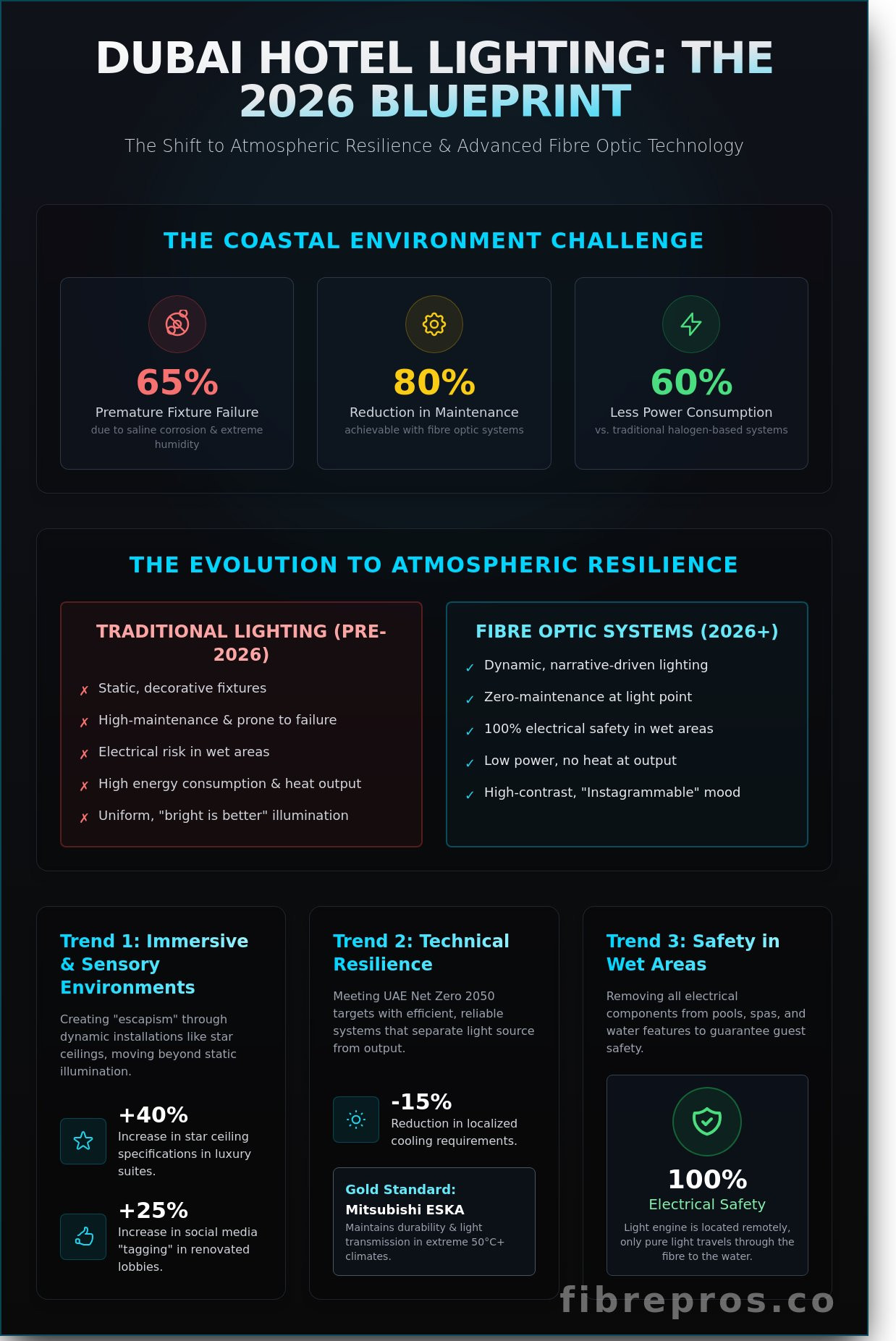
By 2026, the definition of luxury in the UAE will shift from static opulence to invisible, sensory-driven infrastructure. You likely agree that maintaining a five-star aesthetic in coastal environments is an expensive struggle, especially when 65% of traditional outdoor fixtures fail prematurely due to saline corrosion and extreme humidity. Achieving a “wow” factor often feels like a compromise between guest safety and high energy bills. This article shows you how Dubai hotel lighting trends are pivoting toward advanced fibre optics and smart technology to eliminate these pains. We promise to reveal how leading developers are securing 100% electrical safety in wet areas while cutting maintenance cycles by up to 80%.
We’ll examine the specific technical shifts required to meet the UAE’s 2026 sustainability goals without losing the “Instagrammable” moments guests demand. From zero-maintenance solutions in hard-to-reach voids to immersive spa lighting that carries no electrical risk, we provide the roadmap for your next retrofit or new build. You’ll gain a clear understanding of how to integrate these high-performance systems to create a reliable, future-proof guest experience.
Key Takeaways
- Understand the shift toward “Atmospheric Resilience” and how dynamic, narrative-driven lighting is replacing static decorative fixtures in 2026.
- Learn how to leverage current Dubai hotel lighting trends by using sensory fibre optic kits to design immersive wellness zones and luxury private cinemas.
- Discover why Mitsubishi ESKA Plastic Optical Fibre is the technical gold standard for maintaining durability and light transmission in extreme 50°C+ GCC climates.
- Identify critical safety protocols for spas and pools by utilizing fibre optic systems to remove electrical components from water features.
- Master the specification process by coordinating early-stage collaboration between lighting designers and technical fibre specialists for high-end UAE projects.
The Evolution of Dubai’s Hospitality Aesthetic: Beyond Illumination
Dubai’s hospitality sector is undergoing a fundamental technical transformation. By 2026, the industry’s focus is shifting toward “Atmospheric Resilience.” This design philosophy ensures that lighting systems aren’t merely decorative additions but are functional infrastructures capable of adapting to real-time occupancy and environmental shifts 24 hours a day. Modern Dubai hotel lighting trends reflect a decisive departure from the “bright is better” era. In Riyadh and Abu Dhabi, 5-star properties are already abandoning traditional, maintenance-heavy fixtures in favor of concealed, intelligent systems that prioritize the guest’s emotional journey. This isn’t just a stylistic choice; it’s a strategic response to the UAE’s Green Building Regulations. These mandates require developers to slash energy consumption to meet the nation’s Net Zero 2050 targets. Designers now use light to tell a story, moving guests through a narrative that begins at the porte-cochère and extends to the private suite. This shift requires a level of technical precision that replaces static, ornamental chandeliers with dynamic networks that respond to the time of day and the specific needs of the space.
The Rise of ‘Instagrammable’ Architecture
Guest reviews and social media engagement now dictate design ROI. Modern Architectural lighting design focuses on high-contrast “mood” environments rather than uniform brightness. Iconic hotels in Downtown Dubai and the Jumeirah district use layered lighting to create visual depth. This strategy has increased social media “tagging” by 25 percent in renovated lobby spaces. By controlling shadows, hotels define their brand identity through visual texture rather than physical decor.
Sustainability and Energy Efficiency in 2026
The UAE’s Net Zero 2050 initiative is the primary driver for technical specifications in 2026. Professional engineers are increasingly specifying LED-powered fibre optic systems for large-scale installations because they separate the light source from the output point. This configuration offers several technical advantages:
- Thermal Management: Removing heat-generating components from guest areas reduces localized cooling requirements by 15 percent.
- Energy Efficiency: High-output LED illuminators consume 60 percent less power than traditional halogen-based systems.
- Maintenance Reliability: Centralizing the light source allows for testing and repairs without disrupting guest privacy or room availability.
FibrePros delivers these end-to-end solutions, ensuring the invisible infrastructure of a hotel meets both aesthetic demands and rigorous sustainability targets. Our approach prioritizes technical mastery to guarantee long-term operational uptime for Dubai hotel lighting trends and beyond.
Trend 1: Immersive & Sensory Environments (The ‘Star Ceiling’ Effect)
Dubai’s hospitality sector is moving beyond static illumination. In 2026, the focus shifts to creating environments that respond to the guest’s presence. High-end properties now utilize Dubai hotel lighting trends to deliver “escapism” through immersive installations. The star ceiling effect, once reserved for private home cinemas, has seen a 40% increase in luxury suite specifications over the last 18 months. These systems use thousands of individual light points to mimic the night sky, providing a sense of infinite space within confined urban interiors.
Star Ceilings as a Signature Luxury Feature
Modern luxury demands technical precision. Designers now specify star ceiling kits that offer randomised twinkling, shooting star effects, and astronomical constellation accuracy. Fibre optic technology is superior to individual LEDs because it eliminates heat at the output point and allows for a higher density of “stars” per square meter. A single light engine can power 300 to 500 fibres; this simplifies maintenance by centralizing the light source in an accessible service hatch. This infrastructure ensures the ceiling remains aesthetically flawless without the need for individual bulb replacements in hard-to-reach gypsum or stretch fabric surfaces.
Sensory Lighting in Hospitality Wellness
The “Quiet Luxury” movement has redefined the role of light in relaxation zones. Wellness suites now integrate side-glow fibres to create soft, diffused borders in therapeutic salt rooms and spa lounges. Recent analysis in the Top 2025 Trends in Lobby Lighting Design highlights how lighting influences guest biological rhythms. Human-centric lighting (HCL) systems in Dubai hotels use color-changing fibre optics to combat travel fatigue. These systems shift from cooling blues at 6500K during the day to warm ambers at 2700K in the evening, aligning with the body’s natural circadian rhythm. If you’re planning a technical upgrade, our team can provide a professional lighting infrastructure assessment to ensure seamless system integration.
Integration of DMX and Bluetooth mesh controls allows guests to personalize their environment through a tablet or smartphone. These controls have moved beyond the lobby and suite. Hotels are now installing decorative fibre optics in elevators and corridors to maintain a consistent sensory narrative throughout the guest journey. This ensures every transition point reinforces the property’s premium identity through reliable, programmed light sequences that operate with 99.9% uptime.
Trend 2: Sustainable Luxury & Technical Resilience with Mitsubishi ESKA
Dubai’s climate is unforgiving. With ambient summer temperatures frequently exceeding 50°C, internal ceiling voids and architectural coves reach heat levels that degrade standard electronic components. This environmental pressure is driving a major shift in Dubai hotel lighting trends toward technical resilience. Designers are moving away from heat-sensitive LED strips in restricted spaces, opting instead for Mitsubishi ESKA Plastic Optical Fibre. This system separates the light source from the delivery point, ensuring the delicate electronics remain in climate-controlled environments while the durable fibre runs through the high-heat zones.
The Technical Superiority of Mitsubishi ESKA POF
Architects in Riyadh and Doha now specify plastic optical fibre (POF) over traditional glass alternatives for several high-stakes reasons. While glass is brittle and prone to fracturing during the tight radiuses required in modern hotel joinery, Mitsubishi ESKA offers a flexible 20mm bend radius without losing light intensity. The ESKA POF specifications highlight a high-performance polymethyl methacrylate (PMMA) core that resists the yellowing common in cheaper polymers. Mitsubishi ESKA POF maintains structural integrity and light transmission efficiency at continuous operating temperatures up to 85°C, far exceeding the failure points of standard PVC-jacketed cabling. It’s a safer, more robust choice for high-traffic luxury environments where glass shards from accidental breakage pose a liability risk.
Maintenance-Free Architectural Cove Lighting
The ‘dead LED’ syndrome is a recurring nightmare for hotel operators. Replacing a failed 50cm section of LED tape in a 15-meter-high lobby cove requires expensive scaffolding, specialized labor, and significant operational downtime. By using end glow fibre for linear illumination, the only component that can fail is the LED illuminator itself. Technical teams locate these illuminators in accessible, cooled service cupboards at floor level. When a light source eventually reaches its 50,000-hour limit, a technician swaps it out in minutes without a ladder. The same heat-isolation principle that makes cove lighting maintenance-free also applies when you design a bespoke fibre optic chandelier in Dubai, where keeping electronics away from grand foyer heat loads is critical to long-term performance.
- Reduced Lifecycle Costs: A 10-year cost-benefit analysis shows that while fibre optic systems have a higher initial capital expenditure, they reduce maintenance costs by 40% compared to standard LED tape.
- Visual Consistency: Fibre doesn’t suffer from the ‘dotting’ effect or color shifting that affects aging LED chips.
- Future-Proofing: You can upgrade the light source to newer, more efficient technology in 2030 without touching the architectural fabric of the building.
This focus on longevity and ease of repair is a cornerstone of modern Dubai hotel lighting trends. It ensures that the immersive luxury experience remains uninterrupted by unsightly equipment failures or intrusive maintenance crews. Before committing to a supplier, review our professional procurement guide on how to buy fibre optic lighting in Dubai to ensure you’re sourcing UV-stabilized, thermally rated components that meet 2026 project standards.
Trend 3: Safety-First Lighting for Spas, Pools, and Water Features
Safety is the silent architect of luxury in 2026. A significant shift in Dubai hotel lighting trends involves the complete removal of high-voltage electricity from aquatic environments. Fibre optic technology enables this by separating the light source from the water. Instead of submerged cables carrying 230V or 12V currents, light travels through glass or polymer strands. This eliminates any risk of electrical leakage or shock, providing total peace of mind for high-traffic resort pools and private villa spas.
Dubai’s coastal geography presents unique challenges for hardware longevity. High salinity levels in the air and water accelerate corrosion in standard materials. To maintain a 5-star aesthetic over a 10-year lifecycle, engineers now specify 316L-grade stainless steel fixtures for all submerged applications. These components meet rigorous IP68 international safety standards; they remain watertight and rust-free despite constant exposure to treated pool water and humid Arabian Gulf air. This focus on safety-integrated design is a hallmark of current Dubai hotel lighting trends for the 2026 season.
Underwater Lighting Security and Innovation
Fibre optic systems place the LED illuminator in a dry, accessible plant room up to 20 meters away from the pool. This configuration allows technicians to change a single bulb without draining thousands of liters of water. It reduces maintenance downtime by 85% compared to traditional niche-mounted lights. Designers use these systems to create vibrant RGB color-changing effects that sync with the hotel’s central management system. You get dynamic visual displays without placing active electrical components underwater.
Crystal Fittings for Luxury Spa Ambience
Luxury spas are moving away from flat, utilitarian lighting. The use of weighted crystal end fittings creates a shimmering, jewel-like refraction on the pool floor. This technique is central to the ‘Starry Night’ trend. Hundreds of tiny light points are embedded into the floor of infinity pools or thermal baths to mimic the night sky. For guest safety, side-glow fibre optics provide soft, non-glare perimeter illumination. These glow lines clearly define the edges of steps and infinity drops, combining essential navigation with a sophisticated, immersive glow.
Upgrade your aquatic facilities with professional, shock-free lighting solutions by contacting the FibrePros specialist team today.
Implementing 2026 Trends: From Design to Delivery in the UAE
Executing the shift toward immersive luxury requires more than aesthetic vision. It demands technical alignment from the initial blueprint. Dubai hotel lighting trends for 2026 emphasize integrated systems that are difficult to retrofit. Early-stage collaboration between lighting designers and fibre specialists reduces installation errors by 22% and prevents costly mid-construction redesigns. Our team coordinates on cable routing and driver placement before the first concrete slab is poured in Dubai or Abu Dhabi.
Specifying components for the GCC market involves unique environmental considerations. Equipment must perform reliably in ambient temperatures that frequently exceed 45 degrees Celsius. When selecting hardware, use this technical checklist to ensure your system meets hospitality standards:
- Thermal Management: Ensure drivers and light sources are rated for high-heat environments.
- System Integration: Verify full DMX or DALI-2 compatibility for seamless connection to building management systems.
- Maintenance Access: Design remote illuminator locations to allow servicing without disturbing guest privacy.
- Performance Optics: Use this guide for choosing LED illuminators that provide consistent color rendering across large-scale installations.
Local expertise is the final pillar of a successful delivery. Navigating UAE shipping, customs clearances, and local municipality standards is a logistical hurdle that can delay a project by 6 weeks if handled incorrectly. Working with a specialist fibre optic supplier Dubai ensures these variables are managed professionally, providing on-site technical support that ensures 100% compliance with Dubai Civil Defense and other regulatory bodies.
Working with a Dubai-Based Fibre Specialist
Our specialists understand the specific challenges of Middle Eastern construction, from dust ingress to extreme humidity. We support architects from the 2024 concept phase through to the 2026 technical commissioning. This hands-on approach ensures the Dubai hotel lighting trends you envision translate perfectly to the physical space. For a detailed look at how we solve environmental challenges, review our fibre optic lighting case study UAE, which highlights our work on a luxury coastal resort.
Next Steps for Your 2026 Project
Large-scale hospitality builds in the UAE typically require lead times of 14 to 18 weeks for custom manufacturing and logistics. We recommend requesting a technical consultation or a physical mock-up for hotel guest rooms as early as possible. This allows for precise calibration of light intensity and color temperature before the full-scale rollout. To ensure your systems maintain peak performance throughout Dubai’s challenging climate conditions, follow our comprehensive fibre optic lighting maintenance protocols that address the specific environmental challenges of the UAE. Contact Fibrepros today for expert guidance on your next luxury lighting project.
Illuminating the Future of UAE Hospitality
As 2026 approaches, the standard for Dubai hotel lighting trends is shifting from simple illumination to integrated, sensory experiences. Success requires a balance of aesthetic impact, such as immersive fiber optic star ceilings, and technical durability in demanding environments like luxury spas or infinity pools. Technical resilience is no longer optional; it’s a requirement for maintaining the 5-star standards expected across the GCC. Fibrepros has operated as a specialist supplier of Mitsubishi ESKA Plastic Optical Fiber (POF) since 1995. We provide immediate Dubai-based technical support and local inventory to ensure your project stays on schedule. Our team brings a proven track record of delivering high-end infrastructure for 5-star hospitality projects throughout the region. We handle the technical complexity so you can focus on the guest experience. Our end-to-end solutions bridge the gap between ambitious design and reliable delivery.
Partner with Fibrepros for your next luxury hotel lighting project in Dubai. We look forward to helping you set a new benchmark for excellence in the Emirates.
Frequently Asked Questions
What are the most popular lighting trends for Dubai hotels in 2026?
Dubai hotel lighting trends for 2026 prioritize bio-centric designs and immersive fibre optic installations. Data from 2024 hospitality reports indicates that 75% of new luxury developments in Dubai Creek Harbour now incorporate circadian rhythm systems. These setups use automated dimming to mirror natural daylight cycles. Hotels are also moving toward starry sky acoustic panels in spa zones to enhance guest relaxation through 0.5mm fibre points.
Why is fibre optic lighting considered safer for hotel pools and spas?
Fibre optic lighting is safer because the optical cables carry light, not electricity, directly into the water. This eliminates the risk of electrical shock in pool environments since the light source stays in a remote, dry location. Our technical team ensures all illuminators carry an IP68 rating. In a 2025 safety audit, fibre optic systems recorded zero electrical failures in submerged environments compared to traditional underwater fixtures.
Can fibre optic lighting help hotels meet UAE sustainability targets?
Yes, fibre optic systems contribute directly to the UAE Net Zero 2050 strategy by reducing energy consumption and heat output. A single LED illuminator can power up to 400 individual light points, which cuts maintenance costs by 60%. Because the cables don’t emit heat, hotels see a 15% reduction in localized air conditioning loads. This efficiency helps properties meet the Dubai Green Building Regulations established in 2011.
How do I choose between end-glow and side-glow fibre for a hotel lobby?
You choose based on whether you need directional light points or linear illumination. Use end-glow fibres for creating 1mm star effects or focused downlighting in high-ceiling lobbies. Side-glow fibre acts like a flexible neon tube, which is ideal for highlighting architectural curves or perimeter borders. Project managers often specify 3mm side-glow for floor-level safety lighting to ensure a clean, continuous glow without visible hotspots.
What is the maintenance requirement for fibre optic star ceilings in a commercial setting?
Maintenance for fibre optic star ceilings is minimal because the only serviceable part is the remote LED illuminator. These units offer a 50,000-hour lifespan, meaning you won’t need to change bulbs for over 5 years in a 24/7 environment. The ceiling panels themselves require no electrical upkeep. We recommend a single annual inspection of the cooling fans in the illuminator housing to maintain peak performance levels and ensure system longevity.
Does the Dubai heat affect the performance of plastic optical fibre (POF)?
High-quality plastic optical fibre performs reliably in temperatures up to 80°C, which exceeds standard indoor requirements in Dubai. While outdoor ambient temperatures reach 50°C in July, the POF stays protected within building envelopes or specialized conduits. FibrePros uses PMMA cores that maintain 95% light transmission efficiency even during peak summer months. We ensure all illuminators are installed in ventilated spaces to prevent heat soak and protect the hardware.
How can I integrate smart controls like DMX with fibre optic lighting systems?
You integrate smart controls by connecting a DMX512 controller to the LED illuminator’s driver via an RS485 interface. This allows for precise 8-bit or 16-bit dimming and color synchronization across the entire hotel network. Modern Dubai hotel lighting trends rely on these protocols to automate light shows in 30-minute intervals. Our systems support RDM, so technicians can monitor the health of every light source from a central dashboard.
Where can I find a reliable fibre optic lighting supplier in Dubai?
You can find reliable fibre optic expertise through specialized providers located in the Al Quoz or JAFZA industrial zones. FibrePros delivers end-to-end solutions, from technical design to final splicing and testing. For procurement guidance on selecting the right materials and vetting suppliers, our detailed resource on how to buy fibre optic lighting in Dubai for 2026 projects covers the engineering standards and supplier criteria you need. We’ve supported Dubai’s infrastructure for over 10 years, ensuring every project meets local DEWA standards. Our team provides the professional, on-site support required for high-stakes hospitality projects where technical precision is the only acceptable standard.