
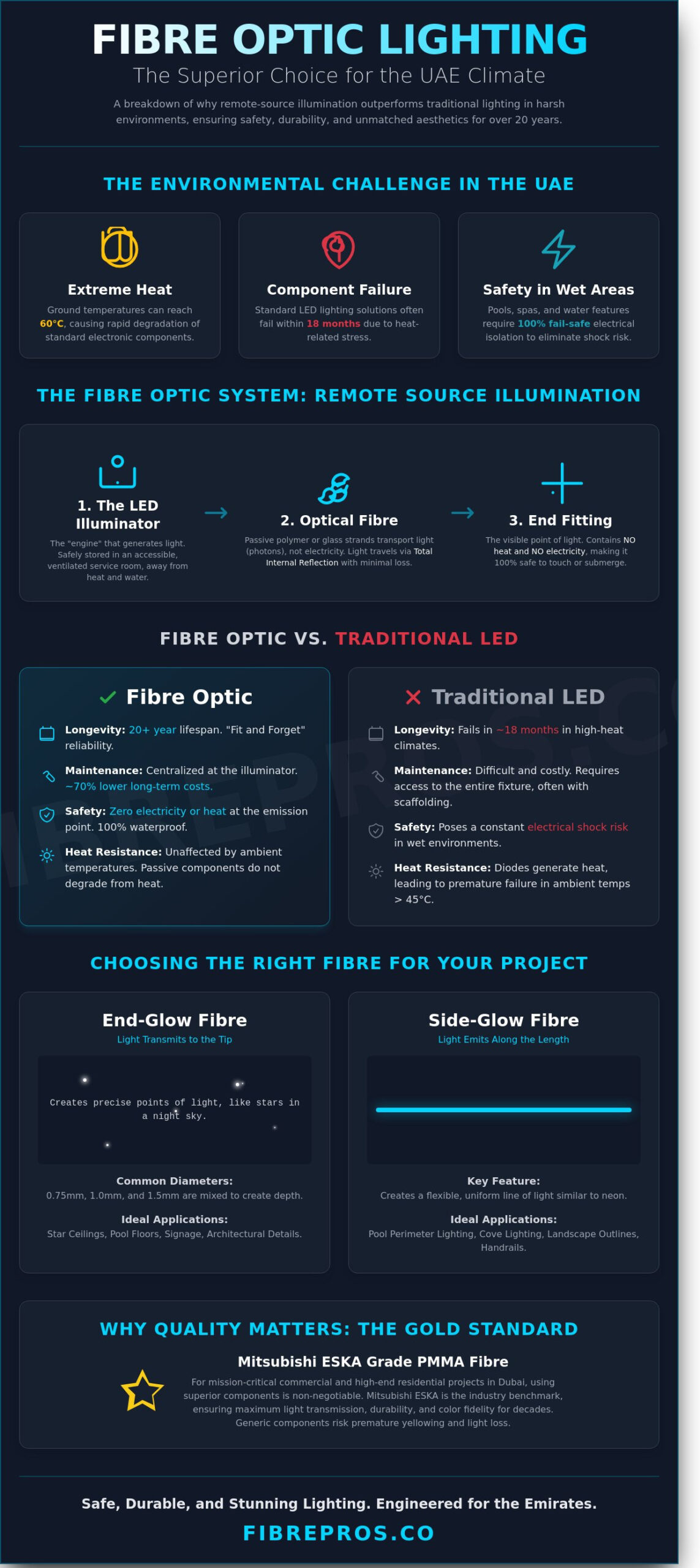
What if the most reliable way to illuminate a 25-meter lap pool in Downtown Dubai involves removing every electrical wire from the water entirely? You likely recognize that the intersection of water and electricity requires 100% fail-safe engineering. In the UAE, where ground temperatures can reach 60 degrees Celsius, standard LED solutions often degrade within 18 months. This fibre optic lighting faq addresses these specific environmental challenges. It provides the technical precision required for high-end residential and commercial installations across the Emirates.
It’s a common concern that the region’s intense heat might compromise cable lifespan or that pool lighting poses a hidden shock risk. We agree that safety and durability aren’t areas where you can afford to compromise. We promise this guide will clear the confusion between data infrastructure and decorative lighting. We’ve compiled expert data to help you distinguish between various fibre types, ensuring your installation remains stable for over 20 years. You’ll gain a clear understanding of the components needed for a bespoke star ceiling and the actionable steps to secure a high-performance, heat-resistant lighting network.
Key Takeaways
- Understand the core components of decorative lighting systems to ensure efficient light distribution from a centralized LED source.
- Consult our definitive fibre optic lighting faq to distinguish between end-glow and side-glow applications for star ceilings and architectural task lighting.
- Learn how specialized optical fibres maintain durability in the UAE climate and provide total electrical isolation for luxury pool and spa projects.
- Master the professional planning process for calculating light point density and illuminator wattage to ensure consistent performance across large-scale installations.
- Identify the technical risks of generic components and why Mitsubishi ESKA standards are the preferred choice for high-end Dubai commercial projects.
What is Decorative Fibre Optic Lighting and How Does It Work?
Decorative fibre optic lighting is a remote source illumination system. Unlike a standard bulb that generates light exactly where you see it, this technology physically separates the light source from the point of emission. This architectural distinction is a primary focus for this fibre optic lighting faq because it solves the most common safety and maintenance hurdles in high-end Dubai projects. The light travels through flexible strands of glass or polymer, allowing designers to place light in locations where traditional electricity is either dangerous or impractical.
Every professional installation consists of three core components that work in unison:
- The LED Illuminator: This is the “engine” or light box. It generates the light and often includes flicker wheels or DMX controls for color changes.
- Optical Fibre: These are the “cables” that transport the light. They don’t carry electricity; they only carry photons.
- End Fittings: These are the decorative heads or lenses that shape the light as it exits the fibre.
It’s vital to understand that lighting fibre isn’t the same as the fibre used for your office internet. Telecommunications fibre is designed for data transmission via high-frequency pulses over kilometers. Lighting fibre is engineered to maximize the transmission of the visible light spectrum, using much larger core diameters, typically ranging from 0.75mm to 18mm. The primary advantage of this setup is the total absence of heat and electricity at the output point. You can safely touch the light tips or submerge them in water without any risk of electrical shock or thermal damage.
The Anatomy of a Lighting Fibre System
The LED illuminator serves as the centralized powerhouse of the system. Light enters the fibre bundle and moves through the core via total internal reflection. This physical principle ensures light bounces off the internal cladding with minimal loss, usually keeping intensity high over runs of 15 to 20 meters. You must place the illuminator in a ventilated, accessible location. In 95% of our professional installations, we hide the engine in a service cupboard or plant room. This ensures the electronics stay cool and remain accessible for future upgrades without disturbing the finished ceiling or pool structure.
Fibre Optic vs. Traditional LED Strips
Traditional LED strips generate heat directly at the diode, which is a major failure point in Dubai’s climate where ambient temperatures often exceed 45°C. Fibre optics eliminate this risk entirely. Since the emission point is passive, it doesn’t degrade from heat build-up. Maintenance is also significantly more efficient. If an LED strip fails behind a 10-meter high architectural feature, you need scaffolding for the repair. With fibre, you simply service the illuminator at floor level. Data from our recent projects shows that using fibre optics in hard-to-reach areas reduces long-term maintenance costs by roughly 70%. This fibre optic lighting faq emphasizes that for “fit and forget” reliability, fibre is the superior choice for luxury infrastructure.
Types of Optical Fibre: Choosing Between End-Glow and Side-Glow
Selecting the correct cable type is the first technical decision in any fibre optic lighting faq. The choice depends entirely on the intended light distribution. End-glow fibre transmits light to the very tip of the strand, while side-glow fibre allows light to escape through the outer cladding along its entire length. Most Dubai installations utilize PMMA (Polymethyl Methacrylate) because it’s flexible and durable. While glass fibre exists, it’s typically reserved for high-heat environments or specific medical applications. PMMA remains the industry standard for 95% of decorative projects in the UAE.
End-Glow Fibre and Star Ceiling Kits
Luxury residential projects in Dubai often demand immersive star ceiling effects. End-glow fibre achieves this by acting as a precise point-of-light. To create a realistic night sky, professionals mix fibre diameters. We typically use a combination of 0.75mm, 1.0mm, and 1.5mm strands. This variation creates an illusion of depth, making some “stars” appear more distant than others. You can find more technical specifications in our End Glow Fibre: The Professional Guide to Decorative Lighting in Dubai. These kits are often integrated into home cinemas or master suites to provide a low-glare, ambient light source. Key benefits include:
- Minimal power consumption, often less than 50 watts per 100 strands.
- Zero heat at the output point, protecting delicate ceiling finishes.
- Ability to create complex patterns like constellations or galaxies.
- Easy maintenance since the light engine is located in a remote, accessible cabinet.
Side-Glow Fibre for Architectural Lines
Side-glow fibre functions as a modern, flexible alternative to traditional neon. The cable features a specialized cladding that encourages light to bleed out laterally. This creates a continuous, vibrant line of light. In the GCC, we use side-glow for landscape marking, pool perimeters, and building facades. Because Dubai experiences temperatures exceeding 45°C during summer months, we specify cables with UV-stabilized PVC or Teflon jackets. These materials prevent the fibre from yellowing or becoming brittle under intense solar exposure.
The light emission is uniform and doesn’t suffer from the “hot spots” often seen in low-quality LED strips. It’s a safer choice for water features because no electricity travels through the cable itself. If you’re planning a complex outdoor installation, you should consult with our technical team to ensure material compatibility with local climate conditions. High-quality side-glow maintains its clarity for over 10 years when installed with the correct protective housing and professional-grade light engines.
Safety and Durability in the UAE Climate
Dubai’s environmental conditions represent a maximum-stress environment for architectural lighting. With summer temperatures frequently exceeding 52°C, the durability of components is the primary concern for developers and engineers. A common entry in any fibre optic lighting faq involves the resilience of plastic fibre under these conditions. We utilize Mitsubishi ESKA PMMA fibre, which is rated for continuous operation at temperatures up to 80°C. This thermal overhead ensures the material won’t yellow, melt, or become brittle under the intense Arabian sun, even when installed in exposed rooftop or facade applications.
Beyond heat, the saline atmosphere of coastal regions like Jebel Ali or the Red Sea coast accelerates corrosion in traditional electrical systems. Fibre optics are inherently immune to this. Because the cable contains no metal conductors, there’s nothing to oxidize or short-circuit. This makes it the only logical choice for high-end infrastructure where long-term reliability is the benchmark for success. By removing electricity from the point of light, we eliminate the most frequent failure point in UAE exterior lighting. Before committing to a supplier, reviewing a comprehensive guide to buy fibre optic lighting Dubai professionals rely on will help you identify the specific UV-stabilized polymer standards and vetting criteria that separate reliable components from those that fail within 18 months.
Fibre Optics in Dubai Swimming Pools
Safety is the defining factor for luxury pool and spa installations. Traditional 12V or 24V LED systems require electrical current to be delivered directly into the pool niche. If a seal fails, the risk of moisture ingress into the electrical components is high. Fibre optic systems operate on a “No Electricity in Water” rule. The light source stays in a remote plant room, and only pure light travels through the cable to the pool. We use 316L marine-grade stainless steel fixtures to ensure these systems withstand saline water without pitting or surface rust. You can see these principles applied in our Fibre Optic Lighting Case Study UAE: Luxury Solutions for Extreme Climates.
Heat Management for Illuminators
The performance of the light engine depends entirely on its thermal environment. While the fibre cables are passive, the LED illuminators generate internal heat that must be dissipated. In the UAE, we mandate housing these units in AC-controlled spaces or specialized ventilated housings. If an illuminator operates in ambient temperatures above 40°C, the internal chip temperature can spike, cutting the 50,000-hour rated lifespan by 60% or more. Maintenance in Dubai’s high-dust environment is equally critical to prevent overheating. Following a comprehensive fibre optic lighting maintenance schedule ensures your system maintains peak performance despite the challenging environmental conditions:
- Quarterly Filter Cleaning: Dust buildup from Shamal winds on intake fans is the leading cause of driver failure.
- Enclosure Inspections: Ensuring seals remain intact against fine PM2.5 desert sand particles.
- Loom Integrity Checks: Verifying the connection point between the fibre and the light source remains free of debris.
Following these professional standards ensures your fibre optic lighting faq concerns regarding longevity are fully addressed through technical precision and proactive maintenance schedules.
Planning and Installing Your Fibre Optic Project
Precision planning is the foundation of any successful installation. In this fibre optic lighting faq section, we break down the technical steps required to move from a design concept to a fully operational system. Skipping the calculation phase often leads to dim points or overheated equipment, so accuracy is vital from day one.
- Step 1: Determine light points and cable length. A premium Dubai residential project typically requires 40 to 60 light points per square metre for a dense star effect. Measure the distance from the furthest star point back to your light source location to determine the maximum harness length.
- Step 2: Calculate the required wattage. A 45W LED illuminator effectively powers up to 500 individual 0.75mm fibres. If your project exceeds 1,000 points, you’ll need to specify multiple light engines or a high-output 100W unit to maintain brightness.
- Step 3: Select end fittings. Use bare fibres for star ceilings where the light should appear as a sharp point. Choose crystal fittings for decorative wall patterns to create light “bursts” or stainless steel fittings for submerged pool lighting and steam rooms.
- Step 4: Design the access point. Light engines generate heat and require a ventilated, accessible location. Ensure the designated cupboard or ceiling void provides at least 150mm of clearance on all sides and a dedicated 13A power outlet.
Designing a Star Ceiling for a Home Cinema
For a balanced luxury aesthetic, aim for 50 stars per square metre. Use a varied mix of 0.75mm, 1.0mm, and 1.5mm fibres to create a sense of depth and realistic celestial scale. Installers should drill the gypsum board using a 1mm bit and secure fibres with a professional grade adhesive. To streamline the installation, many contractors opt for star ceiling kits which come pre-loomed and ready for immediate mounting.
Specifying the Right Illuminator
The illuminator is the heart of your system. RGBW engines offer 16 million color variations, while mechanical twinkle wheels provide a physical shimmer effect that LEDs alone can’t replicate. Most high-end UAE smart homes now require DMX or Bluetooth connectivity for integration with systems like Control4 or Crestron. For a deeper technical comparison, read our detailed guide on Choosing LED Illuminators for Fibre Optic Systems to find the right match for your project’s fibre optic lighting faq requirements.
Ready to start your installation? Contact FibrePros for professional technical support and hardware supply.
Why Quality Matters: The Mitsubishi ESKA Gold Standard
Selecting the wrong materials for a high-end installation leads to catastrophic failure within 24 months. While generic plastic optical fibre (POF) might look identical to premium brands on a specification sheet, the real-world performance in the UAE climate tells a different story. Low-grade polymers often suffer from rapid thermal degradation. In the 50°C heat typical of Dubai summers, inferior fibres lose their flexibility and begin to “yellow.” This yellowing shifts the color temperature of your lighting design, turning a crisp 4000K white into a muddy, aged amber. This is a primary concern for professionals browsing any fibre optic lighting faq before committing to a project. Understanding the full procurement process before purchasing is essential; our 2026 professional procurement guide for buying fibre optic lighting in Dubai outlines how to vet suppliers and confirm material standards before placing an order.
Mitsubishi ESKA is the industry benchmark for a reason. It uses a high-purity Polymethyl Methacrylate (PMMA) core clad in a specialized fluorinated polymer. This combination ensures a 98% light transmission efficiency that remains stable for decades. Architects in Dubai specify ESKA because it eliminates the risk of “hot spots” and uneven illumination across long runs. When you invest in the Gold Standard, you’re paying for optical clarity that doesn’t quit when the project warranty expires. These principles align with the emerging Dubai hotel lighting trends that prioritize zero-maintenance solutions and electrical safety in luxury hospitality environments. For grand foyer installations where a statement centrepiece is required, understanding how to design a bespoke fibre optic chandelier Dubai architects and developers rely on ensures your specification delivers both visual impact and long-term thermal resilience.
Technical Advantages of ESKA Fibre
Precision engineering allows Mitsubishi ESKA to achieve a tighter bend radius than standard competitors. While generic fibres might crack or show significant light leak when bent at a 30mm radius, ESKA CK-grade fibre maintains its integrity at 20mm or less. This flexibility is vital for intricate star ceilings or tight architectural coves. Most professional installations see a light loss of less than 0.15 dB per metre, ensuring that the last point of light is just as bright as the first. For a deeper dive into these metrics, read our Mitsubishi ESKA POF Specifications: A Technical Guide.
Sourcing and Support in the UAE
Dubai construction timelines don’t allow for six-week lead times from overseas suppliers. FibrePros maintains a robust local inventory of Mitsubishi ESKA components to support the fast-moving Middle East market. We provide 48-hour dispatch for standard reels and custom-cut lengths, ensuring your site team stays on schedule. Our role extends beyond simple supply; we assist designers during the initial CAD phase to calculate precise light-loss budgets. Working with a specialist fibre optic supplier Dubai ensures you receive components specifically engineered for the region’s extreme heat and salinity conditions, rather than generic telecom-grade materials that fail within months.
Using a comprehensive fibre optic lighting faq helps identify the right fibre grade, but our technical team provides the final layer of certainty. We offer end-to-end support, from selecting the correct numerical aperture to advising on the best light engines for your specific environment. Don’t risk your reputation on unbranded components. Consult with the Pros today to secure professional-grade Mitsubishi ESKA fibre for your next architectural masterpiece.
Elevate Your Dubai Project with Precision Lighting Solutions
This fibre optic lighting faq demonstrates that successful architectural illumination depends on technical precision and material integrity. Choosing Mitsubishi ESKA optical fiber ensures your installation maintains 98% light transmission efficiency even after years of continuous use. You’ll need to select between end-glow cables for precise points of light and side-glow variants for linear definition, ensuring every component meets the demands of the 50 degree Celsius UAE climate.
We eliminate technical uncertainty by providing architectural-grade 316 stainless steel fixtures and specialized PMMA fiber that resists UV degradation. As a Mitsubishi ESKA Authorized Supplier, we maintain comprehensive Dubai-based stock to support 24-hour delivery cycles for urgent project milestones. Our team provides the end-to-end support required to transform complex technical specifications into reliable, high-performance lighting infrastructure. For projects requiring a dramatic centrepiece, our professional guide to designing a fibre optic chandelier Dubai luxury developments demand covers the full engineering and material selection process.
Consult the Dubai Lighting Experts at FibrePros to secure the specialized components your design requires. We’re ready to help you deliver a world-class lighting experience today.
Frequently Asked Questions
Can I cut fibre optic lighting cables to any length myself?
You can cut PMMA plastic fibre optic cables yourself using a sharp heavy-duty blade or a specialized hot knife. It’s essential to achieve a clean, 90-degree perpendicular cut at the end of the strand. A jagged edge can cause a 15% reduction in light output at the tip. Most installers buy 50-meter or 100-meter spools and trim them onsite to fit the specific dimensions of the Dubai project area.
Are fibre optic lights more energy-efficient than standard LEDs?
Fibre optic systems are often 80% more efficient for decorative applications because one 45W or 75W LED illuminator powers hundreds of points. A typical 100-point star ceiling uses approximately 0.45 watts per point. Standard LED fixtures often require 3 to 5 watts per individual unit. This centralized light source reduces power consumption and simplifies the electrical infrastructure required for large-scale residential or commercial installations.
How many years does a typical fibre optic lighting system last in Dubai?
A high-quality fibre optic lighting system lasts 20 to 25 years when installed correctly in Dubai’s climate. The PMMA cables are inert and withstand internal temperatures up to 70 degrees Celsius. The LED illuminator is the only component requiring maintenance. It’s designed for 50,000 hours of use, which equates to over 11 years of operation if the lights stay on for 12 hours every day.
Is it possible to dim fibre optic lighting using a smart home system?
You can dim fibre optic lighting by integrating DMX or 0-10V drivers into your smart home system. Systems like Control4 or Lutron connect to the LED illuminator via a standard RJ45 or 5-pin XLR interface. This allows for a precise 0% to 100% dimming range across all connected fibre points simultaneously. It’s a reliable way to manage ambiance in home cinemas or luxury hotel suites.
What is the maximum distance light can travel through the fibre?
Light typically travels effectively up to 15 meters through PMMA plastic fibre before visible attenuation occurs. For runs exceeding 20 meters, professional installers use glass silica fibre to maintain 95% brightness. This fibre optic lighting faq recommendation ensures that large Dubai villas maintain consistent luminosity from the source to the furthest point. Using the correct fibre grade prevents the dulling effect seen in lower-quality installations.
Can fibre optic lighting be used in steam rooms or saunas?
Fibre optic lighting is the safest option for steam rooms and saunas because the cables carry no electricity or heat. Since the LED illuminator sits in a dry plant room up to 10 meters away, there’s zero risk of electrical short circuits in 100% humidity. The PMMA fibres operate safely in temperatures reaching 80 degrees Celsius without degradation. This makes them ideal for high-end spa projects.
Do I need a special transformer for my LED illuminator in the UAE?
You don’t need a special transformer as most professional illuminators operate on a universal 100-240V AC input. These units are fully compatible with the UAE’s standard 230V, 50Hz electrical grid. Ensure your illuminator carries an IP65 rating if you place it in an external housing. This protects the internal components against 45-degree summer heat and fine dust ingress common in the Middle East.
Will the stars in my ceiling actually twinkle like real ones?
Your star ceiling will twinkle using a motorized scintillation wheel located inside the LED illuminator. This wheel rotates at variable speeds to intermittently block light to specific strands, creating a 100% realistic celestial effect. Using three different fibre diameters, such as 0.75mm, 1.0mm, and 1.5mm, adds visual depth. This technique mimics the varied magnitudes of stars found in the actual night sky for a premium finish.