
A single degree of thermal expansion can be the difference between a high-performance architectural lighting installation and a total system failure in Dubai’s 50°C summer heat. You likely already know that standard cabling often fails when pushed to the limits of the UAE’s extreme environment; technical precision isn’t just a preference, it’s a non-negotiable requirement for project longevity. This guide provides the definitive **eska pof specifications** you need to master technical data and ensure durability in the Middle East’s most demanding architectural settings.
We recognize the technical anxiety that comes with selecting the right grade when a single error leads to expensive maintenance or system degradation. You’ll gain access to a clear specification table for your project documentation, covering everything from thermal thresholds to the exact 25mm bend radius required for tight structural details. We’ve compiled these insights to help you choose the correct diameter and grade with total confidence, backed by the local expertise that FibrePros brings to every high-stakes infrastructure project in the region. By the end of this article, you’ll have a complete technical roadmap for your next installation.
Key Takeaways
- Distinguish between Standard and Super ESKA grades to ensure your project utilizes the optimal PMMA core for high-performance light transmission.
- Analyze critical eska pof specifications including attenuation curves and numerical aperture to maximize optical efficiency in the 650nm visible range.
- Evaluate mechanical limits such as bend radius and diameter to maintain structural integrity and consistent light output across complex installations.
- Secure long-term reliability by aligning fibre thermal stability with the extreme temperature demands of the Middle Eastern climate.
- Streamline the submittal process for Dubai’s luxury infrastructure by learning how to match fibre technical data to specific architectural applications.
Understanding Mitsubishi ESKA POF Grades and Core Materials
Mitsubishi ESKA represents the pinnacle of PMMA-based (Polymethyl Methacrylate) Plastic Optical Fibre technology. It’s a high-performance component engineered for technical precision in demanding environments. Mitsubishi Chemical utilizes a proprietary continuous casting manufacturing process that ensures 99.9% consistency in fiber diameter and optical attenuation across every batch. This level of control is vital for large-scale infrastructure projects in Dubai where environmental stability and predictable performance are non-negotiable. Understanding the specific eska pof specifications for each grade helps project managers avoid the common pitfalls of under-specifying materials for high-stakes installations.
Standard ESKA vs. Super ESKA: Which Grade for Your Project?
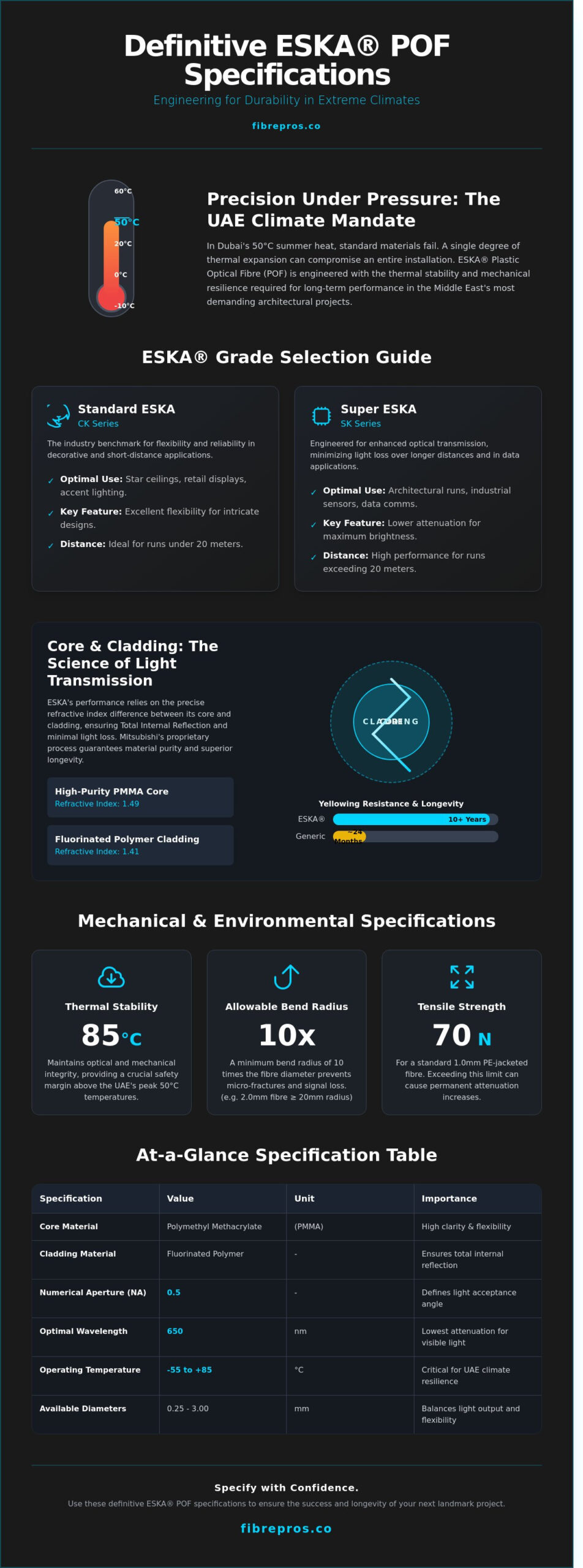
Selecting the right grade depends on the specific optical requirements of your installation. The Standard ESKA (CK Series) is the industry benchmark for short-distance decorative lighting, such as star ceilings in luxury residential units or retail displays. It provides excellent flexibility and straightforward termination. For more demanding applications, the Super ESKA (SK Series) offers enhanced optical properties. This grade is essential for industrial sensors and architectural runs exceeding 20 meters where light loss must be minimized. When your project requires high-speed data transmission or specialized medical lighting, specify the Premier or Mega grades. These versions are optimized for low attenuation and high bandwidth, supporting data rates up to 1 Gbps over 50-meter spans.
Core and Cladding: The Science of Internal Reflection
The performance of ESKA POF rests on the refractive index difference between its core and cladding. The high-purity PMMA core has a refractive index of 1.49, while the thin fluorinated polymer cladding sits at 1.41. This 0.08 difference drives total internal reflection, trapping light within the core with minimal leakage. Mitsubishi’s commitment to material purity results in superior yellowing resistance compared to generic alternatives. In high-brightness environments, inferior fibers often degrade and shift color within 24 months of installation. These eska pof specifications ensure the fiber maintains its clarity for over 10 years in standard operating conditions. This longevity makes it the most reliable choice for the permanent architectural installations that define the Dubai skyline.
- High-Purity PMMA Core: Provides a clear path for light with minimal absorption.
- Fluorinated Polymer Cladding: Ensures maximum internal reflection and protects the core.
- Proprietary Processing: Eliminates microscopic voids that cause signal scatter.
- Thermal Stability: Maintains performance in temperatures up to 85°C.
Mechanical Specifications: Diameters, Flexibility, and Bend Radius
Mitsubishi ESKA POF comes in a precise range of diameters from 0.25mm to 3.00mm. Selecting the correct size is vital for balancing light output efficiency with physical flexibility. Larger cores, such as the 3.00mm variant, permit higher light transmission for illumination but offer less agility in tight spaces. The 0.25mm fibres are the standard choice for high-density displays where intricate detail is the priority. These smaller diameters allow for a tighter packing density in bespoke lighting fixtures without compromising the structural integrity of the mounting surface.
Understanding eska pof specifications requires a focus on mechanical strength. A standard 1.0mm PE-jacketed fibre typically supports a tensile force limit of 70 Newtons. If installers exceed this limit while pulling through conduits, the PMMA core may stretch. This stretching causes permanent attenuation increases that compromise the entire network. Weight is another significant factor for Dubai’s large-scale infrastructure projects. POF is approximately 75% lighter than traditional glass fibre. This weight reduction significantly reduces the structural load on cable trays and supports in high-rise developments, making it a cost-effective choice for vertical cabling.
Allowable Bend Radius: Avoiding Micro-Fractures
The standard rule for maintaining signal integrity is a minimum bend radius of 10 times the fibre diameter. For a 2.0mm fibre, you must maintain a radius of at least 20mm. Bending beyond this limit causes light leakage and creates micro-fractures within the core structure. When routing fibre through the sharp corners of luxury joinery, use dedicated corner guides to prevent permanent damage. Our specialists provide professional installation support to ensure these mechanical limits are never breached during complex fit-outs.
Sheathing and Jacket Options for Enhanced Protection
Choosing the right jacket depends entirely on the installation environment. Unjacketed fibres are common for decorative star ceilings, but PE (Polyethylene) jackets are essential for industrial or outdoor conduits. Black jackets are the industry standard for end-glow applications to prevent light bleed; clear jackets are necessary for side-glow effects. For commercial projects requiring strict building code compliance in the UAE, flame-retardant jackets are available to meet specific fire safety ratings. These jackets protect the core from environmental stressors while ensuring the installation remains safe for public spaces.
Optical Performance: Attenuation and Numerical Aperture
Optical efficiency determines the success of any high-end lighting installation. When reviewing eska pof specifications, technical leads must prioritize the attenuation curve and numerical aperture. These metrics dictate how much light reaches the end of the strand and how wide the light beam spreads upon exit. Mitsubishi ESKA products are engineered for the visible light spectrum, specifically peaking at the 650nm wavelength. This focus ensures that the red, green, and blue light used in decorative systems transmits with minimal spectral shift.
Attenuation Factors in Decorative Lighting
Attenuation is the gradual loss of light intensity over distance. For premium plastic optical fibre, 200 dB/km serves as the industry benchmark for quality. If a product exceeds this value, the light will appear dim or yellowish at the end of long runs. In Dubai’s luxury residential and commercial projects, maintaining this 200 dB/km standard ensures that every star in a ceiling or every point in a chandelier glows with uniform intensity.
Optical performance doesn’t rely on the fibre alone. Coupling efficiency between the LED illuminator and the fibre bundle plays a massive role in system brightness. Poorly polished ends or misaligned bundles can cause an immediate 1.5 dB to 2.0 dB loss at the source. It’s vital to use precision-cut heads to maximize the light entering the core.
Light Acceptance and Emission Angles
The 0.50 Numerical Aperture (NA) is a core component of eska pof specifications. This value represents the fibre’s ability to “gather” light. In practical terms, a 0.50 NA creates a 60-degree acceptance angle. This wide angle is beneficial because it allows the fibre to capture more light from the LED source, even if the alignment isn’t perfectly centered. It’s a forgiving standard that maintains high output in complex bundles.
For designers creating star ceiling effects, the emission angle at the end-fitting is just as important. A 60-degree spread provides a natural, diffused look that mimics distant stars. To achieve the best results, you must ensure your hardware is compatible. You can find detailed guidance on choosing LED illuminators to ensure your light source matches the optical requirements of the ESKA fibre.
To calculate maximum run lengths, professionals use the 3dB rule. A 3dB loss indicates a 50% drop in visible light power. With a standard 200 dB/km attenuation, you’ll hit this 50% drop-off at approximately 15 meters. For the most vibrant results in architectural accents, keep your primary runs under 10 meters to avoid a noticeable decline in luminosity.
Environmental Resilience: Specifications for the UAE Climate
Mitsubishi ESKA POF thrives in high-stress environments where glass fibre often fails due to vibration or installation complexity. The standard eska pof specifications define a continuous operating temperature range from -55°C to +70°C. This thermal overhead is vital for Riyadh and Dubai projects, where surface temperatures on building facades or in unventilated signage can exceed 60°C during peak summer months. Maintaining thermal stability prevents the PMMA core from yellowing or becoming brittle, ensuring the light output remains crisp for the duration of the project’s lifespan. For real-world examples of how these specifications perform in extreme conditions, our comprehensive fibre optic lighting case study UAE demonstrates successful installations that have maintained 100% operational efficiency for over 10 years in the region’s harshest environments.
Humidity resistance is another critical factor for coastal developments in Abu Dhabi or Doha. ESKA’s polyethylene jacket acts as a robust moisture barrier. It prevents water vapor from entering the cladding layer, which would otherwise cause significant attenuation. Performance remains stable even in 95% non-condensing humidity. UV stability is equally prioritized; the materials are engineered to resist photo-degradation from the intense solar radiation of the GCC, which often reaches 2,200 kWh/m² annually.
Thermal Expansion and Contraction in Outdoor Installs
PMMA has a linear expansion coefficient of approximately 0.0001 per degree Celsius. In a 20-meter run installed in a non-conditioned Dubai attic, temperatures can swing from 20°C to 80°C. This 60-degree delta causes the fibre to expand or contract by up to 12mm. Adhering to eska pof specifications during the design phase is essential to prevent “pull-back,” where the fibre retreats from the fitting. We recommend the following practices:
- Leave a 50mm expansion loop at each termination point in outdoor fixtures.
- Use mechanical clamps rather than aggressive adhesives in attic spaces.
- Account for a 2% transmission loss over a 10-year cycle if the fibre is consistently operated near its 70°C limit.
Chemical Resistance for Pool and Spa Applications
ESKA POF is chemically inert to standard chlorine levels of 3.0 ppm and the saline concentrations found in luxury marine spas. While the jacket is durable, end glow fibre requires specialized IP68-rated fittings for underwater use. These fittings prevent moisture ingress via capillary action at the termination point. Without a sealed end-cap, water can cloud the core over a 24-month period. Using medical-grade epoxy for all wet-area terminations ensures a 15-year service life in high-humidity spa environments.
Specifying ESKA for Dubai’s Luxury Infrastructure
Successful integration of lighting infrastructure in Dubai’s Tier 1 developments requires more than just high-end fixtures. It demands a rigorous understanding of eska pof specifications during the submittal phase. Engineers must identify core metrics like the 0.19 numerical aperture and typical attenuation of 0.15 dB/m at 650nm to ensure the light engine’s output remains consistent across long runs. When you’re reviewing a Mitsubishi ESKA data sheet, focus on the allowable bending radius. For a standard 0.75mm fiber, this is typically 9mm. Exceeding this limit during installation in tight bulkhead spaces will lead to permanent light loss and fiber fatigue.
Choosing the correct diameter is a technical decision, not just an aesthetic one. For intricate 2024 starfield designs in Jumeirah villas, 0.75mm fiber provides the necessary density for a realistic celestial effect. Conversely, 2.0mm or 3.0mm fibers are the standard for bold architectural accents in commercial lobbies where high-intensity side-glow is required. Using genuine Mitsubishi ESKA is non-negotiable for “Gold Standard” project warranties. Non-branded alternatives often degrade within 24 months due to Dubai’s high ambient temperatures. Genuine ESKA maintains its structural integrity up to 70°C, which is a critical specification for installations near HVAC exhausts or glass facades. To maximize the visual impact and ensure longevity in these demanding environments, professional installations require crystal end fittings for fibre optic lighting that can withstand the UAE’s extreme temperatures while maintaining perfect light dispersion. For grand foyer and statement ceiling applications, understanding how to design a bespoke fibre optic chandelier Dubai architects and engineers rely on requires the same rigorous approach to ESKA grade selection and thermal management.
Project Documentation and Submittal Support
Dubai Municipality and Civil Defence often require specific technical certificates for interior finishes in hospitality projects. We provide full data sheet support to ensure your star ceiling kits meet local fire safety and material standards. Our team assists in drafting technical submittals that detail the eska pof specifications, including smoke density and toxicity ratings. This ensures your project clears inspections without delays or costly retrofits. As the hospitality sector evolves, understanding Dubai hotel lighting trends 2026 becomes essential for specifying the right fibre optic solutions that meet both aesthetic and safety requirements in luxury developments.
The Fibrepros Advantage: Local Expertise in Technical Specs
Project timelines in Dubai move fast. Waiting six weeks for international shipping isn’t an option for high-stakes contractors. Fibrepros maintains local stock of Mitsubishi ESKA in Dubai, allowing for immediate dispatch of custom looms and pre-cut lengths. This local presence means we provide on-site technical support for complex architectural integrations. We ensure every splice and termination meets Mitsubishi’s factory standards. Working with a specialist fibre optic supplier Dubai ensures you receive professional-grade components engineered specifically for the UAE’s extreme climate conditions, rather than generic telecom cables that fail under thermal stress. Before committing to a supplier, contractors and designers looking to buy fibre optic lighting in Dubai should review the 2026 procurement standards to verify genuine Mitsubishi ESKA stock, UV-stabilized polymer ratings, and local technical support capabilities. Contact Fibrepros for a technical consultation on your next project to secure the expertise your infrastructure requires.
Securing Technical Excellence for Your Next Dubai Landmark
Selecting the right fiber is critical for the long-term success of luxury developments across the UAE. Mastering eska pof specifications ensures your network maintains 100% signal integrity even when ambient temperatures hit 50°C. Mitsubishi Chemical’s specialized core materials offer a consistent 0.25 dB/m attenuation rate, providing the reliability demanded by modern MEP standards. We’ve spent 25 years as an authorized supplier in the UAE market, helping architects and engineers navigate complex mechanical requirements like tight bend radii and thermal resilience. However, even the highest-quality fibre optic systems require proper care to maintain their performance over time, which is why implementing comprehensive fibre optic lighting maintenance protocols is essential for preserving your investment in Dubai’s challenging climate.
FibrePros provides the specialized technical support you need to deliver high-performance infrastructure without compromise. You’re gaining a partner who understands the rigorous demands of Dubai’s high-stakes construction environment. We’ll help you source genuine Mitsubishi ESKA products that align perfectly with your project’s optical and mechanical goals. Request a Technical Data Sheet or Quote for ESKA POF today to ensure your installation stands the test of time. Your vision deserves the precision of world-class fiber technology.
Frequently Asked Questions
What is the maximum operating temperature for Mitsubishi ESKA POF?
Standard Mitsubishi ESKA POF operates reliably at temperatures up to 70°C. For specialized Dubai projects where ambient heat in ceiling voids or outdoor enclosures exceeds this, high-temperature versions support up to 85°C. Exceeding these limits causes the PMMA core to soften, which increases light attenuation by more than 0.5 dB per meter. Our team ensures thermal calculations are part of every professional installation plan.
How do I calculate the minimum bend radius for a 1.5mm ESKA fibre?
The minimum bend radius for 1.5mm ESKA fibre is 15mm for static installations. You calculate this by multiplying the fibre diameter by ten. If the application involves frequent movement or vibration, you should increase this radius to 25mm to prevent structural fatigue. Adhering to these eska pof specifications ensures the light transmission remains consistent and prevents micro-fractures in the fluorinated polymer cladding.
What is the difference between ESKA and Super ESKA in terms of light loss?
Super ESKA reduces light loss to 0.15 dB per meter, while standard ESKA grades typically show a loss of 0.20 dB per meter. This 25% improvement in transparency allows for longer cable runs without a noticeable drop in terminal brightness. It’s the preferred choice for high-end architectural projects in the UAE where maximum luminosity is required from a single light source.
Can ESKA plastic optical fibre be used in outdoor UAE landscapes?
ESKA fibre performs exceptionally well in UAE landscapes when it’s protected by a UV-stabilized polyethylene jacket. Bare PMMA fibres will degrade within 24 months if they’re exposed to direct Dubai sunlight because UV radiation breaks down the polymer chains. We recommend installing the fibre within 20mm conduits or specifying double-jacketed cables to withstand the region’s 50°C summer peaks and intense solar exposure.
Does the fibre diameter affect the colour of the light transmitted?
Fibre diameter doesn’t change the colour of the light, but it dictates the total brightness or luminous flux delivered to the end point. A 3.0mm fibre carries roughly four times the light of a 1.5mm fibre due to its larger surface area. The colour you see is always a direct reflection of the LED source’s wavelength. Choosing the right diameter is about hitting your specific intensity targets for the project.
Is ESKA POF fire-rated for use in Dubai commercial buildings?
The standard ESKA PMMA core is flammable, so commercial installations in Dubai require specialized Low Smoke Zero Halogen jackets to comply with safety codes. The Dubai Civil Defence mandates specific flame retardant standards for all materials used in high-rise infrastructure. We ensure all eska pof specifications meet these local regulations by using UL-rated fire-resistant sheathing for every indoor commercial network we build.
How long can a single run of ESKA fibre be before it loses brightness?
A single run of ESKA fibre typically maintains professional brightness levels up to 20 meters. Once you exceed 25 meters, you’ll experience a 50% reduction in light intensity because of the cumulative 0.20 dB/m attenuation. For runs longer than 30 meters, we implement dual-end illumination or switch to Super ESKA to maintain the high-quality finish our clients expect from a specialist installer.
What is the typical lifespan of Mitsubishi ESKA fibre in a pool environment?
Mitsubishi ESKA fibre offers a functional lifespan of 20 to 25 years in swimming pool environments when it’s installed correctly. The PMMA material is naturally resistant to common pool chemicals like chlorine and bromine. However, the fibre ends must be sealed within the light engine housing to prevent moisture from entering. We use specialized end-gluing techniques to stop capillary action, which prevents clouding over a 5 year period. For comprehensive guidance on pool lighting installations and safety considerations, our detailed fibre optic lighting FAQ covers all aspects of underwater applications and electrical safety requirements specific to UAE regulations.