
In the high-salinity environments of coastal developments like Palm Jumeirah, nearly 40% of standard exterior fixtures fail within their first 18 months due to salt air corrosion and fine particulate ingress. You likely understand that the UAE climate is uniquely unforgiving. High humidity and relentless desert sand don’t just challenge your installations; they actively dismantle them if your specifications lack technical precision. Selecting a fixture that simply looks the part isn’t enough when the cost of premature replacement in a luxury project can exceed the initial hardware investment by 150%.
This guide helps you master the outdoor lighting IP rating standards required for 2026 projects across the Middle East. We provide the technical clarity needed to protect your infrastructure from dust, humidity, and extreme heat. You’ll gain the expertise to distinguish between basic waterproofing and the advanced sand-proof seals required for long-term reliability in the region. We’ll outline a clear framework for specifying hardware across pool, garden, and facade zones. This ensures you have total confidence in your equipment selection for high-end UAE projects where uptime and durability are the only acceptable metrics.
Key Takeaways
- Learn why standard international IEC 60529 specifications must be adapted to survive the extreme heat and humidity of the Middle Eastern climate.
- Understand why the first digit of an outdoor lighting IP rating is the primary defense against fine desert sand and dust ingress in Dubai and Riyadh.
- Identify the precise waterproofing levels required for pool areas and high-humidity zones to maintain electrical integrity and long-term performance.
- Discover a zone-by-zone specification strategy for luxury villas to protect facade and landscape lighting from wind-blown debris.
- Explore how fibre optic technology provides a fail-safe solution by removing electrical components from high-risk, wet environments entirely.
What is an IP Rating and Why is it Critical in the UAE?
An Ingress Protection rating, or IP Code, is a technical classification defined by the International Electrotechnical Commission (IEC) under the 60529 standard. It measures how effectively an electrical enclosure prevents the entry of solid objects and liquids into its sensitive internal components. For developers and project managers in Dubai, choosing the correct outdoor lighting IP rating isn’t a suggestion; it’s a structural requirement. Standard fixtures designed for temperate European or North American climates often fail within 12 to 18 months when exposed to the Arabian Peninsula’s extreme conditions. Precision in these specifications prevents catastrophic electrical shorts and ensures the long-term viability of your infrastructure.
The Dubai Environment vs. Standard Lighting
Dubai’s climate presents three primary threats to lighting hardware. First, Shamal winds carry fine particulate sand as small as 0.1mm, which can bypass inferior seals and cause internal abrasion or heat buildup. Second, coastal areas like the Palm Jumeirah frequently experience humidity levels exceeding 90%, leading to rapid condensation and electrolytic corrosion. Finally, surface temperatures often hit 50°C or higher. This intense heat causes materials to expand at different rates. If a seal isn’t engineered for this thermal cycling, it loses its integrity, allowing moisture to seep into the circuitry during the cooler night hours.
Decoding the IP Number Format
The IP rating consists of two distinct digits that define the protective capabilities of the housing. Understanding these numbers is vital for selecting a outdoor lighting IP rating that matches the specific demands of your site.
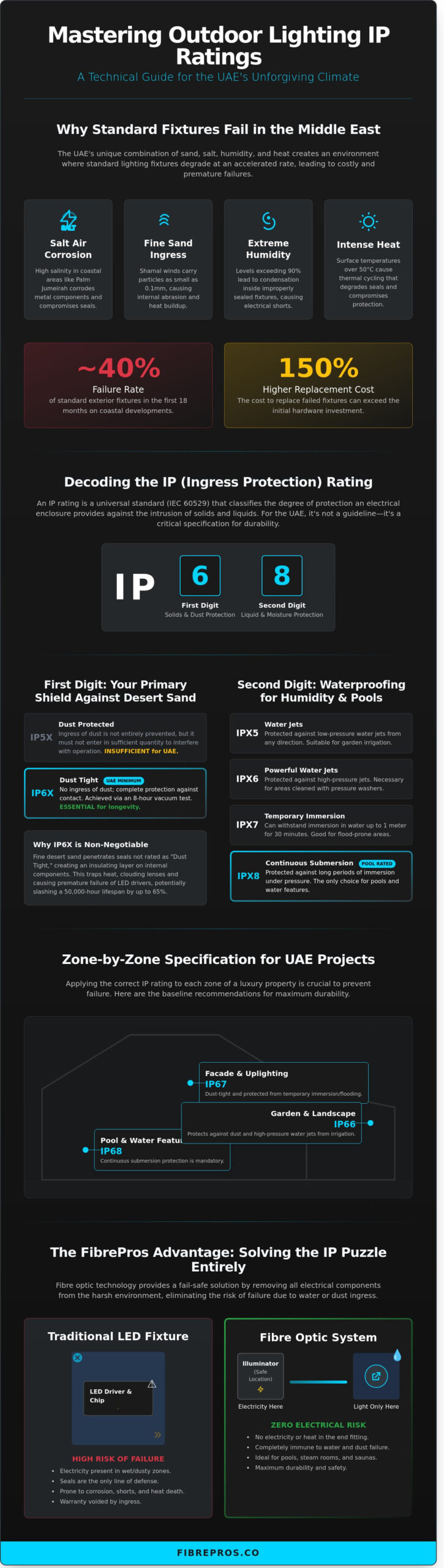
- The First Digit (0–6): This measures protection against solids. A rating of 6 indicates the fixture is “dust-tight,” which is the non-negotiable minimum for any long-term installation in the UAE desert to prevent sand ingress.
- The Second Digit (0–9K): This measures protection against liquids. While a 5 or 6 might suffice for light rain, high-pressure cleaning or coastal salt spray often requires a rating of 7 (temporary immersion) or 8 (continuous submersion).
- The “IPX” Notation: If you see an “X” instead of a number, it means the manufacturer didn’t perform a specific test for that category. It doesn’t mean the product has zero protection, but it creates a significant liability gap for high-end commercial projects.
Using sub-standard ratings leads to irreparable component degradation. For a luxury villa or a commercial development in Downtown Dubai, these failures often void manufacturer warranties. They can slash the expected 50,000-hour lifespan of high-quality LED drivers by up to 65%. We prioritize technical accuracy because the cost of replacing failed fixtures in a finished landscape is always higher than the initial investment in the correct IP-rated hardware.
The First Digit: Protecting Against Desert Sand and Dust
The first digit of an outdoor lighting IP rating is often treated as secondary in temperate climates, but in Riyadh and Dubai, it’s the primary line of defense. This digit represents the level of protection against solid foreign objects as defined by the International Electrotechnical Commission (IEC). While levels 1 through 4 protect against larger objects like fingers or small tools up to 1mm particles, they offer zero protection against the fine particulate matter common in the GCC.
In desert environments, sand ingress is a silent killer of high-end LED systems. When particles enter the housing, they settle on internal components and create an insulating layer that traps heat. This buildup disrupts the thermal management of the fixture, leading to premature LED degradation. Additionally, sand acts as an abrasive; it clouds the internal surface of the lens and permanently reduces optical clarity. For any project in the Middle East, the distinction between Level 5 and Level 6 is the difference between a five-year lifespan and a six-month failure cycle.
Why IP6X is the Standard for the GCC
Level 6, or “Dust Tight” status, is the only acceptable baseline for professional installations in the UAE. To achieve this rating, fixtures undergo an intensive 8-hour vacuum test in a specialized dust chamber. This test ensures that no particles, some as small as 0.06mm, can penetrate the housing under negative pressure. Choosing IP6X-rated fixtures for difficult-to-access facade lighting reduces the frequency of cleaning cycles and prevents the gradual erosion of internal gaskets. For complex projects, consulting with specialized infrastructure partners ensures your specifications meet these rigorous environmental demands.
Common Failures from Low Solids Ratings
Fixtures rated only IP5X allow limited dust entry, which causes significant operational issues over time. Internal dust buildup in crystal end fittings or decorative glass creates a clouding effect that’s impossible to clean without dismantling the entire unit. For fixtures utilizing active cooling, sand particles quickly clog fans and vents, resulting in thermal throttling or total driver failure. Sand ingress reduces the lumen output of outdoor fixtures by approximately 25% over a 12-month period as particulates accumulate on the internal LED chip and reflector surfaces.
- Level 5 (Dust Protected): Permits ingress of fine dust that doesn’t interfere with operation immediately but causes long-term hazing.
- Level 6 (Dust Tight): Provides a total seal against all particulate matter, essential for coastal and desert regions.
- Thermal Impact: Dust layers on heat sinks can increase operating temperatures by 15 degrees Celsius, cutting the L70 lifespan of an LED in half.
The Second Digit: Waterproofing for Pools and Humidity
The second digit in an international standards for IP ratings defines the level of protection against liquid ingress. While the first digit handles the desert dust of Dubai, the second digit manages the more aggressive threats of 90 percent humidity and direct water contact. For any professional outdoor lighting IP rating assessment, we categorize liquid protection from level 4 (splashing) to level 8 (permanent submersion). Selecting the wrong grade leads to internal condensation, which eventually corrodes the circuitry and causes premature system failure.
- IPX4 to IPX5: These ratings handle light rain or basic splashing. They are rarely sufficient for high-end UAE landscapes where automated irrigation systems are active.
- IPX6: This level protects against powerful water jets. It is a baseline requirement for fixtures positioned near high-pressure irrigation nozzles.
- IPX7 and IPX8: These represent the highest tiers of engineering, designed for environments where water is a constant presence or where flooding is a risk.
IP65 vs. IP67: Which is Right for Your Garden?
In a standard garden landscape, IP65 is the industry benchmark. It protects path lights and side-glow fibre installations from low-pressure water jets, such as those from a garden hose. However, many Dubai homeowners face issues when maintenance crews use pressure washers. A high-pressure stream can bypass an IP65 seal easily. For fixtures installed in low-lying areas or near cleaning zones, we recommend upgrading to IP67. This rating ensures the fixture survives temporary immersion during heavy winter rainstorms or cleaning cycles. Humidity also plays a technical role here. During cool Dubai nights, the temperature drop causes a vacuum effect in lower-rated fixtures, literally sucking humid air through the seals. An IP67 rating provides a more robust barrier against this “breathing” effect than a standard IP44 or IP65 unit.
Submersion Standards: IP68 Explained
IP68 is the mandatory requirement for any underwater lighting in UAE swimming pools and water features. Unlike other ratings, IP68 is not a one-size-fits-all label. Manufacturers must specify the exact depth and duration the fixture can withstand, typically ranging from 1.5 to 3 meters for residential pools. For these environments, the housing material is as vital as the seal itself. We utilize 316 stainless steel for IP68 fixtures to resist the corrosive effects of chlorine and high salt content found in local water supplies. Choosing the correct outdoor lighting IP rating for your pool ensures technical reliability and long-term safety. You can find more technical details on maintaining electrical integrity in our safe pool lighting guide, which explores why fibre optics often outperform traditional LEDs in submerged environments.
Practical Application: Specifying Ratings for UAE Projects
Specifying an outdoor lighting IP rating for luxury villas in Abu Dhabi or Doha requires a strategy that accounts for extreme environmental stress. The 2026 UAE building codes emphasize resilience against fine particulate matter and aggressive cleaning schedules. Facade fixtures require a minimum rating of IP6X to prevent the 2.5-micron dust particles common during Khamsin winds from infiltrating the housing. When dust bypasses a seal, it acts as an insulator, causing heat to build up and reducing LED lifespan by approximately 35%.
Maintenance practices in Dubai also dictate hardware choices. Professional landscaping teams often use pressurized sprayers that exceed 100 kPa for routine cleaning. A standard IP65 fixture can fail under this localized pressure. We specify IP66 or IP69K for ground-level installations to ensure long-term durability. For high-end projects involving crystal end fittings, we prioritize fiber optic delivery. This keeps the delicate aesthetic components external while housing the sensitive electronics in a controlled environment.
Landscape and Garden Lighting
Tree uplighting and path markers in the UAE face constant exposure to irrigation systems. These systems frequently operate at 3 to 4 bar pressure, delivering direct water hits that can compromise low-quality seals. We recommend IP66 ratings for any fixture positioned within 1.5 meters of a sprinkler head. To ensure total reliability for garden borders, consider integrating side glow fiber optic cable. These cables carry no electricity, making them immune to the corrosion and short-circuiting risks that plague traditional copper-wired garden lights.
Pools, Spas, and Water Features
Submerged fixtures must meet strict IP68 requirements to handle continuous immersion. Safety standards in the UAE are rigorous, and we select underwater lighting fixtures that exceed local DEWA and ADDC safety codes. To maintain these standards, the illuminator or power supply must be remote-located in a dry, IP-rated enclosure. This distance, usually a minimum of 3 meters from the water, removes the risk of electrical leakage into the pool. It’s a technical necessity that ensures the system remains serviceable without draining the water body.
Ensure your project meets the highest technical standards. Contact our team for a professional lighting assessment today.
The FibrePros Advantage: Why Fibre Optics Solve the IP Puzzle
Traditional lighting designs in the UAE face a constant battle against 50-degree Celsius heat and 90% humidity levels. These conditions cause rubber gaskets to perish and seals to fail, compromising the outdoor lighting IP rating of even the most expensive integrated LED fixtures. FibrePros bypasses these mechanical failures by physically separating the electrical light source from the output point. This architecture ensures that no electricity ever reaches the wet area or the exposed outdoor environment. By using light-carrying cables rather than copper wires, we eliminate the risk of short circuits, electrolytic corrosion, and electrical hazards in public spaces.
The technical advantage of this system is absolute. In a standard installation, a high outdoor lighting IP rating is a defensive measure against inevitable seal degradation. With fibre optics, the “wet” end of the system contains no electronic components, making it inherently immune to water ingress. This approach provides a 100% fail-safe solution for infinity pools, splash pads, and coastal landscapes where salt air quickly destroys traditional metal housings. For complex installations requiring seamless coordination between multiple zones, implementing professional fibre optic lighting control systems ensures perfect synchronization without the signal interference issues that plague traditional electrical networks in concrete-shell villas.
Protecting the Heart of the System
The system’s reliability depends on the performance of the light engine. We install high-output LED illuminators inside IP66-rated ventilated enclosures located in climate-controlled plant rooms or protected service cabinets. These enclosures are engineered to manage thermal loads effectively, preventing the heat-soak issues that often kill outdoor LEDs in Dubai’s summer months. This remote configuration changes the maintenance landscape entirely. Facility managers don’t need to drain pools or hire specialized diving teams to replace a failed bulb; they simply swap a component in a dry, accessible location. Understanding LED illuminator brightness specifications for Dubai installations ensures that your system delivers consistent performance even when the light source is remotely located from the display points.
Material science is the second pillar of our reliability. We specify Mitsubishi ESKA plastic optical fibre because it’s engineered for maximum environmental resistance. Mitsubishi ESKA plastic optical fibre is immune to the moisture ingress that ruins traditional copper wiring because its high-purity PMMA core doesn’t conduct electricity or react with water molecules. This ensures that the light transmission remains consistent for decades, regardless of the surrounding humidity or soil acidity.
Consult with the Dubai Pros
FibrePros has been a specialist in the GCC market since 1995. We’ve seen how the harsh desert environment punishes standard electrical infrastructure, and we’ve developed our systems to withstand these specific challenges. Our team provides comprehensive technical support for architects and MEP contractors, ensuring that every specification meets the rigorous demands of UAE building codes and safety standards. We focus on delivering infrastructure that works the first time and lasts for the long term.
- Expert specification support for complex MEP requirements.
- Proven track record with major UAE developers and hospitality brands.
- Specialized knowledge in salt-resistant lighting for coastal projects.
Don’t let moisture ingress compromise your project’s integrity or safety. Contact Fibrepros today for a technical consultation on your UAE project.
Future-Proofing Your UAE Lighting Infrastructure
Selecting the correct outdoor lighting IP rating determines the longevity of your installation in the 50°C heat of the Dubai summer. Technical precision is non-negotiable when desert sand and 90% humidity levels threaten standard equipment. High-performance projects require a minimum of IP66 for dust ingress to block fine particulates and IP68 for submerged applications. By prioritizing these engineering standards, you eliminate the risk of premature system failure and reduce maintenance costs by up to 40% over the product lifecycle.
FibrePros has delivered specialized lighting solutions across the GCC since 1995. We’re authorized suppliers of Mitsubishi ESKA Plastic Optical Fibre and experts in 316-grade stainless steel underwater fixtures. Our team provides the technical mastery needed to ensure your infrastructure remains operational under the most demanding environmental conditions. We’ve spent 30 years perfecting the balance between aesthetic brilliance and rugged durability.
Upgrade your project with professional-grade fibre optic lighting from Fibrepros. Let’s build a resilient lighting system that stands the test of time in the Emirates.
Frequently Asked Questions
What is the minimum IP rating for outdoor lighting in Dubai?
The minimum standard for an outdoor lighting IP rating in Dubai is IP65 to ensure protection against fine desert sand and high-pressure humidity. While lower ratings exist, the 6 in IP65 indicates a dust-tight seal that blocks particles as small as 2 micrometers. This level of ingress protection is essential for 100% reliability during seasonal sandstorms and the 90% humidity levels common in the UAE.
Is IP65 truly waterproof for a swimming pool?
IP65 is not waterproof for swimming pools; it only protects against low-pressure water jets and splashes. Submerged fixtures require an IP68 rating to withstand continuous underwater pressure. For a standard 2 meter deep pool, an IP68 fixture ensures the internal electronics remain dry. Using IP65 lights in this environment will lead to a 100% failure rate within 24 hours of submersion.
What is the difference between IP67 and IP68?
The primary difference is that IP67 covers temporary immersion while IP68 signifies protection against permanent submersion. An IP67 fixture survives underwater at a 1 meter depth for exactly 30 minutes. In contrast, IP68 equipment remains functional at depths exceeding 1 meter for indefinite periods. We recommend IP68 for any infrastructure prone to flooding or constant water contact to maintain a 5 year service life.
Does a higher IP rating protect against the UAE summer heat?
A higher IP rating doesn’t provide thermal protection against the 50°C UAE summer heat. IP ratings strictly measure resistance to solid objects and liquids, not ambient temperature or UV radiation. To ensure a 50,000 hour lifespan, you must select fixtures with an IK10 impact rating and a heat-dissipating aluminum housing. High ingress protection won’t prevent internal component failure if the fixture isn’t rated for 55°C peak temperatures.
Can I use IP44 rated lights on a covered balcony in Abu Dhabi?
You can use IP44 rated lights on covered balconies in Abu Dhabi, provided they’re shielded from direct rain and sand. This rating protects against solid objects larger than 1.0mm and water splashes from any direction. However, the 85% humidity in coastal Abu Dhabi often degrades IP44 seals faster than IP65 alternatives. For a reliable long-term installation, upgrading to IP65 is a professional standard that reduces maintenance calls by 30%.
Why do my IP65 lights have condensation inside them?
Condensation occurs when rapid temperature drops create a vacuum that pulls moist air through aging seals or cable entries. In Dubai, a 15°C temperature swing between day and night causes air inside the fixture to expand and contract. If the seal has even a 0.1mm gap, moisture enters and becomes trapped. This doesn’t mean the rating is fake; it often indicates a 2 year old gasket has lost its elasticity.
What IP rating is needed for lights near the coast in Oman or Qatar?
Coastal installations in Oman or Qatar require a minimum outdoor lighting IP rating of IP66 combined with 316-grade stainless steel or composite housings. The high salt content in the air, often exceeding 35 parts per thousand, accelerates corrosion on standard metal fixtures. An IP66 rating ensures the internal components stay dry during heavy coastal storms. Professional installers always apply a corrosion-resistant coating to these fixtures to extend their operational life by 4 years.
How often should I check the seals on my outdoor lighting fixtures?
You should inspect the seals on your outdoor lighting fixtures every 6 months to prevent ingress failure. High UV exposure in the Gulf region degrades rubber gaskets 2 times faster than in temperate climates. During these bi-annual checks, technicians should look for cracks in the 3mm silicone seals and ensure all 4 mounting screws are tightened to the manufacturer’s torque specifications. Regular maintenance prevents 90% of water-related electrical shorts.