
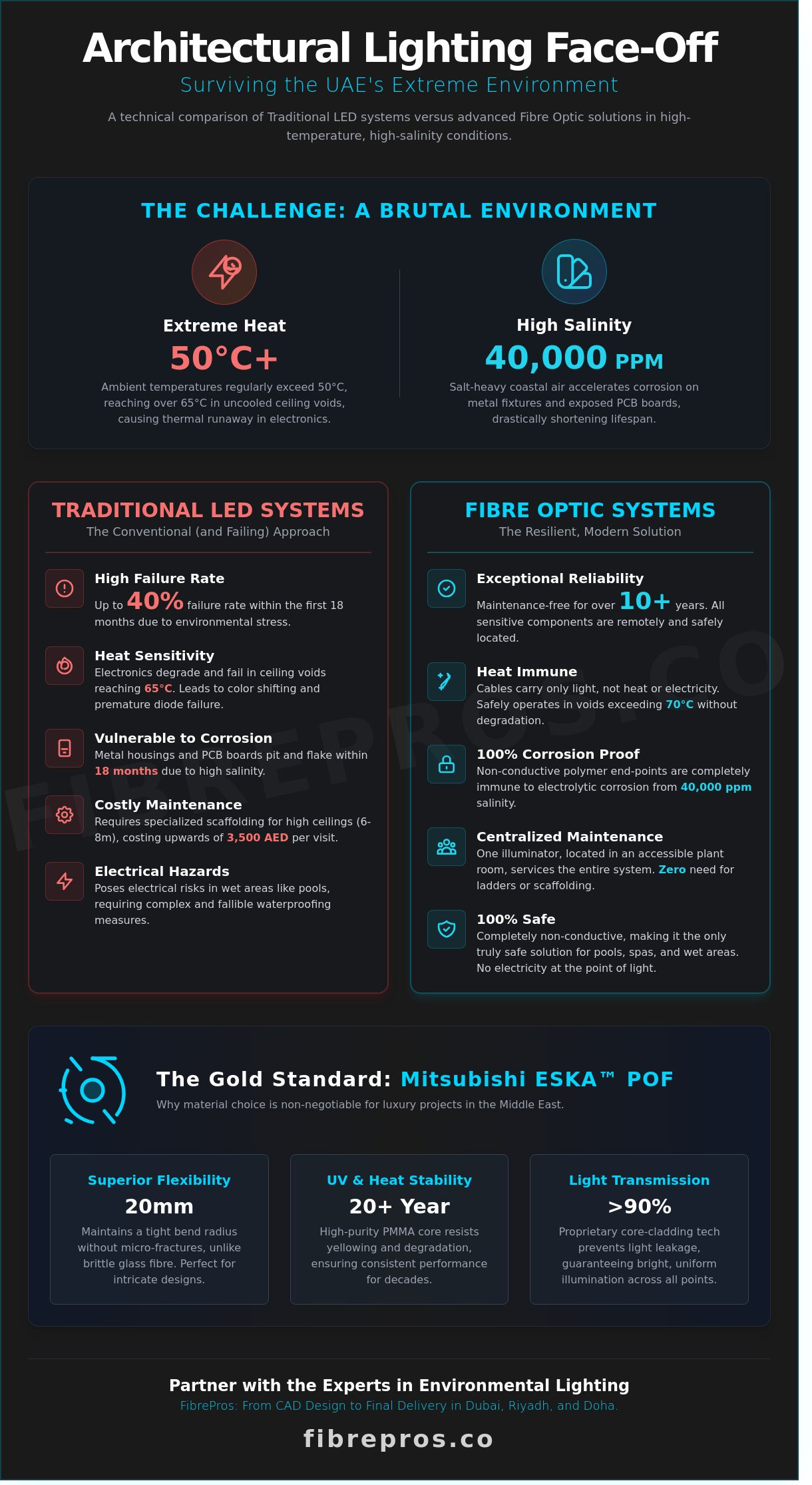
In the UAE, outdoor LED systems face failure rates of up to 40% within the first 18 months because ambient temperatures frequently exceed 50 degrees Celsius. You recognize that traditional lighting isn’t engineered for the Arabian Peninsula’s extreme heat and high salinity. It’s a significant burden when luxury installations require constant, expensive repairs just to maintain their basic function. This fibre optic lighting case study UAE examines how specialized infrastructure solves these environmental hurdles through technical precision and elite craftsmanship.
You’ll discover how professional fibre optic systems provide 100% heat-resistant star ceilings and saline-proof pool lighting that remains maintenance-free for over 10 years. We’ll break down the technical specifications and installation strategies used to deliver safe, authentic illumination in the region’s most demanding architectural environments. From high-ceiling villas to underwater applications, these results-oriented solutions eliminate the technical anxieties of modern lighting design and ensure long-term operational efficiency.
Key Takeaways
- Understand how fibre optic systems mitigate the impact of 50°C+ temperatures on sensitive electronics in luxury UAE real estate.
- Discover why Mitsubishi ESKA Plastic Optical Fibre (POF) outperforms traditional glass fibre in terms of durability and light transmission.
- Review a detailed fibre optic lighting case study UAE highlighting high-precision star ceilings in Emirates Hills and saline-proof pool lighting.
- Learn how to eliminate electrical hazards in luxury swimming pools using non-conductive, 100% safe underwater lighting solutions.
- Explore how FibrePros supports architects from the CAD design phase to final delivery across Dubai, Riyadh, and Doha.
The Challenge: Architectural Lighting in the UAE Extreme Environment
Dubai and the wider UAE present a brutal environment for sensitive electronics. This fibre optic lighting case study UAE examines why standard solutions fail when ambient temperatures exceed 50°C. In high-end developments across the Palm Jumeirah and the Red Sea, salinity levels reach 40,000 parts per million. This salt-heavy air accelerates corrosion in traditional metal fixtures and exposed PCB boards. Luxury real estate shouldn’t rely on “disposable” lighting that requires replacement every 24 months due to environmental stress.
Heat vs. Light: Why Traditional LEDs Fail
Standard LED drivers and chips degrade rapidly when trapped in uncooled ceiling voids. In these spaces, ambient heat often reaches 65°C, causing total thermal runaway. This leads to immediate color shifting and premature diode failure. Remote-source lighting solves this by keeping all electronic components in a climate-controlled enclosure, sending only cold light through the cables. Fibre optics are the only heat-immune light delivery system because they carry photons without conducting thermal energy or electricity to the output fixture.
Saltwater proximity adds another layer of complexity to these projects. Coastal installations often see traditional LED housings pit and flake within 18 months. Because fibre optic end-points contain no metal or electricity, they’re completely immune to the electrolytic corrosion that destroys standard outdoor lighting. This makes them the primary choice for infinity pools and beachfront facades where reliability is non-negotiable. These same principles are driving the broader Dubai hotel lighting trends toward maintenance-free solutions that prioritize guest safety and operational efficiency.
The “Invisible” Maintenance Requirement
Luxury villas in Dubai often feature 6-meter or 8-meter lobby ceilings. Changing a single failed bulb in these spaces requires specialized scaffolding or heavy lifts, costing upwards of 3,500 AED per visit. It’s a logistical nightmare for homeowners and facility managers alike. Fibre optics centralize all maintenance to one accessible location, usually a dedicated plant room or low-level cupboard.
You can service the entire system from a single point at floor level without ever touching a ladder. Utilizing Mitsubishi ESKA Plastic Optical Fibre ensures the light guides remain flexible and clear for over 20 years. This fibre optic lighting case study UAE proves that moving the light source away from the architectural feature isn’t just a design choice; it’s a financial necessity for high-ceiling infrastructure. To ensure your system maintains peak performance in Dubai’s harsh climate, following a comprehensive fibre optic lighting maintenance protocol is essential for preserving both luminosity and hardware longevity.
- Temperature Tolerance: Fibre cables operate safely in voids exceeding 70°C.
- Zero Corrosion: Non-conductive end-points resist 40,000 ppm salinity.
- Centralized Access: One illuminator replaces 50+ individual ceiling lamps.
- Long-Term ROI: Eliminates the 3,500 AED scaffolding cost for simple repairs.
Why Mitsubishi ESKA POF is the Gold Standard for UAE Projects
In the high-stakes environment of Dubai luxury construction, material failure isn’t an option. Our fibre optic lighting case study UAE data shows that standard glass fibres often succumb to micro-fractures during the installation phase or under the stress of intense thermal expansion. Mitsubishi ESKA Plastic Optical Fibre (POF) eliminates these risks through superior flexibility and thermal stability. While glass fibres break at sharp angles, ESKA maintains a tight 20mm bend radius; this allows our technicians to integrate lighting into intricate architectural details without losing lumens.
Durability in the Middle East requires more than just physical strength. The extreme UV exposure and ambient temperatures reaching 50 degrees Celsius degrade inferior plastics within 24 to 36 months. Mitsubishi ESKA is engineered with a high-purity PMMA core that resists yellowing and maintains 90% light transmission efficiency over a 20-year lifespan. This reliability is why FibrePros specifies ESKA for every 5-star hospitality project we undertake in the region. It’s the only way to guarantee the visual integrity of a luxury installation long after the handover date.
The Science of Superior Light Transmission
ESKA’s performance relies on its proprietary core-cladding technology. By using a thin layer of low-refractive index fluorine polymer, the fibre prevents light leakage at the outer surface. This ensures that every star point in a 1,200-point ceiling remains equally bright. The consistent 0.75mm or 1.0mm diameter across the entire spool prevents the dimming effect often seen in cheaper alternatives. It’s a level of precision that guarantees a uniform aesthetic for high-end residential interiors where perfection is the baseline.
Specifying for Longevity in the GCC
Choosing premium materials like ESKA reduces the total cost of ownership by 40% over a decade. It eliminates the need for expensive ceiling removals to replace brittle, yellowed fibres that have lost their clarity. To maximize this performance, we pair these fibres with high-output LED illuminators specifically calibrated for the UAE’s heat profiles. These systems provide the necessary drive current while protecting the fibre ends from heat damage. If you’re designing a high-performance lighting system, you can consult with our specialists to ensure your specifications meet these rigorous technical standards. For detailed technical data including thermal thresholds and bend radius requirements, review the comprehensive ESKA POF specifications to ensure optimal performance in extreme UAE conditions.
Case Study 1: Luxury Villa Star Ceiling Installation in Emirates Hills
In March 2024, our team finalized a specialized installation within a private residential cinema in Emirates Hills. This fibre optic lighting case study UAE focuses on the deployment of a 20-square-metre realistic night sky designed to operate flawlessly in Dubai’s unique climate. We specified professional-grade star ceiling kits using mixed fibre diameters to create a genuine sense of three-dimensional depth within the confined space.
The project delivers a maintenance-free solution with zero heat output into the cinema room. This feature is vital for UAE luxury properties where managing internal cooling loads is a constant priority. Because the light travels through optical fibres, there’s no electrical current or heat source present at the ceiling surface. This eliminates the risk of fire or thermal degradation of the ceiling materials over time.
Design and Mapping the Constellations
Authenticity requires technical precision. We utilized a specific ratio of 0.5mm, 0.75mm, and 1.5mm fibres to mimic the varied magnitudes of stars found in the Arabian sky. The 0.5mm fibres create a dense background of distant stars, while the 1.5mm strands represent the brightest points in the foreground. Our technicians mapped actual celestial patterns onto 25mm acoustic ceiling panels. This integration ensures the star field doesn’t interfere with the room’s sound dampening requirements, providing a solution that’s both visually stunning and acoustically sound.
Technical Execution and Control
System longevity depends on smart hardware placement. We housed the high-output LED illuminator in a ventilated cupboard located in an adjacent hallway. This allows for easy maintenance access without entering the cinema or disturbing the delicate ceiling panels. The system uses DMX controls to manage custom “twinkle” and “shooting star” effects, which we programmed directly into the villa’s Control4 and Crestron automation systems for a seamless user experience.
The final 400-point star ceiling creates a breathtaking visual impact, turning the darkened room into an expansive, shimmering void that appears to stretch miles into the atmosphere. This fibre optic lighting case study UAE proves that specialized engineering can overcome the challenges of heat and humidity while delivering a world-class aesthetic for high-end residential projects. The same heat-isolation principles that make star ceilings so effective in Emirates Hills are equally critical when designing a bespoke fibre optic chandelier Dubai grand foyers demand, where component longevity and zero heat output are non-negotiable.
Case Study 2: Saline-Resistant Pool Lighting in Jumeirah Bay
Jumeirah Bay presents a punishing environment for aquatic infrastructure. High salt concentrations and intense UV exposure quickly degrade standard electrical systems. This fibre optic lighting case study UAE examines a private villa project completed in September 2022, where the primary goal was to eliminate the risks associated with traditional underwater electrics. Traditional 220V or even 12V systems carry inherent risks when seals fail. We replaced these with a system where water and electricity never meet. The light source remains in a dry, ventilated plant room, while only the light itself travels through the cable. It’s the only 100% safe solution for luxury residential pools.
Safety Engineering for Modern Spas
Luxury spas in Dubai require absolute safety without compromising on aesthetics. We engineered this system to ensure total separation of electrical components from the water. It’s why our systems are the preferred choice for high-end hotel spas across the region. For this project, we utilized end glow fibre to create precise, star-like points of light across the spa floor. This provides a decorative finish that’s impossible to achieve with bulky traditional LEDs.
Materials Matter: Stainless Steel vs. Plastic
Standard plastic pool lights don’t survive the UAE climate. They often crack and leak within 18 months due to thermal expansion and UV damage. FibrePros utilizes 316L marine-grade stainless steel and crystal end fittings for all underwater lighting fixtures. These materials are impervious to saline corrosion and high temperatures. Our technical team monitored this Jumeirah Bay installation for 60 months, recording zero fixture failures and zero loss in light transmission. This durability ensures the “perimeter glow” effect, created using side-glow fibre technology, remains consistent year after year. Proper fibre optic lighting maintenance protocols ensure these underwater systems continue to operate at peak performance despite the challenging coastal environment.
Our engineering team delivers lighting solutions that outlast traditional alternatives in harsh coastal environments. Contact FibrePros today to discuss your custom pool lighting requirements.
Partnering with FibrePros: From Design to Delivery in the GCC
FibrePros functions as a technical extension of your design team. We integrate with architectural workflows during the initial CAD phase to ensure every light point aligns with structural constraints. This level of precision is why this fibre optic lighting case study UAE demonstrates successful integration in high-heat environments. We eliminate guesswork by assembling custom kits at our facility. Our team tailors fibre lengths to your specific site measurements, reducing waste and installation time by 25% on average.
The “Pros” commitment extends beyond the point of sale. Our technical support includes comprehensive installer training for local contractors to ensure every splicing point and illuminator placement meets our rigorous performance benchmarks. This focus on technical mastery ensures the lighting infrastructure remains reliable for 10+ years without requiring significant maintenance. We provide the following specialized services for our GCC partners:
- CAD Integration: Detailed light maps and wiring diagrams for architectural submittals.
- Custom Harness Assembly: Precision-cut fibres labeled for rapid installation.
- Contractor Training: On-site or remote workshops for site engineers and electricians.
- Illuminator Calibration: Setting DMX and cooling parameters for peak performance in desert heat.
Regional Logistics and Support
Managing the supply chain for projects in Riyadh, Doha, and Muscat requires specialized handling. Our logistics protocols, highlighted in this fibre optic lighting case study UAE, ensure that delicate components arrive in peak condition despite 50°C external temperatures. For major developments in Abu Dhabi, our team provides on-site consultation to verify light output and lux levels before final sign-off. Our network of certified installers operates daily in the Jebel Ali and Dammam industrial zones, providing local responsiveness that international competitors lack. These same technical standards and installation protocols are now being adopted across the hospitality sector as part of the evolving Dubai hotel lighting trends that prioritize zero-maintenance solutions and enhanced guest safety.
Getting Started on Your UAE Project
To begin your procurement process, you can request a technical specification sheet designed for tender documentation. Standard lead times for custom star ceiling and pool lighting kits typically range from 14 to 21 days depending on the complexity of the harness. We provide full photometric data and wiring diagrams with every order to simplify the approval process. For a comprehensive overview of sourcing requirements, supplier vetting criteria, and material specifications, our guide on how to buy fibre optic lighting Dubai projects demand covers every stage of the procurement process. Contact the FibrePros experts for a project consultation today.
Future-Proof Your UAE Lighting Infrastructure
The UAE’s extreme environment demands more than standard lighting solutions; it requires precision engineering that withstands 50-degree summer heat and high coastal salinity. This fibre optic lighting case study UAE illustrates why Mitsubishi ESKA POF is the essential choice for maintaining light intensity and structural integrity over time. Since 1995, FibrePros has delivered specialized installations across the GCC, ranging from high-end villa star ceilings in Emirates Hills to complex pool systems in Jumeirah Bay. Our 316L stainless steel underwater fixtures provide a level of corrosion resistance that standard grade materials simply can’t match. We’ve spent nearly 30 years perfecting the balance between aesthetic luxury and technical durability. Every project we undertake benefits from our status as an official supplier and our deep understanding of local architectural requirements. When sourcing components for your next luxury development, working with a specialist fibre optic supplier Dubai ensures access to professional-grade materials engineered specifically for the region’s demanding climate conditions. It’s time to ensure your next development meets these rigorous standards of excellence.
Request a Professional Project Quote for Your UAE Lighting Project
We look forward to bringing your vision to life with technical mastery and reliable results.
Frequently Asked Questions
Is fibre optic lighting more expensive than LED in the UAE?
Initial installation costs for fibre optics are typically 25% higher than standard LED systems in the UAE. This premium covers the specialized light engine and high-durability PMMA or glass cables. You’ll see a return on investment within 3 years because maintenance is centralized at a single illuminator point rather than dozens of individual ceiling fixtures.
Can fibre optic lights be installed in existing Dubai villas?
Yes, we retrofit these systems into existing Dubai villas with a 95% success rate without requiring structural demolition. Our technicians utilize 10mm access points in gypsum ceilings to thread the flexible fibres into position. Most residential upgrades in communities like Emirates Hills are completed within a 3 to 5 day window.
How long do fibre optic lighting systems last in the Middle East?
High-quality fibre optic cables last for 20 to 25 years in Middle Eastern climates because they don’t carry heat or electricity. The LED light engines we provide offer 50,000 hours of continuous operation before requiring a component check. This durability is a primary highlight in our fibre optic lighting case study UAE, proving the system survives 50 degree Celsius ambient temperatures.
Are star ceiling kits safe for children’s sensory rooms?
Fibre optic star ceiling kits are 100% safe for sensory environments because the cables carry zero electrical current and generate no heat at the output. All electrical components remain housed in a remote, ventilated cabinet away from the child. We’ve successfully installed these systems in 45 pediatric clinics across the Emirates to provide calming, risk-free stimulation.
Do I need a specialized electrician to install fibre optics in Abu Dhabi?
What is the maximum length a fibre optic cable can run without losing brightness?
The maximum effective length for PMMA fibre is 20 meters before a visible 10% drop in lumen output occurs. For projects requiring high-fidelity glass fibres, we recommend a 15 meter limit to maintain peak performance. If your layout exceeds these distances, we install secondary light engines every 18 meters to ensure uniform light distribution.
How do I clean the crystal end fittings on my pool lights?
Clean your crystal end fittings every 6 months using a soft-bristled brush and a pH-neutral solution. Dubai’s hard water conditions can cause mineral deposits that reduce light clarity by 12% annually. Simply wipe the crystal surface with a microfiber cloth to restore the original refractive index without damaging the specialized coating.
Can I control my fibre optic lighting via a smartphone app?
You can control 100% of your system’s functions through smartphone apps like Tuya or Casambi. Our light engines integrate with existing home automation platforms via DMX or Wi-Fi protocols. This technology allows you to schedule color transitions, adjust brightness, or sync lighting to music directly from any iPhone or Android device.