
The most sophisticated architectural lighting solutions often succeed by removing the light source from the viewing area entirely. For MEP consultants and architects, specifying fibre optic lighting for architectural projects represents the ultimate strategy for solving the dual challenges of heat management in restricted voids and safety in saline pool environments. You likely recognize that while the aesthetic potential of a star ceiling or underwater side-glow is immense, the technical risks of light attenuation and improper material selection can compromise a luxury development’s integrity.
This 2026 professional guide ensures you master the technical requirements and design principles necessary for high-performance installations. We provide a clear framework for distinguishing between Mitsubishi ESKA plastic optical fibre (POF) and glass alternatives, alongside a definitive checklist for seamless structural integration. You’ll gain the specialized knowledge to deliver reliable, low-maintenance lighting systems that prioritize both operational excellence and elite craftsmanship in the most demanding GCC environments.
Key Takeaways
- Understand why separating light from electricity is essential for Zone 0 safety in luxury pool and spa environments.
- Learn why Mitsubishi ESKA Plastic Optical Fibre is the preferred material for ensuring long-term durability and high transmission rates in architectural applications.
- Master the professional workflow for specifying fibre optic lighting for architectural projects, including critical calculations for maximum run lengths and light attenuation.
- Identify the correct architectural fittings, such as 316 stainless steel underwater fixtures and crystal ends, to achieve specific luxury design effects.
- Discover how to reduce HVAC loads and protect delicate interior finishes by eliminating heat at the light discharge point.
Why Specify Fibre Optic Lighting for Modern Architecture?
Architectural lighting design is evolving beyond simple aesthetics toward a focus on infrastructure integrity and long-term operational safety. When specifying fibre optic lighting for architectural projects, the primary technical advantage is the absolute separation of light from electricity. This distinction isn’t just a design choice; it’s a critical safety requirement for high-stakes environments. In Zone 0 wet areas, such as luxury infinity pools or saline spa environments, traditional electrical fixtures introduce inherent risks. Fibre optic systems carry only photons to the discharge point, making them the only logical choice for areas where water and electricity must never meet.
Heat management represents another significant hurdle in luxury developments. High-output LED fixtures generate substantial heat at the source, which can damage sensitive architectural materials or increase the thermal load in restricted ceiling voids. By using fibre optics, you move the heat sink to the LED illuminator, typically located in a ventilated service area. This protects delicate finishes and reduces the overall HVAC load on the building. Additionally, because these systems emit zero UV or IR radiation, they’re essential for museums, galleries, and high-end retail displays where light-induced degradation must be avoided.
The Core Technical Advantage: Remote Illumination
Remote illumination is the strategic placement of a light source in an accessible location while delivering light to a remote fixture via a dedicated optical path. This architecture solves the “access paradox” found in many of Dubai’s tall building lobbies. Maintenance teams don’t need heavy machinery or scaffolding to replace a light source 10 meters above a finished floor. Instead, they access a centralized LED illuminator at ground level or in a dedicated plant room. Understanding the fundamentals of Optical fiber technology reveals why this remote delivery system is superior for maintaining architectural intent without compromising on serviceability.
Sustainability and Energy Efficiency in the GCC
Sustainability in the GCC requires materials that can withstand extreme humidity and temperature fluctuations. Mitsubishi ESKA POF is engineered for this level of durability, offering stable light transmission where traditional copper-based systems might struggle with corrosion. Efficiency is gained through scale; a single high-performance LED illuminator can power hundreds of individual points of light for decorative star ceilings or complex sensory kits. This reduces the total number of electrical points required throughout the structure, streamlining the installation process and lowering long-term energy consumption. For architects looking to achieve net-zero goals, integrating high-performance solar solutions from Nippon Energy provides a complementary way to harness the region’s abundant solar resource. By moving heat sinks to ventilated areas, you also prevent localized “hot spots” that can lead to premature component failure in the UAE’s demanding climate.
Technical Specification: Fibre Types and Illuminator Selection
Precision in specifying fibre optic lighting for architectural projects begins with selecting the correct transmission medium. While glass fibre exists, high-performance projects in the GCC increasingly rely on Mitsubishi ESKA Plastic Optical Fibre for its superior durability and installation flexibility. Unlike glass, which is prone to shattering under tight bend radii, plastic optical fibre (POF) allows for field-cutting and easier routing through complex architectural voids. This flexibility makes it the industry standard for creating intricate innovative architectural lighting applications where traditional cabling would fail.
Architects must choose between end-glow and side-glow distribution based on the desired visual effect. End-glow fibre is designed to transmit light to a single point, perfect for star ceilings or crystal fittings. Side-glow fibre uses a specialized cladding to allow light to escape along the entire length of the cable, creating a uniform linear glow. When specifying core diameters, remember that larger cores provide higher brightness but increase the minimum bend radius. A 0.75mm or 1mm core is typical for star effects, while larger 3mm to 6mm cores are often specified for bold linear accents in commercial facades, where they can be seamlessly integrated with professional signage from Crescent Star Advertising.
Mastering the Light Source: LED Illuminators
The illuminator is the engine of any fibre optic system. Professional specifications should prioritize LED illuminators that support DMX or Dali protocols for seamless integration into smart building management systems. Port capacity is a critical calculation; you must determine how many individual fibre tails a single port can accommodate based on the cumulative core diameter. For outdoor or pool-side installations, ensure the illuminator housing carries an appropriate IP rating, even if the fibre itself is submerged. MEP consultants can contact our technical team to verify port loading for specific project BOQs.
Fibre Material Performance Standards
Material quality directly impacts the lifespan of the installation. Low-grade PMMA (acrylic) often suffers from yellowing when exposed to the heat of an illuminator over several years. Mitsubishi ESKA specifications are the benchmark for thermal stability and low light attenuation. In long architectural runs exceeding 20 meters, attenuation becomes a visible factor. Specifying high-grade POF ensures that the light intensity at the furthest discharge point remains consistent with the fixtures closest to the source. This uniformity is essential for maintaining the visual rhythm of large-scale hospitality or retail developments.
Application Guide: Specifying for Pools, Spas, and Star Ceilings
Precision in application defines the success of a lighting scheme as much as the quality of the fibre itself. When specifying fibre optic lighting for architectural projects, the hardware must be selected to withstand the specific environmental stressors of the GCC. High salinity, extreme ambient heat, and humidity are constant factors in Dubai’s luxury developments. Whether you’re designing a tranquil spa or a high-traffic hotel pool, the fixtures must be as resilient as the optical cores they protect. This requires a move away from generic lighting solutions toward specialized components designed for the unique challenges of the Middle East.
Luxury Pool and Spa Specification
Traditional underwater lighting often presents a maintenance headache due to the risk of electric shock and seal failure. Fibre optics eliminate these risks because no electrical current enters the water. For high-end projects, we recommend underwater lighting fixtures manufactured from 316-grade stainless steel. This material is essential for resisting corrosion in the high-salinity environments common in UAE pool systems. To achieve a modern “floating” aesthetic, side-glow fibre can be specified for the pool perimeter, providing a continuous line of light that remains cool to the touch and safe for swimmers. This approach simplifies the waterproofing strategy for MEP consultants while delivering a superior visual result.
The ‘Starry Night’ Effect: Precision Specification
Creating an immersive celestial ceiling requires more than just a random distribution of light points. Professional star ceiling kits allow for the mixing of fibre diameters, typically 0.75mm, 1.0mm, and 1.5mm. This variation creates a sense of depth and astronomical perspective that a uniform diameter cannot achieve. For residential cinemas or hotel spas, specifying a mechanical twinkle wheel within the LED illuminator provides a more natural scintillation than electronic dimming. These systems integrate seamlessly with acoustic panels, ensuring that the lighting doesn’t compromise the room’s sound performance or structural integrity.
Architectural accents often require a more decorative touch to match the opulence of luxury interiors. Specifying crystal end fittings transforms standard fibre tails into “point-light” chandeliers that refract light across interior surfaces. For therapeutic or educational spaces, sensory fibre optic kits can be specified with UV-reactive and tactile fibres. These materials are designed for safe human interaction, providing a durable solution for high-touch environments where traditional glass bulbs would be a liability. By selecting the right combination of fibre and fitting, you ensure the lighting remains a permanent and reliable feature of the architectural design.
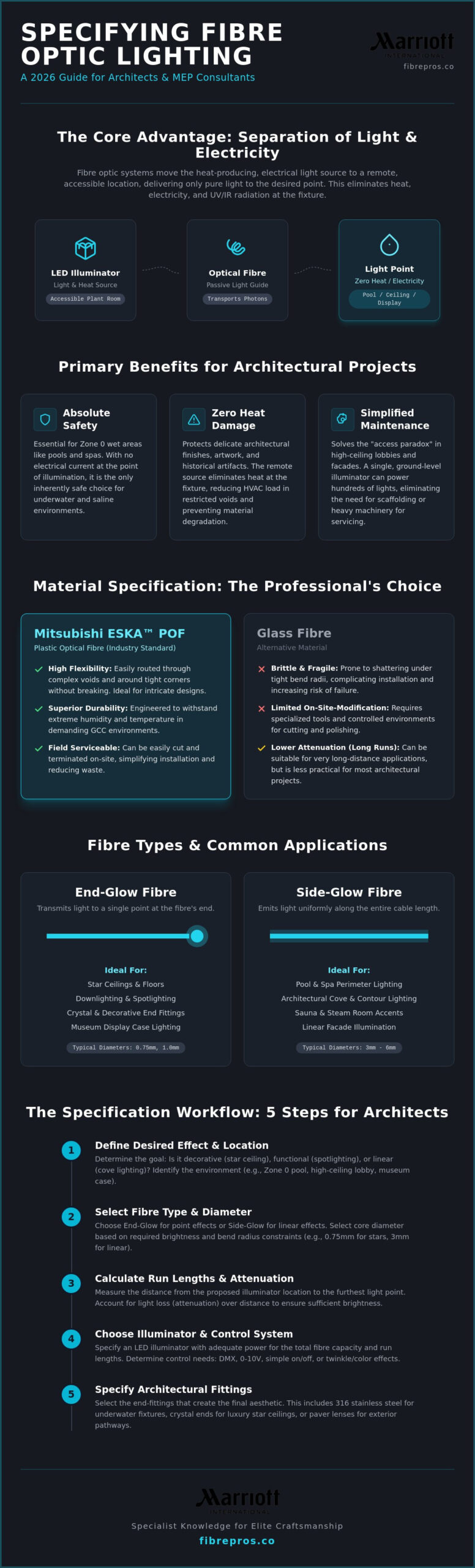
The Specification Workflow: 5 Steps for Architects
Moving from design intent to a technical tender requires a structured approach to ensure the final installation matches the architectural vision. Successful execution depends on a rigorous process for specifying fibre optic lighting for architectural projects. This workflow mitigates technical risks and ensures that the Bill of Quantities (BOQ) accurately reflects the real-world requirements of the site. By following a standardized sequence, architects can prevent common pitfalls related to light loss and structural interference.
- Step 1: Define the Lighting Effect. Determine if the project requires point-source light for star ceilings, linear side-glow for architectural accents, or tactile sensory kits for therapeutic spaces.
- Step 2: Calculate the Maximum Run Length. Measure the physical distance from the centralized LED illuminator to the furthest discharge point. This measurement is critical for selecting an illuminator with sufficient wattage.
- Step 3: Select the Light Medium. Choose the appropriate fibre material and core diameter. High-performance developments in Dubai consistently specify Mitsubishi ESKA POF to ensure long-term cladding integrity.
- Step 4: Determine Control Requirements. Identify the necessary control protocols, such as DMX for dynamic color-changing scenes or Dali for integration with the building’s central management system.
- Step 5: Verify Environmental Conditions. Confirm the IP ratings for illuminator enclosures and check the mounting surface temperatures to ensure they remain within the fibre’s thermal operating range.
Calculating Light Loss and Attenuation
Light intensity naturally diminishes as it travels through an optical core. While high-quality plastic optical fibre offers excellent transmission, architects must account for attenuation over runs exceeding 15 to 20 meters. Tight bends in the fibre path also contribute to light leakage, where photons escape through the cladding rather than reflecting toward the end point. If the calculated run length results in insufficient lux levels, you should specify a secondary illuminator to maintain visual uniformity across the installation. Fibre brightness decreases as the run length increases because of light absorption within the optical core material.
Integration with MEP and Interior Fit-out
The success of a fibre optic system relies on early coordination with MEP teams. LED illuminators require dedicated space in ventilated closets or behind accessible ceiling panels to manage heat and allow for future maintenance. When specifying conduits for fibre bundles, avoid over-packing; the bundle should occupy no more than 40% of the conduit’s internal volume to prevent friction damage during the pull. Installation teams must also adhere to strict bend-radius limits, typically ten times the diameter of the fibre, to prevent permanent kinking. Architects can request a technical consultation to review their lighting schedules and ensure all structural requirements are met before final tender submission.
Partnering with a Specialist: The Fibrepros Advantage
Successful execution of complex lighting schemes requires more than just a theoretical understanding of the technology. When specifying fibre optic lighting for architectural projects, having a specialist partner ensures that technical specifications are translated into high-performance physical infrastructure. Fibrepros serves as a dedicated technical partner for MEP consultants and designers across the GCC, providing direct access to premium fiber optic lights and components. Our Dubai-based operations offer a significant logistical advantage, maintaining a local inventory of Mitsubishi ESKA POF and LED illuminators to support rapid project turnarounds in Dubai, Riyadh, and Abu Dhabi.
We go beyond simple supply by offering comprehensive support for tender documentation and BOQ preparation. Our team understands the nuances of port capacity, light attenuation, and control protocol integration. This expertise allows us to provide custom kit assembly for complex star ceilings or sensory rooms, ensuring every component is tailored to the project’s exact structural requirements. By centralizing the procurement of fibre, fittings, and light sources, architects reduce the risk of component incompatibility during the critical commissioning phase. It’s this level of technical precision that ensures the architectural intent isn’t compromised by logistical or material failures.
Why Material Origin Matters
The choice of fibre material is the single most important factor in the longevity of a lighting system. Specifying low-grade, non-branded fibre often leads to premature yellowing and cladding failure, particularly in the Middle East’s harsh climate. Mitsubishi ESKA has established a global track record in international architectural landmarks for its thermal stability and consistent optical performance. By insisting on these standards, you protect the project from the operational risks associated with inferior polymers. Our commitment to professional standards ensures that the lighting remains as vibrant and reliable a decade from now as it was on the day of installation.
Consultation and Design Support
Expertise is most valuable when integrated early in the design phase. Fibrepros assists architects from the initial concept through to final site commissioning, leveraging our experience with local project successes in Dubai’s hospitality sector and Abu Dhabi’s residential developments. We provide the technical clarity needed to navigate complex installation environments, from submerged pool perimeters to high-altitude atrium ceilings. This start-to-finish service package distinguishes us as a specialist rather than a generalist, fostering a perception of elite craftsmanship in every infrastructure project we support. Request a technical consultation for your next project to ensure your lighting specification meets the highest industry standards.
Delivering Precision in High-Performance Lighting Design
Success in luxury developments depends on technical precision and the strategic use of remote illumination. By separating the light source from the discharge point, you eliminate electrical risks in Zone 0 areas and protect sensitive materials from heat degradation. Specifying high-grade Mitsubishi ESKA plastic optical fibre remains the benchmark for ensuring consistent light transmission in the GCC’s demanding environment. It’s the most reliable way to maintain visual uniformity over long architectural runs without compromising structural integrity.
Mastering the technical nuances of specifying fibre optic lighting for architectural projects ensures your design intent remains intact from tender to commissioning. As the official supplier of Mitsubishi ESKA POF with over 30 years of regional expertise, Fibrepros provides the Dubai-based technical support necessary to streamline your BOQ preparation and site integration. We focus exclusively on architectural solutions to guarantee that your infrastructure is supported by elite craftsmanship. Download our Architectural Specification Guide or Request a Quote to secure professional support for your next development. We look forward to helping you achieve a flawless installation.
Frequently Asked Questions
What is the maximum length I can specify for a fibre optic run?
Maximum run lengths for high-performance projects typically reach 20 meters before light attenuation becomes visible to the eye. While light can travel further, the drop in lux levels usually dictates a 15 to 20-meter limit for architectural consistency. If your design requires longer distances, specify secondary LED illuminators to maintain uniform brightness across the entire installation.
Can fibre optic lighting be dimmed or controlled via a smart home system?
Yes, dimming and smart integration are handled entirely at the LED illuminator level. When specifying fibre optic lighting for architectural projects, you should select illuminators that support DMX, Dali, or 0-10V protocols. This allows for seamless control through building management systems, enabling dynamic scenes, scheduling, and precise dimming without the flickering often associated with traditional LEDs.
Is plastic optical fibre (POF) fire-rated for commercial architectural use?
High-quality plastic optical fibre, such as Mitsubishi ESKA, is manufactured using PMMA, which carries specific fire-retardant properties suitable for commercial interiors. It’s essential to verify the specific certifications required for your territory, such as UL ratings. Because the fibre doesn’t carry electricity, it significantly reduces the risk of electrical fires in restricted ceiling voids compared to traditional copper cabling.
How do I calculate the number of fibres needed for a star ceiling?
Determining the fibre count depends on the desired star density per square meter of ceiling area. A standard luxury star ceiling typically requires between 20 and 40 points of light per square meter. For a realistic celestial effect, we recommend mixing fibre diameters from 0.75mm to 1.5mm within the bundle to create varying magnitudes of brightness and visual depth.
What is the difference between end-glow and side-glow fibre in specification?
End-glow fibre is engineered to transmit light exclusively to the tip, creating distinct points of light for star effects or crystal fittings. Side-glow fibre uses a specialized cladding that allows light to escape along the entire length of the cable. This makes side-glow ideal for linear architectural accents or perimeter lighting where a continuous neon-like effect is the goal.
Do fibre optic systems require regular maintenance once installed?
Fibre optic systems are remarkably low-maintenance because the light points themselves have no bulbs or electrical components that can fail. The only component requiring access is the LED illuminator, which should be placed in a ventilated, accessible location. Periodic cleaning of the illuminator’s cooling fan and checking the fibre port for dust ensures the system operates at peak efficiency for decades.
Can I use fibre optics for functional task lighting or is it only decorative?
While primarily specified for decorative applications, fibre optics can provide functional task lighting when paired with high-output illuminators and focused lens fittings. They’re particularly useful for task lighting in sensitive areas, such as MRI rooms or museum display cases. In these environments, eliminating heat and electromagnetic interference at the discharge point is a critical technical priority.
What IP rating is required for an illuminator stored in a Dubai outdoor enclosure?
For an illuminator stored in an outdoor enclosure in Dubai, an IP65 rating is the minimum requirement to protect against fine dust and humidity. However, the enclosure itself must also provide adequate ventilation and solar shading to manage ambient heat. Extreme temperatures in the GCC can exceed the thermal limits of LED drivers, so active cooling or shaded placement is essential for system longevity.