
What if the very feature designed to draw crowds into your luxury retail space became a recurring maintenance nightmare and a potential safety hazard? In the high-stakes environment of Qatar’s retail sector, maintaining reliable lighting for water features in malls Doha often feels like a constant struggle against extreme heat and the inherent risks of submerged electrical components. You likely already know that traditional underwater LEDs, while bright, frequently succumb to the region’s intense climate or require costly, invasive repairs that disrupt the shopping experience.
You can achieve a world-class, zero-risk aesthetic that thrives in the Doha heat without the burden of constant technical failures. This guide demonstrates how advanced fibre optic technology creates the seamless, “invisible” lighting effects currently defining the 2026 luxury standard. We will examine how utilizing Mitsubishi ESKA plastic optical fibre and high-performance LED illuminators allows you to keep electricity far from the water, ensuring total public safety and a maintenance-free lifespan. From side-glow fibre techniques to precision stainless steel fixtures, discover the technical path to an enduring, vibrant aquatic display.
Key Takeaways
- Understand why water features are essential to the luxury atmosphere in Qatari developments and how design standards are evolving for 2026.
- Compare the technical performance of remote LED illuminators against submerged lighting to ensure system reliability in extreme climates.
- Learn how to eliminate electrical liability for lighting for water features in malls Doha by using fibre optic technology that keeps voltage away from the water.
- Explore advanced design applications like “Starry Night” floor fountains and neon-like perimeters created with Mitsubishi ESKA plastic optical fibre.
- Identify the critical components and regional expertise required to specify the right core materials for long-term operational success in the GCC.
The Evolution of Mall Water Feature Lighting in Doha
Doha malls represent the global pinnacle of retail architecture and sensory experience. These developments aren’t merely shopping centers; they are climate-controlled escapes where water features are central to the “coolth” and luxury atmosphere. In a region where residents spend an average of 90% of their time indoors, these aquatic installations provide a vital psychological connection to nature. The technical challenge of illuminating these features has evolved significantly to meet the rigorous standards of the Qatari market.
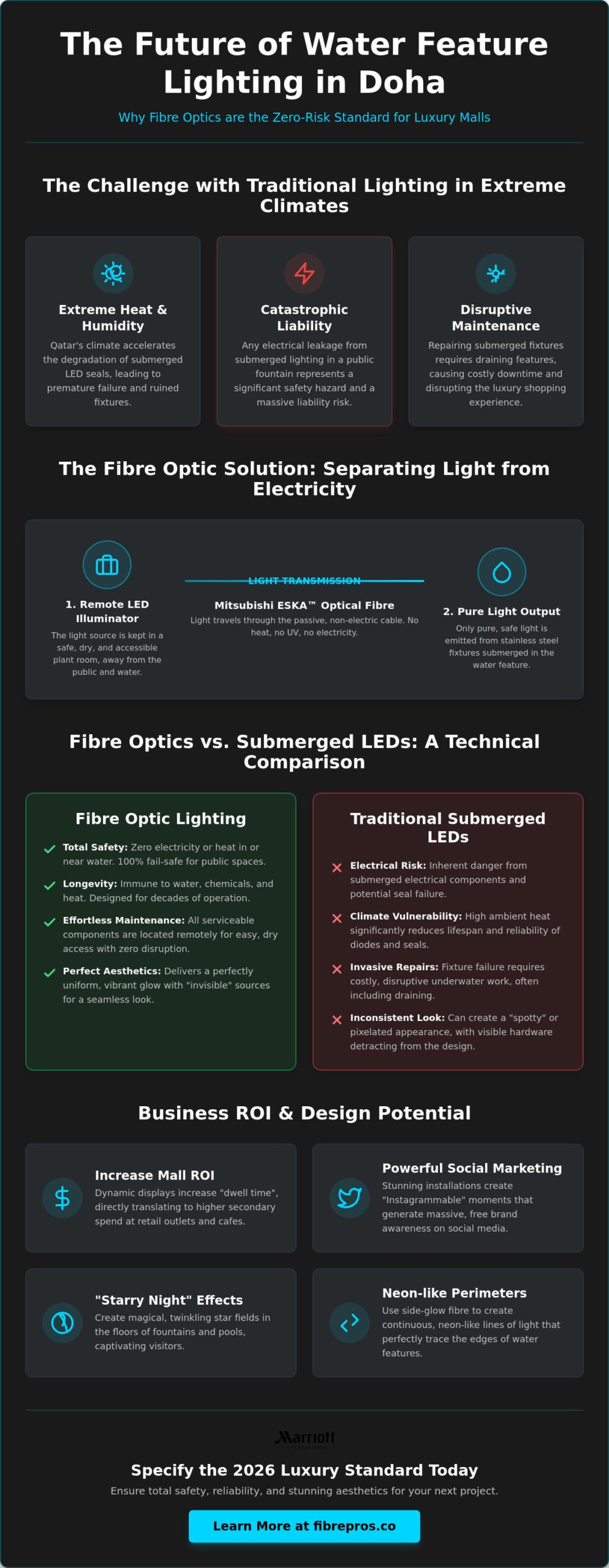
The industry has shifted from high-maintenance halogen bulbs to submerged LEDs, and now to advanced fibre optic systems. Traditional lighting for water features in malls Doha often faced reliability issues due to the aggressive combination of humidity and chemical treatments in the water. Fibre optic water lighting solves this by using a remote LED illuminator to transmit light through specialized cables. This configuration keeps all electrical components in a dry, accessible location. By reviewing how optical fibers work, it’s clear that transmitting light without electricity in the cable is the only way to guarantee total safety in public spaces. It’s a system designed for high-stakes environments where uptime is critical.
Why Doha Retail Environments Demand Specialized Lighting
High footfall in destinations like the Mall of Qatar or Place Vendôme requires fail-safe public safety. Any electrical leakage in a public fountain represents a catastrophic liability. Qatar’s extreme ambient heat also accelerates the degradation of submerged LED seals. When a seal fails, the fixture is ruined. Specialized lighting for water features in malls Doha must withstand these conditions while delivering a vibrant, programmable, and perfectly uniform glow. Designers now demand “invisible” lighting where the source is hidden, leaving only the pure aesthetic of the water itself. This requires technical precision that standard retail fixtures cannot provide.
The Role of Lighting in Mall ROI
Investing in premium water lighting is a calculated business move. Dynamic displays increase “dwell time,” keeping visitors in luxury shopping districts for longer periods. This translates directly into higher secondary spend at cafes and retail outlets. These installations create “Instagrammable” moments that generate massive brand awareness on social media, acting as a powerful marketing tool. By utilizing high-standard materials like Mitsubishi ESKA plastic optical fibre, mall operators balance these spectacular visual effects with operational efficiency. You get a system that survives the Doha climate while eliminating the need for expensive, disruptive underwater maintenance. It’s about achieving a high-standard finish that preserves the mall’s prestige while protecting the bottom line.
Why Fibre Optics Outperform Traditional LEDs in Water
The superiority of fibre optic technology in aquatic environments stems from its unique separation of light and electricity. While traditional submerged LEDs are the industry norm in residential settings, they often fail to meet the specific demands of lighting for water features in malls Doha. The primary issue is thermal management. Submerged LED chips generate heat that must be dissipated into the surrounding water. In Qatar’s high ambient temperatures, this heat exchange is less efficient, leading to premature diode failure and seal degradation. Fibre optic systems eliminate this risk by placing the light source in a remote, climate-controlled plant room.
The Science of Remote Source Lighting
Remote source lighting relies on a high-output illuminator to project light into a bundle of optical fibres. This method aligns with contemporary architectural lighting principles by treating light as a flexible, structural element rather than a series of fixed bulbs. Selecting high-quality LED illuminators allows for centralized control and effortless color synchronization across large mall installations. The efficiency of this transmission depends heavily on the core material. We utilize Mitsubishi ESKA plastic optical fibre because its high-purity core ensures maximum light transmission with minimal attenuation over long distances. This results in a uniform, vibrant glow that avoids the “spotty” or pixelated appearance common with lower-tier LED strips.
Durability in Treated Water Environments
Mall water features require aggressive chemical treatments, including chlorine and bromine, to maintain hygiene in high-traffic areas. These chemicals quickly degrade the seals and housings of standard underwater electronics, causing eventual short circuits. In contrast, plastic optical fibre (POF) is chemically inert. It won’t corrode, cloud, or fail when exposed to treated water. For features that transition between indoor and outdoor spaces, our side-glow fibre is UV-stabilized to prevent yellowing or brittleness from Doha’s intense solar radiation. We combine these fibres with stainless steel fixtures to ensure the entire installation remains structurally sound and aesthetically pristine for years.
Maintenance efficiency is perhaps the most significant operational advantage. Replacing a failed submerged LED often requires draining the fountain, which disrupts mall operations and risks damaging the waterproof membrane. With fibre optics, maintenance is a simple task performed in a dry plant room. You can swap a single lamp or update a control board without ever touching the water. If you’re planning a new installation, choosing the right fibre optic lights ensures your project remains a low-maintenance asset rather than a recurring liability.
Eliminating Liability: The Safety Advantage of Fibre Optics
For mall operators in Qatar, public safety is the primary operational concern. Any aquatic installation in a high-traffic retail environment must comply with the KAHRAMAA Low Voltage Electricity Wiring Code. While traditional lighting for water features in malls Doha relies on submerged electrical circuits, fibre optic technology offers a fundamentally safer alternative. These systems function by transmitting light via photons rather than electrons. There is zero electrical current within the water feature itself, which removes the risk of electrical leakage or shock. It’s a technical solution that addresses the root cause of public liability rather than just managing the symptoms.
Zero Electricity in the Pool or Fountain
This technology effectively eliminates the “wet-niche” lighting hazard common in older fountain designs. In standard LED installations, the power source is housed within the water body, separated only by seals that can fail over time due to chemical exposure or physical wear. Fibre optics physically separate the power source from the water entirely. The LED illuminator stays in a dry, secure location, while only the inert cable enters the fountain. This provides total peace of mind for developers, especially in family-centric zones where children interact closely with floor-level water jets and interactive ponds. You don’t have to worry about seal integrity when there’s no electricity to contain.
Heat Management in the Doha Climate
Qatar’s summer temperatures present a unique challenge for submerged electronics. Water in outdoor-to-indoor features can reach temperatures that exceed the safe operating range for many LED chips. When these chips overheat, they suffer from “thermal runaway,” leading to permanent damage or immediate shutdown. Fibre optic cables are thermally stable and remain unaffected by water temperature fluctuations. By positioning the illuminator in a climate-controlled plant room, you ensure the sensitive electronics operate in an optimal environment. This setup vastly extends the system’s lifespan compared to submerged alternatives that struggle against the Doha heat. It’s a more reliable way to maintain consistent performance throughout the year.
Beyond immediate safety, this approach supports long-term financial stability for the property. Adhering to international standards like IEC 60364 and BS 7671 is mandatory, but exceeding these standards with non-electrical underwater lighting can lead to more favorable risk assessments. Insurance providers favor installations that remove hazards at the source rather than relying solely on protective devices like RCDs, which require frequent testing and can still fail. By choosing high-standard fibre optic lights, you’re investing in a system that protects both the public and your operational budget.
Designing Water Effects for Doha Mall Interiors
Achieving the 2026 luxury standard for retail environments requires the precise manipulation of light to enhance architectural water features. In Doha’s most prestigious developments, designers are moving away from floodlighting and toward point-source effects. The “Starry Night” effect is a prime example. By embedding hundreds of end-glow fibre points into the floor of a shallow fountain, you create a celestial reflection that appears to float beneath the water’s surface. This technique is particularly effective for lighting for water features in malls Doha where floor-level interaction is encouraged, as the light sources remain flush with the masonry and completely cool to the touch.
Modern retail pods and pop-up luxury boutiques also benefit from the sleek, neon-like perimeters provided by side-glow fibre. Unlike traditional neon or LED strips, side-glow fibre offers a perfectly uniform line of light without any visible “hot spots” or pixelation. It’s flexible enough to follow the organic curves of contemporary Qatari architecture, providing a soft, sophisticated glow that defines the water’s edge. For vertical installations, such as water curtains or rain walls, end-glow fibre can be paired with crystal end fittings. These precision-engineered components refract the light as it exits the fibre, creating a shimmering, diamond-like brilliance within the falling water droplets.
Architectural Integration Techniques
Successful lighting for water features in malls Doha depends on the invisible integration of hardware. Fibre optic cables are thin and flexible, allowing them to be concealed within fountain nozzles or narrow joints in stone masonry. This was a critical factor in large-scale projects like those seen at Lusail Winter Wonderland, where lighting had to be integrated into complex aquatic structures without visible conduits. Designers must account for the specific bend radius of the fibre to prevent light loss, especially when navigating the tight coves and shadow gaps common in modern mall interiors. Proper planning ensures the light appears to emerge from the architecture itself rather than a visible fixture.
Dynamic Colour and Motion
Luxury malls now utilize DMX-controlled LED illuminators to synchronize water lighting with music and digital displays. This allows operators to program specific colour sequences for regional events, such as the maroon and white of Qatar National Day, or to create sparkle effects that mimic the shimmering Arabian Gulf. The success of these dynamic displays relies on the technical superiority of Mitsubishi ESKA Plastic Optical Fibre. Its high-purity core ensures that programmed colours remain vibrant and accurate across the entire feature, even during complex transitions. For expert assistance in specifying these advanced aquatic systems, consult with our technical team today to ensure your design meets the highest regional standards.
Procuring Professional Lighting Components in the GCC
Executing a world-class aquatic display requires a supply chain that prioritizes technical precision over generic solutions. In the Qatari market, procurement for lighting for water features in malls Doha must account for rigorous operational demands and local regulatory compliance. Sourcing components from a specialist with a physical presence in the GCC ensures that the materials provided are specifically rated for the region’s unique environmental stresses. This local expertise is the difference between a system that fails within two seasons and one that maintains its brilliance for a decade.
The foundation of any high-standard installation is the core material. We specify Mitsubishi ESKA plastic optical fibre because its performance metrics are unmatched in commercial applications. This core material provides superior clarity and resists the yellowing that often plagues inferior alternatives in high-UV environments. Beyond the fibre, the hardware must be equally resilient. All underwater fixtures and end-fittings must be manufactured from 316-grade stainless steel. This specific grade is essential for resisting the corrosive effects of the high-saline and heavily treated water common in GCC mall fountains. Lower grades of steel will inevitably tea-stain or pit, compromising the luxury aesthetic of the development.
Illuminator selection is another critical procurement factor. For high-ceiling mall atriums, standard residential-grade units lack the necessary punch. You must select high-wattage LED illuminators capable of driving light through long fibre runs without significant attenuation. Proper wattage ensures that the water effects remain visible even under the intense ambient light of a glass-roofed mall during peak daylight hours.
The Fibrepros Advantage for Qatar Projects
Our team provides a specialized supply of fiber optic lights tailored for the most demanding luxury commercial applications. We don’t just deliver boxes; we offer start-to-finish component support for mall developers and contractors to ensure every fitting is correctly specified. With a proven track record across Doha, Riyadh, and Dubai, we understand the logistical and technical requirements of large-scale infrastructure projects. This regional experience allows us to anticipate challenges before they impact the project timeline.
Next Steps for Mall Developers
Transitioning from a design concept to a functional installation requires detailed technical coordination. Developers and project managers should begin by requesting a comprehensive technical lighting layout and a detailed bill of quantities (BOQ). This documentation is vital for coordinating with MEP contractors regarding the placement of illuminators and the routing of fibre conduits. Early-stage consultation prevents costly site modifications later in the construction phase. For specialized GCC lighting consultancy and component specification, contact our technical department to review your project requirements. We provide the specialized mastery needed to bring the 2026 Doha luxury standard to your retail environment.
Elevating Aquatic Architecture for 2026 and Beyond
Mastering the balance between visual impact and operational safety is the hallmark of modern Qatari retail design. By transitioning to remote-source technology, you eliminate electrical hazards while ensuring your installations survive the region’s unique thermal challenges. Utilizing high-standard materials like 316-grade stainless steel fixtures and Mitsubishi ESKA POF provides the durability required for permanent, high-prestige features that define a luxury atmosphere.
Achieving the 2026 standard for lighting for water features in malls Doha requires a partner with deep regional knowledge. We bring over 25 years of Middle East lighting expertise to every project, serving as an authorized distributor for the industry’s most reliable optical materials. Whether you’re designing a celestial floor fountain or a dynamic water curtain, our team provides the technical mastery to ensure long-term uptime and accuracy. Consult with Fibrepros for your Doha mall lighting project to secure a fail-safe, world-class aquatic display for your development. We look forward to helping you set the new benchmark for retail excellence in Qatar.
Frequently Asked Questions
Is fibre optic lighting bright enough for large mall fountains?
Yes, modern LED illuminators provide sufficient lumen output for even the largest aquatic displays. Brightness depends on the wattage of the light source and the quality of the fibre core. By using Mitsubishi ESKA plastic optical fibre, you ensure minimal light loss over long distances. This combination allows for vibrant lighting for water features in malls Doha that remains visible under high-intensity architectural lighting.
Can fibre optic lighting be integrated with existing mall automation systems?
Integration is standard via DMX512 or other common building management protocols. Our LED illuminators are designed to interface seamlessly with existing mall automation systems. This enables centralized control over color changes, timing, and synchronization with water shows or background music. It ensures that the water feature remains an active, programmable part of the mall’s sensory environment rather than a static installation.
What is the lifespan of Mitsubishi ESKA fibre in a mall environment?
Mitsubishi ESKA fibre is engineered for extreme longevity, often maintaining its optical clarity for over 20 years. Because the fibre is a passive, inert material, it doesn’t suffer from the diode degradation that limits the lifespan of submerged LEDs. Only the remote illuminator requires eventual servicing, which is performed in a dry environment. This makes it a highly reliable choice for permanent mall infrastructure in Qatar.
Does fibre optic lighting require specialized maintenance staff?
Specialized maintenance teams aren’t necessary for the day-to-day operation of these systems. Because the electrical components are located in a dry plant room, your standard facility team can perform routine checks or lamp replacements. There’s no requirement for divers or draining the fountain to access the light source. This accessibility reduces operational downtime and eliminates the technical complexities associated with underwater electrical repairs.
How does the cost of fibre optic lighting compare to traditional LED over 5 years?
Fibre optic systems typically deliver a lower total cost of ownership over a five-year period. While the initial procurement might be higher than basic LEDs, you save significantly on maintenance, water replacement, and energy. You won’t face the recurring costs of replacing failed underwater fixtures or repairing damaged waterproof membranes. In the demanding Doha climate, these operational savings quickly offset the initial investment.
Can fibre optics be used in outdoor mall features in Doha’s humidity?
Fibre optics are perfectly suited for the high humidity and salinity of Doha’s coastal environment. Since the cables carry only light and no electricity, they are immune to the short circuits and corrosion that humidity causes in traditional wiring. For outdoor-to-indoor transitions, we utilize UV-stabilized side-glow fibre to prevent degradation from intense sunlight. It’s the most resilient solution for Qatar’s unique weather conditions.
What IP rating is required for mall water feature illuminators?
The required IP rating depends on the placement of the light source. If the LED illuminators are housed in a climate-controlled plant room, a standard IP20 rating is often sufficient. However, for installations where the light source is closer to the water body, we provide housings with higher IP ratings to ensure protection against moisture. The fibre cables themselves are solid and unaffected by water ingress or pressure.
Is it possible to retrofit fibre optics into an existing mall fountain?
Retrofitting is a highly effective way to upgrade lighting for water features in malls Doha without a total rebuild. We can often utilize existing conduits or integrate new fibre runs into the masonry during a scheduled renovation. This process replaces high-maintenance underwater bulbs with a remote-source system, immediately improving safety and reducing future maintenance costs. It’s a strategic investment for aging retail properties looking to meet 2026 luxury standards.