
Did you know that 85% of luxury home cinema projects and premium master suites in the UAE now feature professional star ceiling systems as a standard architectural element? In a high-end property market, a simple flickering light isn’t enough to satisfy sophisticated design requirements. You need a solution that replicates the subtle, organic shimmer of a desert night sky without the mechanical hum or material degradation common in entry-level hardware. Selecting a high-performance twinkle effect star ceiling illuminator Abu Dhabi architects trust is the only way to ensure your project maintains its value and visual impact.
It’s frustrating when a luxury ambiance is ruined by noisy light engines or fiber optic cables that yellow after just a few months of use. You expect technical precision and reliability from your interior infrastructure. This guide will teach you how to identify professional-grade LED illuminators and Mitsubishi ESKA plastic optical fiber that withstand the local climate. We’ll cover everything from achieving silent operation in master suites to meeting the specific Abu Dhabi Department of Energy wiring regulations for 2026, ensuring a seamless and durable installation.
Key Takeaways
- Understand the technical distinction between mechanical twinkle wheels and digital scintillation for achieving organic, realistic light fluctuations.
- Identify the high-performance twinkle effect star ceiling illuminator Abu Dhabi projects require by comparing port capacity and technical specifications.
- Learn how to integrate professional lighting systems into centralized smart home hubs using DMX512 protocols for effortless automation.
- Implement essential ventilation and heat management strategies to protect your hardware within the unique environmental conditions of the UAE.
- Discover the performance advantages of pairing LED engines with Mitsubishi ESKA plastic optical fiber to prevent cable yellowing and maintain long-term brilliance.
Defining the Twinkle Effect Star Ceiling Illuminator for Abu Dhabi Interiors
A professional star ceiling system relies on a central light engine to drive its visual performance. The twinkle effect star ceiling illuminator Abu Dhabi luxury projects require is far more than a simple bulb; it’s a precision-engineered device that controls the intensity, color, and animation of thousands of individual points of light. This illuminator acts as the system’s heart, converting electrical energy into focused light that is then distributed through bundles of plastic optical fiber. For high-end villas, private cinemas, and luxury spas, the quality of this engine determines whether the ceiling looks like a sophisticated celestial map or a low-quality DIY project.
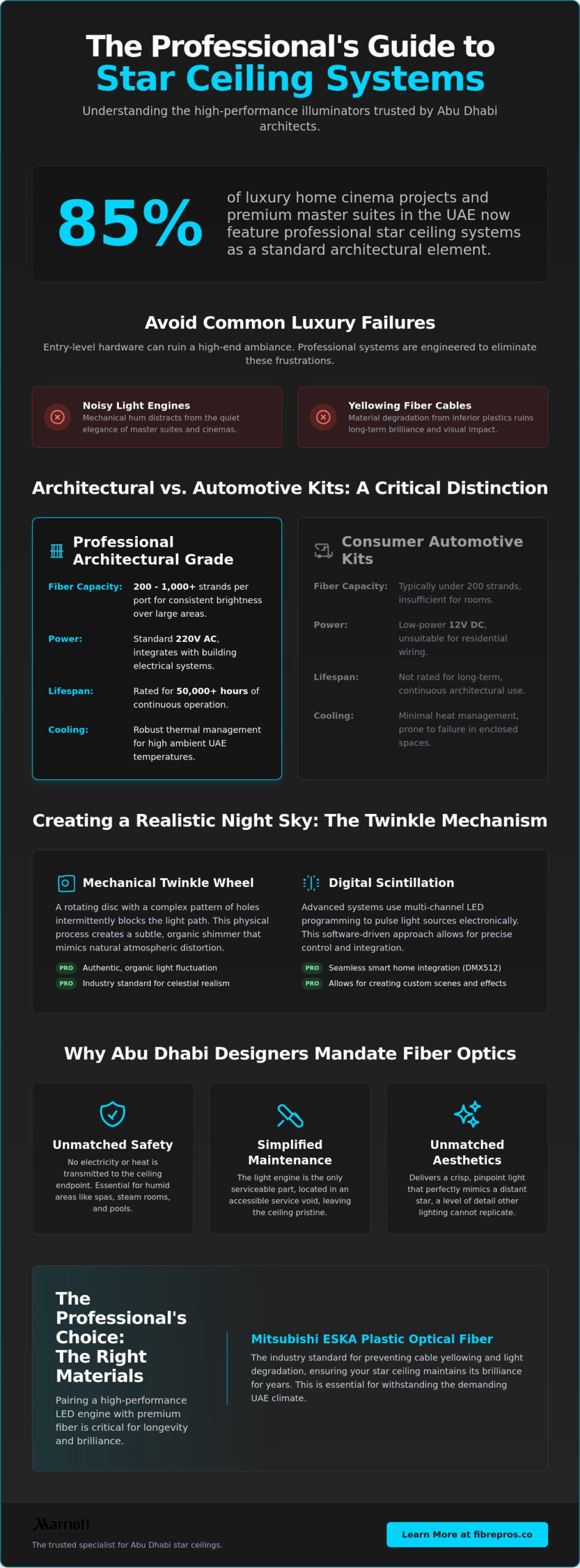
The coveted “twinkle” isn’t a random flicker. It’s typically achieved through two primary methods. Mechanical units utilize a rotating, perforated wheel that intermittently interrupts the light path, creating a natural, organic shimmering effect that mimics atmospheric distortion. Advanced digital models use specialized LED programming to pulse individual light channels. Both methods aim to replicate the subtle scintillation seen in the desert night sky, providing a depth and realism that standard static lighting can’t achieve.
Architectural vs. Automotive Star Kits
It’s a common mistake to assume car starlight kits are suitable for residential architecture. While automotive kits are designed for the small surface area of a vehicle roof, a villa or home cinema requires a vastly different scale. Architectural illuminators are engineered to handle 200 to over 1,000 fiber strands from a single port, ensuring consistent brightness across a large ceiling. They operate on standard 220V AC building power rather than 12V DC vehicle systems. Most importantly, professional units are built for longevity, often rated for 50,000 hours of continuous operation with robust thermal management systems designed for the UAE’s ambient temperatures.
Why Abu Dhabi Designers Prefer Fibre Optics
Designers in the region prioritize fiber optics for several specific technical reasons. First, safety is paramount. Because the system utilizes Optical Fiber Technology to transmit light, no electricity or heat is present at the ceiling level. This makes it the only viable choice for humid environments like luxury spas, steam rooms, or indoor pool areas. Second, maintenance is simplified. The only component that ever needs servicing is the illuminator itself, which is typically tucked away in a ventilated cupboard or accessible ceiling void, leaving the decorative ceiling untouched. Finally, the aesthetic is unmatched. Fiber optics provide a crisp, pinpoint light that mimics a distant star, offering a level of detail that traditional LEDs simply cannot replicate.
How the Twinkle Mechanism Creates a Realistic Night Sky
Achieving a convincing night sky requires more than just a light source. It demands a sophisticated twinkle effect star ceiling illuminator Abu Dhabi professionals rely on to mimic the natural scintillation of stars. The realism of the installation depends entirely on how the light is manipulated before it ever enters the fiber optic strands. While entry-level kits often produce a rhythmic, distracting flicker, architectural-grade systems utilize advanced engineering to ensure the movement feels organic and atmospheric.
The Role of the Twinkle Wheel
The mechanical twinkle wheel is a rotating, perforated disc positioned precisely between the LED light source and the fiber optic harness. As this disc spins, it intermittently blocks and reveals light to different fiber bundles. High-performance units use complex, random hole patterns to ensure the effect doesn’t appear mechanical or repetitive to the human eye. The scintillation effect is the technical term for this key visual element that provides the essential celestial realism required for luxury interior spaces. By adjusting the rotation speed, you can transition from a slow, meditative shimmer suitable for a master suite to a more dynamic sparkle for a home cinema.
While mechanical wheels remain the standard for natural light transitions, some 2026 systems incorporate digital scintillation. This software-driven approach uses multi-channel LEDs to pulse light electronically. Digital systems allow for greater integration with smart home scenes, though many architects still prefer the mechanical wheel for its softer, more traditional “glow and fade” characteristic. Most premium illuminators now offer RGBW (Red, Green, Blue, White) color options. This allows you to maintain a realistic white-only twinkle for standard use while having the flexibility to introduce subtle cosmic hues for themed environments.
LED Technology in 2026 Illuminators
Modern illuminators utilize high-intensity LED chips that maintain exceptional brightness even when light must travel through long fiber runs. Understanding the precision involved in high-quality optical fiber manufacturing highlights why these light engines must be so powerful; any loss in light at the source is magnified at the ceiling point. Because these units are often installed in confined ceiling voids where temperatures can rise, silent cooling fans and advanced heat sinks are critical. These components ensure the unit operates within safe thermal limits without ruining the room’s acoustic ambiance.
Energy efficiency is another hallmark of professional-grade hardware. A full-scale star ceiling installation often consumes less power than a single standard 60-watt light bulb, making it a sustainable choice for large-scale residential projects. If you’re designing a bespoke lighting environment, you can source these specialized components at Fibrepros to ensure your infrastructure meets these rigorous technical standards.
Technical Comparison: Choosing the Right Illuminator for Your Project
Selecting the right hardware for a celestial installation requires a rigorous assessment of technical specifications. A twinkle effect star ceiling illuminator Abu Dhabi architects specify must balance high-intensity output with precise control mechanisms. The choice of engine dictates not only the brightness of the stars but also the long-term stability of the entire system. Professional-grade units are engineered to operate within high-performance environments where failure is not an option. This technical selection process separates a standard lighting feature from a true architectural masterpiece.
Port capacity serves as the primary metric for scalability. While consumer-grade kits often cap out at 150 strands, professional illuminators support between 200 and over 1,000 fibers per port. To achieve the highest standards of light transmission, the engine must be fully compatible with Mitsubishi ESKA Plastic Optical Fibre. This specific pairing prevents the fiber ends from yellowing or melting due to the concentrated heat of the LED chip. Inferior systems often fail at this junction, leading to a permanent loss of brightness over time.
Acoustic performance is equally critical in luxury residential applications. In a master bedroom or a private spa, the subtle whir of a cooling fan can be highly intrusive. Premium illuminators utilize advanced thermal management, including oversized passive heat sinks and low-decibel active cooling, to maintain near-silent operation even during extended use in warm ceiling voids. To complement the serene atmosphere of a luxury home spa, you can also learn more about Skin Care Pro Group to see how professional aesthetic services can enhance your personal wellness routine.
Fiber Port Density and Light Loss
Achieving a realistic sky density often requires 40 to 100 points of light per square meter. In large Abu Dhabi ballrooms or home cinema rooms, a single illuminator may reach its physical fiber capacity. To avoid light drop-off and ensure uniform brilliance, we utilize multiple synchronized light engines that operate as a single cohesive unit. Incorporating a mix of fiber diameters, such as 0.5mm for distant stars and 1.0mm for foreground celestial bodies, adds significant visual depth and perspective to the ceiling plane.
Smart Home & DMX Integration in the UAE
Modern Abu Dhabi interiors rely on centralized automation for effortless control. Professional illuminators feature DMX512 ports that allow seamless communication with Control4, Crestron, or KNX systems. This level of connectivity enables the programming of specific lighting scenes. You can transition from a bright, vibrant party mode to a dimmed, romantic shimmer with a single tap on a wall panel. Bluetooth and Wi-Fi connectivity provide additional layers of accessibility for quick speed or color adjustments via a smartphone app.
Installation Guidance for Abu Dhabi’s Unique Environment
Successful integration of a twinkle effect star ceiling illuminator Abu Dhabi depends on meticulous planning during the early construction phases. Unlike standard lighting fixtures, fiber optic engines require specific environmental conditions to maintain peak performance over their 50,000-hour lifespan. In the UAE, the primary challenges are ambient heat within ceiling voids and the ingress of fine desert dust. Both can compromise the optical port’s efficiency if you don’t address them during the initial MEP layout.
Positioning the light engine is a critical design decision. It must remain accessible for future maintenance without requiring the demolition of the decorative ceiling. We recommend locating units in dedicated ventilated cupboards or accessible service hatches. Because ceiling temperatures in Abu Dhabi can exceed 45 degrees Celsius in unconditioned voids, active ventilation or sufficient air clearance is mandatory. To simplify the procurement process, many architects utilize professional Star Ceiling Kits that include pre-configured looms and matched engines, ensuring all components are rated for high-temperature operation.
Preparing the Ceiling Substrate
The choice of substrate significantly impacts the final aesthetic. Standard gypsum board offers a rigid surface for precise drilling, while stretch ceilings provide a seamless, high-gloss finish that enhances celestial reflections. When installing the fibers, avoid uniform grids. Instead, create clusters with varying point densities to replicate a high-end, organic look. For added brilliance, integrating crystal end fittings onto specific fibers can create larger, more radiant focal points within your starfield.
MEP Coordination in Abu Dhabi Construction
Coordination with the electrical contractor is essential to ensure power points are positioned within one meter of the intended illuminator location. During the rough-in stage, cable management is the priority. Fiber looms must be organized and secured to prevent kinking; a sharp bend in the cable will cause immediate light loss and potential fiber breakage. The final commissioning stage involves fine-tuning the rotation speed of the twinkle wheel and calibrating brightness levels to match the room’s ambient light. For professional support with your technical layout, contact the specialists at Fibrepros for a comprehensive installation consultation.
Why Fibrepros is the Trusted Specialist for Abu Dhabi Star Ceilings
Since 1995, Fibrepros has established itself as the premier technical partner for specialized lighting across the Middle East. For designers requiring a reliable twinkle effect star ceiling illuminator Abu Dhabi projects can depend on, our team provides the necessary engineering expertise to ensure operational success. We don’t just supply hardware; we deliver integrated infrastructure solutions that meet the rigorous standards of the UAE construction sector. Our role as a specialist rather than a generalist allows us to focus on the technical precision required for high-stakes architectural environments.
The core of our offering involves high-performance LED illuminators specifically engineered for architectural use. These units prioritize consistent light output and thermal stability, making them far superior to standard consumer-grade kits. By focusing on durability and specialized mastery, we help project managers avoid the common pitfalls of low-quality components that fail to meet the aesthetic demands of luxury Abu Dhabi interiors.
The Mitsubishi ESKA Advantage
Quality begins with the raw materials used in the light transmission process. Generic fibers often degrade under the intense heat of high-wattage LED engines, resulting in brittleness and a permanent loss of clarity. As an authorized supplier of Mitsubishi ESKA Plastic Optical Fibre in the UAE, we provide materials that offer superior light transmission and long-term durability. These fibers are designed to resist yellowing, ensuring the starfield remains crisp and brilliant for decades. Fibrepros is committed to supplying only genuine ESKA components to maintain the integrity and performance of every installation we support.
Custom Solutions for Abu Dhabi Villas and Spas
Every architectural space presents unique challenges, from varying ceiling heights to complex MEP requirements. We offer tailored kits designed specifically for your room dimensions, eliminating the guesswork of fiber counts and loom lengths. Our specialists provide expert advice on selecting the correct twinkle effect star ceiling illuminator Abu Dhabi technicians need for specific ceiling heights. This ensures the stars maintain their visual impact even in grand ballrooms or high-ceilinged master suites. With fast delivery and dedicated technical support available across the UAE, we ensure your project moves from the design concept to a fully commissioned reality with total competence.
Elevate Your Architectural Lighting Standards
Designing a luxury interior in the UAE requires a commitment to technical precision and long-term reliability. As explored throughout this guide, the difference between a standard lighting feature and a professional celestial installation lies in the selection of high-output LED engines and superior fiber materials. Successfully managing the unique environmental challenges of the region, from heat dissipation within ceiling voids to optical port protection, ensures that your investment retains its brilliance for over 50,000 hours of operation.
Integrating a professional-grade twinkle effect star ceiling illuminator Abu Dhabi architects trust provides the organic scintillation and silent operation necessary for high-stakes residential and commercial projects. Since 1995, we’ve served as specialized partners in the Middle East, supplying genuine Mitsubishi ESKA plastic optical fiber and specialized hardware engineered for architectural durability. Our focus on technical mastery alleviates the anxieties of B2B clients by delivering a start-to-finish service package that prioritizes uptime and accuracy.
Ready to transform your ceiling into a precise celestial masterpiece? Contact Fibrepros for Professional Star Ceiling Illuminators in Abu Dhabi to access our specialized hardware and regional expertise. We’re here to ensure your next lighting project exceeds every architectural standard.
Frequently Asked Questions
What is the best twinkle effect star ceiling illuminator for a large bedroom in Abu Dhabi?
The ideal twinkle effect star ceiling illuminator Abu Dhabi homeowners should select is a high-performance LED engine featuring whisper-quiet cooling and a high fiber port capacity. For a large bedroom, you need a unit capable of driving 400 to 800 fibers to ensure adequate star density. Pairing this with Mitsubishi ESKA Plastic Optical Fibre ensures the light remains crisp and brilliant without the distracting hum of an inferior cooling fan.
Can I install a star ceiling illuminator in a bathroom or near a swimming pool?
Yes, fiber optic lighting is perfectly safe for wet areas because the fibers carry light rather than electricity. The illuminator itself must be installed in a dry, ventilated location such as a nearby cupboard or service hatch. This remote setup allows you to create stunning celestial effects over a bathtub or indoor pool without any electrical risk at the point of illumination.
How many fibers can one star ceiling illuminator handle?
A single architectural-grade illuminator typically supports between 200 and 1,000 individual fiber strands depending on the port size. For larger Abu Dhabi villas or commercial spaces, multiple light engines can be synchronized via DMX protocols to act as a single system. This scalability allows for the creation of expansive, high-density starfields across hundreds of square meters.
Do star ceiling illuminators make noise?
Professional LED illuminators are designed for near-silent operation to preserve the ambiance of a quiet room. While some units use low-decibel active cooling fans, high-end architectural models often utilize oversized passive heat sinks to manage thermal loads silently. This is a critical distinction from low-quality kits, which often feature loud, distracting fans that ruin the tranquility of a bedroom or spa.
How long does the LED in a twinkle illuminator last?
The LED light source in a professional-grade illuminator is typically rated for 50,000 hours of continuous use. This lifespan translates to over 15 years of operation if the system is used for eight hours every night. Because LEDs don’t have filaments that burn out, the light output remains stable and reliable throughout the unit’s operational life.
Is it possible to control the twinkle speed of the star ceiling?
Yes, most professional systems allow you to adjust the twinkle speed to match the desired mood of the space. Mechanical units feature a variable-speed motor that controls the rotation of the perforated wheel, while digital systems use software programming. These adjustments are usually made via a dedicated RF remote, a smartphone app, or integrated smart home panels like Control4 or KNX.
Do I need a special technician to install the illuminator in Abu Dhabi?
Engaging a specialist technician is highly recommended to ensure the installation complies with Abu Dhabi Department of Energy wiring regulations. Handling delicate fiber optic bundles and coordinating with MEP services requires specific technical expertise that general contractors may lack. A professional installer ensures the illuminator is correctly ventilated and the fiber looms are organized to prevent light loss.
What is the difference between a car star kit and an architectural illuminator?
Architectural illuminators are engineered for building infrastructure, utilizing 220V AC power and supporting significantly higher fiber counts than 12V DC car kits. They feature robust thermal management systems designed for the high ambient temperatures found in UAE ceiling voids. Additionally, architectural units are built for 50,000+ hours of use, whereas automotive kits often lack the durability required for permanent residential installations.