
In the high-stakes world of Dubai real estate, the most expensive lighting system isn’t the one with the highest quote; it’s the one that fails six months after handover. You’ve likely seen the appeal of low-cost alternatives, but for luxury projects, these budget options often lead to brittle fibres and rapid dimming. By avoiding cheap fibre optic kits from China, you’re not just choosing better light quality; you’re ensuring your project complies with the strict safety standards of Law No. (3) of 2026 on the Quality and Safety of Buildings.
We understand that maintaining technical precision in the UAE’s harsh climate is a priority for any elite developer or homeowner. This article details the specific technical and safety risks associated with uncertified hardware, from fire hazards in LED drivers to the degradation of low-grade polymers. You’ll discover how professional-grade components like Mitsubishi ESKA plastic optical fibre provide the thermal resilience needed to stay bright for over a decade. We’ll also preview the critical certification requirements, including the GCC Mark and Al Sa’fat energy benchmarks, that define high-performance lighting in Dubai today.
Key Takeaways
- Identify how manufacturing tolerances in fibre diameter affect the consistency and brightness of star points in luxury ceiling designs.
- Recognize the importance of certified LED drivers in preventing visual flicker and audible fan noise within quiet residential spaces.
- Protect your project’s long-term value by avoiding cheap fibre optic kits from China that lack the thermal resilience required for the UAE climate.
- Calculate the true cost of ownership by comparing low upfront kit prices against the high structural expense of replacing failed components.
- Learn why high-purity Mitsubishi ESKA remains the regional benchmark for maintaining optical clarity in high-saline and high-heat environments.
The Hidden Risks of Budget Fibre Optic Kits in the UAE
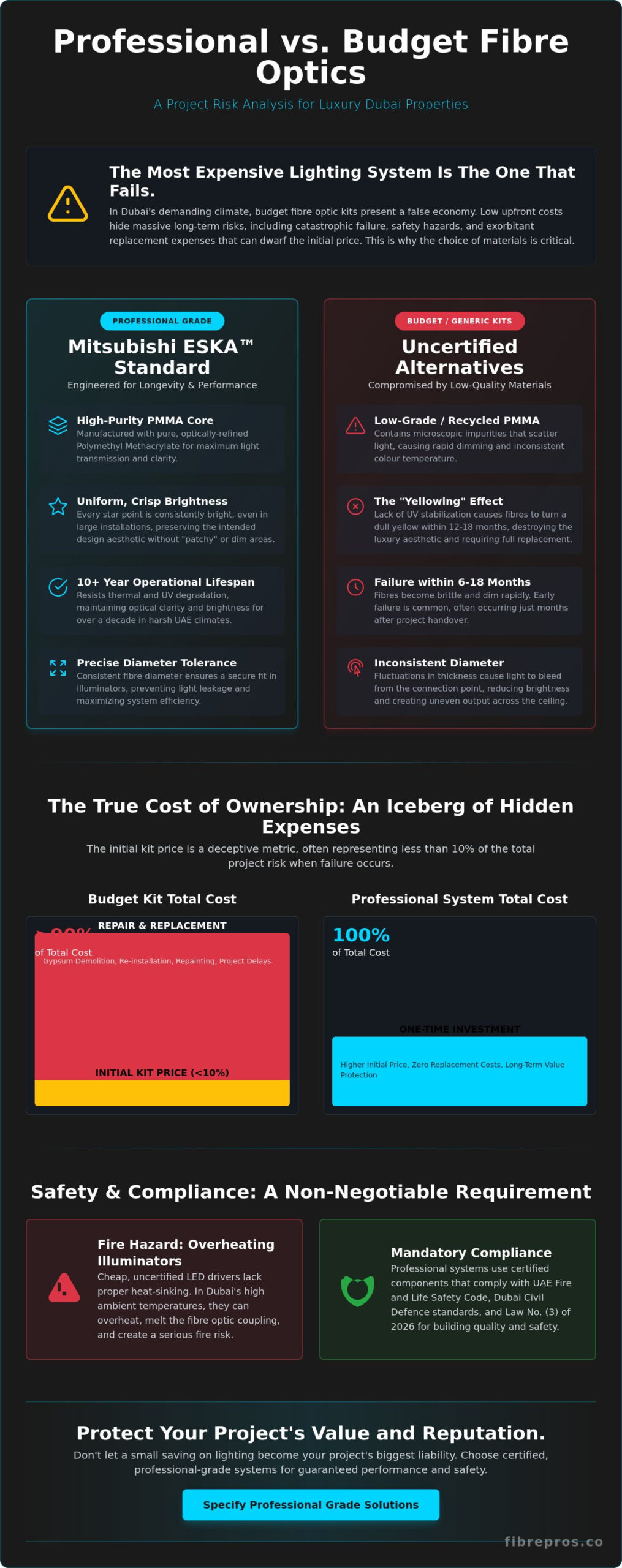
The belief that all plastic optical fibre performs identically is a costly misconception in the UAE construction market. While a budget kit might look functional in a showroom, its performance often degrades rapidly once installed behind a permanent ceiling structure. For high-end residential and commercial projects, avoiding cheap fibre optic kits from China is a matter of operational reliability and safety. If a system fails, the financial burden isn’t the cost of a new kit; it’s the massive expense of stripping back gypsum, repainting, and reinstalling the entire lighting array. The kit price usually represents less than 10% of the total project risk.
To understand the risk, it’s helpful to look at what is optical fiber and how material purity dictates light transmission. In generic kits, the core material often contains microscopic impurities that scatter light. This results in “patchy” ceilings where the fibre tips furthest from the light source appear dim or discoloured compared to those near the illuminator. Professional grade systems ensure uniform brightness across every single endpoint, even in large-scale installations exceeding five metres.
Thermal Instability and Fire Hazards
In regions like Dubai and Riyadh, ambient temperatures in ceiling voids can reach extreme levels during summer months. Cheap LED illuminators often lack sophisticated heat-sinking or high-quality cooling fans. When these uncertified drivers overheat, they don’t just stop working; they can cause the plastic fibre ends to melt at the coupling point. This creates a significant fire hazard. All lighting installations must adhere to UAE Fire and Life Safety Code requirements, which mandate certified hardware to prevent such failures. Professional systems use robust LED drivers designed for continuous operation in high-heat environments, ensuring compliance with Dubai Civil Defence standards.
Aesthetic Degradation: The “Yellowing” Effect
Luxury interiors rely on crisp, uniform light. Generic polymers used in budget kits often lack UV-stabilisation and chemical purity. Over 12 to 18 months, these fibres undergo a chemical breakdown, turning from clear to a dull yellow. This attenuation means your star ceiling kit will lose its lustre, requiring a full replacement. High-performance components like Mitsubishi ESKA are engineered to resist this degradation. They maintain optical clarity for decades, protecting the property’s value and the designer’s reputation. Avoiding cheap fibre optic kits from China ensures that the “wow factor” of a luxury installation doesn’t fade into a maintenance nightmare.
Technical Breakdown: Mitsubishi ESKA vs. Generic PMMA
The technical reality of decorative lighting rests on the quality of Polymethyl Methacrylate (PMMA), the core material used in Plastic Optical Fiber (POF). In the luxury market of Dubai, the distinction between high-purity resin and recycled plastics defines the lifespan of an installation. Avoiding cheap fibre optic kits from China is a strategic decision based on material science. Budget kits frequently utilise lower-grade PMMA that hasn’t been refined for optical clarity, leading to significant light loss before the signal even reaches the endpoint.
Optical purity determines how effectively light travels through the fibre core. Impurities in generic fibres act as microscopic obstructions, scattering light in unintended directions. This scattering reduces the total luminosity and shifts the colour temperature, making a star ceiling look uneven or “muddy.” Professional grade fibre ensures that the light entering the cable is the same light that exits at the tip, maintaining the designer’s intended aesthetic across every square metre.
Manufacturing tolerances are another critical factor. High-end fibre maintains a consistent diameter throughout the entire spool. Generic alternatives often fluctuate in thickness by several microns. While this might seem negligible, these variations prevent a secure fit into the illuminator’s common end, causing light leakage and reducing the overall efficiency of the system. Inconsistent diameters also make it impossible to achieve uniform brightness across a large lighting array.
The Mitsubishi ESKA Advantage
Mitsubishi ESKA Plastic Optical Fibre is the global benchmark for a reason. It features a high-performance cladding that is chemically bonded to the core, ensuring total internal reflection. This bond is vital in the GCC, where high humidity can cause delamination in inferior fibres. ESKA also provides a superior bend radius. It’s flexible enough to navigate tight architectural coves without snapping or developing micro-fractures that bleed light into the ceiling void. This mechanical durability is essential for complex architectural integrations where the fibre is subjected to physical stress during installation.
Generic “No-Name” Fibre Failures
Ultra-low-cost kits often rely on recycled PMMA, which is significantly more susceptible to thermal stress. In the extreme heat of a Dubai ceiling void, these uncertified fibres become brittle and lose their structural integrity. They often snap during routine maintenance or even due to minor building vibrations. Cheap side-glow fibre is particularly problematic; it often loses its glow effect after just a few metres because the internal structure cannot sustain a consistent light leakage rate. This leads to a faded, unprofessional appearance that detracts from the luxury environment. For projects requiring long-term reliability, consulting with a specialist like Fibrepros ensures you receive components engineered for performance.
LED Illuminator Safety: Why Cheap Drivers Fail in the GCC
While the fibre strands provide the visual effect, the LED illuminator serves as the engine of the entire system. If the engine fails, the installation goes dark. By avoiding cheap fibre optic kits from China, project managers protect the most vulnerable electronic component in the installation. Budget illuminators often use low-grade capacitors and unshielded circuits that struggle with the specific power demands of the Middle Eastern grid. These components are prone to failure during minor voltage fluctuations, leading to costly service calls and system downtime.
Acoustic performance is another critical differentiator. Luxury projects demand silence. Budget kits typically rely on inexpensive, high-decibel cooling fans that develop a noticeable rattle within months. Poor Pulse Width Modulation (PWM) dimming in these units also creates a visible flicker. This high-frequency strobing is more than an aesthetic flaw; it can cause eye strain and headaches in residential environments. Professional systems provide smooth, flicker-free dimming and operate with near-silent thermal management, preserving the tranquil atmosphere of a high-end villa or spa.
Integration with modern infrastructure is a standard requirement for Dubai luxury projects. Most high-end residences utilise DALI or KNX home automation systems to centralise lighting control. Budget kits rarely support these protocols, forcing installers to use “workaround” solutions that lack reliability. Professional hardware is designed for seamless smart home integration, allowing for precise control over brightness and colour temperature via a central interface.
Thermal Management in High-End Illuminators
Heat is the primary enemy of LED longevity. In the GCC, where ceiling voids can trap significant ambient heat, passive cooling is rarely sufficient for high-output systems. Choosing professional LED illuminators ensures the system uses advanced heat-sinking technology to keep the light source at an optimal operating temperature. When budget chips overheat, they undergo a permanent colour shift, often turning a crisp white light into a sickly blue or green hue. This degradation is irreversible and signals the imminent failure of the LED chip.
Safety Certifications and Peace of Mind
Safety is not negotiable in luxury construction. Professional grade illuminators carry valid CE, RoHS, and UL listings, confirming they meet international standards for electrical safety and environmental impact. Budget drivers often lack proper electromagnetic interference (EMI) shielding. This can cause significant disruption to local Wi-Fi networks and high-end audio systems. Because of the liability involved, many professional installers refuse to fit client-supplied kits purchased from online marketplaces. They understand that without verified safety certifications, the risk of a fire hazard or electrical fault is simply too high for a professional-grade project.
The Long-Term Cost of “Cheap” Lighting in Dubai
The financial allure of budget hardware is a short-term illusion. In the Dubai luxury market, the purchase price of a lighting kit represents a small fraction of the total investment. Avoiding cheap fibre optic kits from China is primarily a strategy for risk mitigation. If a system fails, you aren’t just replacing a light box; you’re funding a major construction project. Removing failed fibre strands from a finished gypsum ceiling requires structural demolition, specialist labour, and full repainting. These “rip-out” costs can easily reach ten times the value of the original kit.
A malfunctioning lighting system significantly detracts from a property’s valuation. In a high-end villa, a patchy or discoloured star ceiling signals poor maintenance and low-quality construction. When avoiding cheap fibre optic kits from China, you are essentially protecting the property’s long-term marketability. For commercial operators, the stakes are even higher. Closing a spa or a boutique pool area for technical repairs results in immediate revenue loss and damages the brand’s reputation for excellence.
Pool and Underwater Hazards
Specialised environments require even higher material standards. Underwater lighting fixtures must utilise marine-grade stainless steel and superior fibre to withstand the corrosive effects of saline pool water. Cheap plastic fittings often crack under the thermal expansion and chemical exposure typical of UAE pools. Fibre optics remain the safest choice for wet areas because they carry zero voltage, but this safety is only guaranteed if the components are built to survive the environment without leaking or degrading.
Case Study: The “Cheap Kit” Horror Story
We recently consulted on a Palm Jumeirah villa where a 500-strand star ceiling had failed after only 14 months of use. The budget illuminator, lacking a proper thermal cut-off, had overheated and scorched the surrounding insulation. The owner faced a difficult choice: leave a dead ceiling in their primary living space or undergo a three-week renovation. The hidden damage from uncertified drivers often goes unnoticed until the system stops working entirely.
By retrofitting the project with Mitsubishi ESKA fibre and professional hardware, we restored the aesthetic and provided a system engineered to meet the 10-year quality standards mandated by Dubai’s Law No. (3) of 2026. Don’t let your luxury project become a cautionary tale of false economy. Consult with Fibrepros for a professional-grade lighting assessment to ensure your infrastructure is built to last.
Professional Solutions: Why Mitsubishi ESKA is the Regional Standard
For over three decades, Fibrepros has established itself as the technical authority for decorative lighting in the GCC. Since 1995, we’ve focused exclusively on high-performance components that survive the rigorous demands of the UAE environment. Avoiding cheap fibre optic kits from China is only the first step; the second is partnering with a specialist who understands the physics of light transmission and the nuances of regional building codes. Our commitment to quality starts with the raw materials we supply to developers and contractors in Dubai, Abu Dhabi, and Riyadh.
Every star ceiling kit we provide features genuine Mitsubishi ESKA Plastic Optical Fibre. This isn’t just a brand preference; it’s a technical necessity for maintaining luminosity and clarity over a building’s lifecycle. To complement this, we offer crystal end fittings and marine-grade stainless steel fixtures. These components ensure that the final installation matches the architectural vision of a luxury project without the risk of corrosion or aesthetic decay. By avoiding cheap fibre optic kits from China, you ensure your project meets the high-standard qualitative descriptors expected in the Dubai luxury real estate sector.
The Fibrepros Quality Guarantee
We maintain a strict focus on decorative lighting excellence. Unlike generalists, we don’t supply communications fibre; our expertise is 100% dedicated to architectural and sensory lighting. Every LED illuminator in our inventory undergoes rigorous testing to ensure it can handle the high ambient temperatures of the Middle East. We provide custom-cut fibre lengths and bespoke kit configurations, allowing designers to execute unique projects without the limitations of pre-packaged budget kits. This precision is why our systems comply with the energy performance benchmarks of the Al Sa’fat rating system and the safety mandates of Law No. (3) of 2026.
Next Steps for Your Project
Securing a lighting system that lasts 10 or more years requires early technical specification. We work directly with architects, project managers, and contractors to provide detailed submittals and design advice for luxury residential and hospitality developments. Whether you’re designing a private villa in Abu Dhabi or a commercial resort in Riyadh, our team provides the specialized mastery required for a successful handover. Contact the Fibrepros specialists for a professional quote today to ensure your next project avoids the pitfalls of uncertified hardware and achieves lasting operational success.
Securing the Future of Your Dubai Lighting Infrastructure
Building a luxury space in the UAE requires a commitment to materials that can withstand unique local climate challenges. We’ve detailed how technical precision in fibre purity and LED driver safety directly impacts a project’s long-term value and operational safety. By avoiding cheap fibre optic kits from China, you protect your investment from the structural costs of early failure and ensure compliance with Dubai’s evolving building safety laws. Professional-grade hardware maintains its luminosity and safety profile long after budget alternatives have dimmed or degraded.
Fibrepros has operated in the Middle East since 1995, establishing a reputation for specialized mastery in high-heat and saline-resistant lighting hardware. As official suppliers of Mitsubishi ESKA Plastic Optical Fibre, we provide the technical reliability needed for the most demanding architectural environments. Our focus on certified, high-standard components ensures that your lighting system remains a highlight of your property’s design for years to come. You can achieve a flawless, enduring finish by prioritizing quality at the specification stage.
Upgrade to Professional Fibre Optic Lighting Solutions today to guarantee the excellence your project deserves.
Frequently Asked Questions
Why are some fibre optic kits so much cheaper on sites like AliExpress?
Low prices on global marketplaces reflect the use of low-grade, often recycled PMMA and uncertified electronic drivers. These kits bypass international safety testing and utilize thin, non-UV-stabilized cladding that cannot withstand high temperatures. While the upfront cost is lower, the lack of optical purity results in significant light loss and a much shorter operational lifespan than professional alternatives.
Can I use a cheap Chinese kit for a small sensory room project?
Even for smaller installations, avoiding cheap fibre optic kits from China is essential if the project is permanent. Sensory environments require high brightness and consistent colour for therapeutic effectiveness. To understand how these environments impact human behavior through data, you can learn more about Ergoneers and their specialized research platforms. Budget kits often fail to provide uniform luminosity and can become a safety liability if the illuminator overheats in a confined or poorly ventilated space.
How can I tell if a fibre optic kit uses Mitsubishi ESKA fibre?
Genuine Mitsubishi ESKA fibre typically features clear branding on the spool or the cable jacket itself. Professional suppliers provide technical data sheets and material certifications to verify the product’s origin and performance specifications. If the fibre feels exceptionally stiff or lacks a distinct, protective cladding layer, it’s likely a generic, low-performance alternative.
Do cheap fibre optic kits pose a fire risk in hot climates like the UAE?
Yes, the risk is significant in the GCC region. Budget LED drivers often lack the sophisticated heat-sinking required for high-ambient-temperature environments like Dubai ceiling voids. Without proper thermal cut-offs, these uncertified units can overheat. This can melt the fibre coupling or damage surrounding insulation and building materials.
What happens if a single fibre strand breaks in my star ceiling?
A broken strand becomes a permanent dead point in your lighting array. Because star ceilings are usually sealed behind gypsum, replacing a single strand is often impossible without structural demolition. Professional fibres like ESKA have a superior bend radius. They’re much less likely to snap during installation or due to building vibrations.
Is it possible to upgrade my existing cheap illuminator to a professional one?
You can often swap a budget illuminator for a professional LED driver if the fibre harness is compatible with the new common end. This upgrade can improve dimming performance and eliminate fan noise. However, if the existing fibre has already yellowed or become brittle, a new light source won’t restore the original optical clarity.
How long should a professional fibre optic lighting system last?
A professional system using high-purity components should operate reliably for 10 to 20 years. The LED light source itself is typically rated for 50,000 hours of continuous use. Because professional-grade polymers don’t undergo rapid chemical breakdown, the fibre strands maintain their light transmission properties for the life of the interior.
Why does the light at the end of my cheap fibre kit look yellow or dim?
This effect is caused by high attenuation and the chemical breakdown of the polymer core. Impurities in cheap plastic scatter light, which effectively filters out specific wavelengths and leaves a dull yellow tint. High-purity fibres ensure the light exiting the strand remains the same colour and intensity as the light entering it.