
A single specification error in a Riyadh giga-project can lead to catastrophic material failure when ambient temperatures regularly exceed 45°C. For architects and lighting designers, the challenge isn’t just creating a visual masterpiece, but ensuring that the materials can survive the intense thermal demands of the Saudi climate. You already know that generic plastic fibres often yellow or become brittle under these conditions, compromising both aesthetics and safety. Successfully specifying Mitsubishi ESKA fibre for projects Riyadh requires a deep understanding of PMMA resin performance and local regulatory compliance.
This 2026 guide helps you master the technical standards and specification requirements necessary to integrate Mitsubishi ESKA Plastic Optical Fibre into premier architectural developments. You’ll gain the clarity needed to produce bulletproof tender documents that satisfy Saudi Building Code (SBC) 401 and 801 requirements. We’ll outline the critical differences between decorative PMMA and communications fibre, while providing a roadmap for securing a reliable supply chain of authentic Japanese components. By the end of this article, you’ll have the confidence to deliver high-performance lighting solutions that remain durable, efficient, and compliant in one of the world’s most demanding environments.
Key Takeaways
- Master the technical standards for specifying Mitsubishi ESKA fibre for projects Riyadh to ensure long-term performance in high-stakes architectural developments.
- Discover how premium PMMA resin technology provides the thermal stability required to withstand Riyadh’s extreme ambient heat without material degradation.
- Identify the specific performance differences between CK and SK series fibres to optimize lighting quality in luxury hospitality and high-end residential interiors.
- Streamline your tender process with a professional checklist for defining material purity, attenuation levels, and Saudi Building Code compliance.
- Establish a resilient supply chain with local GCC expertise to ensure rapid delivery and expert technical support from design through to final site commissioning.
The Strategic Role of Mitsubishi ESKA™ in Riyadh’s Architectural Giga-Projects
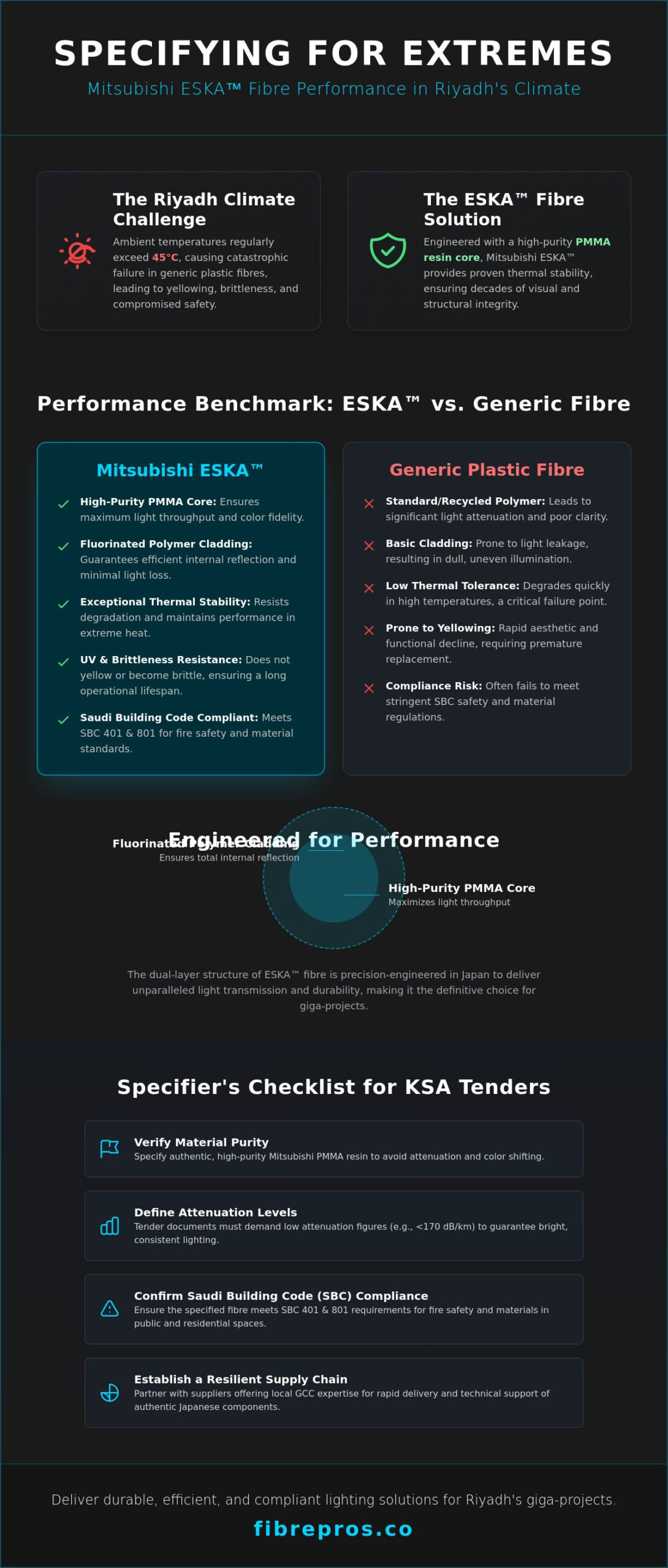
Mitsubishi ESKA™ is a high-performance Plastic Optical Fibre (POF) engineered from a high-purity Polymethyl-Methacrylate (PMMA) core. While the broader field of Optical fiber technology encompasses everything from global data transmission to medical imaging, Mitsubishi ESKA™ stands as the architectural benchmark for decorative lighting. It’s essential to distinguish this from communications fibre. We don’t sell data-grade glass fibre; our focus is purely on the physical delivery of light for aesthetic and functional architectural infrastructure. In Riyadh, where Vision 2030 is driving a massive surge in giga-projects, the margin for error in material selection is zero. Specifying Mitsubishi ESKA fibre for projects Riyadh ensures that lighting installations maintain their structural and visual integrity over decades of operation.
The reputation of ESKA across the Middle East is built on technical precision. Leading developers in Saudi Arabia recognize that generic materials don’t survive the lifecycle of a premier asset. Mitsubishi ESKA™ is defined by several technical advantages:
- A high-purity PMMA core for maximum light throughput and minimal attenuation.
- A specialized fluorinated polymer cladding that ensures efficient internal reflection.
- Exceptional flexibility, allowing for tight bend radii in complex architectural fixtures.
- Superior resistance to environmental heat and UV degradation compared to standard polymers.
Meeting Riyadh’s Luxury Hospitality Standards
The 5-star hotels within the King Abdullah Financial District (KAFD) and surrounding luxury developments require a level of finish that generic materials simply cannot provide. Architects frequently specify ESKA for star ceiling kits because of its superior light transmission and edge-to-edge clarity. In luxury suites, the guest experience depends on the subtle, consistent glow of light that only high-purity PMMA can deliver. These installations must also align with the Saudi Building Code (SBC), particularly regarding fire safety and smoke toxicity for interior decorative elements. Using a certified, Tier-1 material ensures that the project passes inspection without delays.
Durability in the Saudi Landscape
Generic plastic fibres often fail in the harsh Middle Eastern climate. They yellow under heat or become brittle in low-humidity interior environments, leading to a dull, uneven light output. Mitsubishi ESKA Plastic Optical Fibre resists this aging process, maintaining its flexibility and light-carrying capacity even in high-traffic commercial spaces. While the initial capital expenditure for premium Japanese POF may be higher, the long-term cost-efficiency is undeniable. Specifying Mitsubishi ESKA fibre for projects Riyadh reduces the need for expensive ceiling access and premature replacement. This is a critical factor for the operational success of Riyadh’s premier developments where maintenance downtime must be kept to an absolute minimum.
Performance Specs: Why PMMA Fiber Excels in the Saudi Climate
The extreme climate of the Saudi capital presents a significant hurdle for standard lighting materials. When Mitsubishi ESKA Plastic Optical Fibre is deployed, it relies on a proprietary Polymethyl-Methacrylate (PMMA) resin that maintains structural integrity where others fail. Specifying Mitsubishi ESKA fibre for projects Riyadh ensures that the material remains thermally stable even when internal ceiling temperatures climb. The history of advancements in fiber optics shows that the shift toward high-purity polymers was essential for creating durable, light-carrying infrastructure in harsh environments.
Mechanical flexibility is another critical factor. Riyadh’s modern architectural landscape often features complex, fluid geometries that require fibres to navigate tight bends without fracturing. ESKA’s multi-core and single-core options provide the necessary resilience for these intricate designs. This mechanical strength is paired with high UV resistance, which is vital for transitional spaces where indoor lighting might be exposed to incidental sunlight through expansive glass facades. These properties make it a reliable choice for the high-stakes infrastructure currently under construction across the Kingdom.
Thermal Stability and Heat Resistance
The CK and SK series of Mitsubishi ESKA offer specific thermal thresholds that architects must consider. While both series are robust, the SK series is often preferred for applications requiring higher performance under stress. A common failure point in Riyadh installations is fibre yellowing, which occurs when low-grade plastics react to heat. ESKA’s high-purity resin resists this discoloration. However, professional specification must also account for the heat generated by the LED illuminator. Proper heat-sinking at the source prevents thermal transfer to the fibre harness, preserving the system’s lifespan. If you’re unsure about thermal load calculations, our team at Fibrepros can provide the technical data needed for your submittals.
Light Transmission Efficiency
Specifying Mitsubishi ESKA fibre for projects Riyadh allows for consistent brightness across long distances, which is essential for large-scale villa projects and commercial lobbies. Attenuation rates in ESKA are remarkably low, ensuring that the light at the end of a 20-meter run is indistinguishable from the source. This spectral consistency is vital for luxury retail environments where color rendering must remain true to the brand’s intent. By using a high-purity core material, ESKA minimizes light scattering. This results in a crisp, high-fidelity output that defines world-class lighting design and meets the rigorous expectations of Riyadh’s elite developers.
Selecting the Right ESKA™ Grade for Riyadh Hospitality and Residential Interiors
Choosing the correct material grade is the most decisive step when specifying Mitsubishi ESKA fibre for projects Riyadh. The portfolio is primarily divided into the CK and SK series, each serving distinct architectural roles. The CK series is the global standard for high-end star ceiling kits. It offers an optimal balance of light transmission and flexibility for residential applications. In contrast, the SK series provides enhanced optical performance and is specified for more complex lighting fixtures where precision is paramount. Research into the properties of plastic optical fibers in architectural panels demonstrates that selecting the right grade impacts both the structural integration and the visual output of the system.
Architects must also decide between end-glow and side-glow variants. End-glow fibre focuses light at the tip, making it ideal for point-source effects like stars or crystal end fittings. Side-glow fibre emits light along its entire length, creating a neon-like linear effect for facades or pool perimeters. For grand ballrooms in Riyadh, calculating the fibre diameter is essential. Taller ceilings require thicker fibres, typically 1.5mm or 2.0mm, to maintain visible brightness and star definition from the floor level. Using a diameter that’s too small for high-void spaces results in a weak, underwhelming effect that fails to meet luxury standards.
Star Ceiling Specifications for Luxury Villas
In Riyadh’s luxury residential market, a “one size fits all” approach to fibre diameter fails to create a realistic night sky. We recommend a mixed-diameter specification, combining 0.75mm, 1.0mm, and 1.5mm fibres. This variation creates a sense of depth, with some stars appearing distant and others closer. When planning a star ceiling installation for a home cinema, ensure the harness is compatible with high-lumen, DMX-controlled LED illuminators. This allows the user to synchronize the ceiling’s twinkle and color with the room’s automated lighting scenes, providing a fully immersive environment.
Side-Glow Applications for Commercial Facades
Linear architectural highlighting is a hallmark of Riyadh’s modern retail districts. Side-glow fibre provides a seamless alternative to traditional LEDs, offering a uniform glow without visible hot spots. When specifying Mitsubishi ESKA fibre for projects Riyadh that involve exterior or transitional spaces, always include a requirement for protective jacketing. A clear PVC or PE jacket protects the PMMA core from dust and environmental exposure. ESKA technology ensures that even over runs exceeding 10 meters, the light intensity remains consistent from the illuminator to the end of the line, maintaining the visual rhythm of the facade.
The Specifier’s Checklist: Integrating Mitsubishi POF into KSA Tender Documents
Specifying Mitsubishi ESKA fibre for projects Riyadh requires a meticulous approach to tender documentation. A vague lighting schedule often leads to “or equal” substitutions that fail under the intense Riyadh sun. To prevent this, your tender documents must be explicit about material origin and performance thresholds. Contractors often prioritize cost over longevity, so your specification acts as the primary defense against material degradation and system failure.
Follow these five essential steps to ensure your project receives authentic, high-performance materials:
- Step 1: Explicitly define the core material as 100% Mitsubishi ESKA PMMA resin. Avoid generic terms like “plastic fibre” or “acrylic lighting.”
- Step 2: Specify a maximum thermal threshold of 70 to 80°C. This ensures the fibre can survive the heat accumulation common in Saudi ceiling voids.
- Step 3: Detail the specific underwater lighting fixtures or end fittings required for the application.
- Step 4: Mandate a certificate of origin and verification of authorized supply. This is the only way to prevent counterfeit or low-grade fibre from entering the site.
- Step 5: Include clear requirements for maintenance access. The remote LED illuminator must be placed in a ventilated, accessible location for easy servicing without disturbing the fibre harness.
Writing the Technical Specification
Your MEP lighting schedules should use precise language. Include phrases such as “Mitsubishi ESKA CK-series PMMA fiber optic harness with factory-terminated ends.” It’s also vital to standardize bend radius requirements. For a standard 0.75mm fibre, the minimum bend radius is typically ten times the diameter. Violating this leads to light leakage and permanent fibre damage. For high-end hospitality interiors, specify crystal end fittings to transform simple light points into luxury design features.
Quality Assurance and Compliance
Total compliance with the Saudi Building Code (SBC) is a fundamental requirement for any giga-project. Ensure your specification requires the fibre to meet local fire and safety standards, specifically SBC 801 for fire protection. Request official Material Data Sheets (MDS) from Mitsubishi Chemical during the submittal phase. You can spot low-quality imitations by their lack of clarity or a “milky” appearance in the core. Authentic ESKA is perfectly transparent. If a contractor submits an undocumented alternative, it should be rejected immediately to protect the project’s long-term viability.
For expert guidance on drafting these technical clauses for your next Saudi development, consult with our specification specialists today.
Sourcing and Technical Support for Mitsubishi ESKA™ in Riyadh
Securing a reliable supply chain is the final, critical hurdle after specifying Mitsubishi ESKA fibre for projects Riyadh. A bulletproof tender document only provides value if the physical material arrives on-site in pristine condition and according to the project timeline. For Riyadh’s high-stakes giga-projects, sourcing from a local GCC partner is a strategic necessity rather than a preference. It eliminates the risks associated with long-distance international shipping, such as customs delays or environmental damage during transit. We provide the technical accountability that international resellers cannot offer, ensuring that every meter of fibre meets the exact standards defined in your MEP schedules.
Fibrepros acts as more than just a supplier. We’re a technical partner focused on the successful implementation of Mitsubishi ESKA Plastic Optical Fibre across the Kingdom. Our support spans the entire project lifecycle, from initial design consultation to final site commissioning. By maintaining a strong presence in both Dubai and Riyadh, we bridge the gap between Japanese manufacturing precision and the practical realities of Saudi construction sites. This regional expertise ensures that your project benefits from a streamlined workflow and immediate technical intervention if challenges arise during the installation phase.
Logistics and Delivery to Riyadh
Managing lead times for massive developments requires meticulous planning. We specialize in coordinating large-scale orders to ensure that materials arrive exactly when the installation teams are ready. Whether your project is in the heart of Riyadh or the industrial hubs of Dammam, we provide reliable on-site support. Our custom cutting and bundling services are designed to reduce site waste and labor costs. By delivering pre-cut harnesses tailored to your specific lighting layout, we help contractors maintain high speeds of installation without compromising on the quality of the finish.
Consult with the Experts
Our team assists Riyadh architects with complex lighting calculations and detailed layouts to ensure optimal performance. We don’t just deliver boxes; we provide the data needed to justify material choices to developers and stakeholders. Our portfolio includes successful ESKA installations across the GCC, proving our ability to handle the region’s most ambitious architectural designs. If you’re currently in the design phase, we can provide sample packs and technical submittals to streamline your approval process. Contact Fibrepros for Mitsubishi ESKA specifications in Riyadh to ensure your project receives the specialist support it deserves.
Securing Long-Term Performance for Your Riyadh Development
Mastering the technical requirements of high-purity PMMA ensures that your architectural vision survives the rigors of the Saudi climate. By focusing on material purity, thermal thresholds, and precise tender language, you eliminate the risk of premature system failure. We’ve explored how the right grade of fibre, coupled with robust local support, transforms a standard lighting installation into a durable, high-performance asset. Successful execution depends on bridging the gap between design intent and on-site reality.
Specifying Mitsubishi ESKA fibre for projects Riyadh is a commitment to quality that pays dividends in reduced maintenance and superior guest experiences. As an authorized supplier with over 30 years of GCC lighting expertise, we provide the specialized architectural support necessary to navigate Riyadh’s complex regulatory and environmental landscape. Our team ensures that every specification is technically sound and every delivery is managed with precision. We take pride in building the vital infrastructure that defines the Kingdom’s future.
Take the next step in securing your project’s infrastructure. Request a Technical Specification for Your Riyadh Project and ensure your design is backed by genuine Mitsubishi ESKA™ technology. Your vision deserves the reliability of a seasoned specialist.
Frequently Asked Questions
Is Mitsubishi ESKA fibre suitable for the extreme heat in Riyadh?
Yes, Mitsubishi ESKA fibre is engineered specifically to withstand the extreme ambient temperatures common in the Saudi capital. While generic plastic fibres often yellow or become brittle when exposed to heat, the high-purity PMMA resin in ESKA maintains its structural integrity and light transmission levels. Specifying Mitsubishi ESKA fibre for projects Riyadh ensures that installations in ceiling voids or enclosed architectural features remain stable even when temperatures reach their peak.
What is the difference between ESKA CK and SK series for architectural projects?
The CK series serves as the primary standard for decorative applications like star ceilings and standard end-glow effects. It offers excellent flexibility for residential use. The SK series is a higher-performance grade designed for complex architectural fixtures that require superior optical clarity and lower attenuation. When specifying Mitsubishi ESKA fibre for projects Riyadh, designers choose the SK series for larger commercial installations where light must travel longer distances without losing intensity.
Can I use Mitsubishi ESKA fibre for communications in my Riyadh office?
No, the Mitsubishi ESKA products we supply are specifically engineered for architectural lighting and decorative applications. While Mitsubishi Chemical does produce data-grade fibres, our focus is strictly on lighting infrastructure like side-glow and end-glow systems. If your project requires telecommunications infrastructure, you should consult a specialized data network provider. We specialize in the physical delivery of light for aesthetic and functional architectural design.
How do I specify the correct fibre diameter for a star ceiling in a Riyadh villa?
Selecting the correct diameter depends on the ceiling height and the desired visual depth. For a standard Riyadh villa, we recommend a mix of 0.75mm, 1.0mm, and 1.5mm fibres to create a realistic “near and far” star effect. Grand ballrooms with high voids require thicker 2.0mm fibres to ensure the light points remain visible and sharp from the floor level. Using mixed diameters prevents the ceiling from appearing flat or artificial.
Where can I source genuine Mitsubishi ESKA fibre in Saudi Arabia?
Genuine Mitsubishi ESKA fibre should be sourced through authorized GCC partners who understand the logistical requirements of the Saudi market. We provide direct supply and technical support to construction sites in Riyadh, Jeddah, and Dammam. Avoid purchasing from unverified third-party resellers, as they often supply lower-grade generic imitations that lack the thermal stability and longevity required for high-stakes Vision 2030 giga-projects.
Is Mitsubishi ESKA fibre fire-rated for use in Saudi commercial buildings?
Yes, Mitsubishi ESKA fibre meets the necessary fire and safety standards for commercial buildings in the Kingdom. It’s compliant with Saudi Building Code (SBC) 801, which governs fire protection for interior materials. The fluorinated polymer cladding and PMMA core are designed to be low-smoke and flame-retardant. We provide official Material Data Sheets (MDS) during the submittal process to ensure your project passes all local civil defense inspections.
What LED illuminators should be used with ESKA fibre in KSA projects?
You should pair ESKA fibre with high-lumen LED illuminators that feature dedicated heat-sinking systems. In the Riyadh climate, it’s critical that the heat generated by the LED source is dissipated away from the fibre harness to prevent thermal damage. We recommend DMX-controlled illuminators for commercial projects, allowing for seamless integration into building automation systems. This ensures consistent color rendering and brightness across all architectural lighting elements.
How long does Mitsubishi ESKA fibre last in a typical Saudi residential installation?
In a typical residential installation, Mitsubishi ESKA fibre is designed to last for over 20 years without significant degradation. Because the material is resistant to the aging effects of heat and UV exposure, it won’t yellow or lose its flexibility like cheaper alternatives. This longevity makes it a cost-effective choice for Riyadh villas, as it eliminates the need for expensive ceiling repairs or fibre replacements throughout the building’s lifecycle.