
In the high-salinity environment of the Abu Dhabi coastline, an IP67 rating is often nothing more than a delayed repair bill. You likely recognize that the combination of extreme humidity and intense heat creates a brutal testing ground for any external installation. Selecting the correct IP68 rated lighting fixtures Abu Dhabi projects demand is a structural necessity rather than a luxury upgrade. It’s the only way to prevent the rapid corrosion and water ingress that frequently compromise expensive pool lighting and coastal facade systems.
This guide provides the technical roadmap to mastering high-performance, water-tight lighting while ensuring full compliance with the latest UAE Cabinet Resolution No. 25 of 2022 and the Abu Dhabi Dark Sky Policy. You’ll learn how to integrate advanced LED illuminators and stainless steel fixtures that meet the mandatory midnight shut-off and 3000K color temperature limits for public spaces. We’ll preview the essential registration timelines for new products and the specialized components, such as underwater lighting fixtures and fiber optic systems, required to achieve aesthetic excellence without the burden of constant maintenance.
Key Takeaways
- Master the technical distinctions that make IP68 rated lighting fixtures Abu Dhabi essential for continuous submersion and protection against fine desert dust.
- Identify the necessity of 316L Marine Grade Stainless Steel and electropolishing to prevent tea staining and pitting corrosion in high-salinity environments.
- Differentiate between IP67 and IP68 ratings to ensure your fixtures are engineered for 24/7 water feature operation rather than temporary immersion.
- Evaluate the safety advantages of fiber optic lights and LED illuminators which eliminate electrical risks by keeping power sources away from the water.
- Learn professional installation standards, including pre-installation pressure testing and the use of resin-filled connectors, to guarantee long-term seal integrity.
Why IP68 Rating is Non-Negotiable for Abu Dhabi Lighting Projects
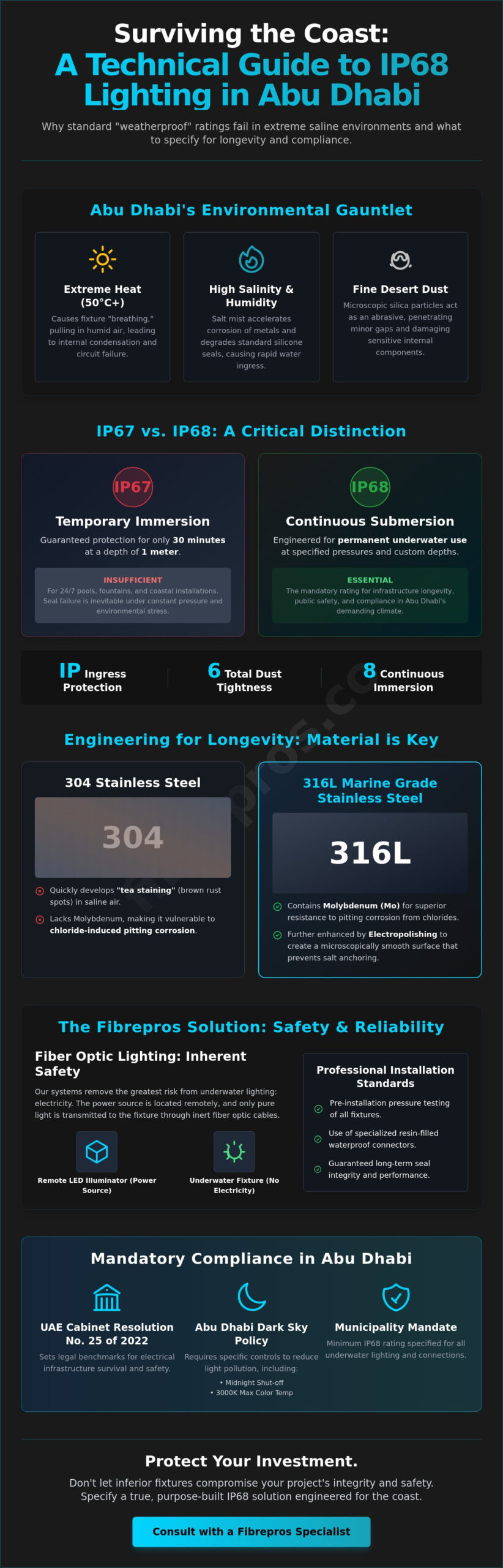
In Abu Dhabi, the environment is an active adversary to electrical infrastructure. While IP65 is often marketed as “weatherproof,” it fails to account for the specific atmospheric pressures of the UAE. IP68 rated lighting fixtures Abu Dhabi installations utilize are designed for total dust exclusion and continuous immersion. This distinction is critical because of the “breathing” effect. When temperatures swing from 50°C midday to cooler night levels, air inside a fixture expands and contracts. Lower-rated seals eventually pull in humid, salt-laden air, leading to internal condensation and circuit failure. Compliance with UAE Cabinet Resolution No. 25 of 2022 isn’t just a legal requirement; it’s a benchmark for survival in these conditions. The Abu Dhabi Municipality now specifies a minimum rating of IP68 for all underwater lighting fixtures, including all connections, to ensure public safety and infrastructure longevity.
The Ingress Protection (IP) Scale Explained
The IP Code provides a standardized framework for evaluating a fixture’s resilience against solids and liquids. The first digit, 6, represents a “dust-tight” seal. In regions bordering the Empty Quarter, fine silica particles can penetrate even microscopic gaps, acting as an abrasive on internal components. The second digit, 8, signifies protection against long-term submersion under pressure. Unlike IP67, which only guarantees protection at 1 meter for 30 minutes, IP68 fixtures are engineered for permanent underwater use at custom depths. This is essential for the high-pressure environments found in Abu Dhabi’s luxury hotel pools and public fountains. A seal that resists splashing water will eventually fail when subjected to the constant hydrostatic pressure of a deep water feature.
Environmental Stressors in Abu Dhabi Coastal Zones
Coastal developments on Saadiyat Island or Yas Island face a lethal combination of high humidity and saline mist. This mist is a silent killer for lighting electronics. It accelerates the corrosion of standard metals and degrades silicone gaskets that aren’t specifically rated for chemical resistance. When ambient temperatures exceed 50°C, the physical stress on fixture housing increases significantly. Traditional LED drivers often overheat and fail when trapped in high-humidity submersible housings that lack proper thermal management. Using IP68 rated lighting fixtures Abu Dhabi specialists recommend ensures that every component, from the housing to the internal driver, is rated for these extreme thermal and chemical loads. High-performance stainless steel fixtures and specialized underwater lighting fixtures are necessary to maintain aesthetic excellence without the constant need for replacement parts or hazardous electrical faults.
Engineering for Longevity: Materials and Saline Resistance
A fixture’s IP rating is only as reliable as the material housing it. In the UAE, the interaction between high temperatures and saline air creates a corrosive environment that quickly destroys standard metals. Specifying IP68 rated lighting fixtures Abu Dhabi projects require means looking beyond the seal to the chemical composition of the chassis. Without the right metallurgy, even the most expensive watertight seal will fail as the surrounding material pits and degrades. Professional installations must prioritize materials that can withstand both the chemical load of treated pool water and the natural salinity of the Gulf.
Marine Grade 316L Stainless Steel vs. 304
The primary distinction between 304 and 316L stainless steel is the addition of Molybdenum. This element provides critical resistance to chloride-induced pitting, which is rampant in Abu Dhabi’s coastal developments. While 304 stainless steel might suffice in arid inland areas, it quickly develops “tea staining,” a brown surface oxidation, when exposed to the salt mist of the Corniche or Yas Island. 316L stainless steel is the gold standard for Abu Dhabi coastal lighting. To further enhance this protection, professional-grade fixtures undergo electropolishing. This electrochemical process removes surface impurities and smooths the metal at a microscopic level, leaving no place for salt crystals to anchor and initiate corrosion.
Lens selection is equally vital for long-term performance. While polycarbonate is impact-resistant, it often yellows under the intense UV radiation and 50°C temperatures of the Gulf summer. Tempered glass remains the superior choice for IP68 rated lighting fixtures Abu Dhabi engineers specify, as it maintains clarity and structural integrity over decades. These sealed housings must also manage heat effectively. Since water-tight units can’t use vents, the housing itself must act as a high-efficiency heat sink to prevent the LED chips from premature lumen depreciation.
Seal Integrity and Gasket Materials
Seal longevity depends on gasket material. While EPDM is common, silicone gaskets offer superior thermal stability in the extreme heat of the UAE. For critical submersible applications, secondary protection is often provided by potting compounds that encapsulate the LED module entirely. This ensures that even if a cable is damaged, water cannot travel through the wire into the light engine. The Abu Dhabi Quality and Conformity Council oversees the standards that ensure these materials meet local safety and performance requirements. For those seeking long-term reliability, choosing stainless steel fixtures engineered for these specific stressors is the only way to avoid recurring maintenance costs.
IP67 vs. IP68: Choosing the Right Protection for UAE Exteriors
Understanding the technical nuances between IP67 and IP68 is vital for long-term project success in the UAE. While IP67 protects against temporary immersion up to one meter for thirty minutes, it’s structurally inadequate for permanent water features. In contrast, IP68 rated lighting fixtures Abu Dhabi installations utilize are engineered for continuous submersion at specified depths. Choosing IP67 for a pool or fountain essentially schedules a future failure. The operational cost of draining a feature to replace a short-circuited light often exceeds the initial savings of a lower-rated fixture. Professional project managers prioritize the “indefinite submersion” rating to ensure infrastructure reliability.
When to Specify IP68 Over IP67
Precise application mapping ensures both safety and budget efficiency. IP67 might suffice for garden uplights in high-elevation areas with excellent drainage. However, IP68 is mandatory for swimming pools, infinity edges, and fountain nozzles where water contact is constant. It’s also the correct choice for low-lying landscape zones prone to flooding during winter storms. Coastal facades on the Abu Dhabi mainland face wind-driven saline rain that can exert pressure similar to submersion; here, IP68 provides a necessary safety margin against moisture ingress. Using the right protection level prevents the common issue of fixture clouding and internal circuit corrosion.
The “Breathability” Problem in UAE Lighting
Extreme temperature fluctuations in the UAE create a vacuum effect within lighting housings. As a fixture heats up during operation and cools rapidly at night, the internal air pressure changes significantly. IP67 seals often lack the resilience to withstand this repeated “suction,” eventually drawing in humid air or water through the cable entry points. High-end IP68 rated lighting fixtures Abu Dhabi specialists provide often include integrated pressure equalization valves or resin-filled cable blocks to neutralize this threat. These technical safeguards are why underwater lighting fixtures require absolute IP68 ratings. They’re built to maintain electrical integrity over years of 24/7 operation without the risk of internal condensation that plagues inferior products. Investing in these specialized components ensures that aesthetic excellence isn’t compromised by the harsh Middle Eastern climate.
Installation Standards for Submersible Fixtures in Abu Dhabi
The integrity of IP68 rated lighting fixtures Abu Dhabi projects rely on is determined during the final hours of installation. A high-quality fixture remains vulnerable if the surrounding infrastructure allows moisture to bypass the primary seals. Professional contractors must conduct pre-installation pressure testing to verify seal integrity before the feature is filled. This proactive step identifies manufacturing defects or transport damage that could lead to immediate failure. Effective cable management is equally critical; using IP68 junction boxes and resin-filled connectors creates a permanent barrier against water traveling through the wiring itself.
Voltage selection has shifted toward 12V or 24V DC systems for all submersible applications. This move prioritizes user safety and aligns with international standards for wet environments. Low-voltage systems reduce the risk of lethal electrical shock and simplify the grounding requirements for complex water features. Maintenance access must be planned during the design phase. Fixtures should be positioned so that drivers or light sources can be serviced without the logistical nightmare of draining thousands of liters of water. If the installation doesn’t account for these variables, the long-term reliability of the system is compromised from day one.
Step-by-Step IP68 Installation Checklist
- Inspect the conduit seal thoroughly. This prevents water from traveling through the pipework into the electrical system.
- Apply dielectric grease to all connectors. This simple step prevents oxidation in the high-humidity Abu Dhabi climate.
- Use calibrated tools for torque settings. Even gasket compression on faceplate screws is essential to maintain the IP68 rating.
MEP Coordination for Abu Dhabi Luxury Villas
Successful execution requires tight MEP coordination between lighting specialists and pool contractors. Niche dimensions must match the fixtures exactly to prevent structural leaks or aesthetic misalignment. For fiber optic projects, locating LED illuminators in accessible, ventilated plant rooms ensures long-term performance and easy maintenance. Ensuring your IP68 rated lighting fixtures Abu Dhabi installations are correctly grounded and bonded is also essential to meet current ADDC regulations. Don’t compromise on the technical details that protect your investment. For expert guidance on selecting and installing high-performance underwater lighting fixtures, partner with a specialist who understands the UAE’s specific regulatory and environmental demands.
Fibrepros Solutions: Specialist IP68 Fixtures and Components
Fibrepros delivers infrastructure that bridges the gap between aesthetic ambition and operational reality. While previous sections detailed the sealing of traditional electrical units, the most effective way to manage water ingress is to remove electricity from the submersible environment entirely. Our systems utilize fiber optic technology to transport light through a non-conductive medium. By specifying the IP68 rated lighting fixtures Abu Dhabi developers require for high-risk zones, we ensure the light source remains in a dry, ventilated plant room. This approach eliminates the risk of short circuits in swimming pools and fountains. Safety is paramount. It provides a level of protection that traditional LED systems cannot match.
Our material choice remains 316L marine-grade stainless steel for all end fittings and fixtures. This ensures total resistance to the high-salinity water common in Abu Dhabi’s coastal developments. We integrate Mitsubishi ESKA Plastic Optical Fibre into our systems because of its superior light transmission. Unlike lower-quality alternatives, this fiber doesn’t yellow or become brittle when exposed to the intense thermal stressors of the UAE climate. This durability is essential for maintaining the lumen output and color consistency of high-end architectural projects over time.
The Fibrepros Underwater Advantage
Eliminating underwater electrical failures is the core benefit of using fiber optic lights. Since no current travels through the water, the seals on our end fittings serve only to maintain lens clarity. They don’t have to prevent a catastrophic short circuit. This technical distinction significantly lowers the stakes of long-term maintenance. In a recent project for a luxury villa pool on Al Reem Island, we provided a complete IP68-compliant system. We combined side-glow fiber for perimeter definition with crystal end fittings for floor accents. The result was a maintenance-free installation that withstands the high humidity and salt air of the island’s coastline.
Bespoke Design and Supply Services
Our expertise extends beyond simple illumination. We offer custom star ceiling kits and sensory fiber optic kits designed for both residential and commercial spaces. These systems are often integrated into architectural facade lighting projects where the IP68 rated lighting fixtures Abu Dhabi architects specify must be durable and visually striking. We provide comprehensive technical support to architects and MEP consultants. We ensure that every component, from LED illuminators to crystal end fittings, meets the specific demands of the local environment. For specialized IP68 lighting consultancy or to review your project specifications, contact the Fibrepros team for a technical review of your design.
Future-Proofing Your Abu Dhabi Lighting Infrastructure
Achieving long-term reliability in the UAE’s coastal zones requires a transition from standard outdoor lighting to specialized, high-performance systems. We’ve established that 316L marine-grade stainless steel and precise installation standards are the foundation for survival in high-salinity environments. Fiber optic technology offers a superior safeguard by removing electrical current from the water entirely; this eliminates the primary cause of submersible failure. Selecting the right IP68 rated lighting fixtures Abu Dhabi projects demand ensures your installation remains compliant with current safety regulations while avoiding the burden of constant maintenance.
As specialists since 1995 and exclusive Mitsubishi ESKA distributors, Fibrepros provides the technical expertise and custom 316 stainless steel fixtures needed for elite infrastructure. We focus on delivering systems that balance aesthetic excellence with total operational security. Consult with Fibrepros for your Abu Dhabi IP68 lighting needs to secure a lighting solution engineered specifically for the Gulf’s most demanding environments. Your project deserves the precision of an expert partner dedicated to technical mastery and lasting performance.
Frequently Asked Questions
What is the minimum IP rating required for a swimming pool in Abu Dhabi?
The Abu Dhabi Municipality specifies a minimum rating of IP68 for all underwater lighting fixtures and their electrical connections. This requirement ensures that installations can withstand continuous submersion and the hydrostatic pressure found in deep water features. Adhering to this standard is mandatory for both public and private projects to maintain safety and infrastructure longevity in the UAE.
Can IP67 lights be used underwater if it is only for a few hours?
No, you should never use IP67 lights for any duration of permanent submersion. IP67 is only engineered for temporary immersion up to 30 minutes at a maximum depth of one meter. In the extreme heat of Abu Dhabi, internal pressure changes can cause an IP67 seal to fail almost immediately when submerged, leading to costly electrical shorts and fixture damage.
Why does my stainless steel lighting fixture have brown spots (tea staining)?
Brown spots, or tea staining, occur when salt and chemicals accumulate on lower-grade stainless steel like 304. This is a frequent issue in coastal areas like Saadiyat Island where saline mist is constant. To prevent this, you must specify 316L marine-grade stainless steel that has been electropolished to create a microscopic surface smoothness that resists salt crystal anchoring.
Are fibre optic lights more expensive than traditional IP68 LED fixtures?
Fiber optic lighting systems involve a different cost structure rather than a higher price point. While the initial hardware for IP68 rated lighting fixtures Abu Dhabi projects might differ, fiber optics often reduce total ownership costs. By moving all electrical components to a dry plant room, you eliminate the need to drain the pool for future repairs, which is a significant long-term saving.
How long do IP68 seals typically last in the UAE climate?
High-quality silicone seals in a professional IP68 fixture typically last between five to ten years. However, the 50°C summer temperatures in Abu Dhabi can cause inferior EPDM gaskets to become brittle and fail much sooner. Regular inspections of the conduit entries and faceplate torque settings are essential to ensure the seal remains watertight as the material ages over time.
What is the difference between IP68 and IP69K for Abu Dhabi projects?
IP68 is the standard for long-term submersion, whereas IP69K is specifically designed to withstand high-pressure, high-temperature steam cleaning. For the majority of pools and fountains in the emirate, IP68 is the correct specification. IP69K is generally reserved for industrial applications or public plazas where high-pressure hosing is used daily to remove heavy desert dust and sand buildup.
Do I need a transformer for IP68 underwater lighting?
Yes, all underwater lighting must operate on low voltage, usually 12V or 24V DC, which requires a transformer or LED driver. These power sources must be installed in a dry, ventilated location away from the water. This is a critical safety standard in the UAE to prevent the risk of lethal electrical shock in the event of a cable or seal breach.
Can I replace the bulb in an IP68 fixture without removing it from the pool?
Most modern IP68 rated lighting fixtures Abu Dhabi suppliers offer are factory-sealed units where the LED module is not user-replaceable. If the light engine fails, the entire fixture usually requires replacement. Fiber optic systems are the exception; the light source is located in a dry illuminator box away from the water, allowing for easy bulb changes without ever touching the pool itself.