
In the UAE’s extreme climate, architectural lighting is a structural necessity for safety rather than a simple decorative luxury. With the Dubai Public Safety Law effective June 1, 2026, project managers now face penalties up to Dh1,000,000 for non-compliance with public safety management standards. You need a system that withstands high ambient temperatures without risking electrical failure in sensitive areas like pools or spas. Selecting the right architectural fibre optic lighting solutions UAE requires a focus on technical precision and genuine components that meet Cabinet Resolution No. (25) of 2022.
We understand the pressure to deliver elite aesthetic results like star ceilings and side-glow accents while adhering to strict DEWA regulations and ECAS conformity requirements. This 2026 guide provides the technical roadmap to integrating high-performance systems that remain maintenance-free for years. You’ll learn how to source genuine Mitsubishi ESKA Plastic Optical Fibre and high-output LED illuminators to ensure your luxury facade or underwater installation remains both safe and visually stunning. We’ll examine exactly how to align your design with the latest Dubai Building Code while achieving unmatched durability in coastal environments.
Key Takeaways
- Learn how to manage thermal loads by keeping the heat source in a controlled environment to prevent lighting failure in extreme UAE temperatures.
- Discover technical specifications for architectural fibre optic lighting solutions UAE in luxury hospitality and residential projects, including star ceilings and side-glow pool accents.
- Understand the essential IP ratings and safety standards required to comply with the latest Dubai public safety laws and building codes.
- Identify how zero UV transmission protects delicate interior materials and high-end finishes from the sun-induced fading common in the Middle East.
- Find out the performance benefits of specifying genuine Mitsubishi ESKA plastic optical fibre and specialized LED illuminators for maintenance-free infrastructure.
The Evolution of Architectural Lighting in the UAE Luxury Sector
The luxury sector in Dubai and Abu Dhabi has undergone a radical transformation. Hospitality venues and high-end residential developments no longer settle for standard illumination. They demand immersive environments that evoke emotion and define space. In this context, architectural fibre optic lighting solutions UAE have become the standard for designers who prioritize durability alongside visual impact. Traditional LED systems often struggle in the Gulf’s coastal humidity. Salt air and extreme ambient temperatures cause electronic components to degrade prematurely when exposed. Fibre optics solve this by removing the heat source and electrical circuitry from the point of light emission.
Understanding how fiber optics work helps explain their resilience in harsh environments. Light travels through a core via total internal reflection, allowing the LED illuminator to stay in a climate-controlled room while the fibre runs through humid or wet exterior areas. This technology serves as a preferred tool for “light art” in modern Middle Eastern architecture. Beyond aesthetics, these systems significantly increase property value for luxury villas. They offer a permanent, high-performance infrastructure that won’t require frequent, invasive repairs or replacement of exposed bulbs.
Defining the Modern UAE Aesthetic
Modern UAE architecture favors organic, fluid forms that require light to follow complex curves. Designers use side-glow fibre to trace these silhouettes without the harsh glare of direct bulbs. High-end residential projects in the GCC increasingly focus on the “Grand Entrance” concept. Subtlety is essential here. By using crystal end fittings, architects create a refined, non-glare shimmer that welcomes guests without overwhelming the senses. This approach integrates light directly into the building’s skin, making the architectural fibre optic lighting solutions UAE an invisible yet powerful design element.
Sustainability and Longevity in the GCC
Sustainability in 2026 isn’t just about energy consumption; it’s about the lifecycle of the installation. Reducing maintenance cycles in hard-to-reach architectural features, such as high domes or deep underwater pool sections, is a financial priority for facility managers. Centralized LED illuminators are far more efficient than distributed lamps because they allow for easier cooling and simplified monitoring. Modern projects prioritize modular systems. This ensures the fibre infrastructure remains intact for decades, even if the light source is upgraded as technology improves. It’s a future-proof investment that aligns with the UAE’s vision for sustainable urban development.
Why Fibre Optics Outperform Traditional LED in the Middle East
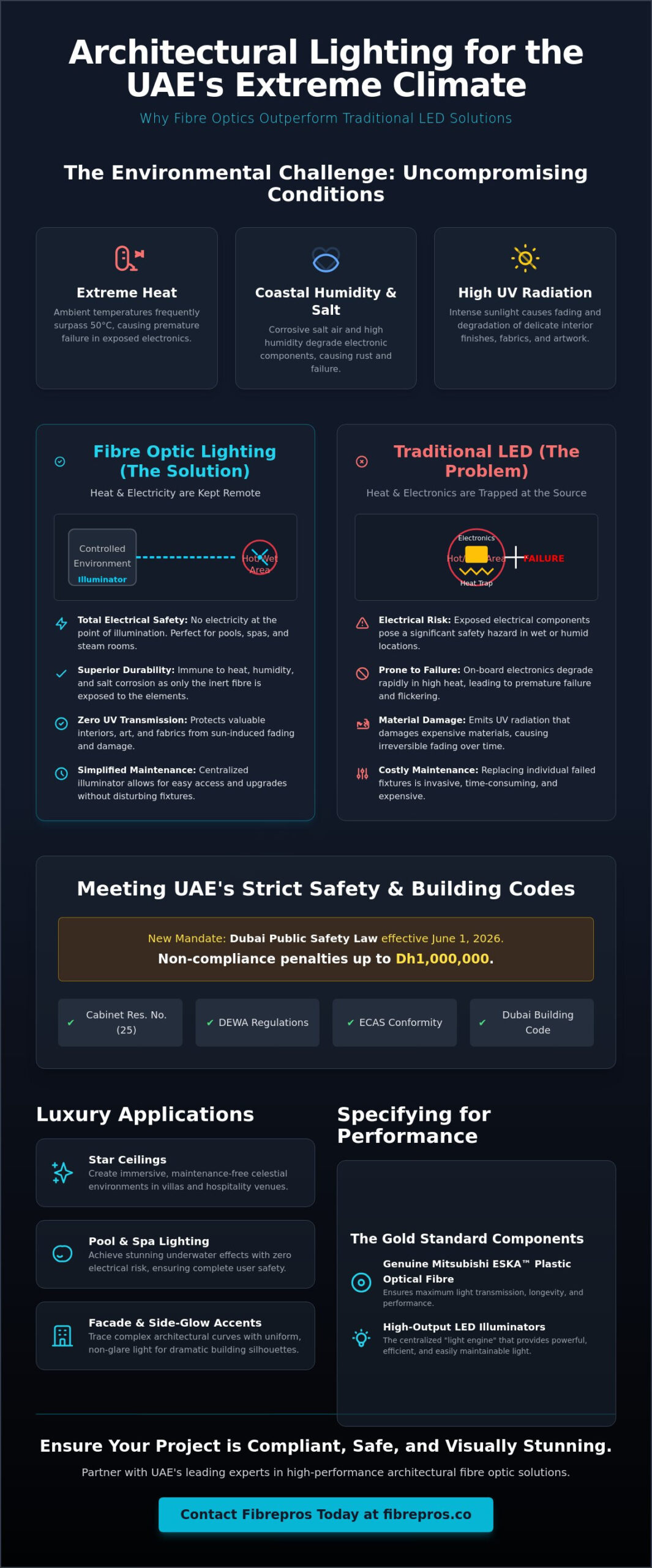
Selecting the right illumination for high-stakes projects in the Gulf requires more than just an eye for design. It demands an understanding of material science under extreme stress. In Dubai, where ambient temperatures frequently surpass 50°C during summer months, traditional LED fixtures often face premature failure. This happens because the electronic drivers and heat sinks are housed within the fixture itself, creating a heat trap that accelerates component degradation. Architectural fibre optic lighting solutions UAE solve this by moving the heat source, the LED illuminator, to a remote, climate-controlled location. Only the light itself travels through the fibre to the output point.
Thermal management isn’t the only advantage. Traditional lighting emits ultraviolet (UV) radiation, which causes sun-induced fading on delicate interior materials, expensive fabrics, and art. Fibre optic systems provide zero UV transmission. This makes them the superior choice for preserving the integrity of luxury interiors in the high-sun environment of the GCC. Since there’s no electricity at the output point, these systems offer total peace of mind for wet areas. You can install light directly into a pool or spa without any electrical risk to the end user. For those focusing on energy-efficient lighting design, centralized illuminators offer a streamlined way to manage power loads across a large-scale architectural footprint.
Mitsubishi ESKA POF: The Engineered Advantage
The technical core of a reliable system is the quality of the fibre itself. We specify Mitsubishi ESKA Plastic Optical Fibre because it’s engineered to resist yellowing and embrittlement, even when exposed to the high-salinity air of coastal developments like Palm Jumeirah. Cheaper alternatives often cloud over time, reducing light transmission efficiency. ESKA POF maintains high clarity over long distances, ensuring that the “Grand Entrance” glow you design today looks identical a decade from now. If you’re currently drafting specifications for a high-salinity environment, you might find our specialized stainless steel fixtures a necessary addition to your material list.
Fibre Optic vs. Traditional LED Comparison
| Feature | Traditional LED Fixtures | Fibre Optic Systems |
|---|---|---|
| Maintenance | High; requires access to each bulb/driver | Low; single remote illuminator access |
| Electrical Safety | Voltage present at the light source | Zero electricity at output point |
| Heat Output | Significant heat generated at fixture | No heat at the point of light |
| Lifespan (50°C+) | 2-3 years (driver failure common) | 10+ years (fibre is inert) |
A cost-benefit analysis over a 10-year architectural lifecycle reveals that while initial setup for architectural fibre optic lighting solutions UAE may vary, the operational savings are substantial. You won’t deal with the labor costs of scaffolding to replace a single failed LED in a high ceiling or the draining of a pool to fix a leaky underwater light. The infrastructure is permanent, modular, and built for the specific rigors of the Middle Eastern climate.
High-End Architectural Applications: From Luxury Villas to Hospitality
When specifying architectural fibre optic lighting solutions UAE for high-end hospitality, the goal is often to create a signature visual experience that standard fixtures can’t replicate. Luxury villas in neighborhoods like Emirates Hills or Palm Jumeirah frequently utilize the “Starry Night” effect in private home cinemas and master bedrooms. By using varying diameters of fibre, designers mimic the natural depth and twinkle of a night sky. This application depends on the technical precision of the illuminator’s twinkle wheel, providing a dynamic yet silent aesthetic that doesn’t rely on motorized parts within the living space.
Beyond residential use, these systems serve critical roles in UAE educational and healthcare facilities. Sensory rooms utilize specialized fibre optic kits to create calm, interactive environments for students. These installations are safe to touch and manipulate because the light carries no heat or electricity. For outdoor landscape accentuation, the use of durable stainless steel fixtures ensures that light points remain aligned and functional against the abrasive desert sands and high-salinity air. This architectural integration allows for precise highlighting of pathways and garden features without the clutter of visible cables or bulky housings.
Luxury Pool and Spa Illumination
Safety is the primary driver for using fibre optics in aquatic environments. We emphasize that underwater lighting fixtures must be fibre-based to eliminate any risk of electrical leakage into the water. Designers use side-glow fibre to provide continuous perimeter definition along pool edges and architectural coves. This creates a “floating” effect that’s particularly popular in Dubai Jumeirah villas. Star-bottom pools are another high-demand application; they utilize hundreds of end-glow points to transform a swimming area into a mirror of the night sky, all while maintaining the structural integrity of the pool shell.
Interior Accents and Crystal Fittings
In high-end interiors, the focus shifts to detail and brilliance. You can enhance custom chandeliers and ceiling features by using crystal end fittings that refract light into sharp, decorative patterns. This technique is often used to define bespoke joinery and cabinetry, where end-glow fibre provides a sharp point of light without taking up the space required by traditional LED tape. These systems integrate seamlessly with modern smart home protocols. This allows residents to adjust mood and color temperature through a single interface, ensuring the architectural fibre optic lighting solutions UAE remain an active part of the home’s automated ecosystem.
Specifying the Right Solution: Safety, Standards, and Durability
Transitioning from a conceptual design to a functional installation requires rigorous technical specification. For architectural fibre optic lighting solutions UAE, compliance with the Dubai Public Safety Law, effective June 1, 2026, is mandatory. This legislation establishes a strict framework for lighting standards in public venues, with non-compliance penalties reaching up to Dh1,000,000. Professionals must ensure that every component, from the light source to the final fixture, meets these updated safety benchmarks to avoid significant project delays or legal liabilities.
Durability in the Middle East begins with Ingress Protection (IP) ratings. For outdoor and wet areas, IP68 is the standard for underwater fixtures, while IP65 or higher is necessary for facade accents exposed to dust and pressurized cleaning. DEWA regulations for electrical installations also dictate that lighting circuits must not exceed a maximum load of 2000W per circuit. Because fibre optic systems centralize the power load at the illuminator, they simplify compliance with these wiring and circuit standards. All cables and housings must be rated for the high ambient temperatures of the UAE climate, ensuring the system remains stable when exterior surfaces exceed 60°C.
Selecting the right LED illuminators involves more than just choosing a wattage. You must calculate the fibre bundle size based on the architectural scale to ensure uniform brightness across the entire run. A common error in GCC projects is underspecifying the light source for high-ceiling voids or large-scale facades. Proper specification ensures that the light intensity remains consistent from the first point to the last, maintaining the intended aesthetic impact without overdriving the LED components.
Technical Specification Checklist
- Bend Radius: Maintain a minimum bend radius of ten times the fibre diameter to prevent micro-fractures in the core that cause light loss.
- Accessibility: House illuminators in ventilated, accessible cabinets for routine maintenance without requiring specialized lifting equipment.
- Control Integration: Specify DMX or Bluetooth-enabled illuminators for large installations to allow for synchronized color changes and dimming.
Material Selection for the GCC
In coastal environments like Abu Dhabi’s Corniche or Dubai’s beachfront, material selection is a matter of structural survival. 316L marine-grade stainless steel is the only viable choice for fixtures to prevent pitting and corrosion. While glass fibre is used in specific high-heat industrial settings, Mitsubishi ESKA Plastic Optical Fibre (POF) is the preferred choice for most architectural fibre optic lighting solutions UAE due to its flexibility and impact resistance. Always verify genuine Mitsubishi ESKA branding; counterfeit or generic fibres often lack the thermal stabilization required for the Gulf, leading to yellowing within a single summer season. If you are ready to finalize your project specifications, speak with a specialist at Fibrepros to ensure your material list meets 2026 standards.
Partnering with Fibrepros: UAE’s Expert for Mitsubishi ESKA Solutions
Successful integration of high-performance lighting requires a partner who understands the specific environmental and regulatory demands of the Middle East. Fibrepros brings over 30 years of specialized expertise to every project, positioning us as the primary source for architectural fibre optic lighting solutions UAE. Unlike international suppliers who ship from abroad, we maintain extensive local stock in Dubai. This ensures that project timelines remain on track, whether you require individual components or complete star ceiling kits for immediate installation. Our status as a direct supplier of Mitsubishi ESKA Plastic Optical Fibre guarantees that every metre of material meets the highest global standards for clarity and thermal resistance.
Our role extends beyond simple distribution. We provide custom design and assembly services tailored to unique architectural requirements. If a project demands a bespoke side-glow configuration for a curved facade or a complex underwater array, our team handles the technical assembly to ensure peak performance. This localized approach allows us to respond quickly to site-specific challenges that generalist lighting companies often overlook. We don’t just sell components; we deliver integrated systems designed to thrive in the Gulf’s demanding conditions.
From Concept to Commissioning
We support architects and consultants from the initial design phase through to final commissioning. Our technical team assists in calculating light loads and selecting the most efficient LED illuminators for your specific application. This collaborative process minimizes the risk of specification errors that could lead to non-compliance with Dubai Municipality or Civil Defence standards. Our track record across Dubai, Abu Dhabi, and the wider GCC includes some of the region’s most prestigious residential and hospitality developments. We understand the high stakes of luxury infrastructure and provide the technical precision required to meet those expectations. Our architectural fibre optic lighting solutions UAE are built on a foundation of reliability and specialized mastery.
Get a Professional Lighting Consultation
Choosing the right system shouldn’t be a matter of guesswork. We offer professional consultations to help you determine the most effective configuration for your commercial or residential project. Whether you need a custom kit for a private villa or a large-scale architectural lighting solution, our specialists are ready to provide a detailed technical roadmap. We focus on results that prioritize uptime and accuracy. To start your project with a dependable expert, contact Fibrepros for architectural lighting solutions today. Our team will ensure your installation is safe, efficient, and visually unmatched.
Securing the Future of Your Architectural Lighting Infrastructure
The transition toward robust, safety-compliant lighting is essential for the UAE’s high-stakes luxury sector. By integrating architectural fibre optic lighting solutions UAE, you eliminate the common failure points associated with traditional LEDs in extreme heat and high-salinity environments. These systems offer a permanent infrastructure that protects your investment while ensuring compliance with the latest 2026 Dubai Public Safety Law. Whether you’re designing a star-bottom pool or a signature hospitality facade, the technical advantages of zero heat and electricity at the output point provide unmatched peace of mind.
Fibrepros has been a dependable partner in the Middle East since 1995. As an authorized supplier of Mitsubishi ESKA POF, we provide the specialized components required for IP68 underwater and high-end architectural fixtures. We maintain local stock to support your project timelines and deliver custom-assembled systems that meet the rigorous standards of the GCC. It’s time to elevate your design with a solution built for technical precision and long-term performance.
Request a Technical Consultation for Your UAE Lighting Project and ensure your next project reflects the highest standards of safety and aesthetic impact.
Frequently Asked Questions
Are architectural fibre optic lights safe for swimming pools in the UAE?
Yes, fibre optic systems are the safest option because no electricity is present at the light output point in the water. The electrical components and LED illuminator stay in a remote, dry location away from the pool shell. This design eliminates any risk of electrical leakage, ensuring total compliance with UAE safety standards for aquatic environments and luxury residential spas.
How long do fibre optic lighting systems last in the Dubai heat?
Properly specified systems using high-grade materials can last over 10 years in the Dubai heat. While traditional LED drivers often fail within 2 to 3 years due to thermal stress, the inert nature of the fibre cables means they don’t degrade from high ambient temperatures. The remote light source is typically housed in a climate-controlled area to maximize its operational lifespan.
Can I integrate fibre optic lighting with my existing smart home system?
Yes, modern LED illuminators are designed for seamless integration with smart home protocols like DMX, KNX, or Bluetooth. This allows you to control brightness, color, and timing through your central interface. For architectural fibre optic lighting solutions UAE, this integration ensures that luxury villa owners can manage their entire lighting ecosystem through a single automated platform without needing separate controllers.
What is the difference between side-glow and end-glow fibre for architectural use?
End-glow fibre transmits light only to the tip, creating distinct points of light like stars or sharp accents. Side-glow fibre emits light along its entire length, resembling a neon tube or linear glow. End-glow is ideal for star ceilings and crystal fittings, whereas side-glow is specifically used for perimeter definition in pools and architectural coves where a continuous line is required.
Do fibre optic lights require frequent maintenance?
No, these systems are virtually maintenance-free because there are no bulbs or electronics at the output points. The only component that may require attention is the LED illuminator. Since this is installed in an accessible, indoor location, replacing a source or cleaning a filter doesn’t require draining pools or erecting scaffolding, significantly reducing long-term operational costs for facility managers.
Why is Mitsubishi ESKA fibre preferred for UAE lighting projects?
Mitsubishi ESKA Plastic Optical Fibre is preferred because of its superior thermal stability and resistance to UV yellowing. In the UAE’s high-sun environment, generic fibres often become brittle and lose clarity within a few years. ESKA POF maintains high light transmission efficiency even in coastal areas with high salinity, making it the gold standard for durable architectural infrastructure in the GCC.
What is an LED illuminator and where should it be installed?
An LED illuminator is the light source that powers the entire fibre optic system, containing the LED chip, cooling fan, and control electronics. It should be installed in a well-ventilated, dry, and accessible location, such as a plant room or a dedicated service cabinet. This protects the sensitive electronics from the harsh exterior environment while making routine maintenance straightforward and safe.
Can fibre optic lighting be used for building facades in the UAE?
Yes, architectural fibre optic lighting solutions UAE are highly effective for facade accents because they can trace complex geometric shapes without visible external wiring. Using stainless steel fixtures ensures the light points remain secure against high winds and abrasive sand. The system provides a clean, minimalist aesthetic that highlights the building’s form without the clutter or weight of traditional bulky fixtures.