
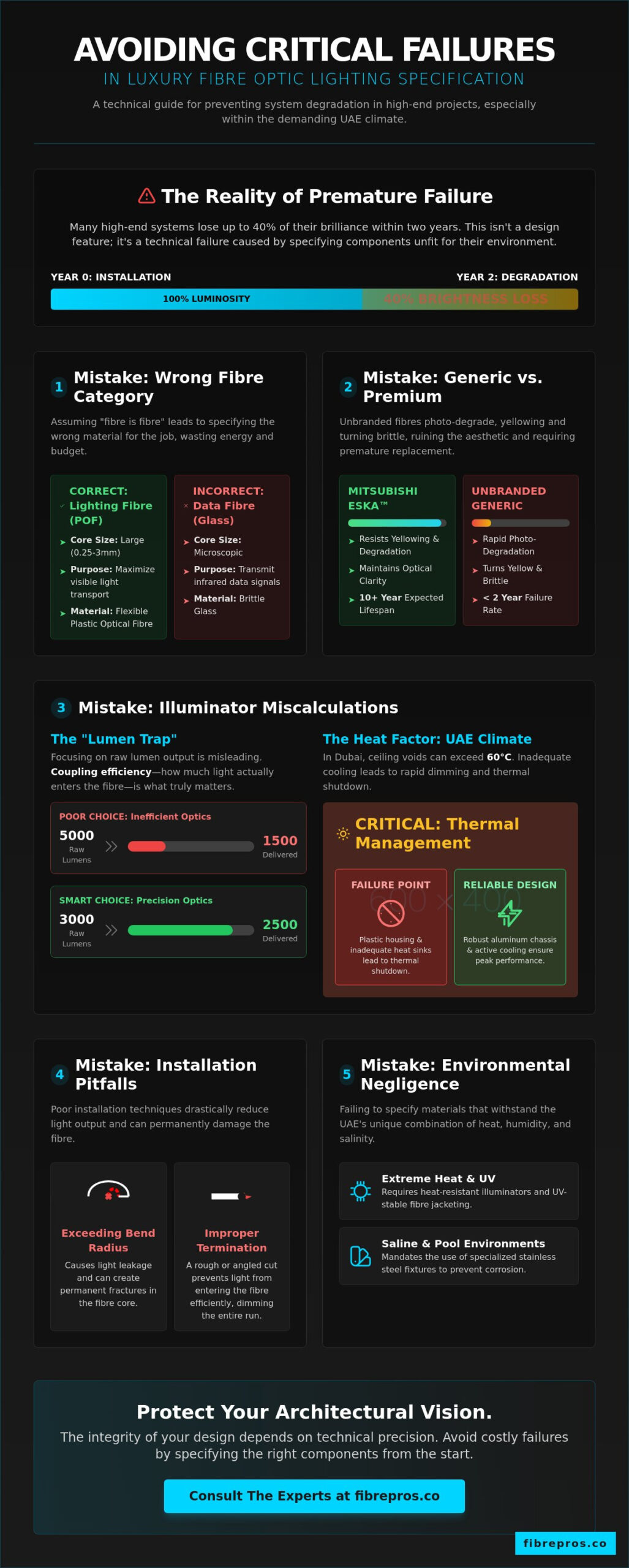
A luxury lighting system that loses 40% of its brilliance within two years isn’t a design choice; it’s a technical failure. Many high-end projects in the UAE suffer from rapid dimming or total system collapse because the hardware was never engineered for the region’s specific environmental stressors. You expect a system that maintains peak performance for a decade, yet the market is flooded with generic materials that degrade under extreme thermal pressure. Avoiding the most common mistakes when choosing fibre optic lighting components is the only way to protect the integrity of your architectural vision and your budget.
We understand that technical precision is non-negotiable when you’re installing intricate star ceilings or high-stakes underwater fixtures. This article provides the specialized knowledge needed to prevent costly errors and ensure your installations meet the latest UAE outdoor lighting regulations, including ECAS conformity standards. You’ll learn how to distinguish high-performance Mitsubishi ESKA plastic optical fibre from standard data cables, why LED illuminator cooling is critical in Dubai’s heat, and how to select stainless steel fixtures that survive aquatic environments. We’ll outline the exact technical specifications that separate a temporary glow from a permanent, high-fidelity architectural asset.
Key Takeaways
- Identify the critical technical differences between decorative plastic optical fibre and communications-grade glass to ensure your lighting system delivers the intended visual effect.
- Avoid the most frequent mistakes when choosing fibre optic lighting components by prioritizing thermal management and illuminator port compatibility for high-temperature UAE environments.
- Prevent system dimming and material brittleness by selecting high-performance brands like Mitsubishi ESKA instead of unbranded generic alternatives.
- Master installation best practices, including proper termination and bend radius limits, to eliminate light leaks and maintain peak brightness across long runs.
- Specify specialized stainless steel fixtures and heat-resistant components to protect your investment against the challenges of saline pool water and extreme ambient heat.
The Critical Distinction: Lighting Fibre vs. Communications Fibre
A common error in architectural planning is the assumption that “fibre is fibre.” This leads to one of the most expensive mistakes when choosing fibre optic lighting components: specifying communications-grade glass fibre for decorative lighting. While glass fibre excels at transmitting high-speed data across continents, its physical structure is ill-suited for luxury lighting. Data-grade fibre features a microscopic core designed to carry infrared signals. Lighting fibre requires a significantly larger core, typically 0.25mm to 3mm, to transport visible light efficiently. Using the wrong material results in a system that cannot handle the output of a high-intensity LED illuminator, leading to poor light transmission and wasted energy.
Understanding Optical fiber principles is essential for technical precision. In luxury lighting, we primarily utilize Plastic Optical Fibre (POF). POF is flexible, durable, and capable of transmitting high-intensity light without the fragility associated with glass. Unlike data cables that prioritize signal integrity over kilometres, lighting components focus on luminosity and colour accuracy over shorter runs. With plastic raw material costs rising by over 30% in 2026, selecting the wrong material isn’t just a technical oversight; it’s a significant financial risk that can compromise the entire project budget.
Why Material Choice Dictates Longevity
Cheap, unbranded polymers often fail within months of installation. These generic fibres suffer from rapid photo-degradation, which manifests as a “yellowing” effect. This discoloration distorts the crisp output of your LED source, turning a cool white star ceiling into a muddy, aged yellow. We specify Mitsubishi ESKA Plastic Optical Fibre because it sets the industry standard for optical clarity. It’s engineered to resist the mechanical stress of installation while providing consistent light output for over a decade. While specialized lighting-grade glass is occasionally used for high-heat industrial applications, POF remains the superior choice for the majority of luxury residential and commercial interiors.
Identifying the Right Fibre for the Job
Choosing the wrong functional category is another frequent error. End-glow fibre is the standard for star ceilings and point-source effects. It’s designed to carry light to the very tip with minimal leakage along the strand. Side-glow fibre is manufactured to allow light to escape through the cladding, creating a linear effect used for perimeter highlighting or as a neon replacement. A common mistake involves installing side-glow in areas with high ambient light. Without a high-output source, side-glow loses its visual impact in bright rooms. Always ensure your fibre type matches the specific visual outcome you intend to achieve.
Illuminator Errors: Brightness, Cooling, and Control
The light source, or illuminator, acts as the engine of any fibre optic system. A frequent oversight involves falling into the “Lumen Trap.” High-end LED illuminators are often marketed based on their total raw lumen output at the chip level. This figure is misleading. What matters is the coupling efficiency, or how much of that light actually enters the fibre optic bundle. Selecting a high-wattage unit that lacks precision optics often results in lower terminal brightness than a well-engineered lower-wattage unit. This is one of the most common mistakes when choosing fibre optic lighting components because it leads to overspending on energy without achieving the desired visual impact.
Investing in energy-efficient lighting solutions requires a focus on system-wide performance rather than isolated component specs.
In Dubai, ceiling voids can reach temperatures exceeding 60°C. Cheap illuminators with plastic housings or inadequate heat sinks fail prematurely in these conditions. Professional-grade LED illuminators utilize active cooling and robust aluminium chassis to dissipate heat effectively. Without this, the LED chip will dim rapidly or the internal electronics will trigger a thermal shutdown. System reliability depends on choosing hardware designed for regional climate extremes. It’s vital to prioritize units with high-quality internal fans and thermal protection circuits.
Matching the port size of the illuminator to the diameter of your fibre bundle is a technical necessity. If the bundle is smaller than the port, you waste light and energy. If it’s larger, the outer fibres receive no light, creating an uneven effect. Accurate calculations of the fibre count must happen before hardware selection. For detailed guidance on this process, see our article on Choosing LED Illuminators for Fibre Optic Systems.
The Physics of Light Coupling
Poor alignment between the LED and the fibre bundle creates “hot spots.” These concentrated points of thermal energy can actually melt the ends of Plastic Optical Fibre (POF). Ensuring a high-quality “common end” finish, where the bundle is polished and heat-shrunk correctly, is vital for light entry. This precision ensures the light enters the core of each strand rather than hitting the cladding or the gaps between fibres. A jagged or unpolished common end can reduce light output by as much as 30%.
Advanced Control and Integration
Luxury projects require seamless integration with home automation systems like Control4 or KNX. A critical error is purchasing non-dimmable units for star ceilings. Star effects require subtle dimming to feel natural and immersive. We recommend specifying DMX-controlled LED illuminators to allow for precise brightness levels and colour sequencing. If you’re planning a high-end installation, you can view our range of professional LED illuminators to find the right control protocol for your project.
Material Quality: The Hidden Cost of ‘Generic’ Fibre
Selecting unbranded or generic fibre is one of the most common mistakes when choosing fibre optic lighting components for high-end developments. In 2026, factory prices for these components rose by 5% to 15% because plastic raw material costs surged by more than 30%. While it’s tempting to offset these costs by purchasing lower-grade materials, the long-term performance trade-off is severe. Generic fibres often lack the chemical stability required for luxury interiors, leading to premature brittleness and significant light loss. This degradation doesn’t just reduce brightness; it compromises the physical integrity of the installation, often requiring a full system replacement within a few years.
UV stabilization is another critical factor frequently overlooked in the Middle East. Standard indoor fibre lacks the necessary additives to withstand the intense solar radiation found in the UAE. When used in outdoor applications like garden pathways or building facades, non-stabilized fibre becomes opaque and cracks. Professionals should consult Fiber Optic Landscape Lighting Basics to understand how UV filtering and heat resistance impact the lifespan of outdoor installations. Choosing materials without these protections is a fundamental error that leads to system failure under the Dubai sun.
The uniformity of the material also dictates how well the system renders colour. Low-quality polymers often have microscopic impurities that scatter light, causing a visible colour shift over the length of the strand. This means a warm white light at the source could appear slightly green or blue at the end of the run. In luxury projects where accurate colour rendering is paramount, these inconsistencies are unacceptable. High-performance components ensure that the visual intent of the lighting designer remains intact from the first metre to the last.
The Science of Light Attenuation
Attenuation is the gradual loss of light intensity as it travels through the optical fibre core. In luxury villas where runs can exceed 20 metres, this loss becomes highly visible. High-purity PMMA cores are essential to minimize this effect. For example, a low-quality fibre might lose a significant percentage of its light over a 20-metre run, leaving the furthest points looking dull and lifeless. By contrast, high-grade components maintain a much higher percentage of light, ensuring that the sparkle in a master suite matches the output at the source. Calculating this loss before installation prevents the mistake of using runs that are too long for the material’s grade.
Durability in High-Traffic Areas
The protective jacket around the fibre dictates its mechanical strength. PVC jackets are standard for indoor use, but PE (Polyethylene) is often required for underground or high-moisture environments. A common mistake is using unprotected fibre in high-traffic zones or sensory rooms where physical contact is frequent. Without a robust jacket, the delicate strands can snap or kink, permanently obstructing light flow. We recommend Mitsubishi ESKA Plastic Optical Fibre: The Gold Standard for projects requiring maximum bend tolerance and uniformity. This specific material ensures that even in tight architectural curves, the light remains consistent and the fibre remains intact.
Installation Pitfalls: Bends, Cuts, and Fittings
Even the highest-grade Mitsubishi ESKA fibre cannot overcome poor installation techniques. One of the most frequent mistakes when choosing fibre optic lighting components is underestimating the precision required during the physical routing and termination phase. While decorative fibre is more forgiving than glass data fibre, it still follows strict physical laws. Exceeding the minimum bend radius creates microscopic fractures in the cladding, leading to “light leaks” that sap the system’s brightness before the light ever reaches the end fitting. These tight turns are often the hidden reason behind a star ceiling that looks uneven or dim in specific corners.
Another critical error involves the use of standard construction adhesives. Many project teams use generic glues to secure fibres within ceiling voids or joinery. However, many common adhesives contain solvents that chemically react with and melt the PMMA plastic core. This causes permanent opacity at the point of contact. Professionals must use specialized, solvent-free adhesives or mechanical fixings to preserve the optical integrity of the run. Ensuring the material remains chemically stable is just as important as the light source itself.
Mastering the Termination
The quality of the cut determines the “sparkle” of the final output. Using standard side-cutters often crushes the fibre end, creating a jagged surface that scatters light inefficiently. We recommend using a professional hot-knife or a specialized heavy-duty fibre cutter to ensure a perfectly flat, perpendicular face. For high-end architectural displays, applying a polishing kit to the common end and individual tips can increase light transmission by up to 20%. To achieve a truly refined aesthetic, integrating crystal end fittings is non-negotiable. These components act as lenses, focusing the light and providing a finished, high-jewellery look that raw fibre ends simply cannot replicate.
Bundle Management and Routing
Effective bundle management prevents long-term system degradation. “Over-bundling” too many fibres into a single tight conduit can lead to heat build-up at the illuminator port, potentially damaging the material over time. When securing bundles, use loose zip ties or specialized clips that don’t crush the cladding. Finally, always plan for future maintenance. Burying an illuminator behind permanent drywall without an access hatch is a major design flaw. Ensure your hardware remains accessible for fan cleaning or LED replacement. If you need technical assistance with your project layout, consult with our specialist team to ensure your installation meets professional standards.
Environmental Negligence: The UAE Climate Factor
The UAE climate presents one of the most aggressive environments for architectural lighting. Neglecting regional stressors like extreme heat and salinity is among the costliest mistakes when choosing fibre optic lighting components. In Dubai, ambient temperatures can exceed 50°C, and coastal humidity levels often reach 90%. Components that perform adequately in temperate climates often fail here within a single season. Success requires selecting hardware specifically engineered for high-thermal loads and corrosive atmospheres. If you don’t account for these variables during the specification phase, the longevity of your luxury installation is effectively halved.
Saunas and steam rooms require specialized attention to moisture ingress. While the fibre itself is immune to electrical short circuits, the fittings and the path to the illuminator must remain airtight. Using standard fittings in these high-humidity zones leads to condensation build-up. This moisture can travel back to the light source or cause mineral deposits on the fibre ends, dulling the output permanently. For these applications, only high-grade polymers and sealed stainless steel fixtures provide the necessary protection against vapour-related failure.
Underwater Safety and Longevity
Pool lighting in the GCC requires 316L marine-grade stainless steel fixtures to resist the corrosive effects of saline water and high chlorine concentrations. A common error is specifying 304-grade steel, which will tea-stain and pit within months in coastal Dubai projects. Additionally, placing the illuminator too far from the pool is a technical oversight. While the illuminator must remain in a dry, ventilated area, excessive run lengths increase light attenuation. You must balance the need for a protected location with the requirement for maximum terminal brightness. For a comprehensive look at these technical requirements, read our Underwater Lighting Fixtures Guide.
Outdoor Landscape Challenges
Direct UV exposure is the primary enemy of side-glow fibre in garden installs. Without UV-stabilized cladding, the material will turn yellow and brittle, losing its flexibility and light-carrying capacity. Maintenance teams also frequently overlook the “Desert Dust” factor. Fine particulate matter can clog the ventilation fans of outdoor illuminators, causing them to overheat. You must specify IP67 or IP68 rated enclosures for any component exposed to the elements to ensure sand and water ingress don’t compromise the internal electronics. Avoiding these mistakes when choosing fibre optic lighting components ensures your landscape design remains as vivid as the day it was commissioned, even in the harshest GCC conditions.
Securing Long-Term Performance for Your Architectural Vision
Precision in component selection is the difference between a system that fails after one summer and one that remains brilliant for over a decade. By prioritizing high-performance materials like Mitsubishi ESKA Plastic Optical Fibre and ensuring your LED illuminators are engineered for the UAE’s thermal loads, you protect both your design and your budget. Remember that environmental resilience, particularly the use of IP68-rated underwater lighting fixtures and 316L stainless steel, is non-negotiable for coastal or aquatic applications in the GCC.
Avoiding the most frequent mistakes when choosing fibre optic lighting components requires a specialist’s perspective on material science and local climate stressors. Since 1995, we’ve provided Dubai’s luxury sector with the technical expertise needed to execute complex architectural lighting with total reliability. Our team ensures every component, from crystal end fittings to side-glow strands, meets the highest industry standards for optical clarity and safety.
We’re ready to help you finalize your specifications with precision. Request a technical consultation for your Dubai lighting project to ensure your next installation delivers a flawless, lasting impression.
Frequently Asked Questions
Can I use standard LED tape instead of fibre optics for star ceilings?
Standard LED tape cannot replicate the point-source precision required for a realistic star ceiling. While tape produces a diffused or linear glow, fibre optics allow for hundreds of microscopic “stars” powered by a single remote LED illuminator. Using tape results in bulky wiring and visible hotspots that compromise the luxury aesthetic. Fibre optics provide a cleaner installation with no electrical components in the ceiling itself.
Is plastic optical fibre better than glass for home lighting?
Plastic Optical Fibre (POF) is the preferred choice for decorative architectural lighting due to its superior flexibility and durability. Glass fibre is extremely fragile and prone to snapping when routed through tight ceiling voids or around corners. We utilize Mitsubishi ESKA POF because its high-purity PMMA core offers excellent light transmission and handles the mechanical stress of installation without the breakage risks of glass.
What happens if I bend the fibre optic cable too sharply?
Bending fibre beyond its specified minimum radius causes light to leak through the cladding instead of reflecting down the core. This error results in a significant loss of terminal brightness and can cause localized heat build-up. It is one of the most frequent mistakes when choosing fibre optic lighting components and installing them, leading to uneven light distribution across the project.
Do fibre optic lights need a special transformer or driver?
Fibre optic systems require a dedicated LED illuminator which houses the light source, cooling fans, and internal driver electronics. You don’t use standard standalone transformers. The illuminator’s integrated driver manages power to the LED chip and often includes advanced control interfaces for DMX or home automation. This specialized hardware ensures the system operates within safe thermal and electrical parameters.
How do I choose the right wattage for my fibre optic illuminator?
You should prioritize coupling efficiency and lumen output over raw wattage. A high-wattage unit is ineffective if the optics don’t focus light precisely into the fibre bundle. You must calculate your total fibre count and run length before selecting an illuminator. This ensures the port size and light intensity are sufficient to maintain brightness at the furthest point of the installation.
Can fibre optic lighting be used in a swimming pool safely?
Fibre optics are the safest underwater lighting solution because they carry no electricity or heat into the water. Only light travels through the strands to the pool fixtures. For long-term reliability in Dubai’s saline environment, you must use 316L stainless steel fixtures. The LED illuminator must stay in a dry, ventilated area to prevent moisture damage to the internal electronics.
Why is my fibre optic lighting losing its brightness over time?
Brightness loss is typically caused by poor thermal management or the use of generic, unbranded fibres. If an illuminator lacks adequate cooling, the LED chip degrades prematurely. Additionally, low-quality fibres without UV stabilization will yellow and become opaque. These mistakes when choosing fibre optic lighting components lead to high attenuation, where the material absorbs light rather than transmitting it to the tips.
What is the difference between end-glow and side-glow fibre?
End-glow fibre transmits light exclusively to the tip for point-source effects like star ceilings or crystal fittings. Side-glow fibre features a specialized cladding that allows light to escape along the entire length of the strand, creating a linear, neon-like effect. Using the wrong category for your design intent will result in poor visual performance and a failure to achieve the desired lighting effect.