
Your fibre optic lighting system is only as reliable as its engine, and treating a high-performance light engine like a standard household bulb is a shortcut to technical failure. Understanding how to choose the right LED illuminator involves more than just picking a wattage; it requires a deep dive into thermal management and optical precision. You likely want a system that delivers a brilliant shimmer without the distracting hum of a cooling fan or the risk of burnout in the intense heat of Dubai. Selecting the wrong unit can result in color inconsistency or premature failure, especially when facing the strict efficiency requirements of the Al Sa’fat green building standards.
Mastering the technical specifications and environmental factors ensures your installation remains both functional and reliable. This guide provides the professional framework you need to select a light engine that balances high-lumen output with silent operation. We will examine critical specifications including DMX control protocols, thermal thresholds for regional installations, and the specific hardware needed to achieve consistent effects across your entire Mitsubishi ESKA plastic optical fibre network.
Key Takeaways
- Differentiate between standard LED fixtures and high-intensity light engines to ensure maximum light coupling into your fibre bundle.
- Learn how to choose the right LED illuminator by calculating actual port capacity instead of relying on misleading raw lumen ratings.
- Evaluate mechanical twinkle wheels versus electronic scintillation to achieve specific visual effects like ‘shimmering’ in professional star ceiling kits.
- Prioritize DMX512 control and robust thermal management to guarantee system reliability and compliance within the UAE’s demanding climate.
- Understand the importance of precision bundle termination in maintaining color consistency and preventing light loss at the engine interface.
What is an LED Illuminator in Fibre Optic Systems?
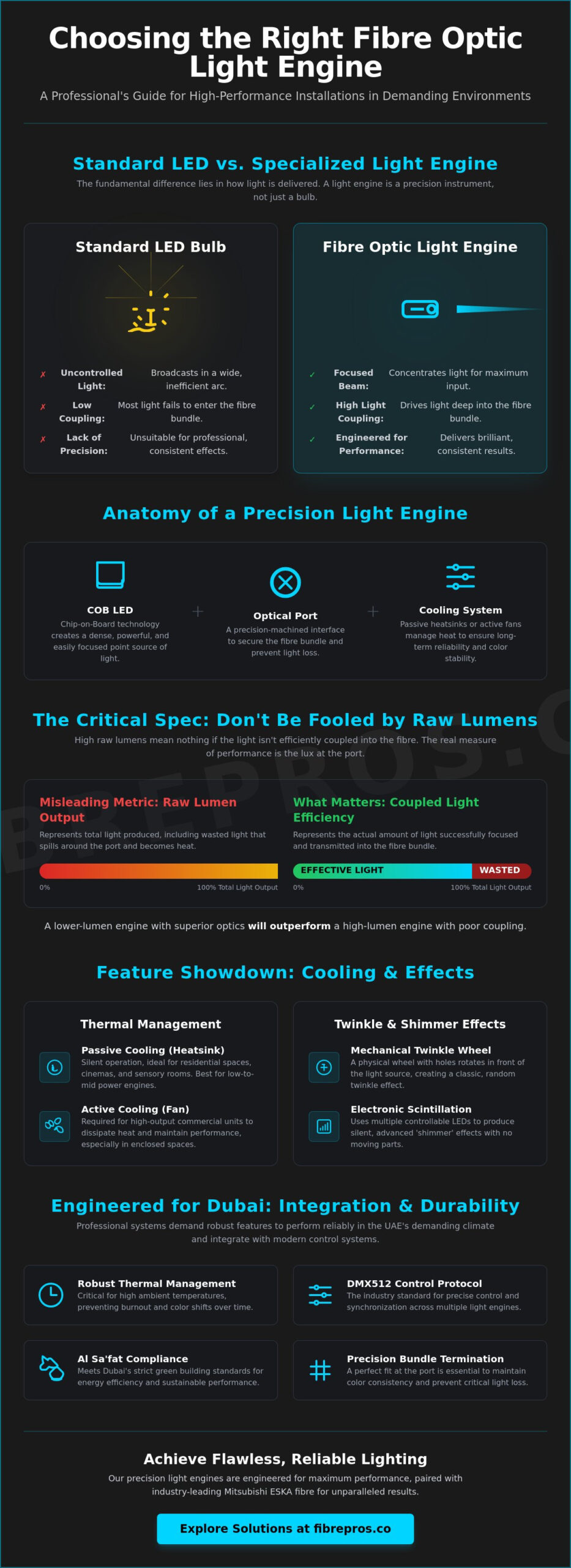
A dedicated light engine is the functional core of any professional lighting project. Unlike a standard LED bulb that broadcasts light in a wide, uncontrolled arc, an illuminator focuses high-intensity light into a concentrated beam specifically calibrated to enter a fibre optic bundle. Understanding What is an LED Illuminator in Fibre Optic Systems? requires looking at the physics of light coupling and transmission. The illuminator serves as the only part of the system connected to a power source. This unique separation allows you to deliver light to sensitive environments, such as underwater lighting fixtures or sensory fibre optic kits, while keeping the electrical engine in a remote and accessible location.
When you’re determining how to choose the right LED illuminator, it’s vital to recognize that these are specialized pieces of hardware rather than simple lamps. Standard fixtures lack the focal precision needed to drive light through hundreds of strands of Mitsubishi ESKA Plastic Optical Fibre. These units are the primary drivers for everything from intricate star ceiling kits to architectural accents using side-glow fibre. By centralizing the light source, you eliminate the need for electrical wiring at the actual point of light emission. This creates a safer, more durable system that is easier to maintain over time.
The Anatomy of a Light Engine
The heart of a modern illuminator is the Chip on Board (COB) LED. This technology packs multiple LED chips into a small footprint to create a dense point source that is easier to focus into the fibre port. The port is the critical interface where the fibre bundle is secured. If this connection isn’t perfectly aligned, significant light loss occurs, which reduces the brightness of your end-glow fibre. Cooling systems are equally important for performance. Passive heat sinks provide silent operation for quiet residential spaces. Active fan cooling is necessary for high-output commercial units that must operate in enclosed spaces without overheating.
Why Quality Matters for Dubai Interiors
In high-end Dubai interiors, color consistency is a non-negotiable standard. Professional illuminators use rigorous binning processes to ensure that every unit in a multi-illuminator installation produces the exact same color temperature. This is essential for large-scale villa star ceilings where multiple engines must sync perfectly. Reliability also dictates how you plan for long-term maintenance. Since the illuminator is the only component that can fail, placing it in a ventilated cabinet or accessible service room simplifies future repairs. You won’t need to dismantle high ceilings or drain pools to fix the light source. This setup also provides a massive safety advantage by keeping high-voltage components away from wet areas.
Technical Specs: Lumens, Port Size, and Fibre Density
Raw lumen counts are often the most deceptive metric on a specification sheet. In general architectural lighting, lumens represent the total light output in all directions. However, for fibre optics, we only value the light that successfully couples into the fibre bundle. High-performance light engines are designed for maximum lux at the focal point of the lens, not just high raw output. When you’re researching Technical Specs: Lumens, Port Size, and Fibre Density, you’ll find that the efficiency of the optical coupling defines the system’s success. As of May 2026, modern commercial LEDs achieve efficacies of 130 to 200+ lumens per watt, but without a precision-engineered port, much of that energy is wasted as heat rather than visible light.
Understanding how to choose the right LED illuminator requires a calculation of “Port Capacity.” This is the physical limit of how many fibre strands can fit into the illuminator’s aperture. A standard 30mm port can accommodate a specific number of strands before the bundle becomes too dense for even light distribution. If you overstuff a port, the strands at the edges will receive significantly less light than those in the center, leading to an inconsistent finish across your installation.
Calculating Your Fibre Load
The diameter of your chosen material determines your total capacity. For instance, using the industry-standard Mitsubishi ESKA Plastic Optical Fibre at 0.75mm allows for a much higher strand count than 1.5mm alternatives. You must also account for light attenuation over distance. A 100W illuminator might be sufficient for a 5-meter run of end-glow fibre, but the same unit will struggle to power side-glow fibre over that same distance due to the way side-glow “leaks” light along its length. For complex projects, it’s often better to consult with a technical specialist to match engine wattage to your specific cable lengths.
Color Temperature and CRI for Luxury Spaces
In Dubai’s luxury residential and retail sectors, the quality of light is as critical as its brightness. We typically specify 3000K (Warm White) to create an inviting atmosphere in villas, while 5000K (Cool White) better suits modern architectural highlights. A Color Rendering Index (CRI) of 90+ is vital for art galleries or high-end retail displays where color accuracy is paramount. While RGBW units offer versatility, dedicated single-color white chips often provide higher purity and intensity. If your design requires a true, crisp white alongside dynamic colors, ensure your illuminator features a dedicated white channel rather than relying on an RGB mix.
Evaluating Features: Twinkle Wheels, Noise, and Effects
Selecting the correct hardware involves looking beyond raw output to the specific visual effects your project requires. While basic units provide static light, professional engines include internal components designed to manipulate that light for specific textures. When you’re determining how to choose the right LED illuminator, you must decide between mechanical and electronic methods of light variation. Mechanical twinkle wheels remain the gold standard for star ceiling kits. These perforated discs rotate between the LED and the fibre bundle, physically interrupting the light path to create a rhythmic, organic shimmer that mimics a natural night sky.
Electronic scintillation offers a different approach by rapidly dimming and brightening the LED chip itself. While this reduces the number of moving parts, it often lacks the sharp, “crisp” twinkle provided by a mechanical wheel. For hospitality installations or large-scale villa projects in Dubai, synchronizing multiple units is a technical necessity. This ensures that the shimmer effect remains uniform across thousands of fibre strands. High-level Integration and Environment: Controls and UAE Durability are essential when managing these complex systems, as the quality of the light engine directly impacts the precision of the final visual output.
Dynamic Effects for Star Ceilings
Modern illuminators allow for fine-tuned control over the speed of the twinkle wheel, enabling you to transition from a slow, relaxing pulse to a more energetic shimmer. Specialized engines also feature sequenced ports to create meteor or shooting star effects, where light travels through specific fibre groups in a timed pattern. For underwater applications, a dedicated “shimmer” disc can be used to replicate the caustic reflections of moving water, adding depth to swimming pool floors and water features.
Noise Levels and Thermal Management
Acoustic performance is a critical factor for indoor installations. In a private home cinema or a master bedroom, the hum of a cooling fan is a significant distraction. Silent, fanless illuminators utilize oversized passive heat sinks to dissipate heat without noise. These are ideal for quiet environments, though they require more space for airflow. To protect your investment, look for units with integrated thermal cut-off switches. These safety features automatically dim or shut down the engine if internal temperatures exceed safe limits, preventing hardware failure during Dubai’s peak summer months. Placing your illuminators in ventilated service cupboards further extends their operational lifespan by keeping them away from stagnant, hot air pockets.
Integration and Environment: Controls and UAE Durability
DMX512 remains the definitive standard for professional lighting integration in Dubai. This protocol allows for granular control over color, dimming, and twinkle speed across multiple engines from a centralized console. For residential applications, Bluetooth and RF remote options provide a simplified plug-and-play experience without the need for complex signal wiring. When you’re assessing how to choose the right LED illuminator, the control interface must align with your existing infrastructure. The release of the Matter 1.5 protocol in February 2026 has further streamlined this process, ensuring seamless interoperability between smart lighting and broader home ecosystems.
Electrical standards in the GCC typically mandate 220V AC input, but the illuminator itself often operates on 12V or 24V DC. High-quality engines include internal transformers that manage this conversion efficiently while minimizing electromagnetic interference. This is particularly critical when powering underwater lighting fixtures, where the illuminator is housed in a dry service area but must deliver consistent output to the pool’s fibre termination points. Selecting an engine with a robust power supply ensures that voltage drops don’t lead to flickering or color shifting at the fibre ends.
Smart Home & DMX Integration
Professional RGBW illuminators require specific wiring to handle high-speed data signals. DMX-controlled units are often daisy-chained, requiring proper signal termination to prevent data reflections that cause erratic lighting behavior. For those utilizing smart home platforms, integrating with systems like Control4, Crestron, or Lutron is essential for automated scenes. Modern illuminators also comply with the Al Sa’fat green building rating system, which mandates a minimum “Silver” rating for new permits in Dubai. Smart lighting systems with automated scheduling and dimming are key to meeting these efficiency requirements. Explore our range of DMX-ready LED illuminators designed for seamless integration.
Durability in the Middle East
The UAE climate presents unique challenges for sensitive electronics. Dust-proofing is a priority, and illuminators installed in ceiling voids should carry an IP5X rating or higher to prevent fine sand and dust from clogging cooling fans or obscuring the optical port. Corrosion resistance is equally important for pool-side units or installations in saline environments near the coast. High-grade stainless steel fixtures and specialized coatings protect the external chassis from degradation. Because ambient temperatures in non-ventilated spaces can exceed 50°C, ensuring your illuminator has adequate ventilation and a high thermal tolerance is the only way to prevent premature hardware failure. Determining how to choose the right LED illuminator for this region means prioritizing thermal management as highly as light output.
The Fibrepros Advantage: Precision Light Engines
Fibrepros provides the specialized hardware required to turn technical specifications into operational success. We specify only high-performance LED chips that maintain stable color temperatures and high lumen maintenance over thousands of hours. Because the interface between the light engine and the fibre is the most common point of failure, we offer custom bundle termination services. This ensures a perfect port-to-fibre fit, which eliminates the air gaps that cause heat buildup and light loss. When you are deciding how to choose the right LED illuminator, having access to local technical support in Dubai ensures your project meets the highest standards of reliability.
Local stock availability across the UAE allows us to support fast-track projects without the delays of international shipping. Every unit we supply is backed by a professional warranty, providing peace of mind for high-stakes installations in hospitality and luxury residential sectors. Our expertise isn’t just in the hardware; it’s in the application of that hardware to the specific environmental demands of the GCC. We understand that a light engine in a ceiling void in Downtown Dubai faces different challenges than one in a climate-controlled showroom.
Professional Grade vs. Consumer Kits
Cheap online alternatives often lack the thermal management and optical precision necessary for professional installations. While a consumer kit might appear bright initially, it often suffers from rapid lumen depreciation and fan failure. Fibrepros’ industrial-grade illuminators are designed for continuous operation. When paired with high-quality crystal end fittings, our engines maximize light output at the point of emission, creating a sharper and more brilliant effect. Architects and MEP consultants choose our systems because they prioritize long-term uptime over low initial costs.
Start Your Project Today
Mastering how to choose the right LED illuminator starts with accurate data. Our technical team is available to provide custom lumen calculations based on your specific fibre lengths and strand counts. You can visit our Dubai showroom to experience our various illuminator effects, including our signature twinkle and shimmer discs, in person. This allows you to verify the light quality and noise levels before finalizing your specification. Contact Fibrepros for a specialized lighting quote to ensure your next fibre optic installation is powered by a precision-engineered light engine.
Optimize Your Lighting Infrastructure
Selecting the ideal light engine requires a disciplined focus on thermal management and optical precision. We have covered why port capacity and IP ratings are more critical than raw lumen counts, especially when managing the high ambient temperatures of the Middle East. A professional installation relies on hardware that can withstand environmental stressors while delivering consistent color and effects. Understanding how to choose the right LED illuminator ensures your project remains a high-performing asset rather than a maintenance liability.
Fibrepros provides the specialized expertise and DMX-ready hardware necessary for high-stakes projects across the UAE. As specialists in Mitsubishi ESKA fibre, we offer the technical support needed to calibrate your system for maximum efficiency and durability. Our Dubai-based team is ready to assist with custom calculations and local stock availability to keep your project on schedule. View our range of professional LED illuminators today to secure a reliable foundation for your lighting design. Your vision deserves the reliability of a precision-engineered engine.
Frequently Asked Questions
How many metres of fibre can one LED illuminator power?
The maximum transmission distance depends on the fibre type and the engine’s wattage. For end-glow applications like star ceilings, a high-output unit can effectively illuminate runs up to 15 or 20 metres before visible light loss occurs. Side-glow fibre loses light more rapidly along its length, so runs are typically limited to 3 to 5 metres to maintain consistent brightness. For longer distances, you should consider using multiple synchronized engines to ensure uniform light distribution.
Can I use one illuminator for both a star ceiling and pool lights?
It’s technically possible if the port capacity allows, but we don’t recommend this configuration. Star ceilings usually require a mechanical twinkle wheel for a shimmering effect, which would look erratic and distracting in a swimming pool. Additionally, the physical distance between a ceiling and a pool usually exceeds the efficient transmission length of the fibre optic cables. It’s more effective to use dedicated engines for each zone to allow for independent control and appropriate effects.
What is the difference between an RGB and an RGBW illuminator?
An RGB illuminator mixes red, green, and blue light to create various colors, but its white light is a composite mix that can appear slightly blue or purple. An RGBW unit includes a dedicated fourth white chip, which provides a much purer, higher-intensity white light. When researching how to choose the right LED illuminator for luxury interiors, selecting an RGBW model is essential if your design requires crisp white architectural accents alongside dynamic color changes.
Do LED illuminators require a transformer or driver?
Most professional LED illuminators feature integrated internal drivers and connect directly to a standard 220V AC power source. However, some compact or low-voltage models are designed to run on an external 12V or 24V DC power supply. Always verify the specific input voltage of your hardware before installation. Using the wrong power source can cause flickering or permanent damage to the LED chip, particularly in sensitive electronic setups.
How long do the LED chips in these illuminators typically last?
High-quality LED chips in modern light engines are rated for a lifespan of up to 50,000 hours. This longevity significantly outperforms older halogen or metal halide technologies, which often failed after 3,000 hours. To achieve this full lifespan in the Dubai climate, the unit must be installed in a well-ventilated area. Proper thermal management prevents heat-related degradation, ensuring the engine maintains its lumen output and color stability for years of continuous use.
Are the fans in LED illuminators loud?
Fan noise varies significantly based on the engine’s power output. High-wattage commercial engines require active fan cooling which produces a noticeable hum, making them better suited for service rooms or ventilated cupboards. For quiet environments like master bedrooms or private home cinemas, we specify fanless illuminators. These units use oversized passive heat sinks for completely silent operation, ensuring the lighting effect doesn’t compromise the room’s acoustic comfort.
What IP rating do I need for an illuminator kept in an outdoor shed?
An illuminator housed in an outdoor shed should have a minimum rating of IP54 or IP55. This provides the necessary protection against dust ingress and splashing water. While the shed provides a primary physical barrier, the IP rating ensures the internal electronics remain safe from the fine sand and high humidity common in the UAE. This is a critical factor when determining how to choose the right LED illuminator for external landscape or pool projects.
Can I dim my fibre optic lights using a standard wall dimmer?
Standard wall dimmers are generally incompatible with the drivers inside fibre optic engines. Dimming is typically handled through an integrated remote control, a dedicated mobile app, or a professional DMX512 signal. If you’re integrating the system into a broader smart home ecosystem, ensure the illuminator supports the specific control protocol used by your system. Attempting to use a traditional phase-cut dimmer will likely result in flickering or internal component failure.