
Would you step into your swimming pool if you knew live voltage was submerged just inches from your family? While standard lighting systems are common, the inherent risk of electrical leaks makes underwater fibre optic lighting the preferred choice for safety-conscious luxury developments. The frustration of frequent bulb replacements and the rapid corrosion of fixtures in the intense UAE heat are challenges that demand a more sophisticated technical solution. You deserve a system that functions flawlessly without compromising the safety of your aquatic environment.
This 2026 guide demonstrates why fibre optic systems are the definitive standard for safety and durability in premium UAE projects. By separating the light source from the water, these systems provide a 100% electrically safe environment while offering unmatched aesthetic flexibility. You’ll learn how specialized Mitsubishi ESKA plastic optical fibre and 316 stainless steel fixtures eliminate maintenance cycles and withstand the GCC climate. We’ll also explore how to achieve stunning decorative effects, from shimmering starry floors to vibrant perimeter glows, ensuring your project meets the highest standards of technical precision and luxury.
Key Takeaways
- Understand why the “cold light” principle makes underwater fibre optic lighting the only 100% electrically safe solution for luxury pools and fountains.
- Learn why Mitsubishi ESKA Plastic Optical Fibre is the superior technical choice over glass for long-term durability and flexibility in aquatic installations.
- Discover why 316 stainless steel fixtures are essential for preventing corrosion in the saline environments and intense heat of the UAE.
- Explore how to specify bespoke aquatic effects, such as celestial starry floors and glowing waterfalls, using specialized end-glow and side-glow fibres.
- Find out how remote illuminator placement simplifies system maintenance by keeping all electrical components in a dry, accessible location.
Why Underwater Fibre Optic Lighting is the Standard for UAE Luxury Pools
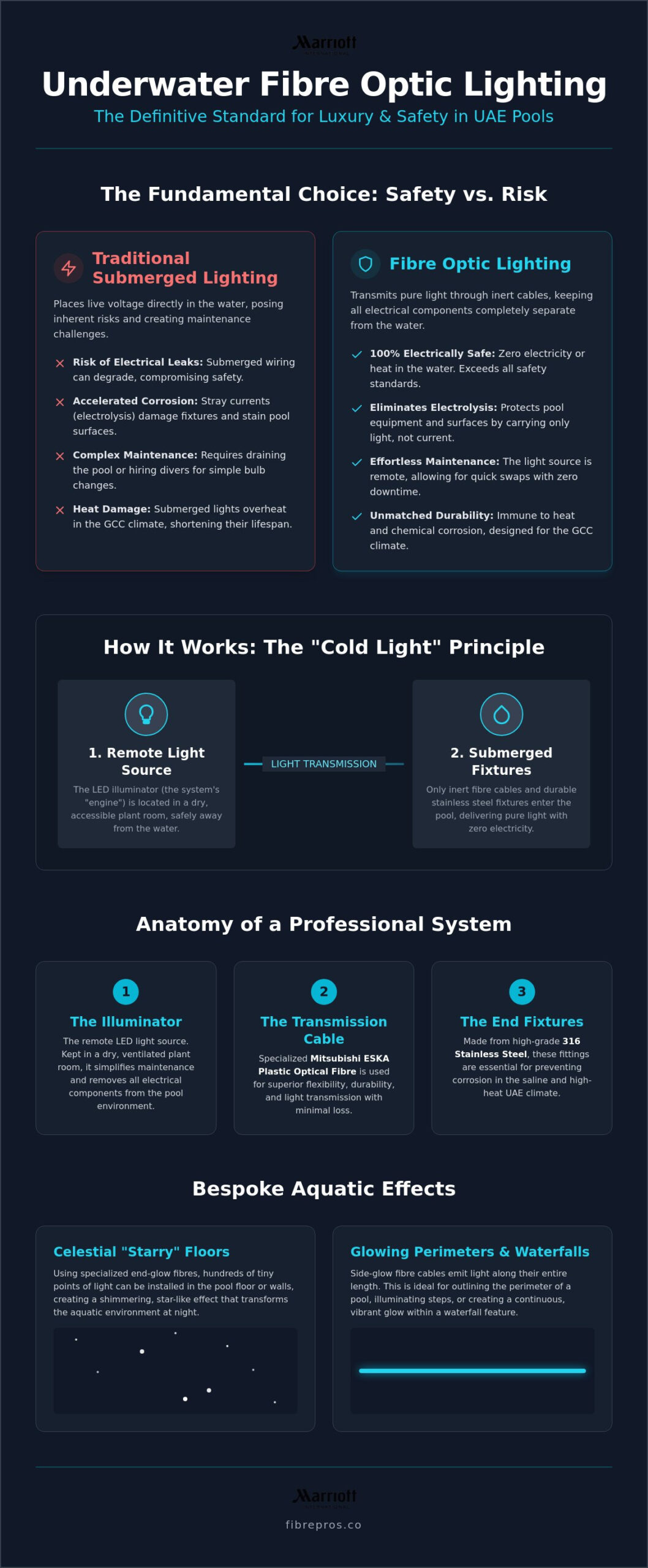
In high-end aquatic design, safety isn’t a luxury; it’s a non-negotiable requirement. Underwater fibre optic lighting has become the benchmark for Dubai’s most prestigious projects because it operates on the “Cold Light” principle. Unlike traditional LED systems that place a powered light source directly in the water, fibre optics transmit light from a remote LED illuminator through flexible cables. This physical separation means there’s zero electricity present in the pool basin. It’s a fundamental shift in how we approach submerged illumination.
Architects and MEP consultants across the GCC prioritize this technology to eliminate the risks associated with electrolysis. In modern pool systems, particularly those using salt-water chlorination, stray electrical currents can accelerate the corrosion of metal components and disrupt ionic filtration. Electrolysis occurs when submerged electrical components leak micro-currents into saline water, causing rapid oxidation of metal parts. This often results in unsightly brown staining on pool tiles and the premature failure of expensive filtration units. Because fibre optics carry only photons and no current, they bypass these electrochemical challenges entirely. Understanding the anatomy of an optical fiber reveals how internal reflection allows light to travel long distances with minimal loss, keeping the electrical infrastructure safely housed in a dry, ventilated plant room.
Maintenance efficiency is another critical factor for commercial operators. In a high-occupancy pool at a Dubai resort, closing the facility to drain water or hire a diver for a bulb change is a logistical nightmare. With a fibre optic system, the “engine” of the light is accessible on land. You can swap an LED source in minutes without ever touching the water. This ensures zero downtime and keeps the facility operational during peak hours.
The Safety Factor: Electricity vs. Light
Current UAE regulations for Zone 0 aquatic environments require Safety Extra-Low Voltage (SELV) systems, typically capped at 12V AC or 30V DC. While compliant, these systems still involve submerged wiring that can degrade over time. Fibre optic systems exceed these standards by removing the voltage source from the water altogether. This is vital for saline environments where water conductivity is higher. By utilizing a remote LED illuminator, you ensure a 100% electrically safe environment for swimmers, meeting the most stringent international aquatic safety standards.
Long-Term Durability in the GCC Climate
The UAE’s extreme ambient temperatures can cause traditional submerged lights to overheat, which shortens the lifespan of internal drivers and seals. Fibre optic systems don’t transfer heat to the water. The cables are designed to withstand high thermal stress without degrading. When paired with high-grade underwater lighting fixtures made from 316 stainless steel, the system remains immune to the chemical corrosion common in chlorinated pools. This combination ensures that the lighting’s aesthetic quality remains consistent for decades, even in the harshest Middle Eastern conditions.
The Anatomy of a Professional Underwater Fibre Optic System
A professional underwater fibre optic lighting installation is a coordinated hardware stack designed for high-performance transmission and environmental resilience. Unlike standalone LED fixtures, this system relies on three distinct components: the remote light source, the transmission cable, and the submerged end-fittings. Each element must meet specific technical grades to ensure the system survives the chemical and thermal pressures of a luxury pool environment. Precision in selecting these components prevents common failure points like light attenuation or fixture tea-staining.
The system’s integrity also depends on the conduit network. A dedicated, smooth-bore conduit protects the fibre harness from mechanical damage during installation and provides a clean path for the light to travel. Following established safety standards for underwater lighting ensures that these conduits are properly sealed, preventing water from migrating back toward the electrical components in the plant room.
Choosing the Right LED Illuminator
The LED illuminator acts as the system’s engine. It stays in a dry, ventilated location, projecting light into the harnessed fibre ends. For luxury residential pools, 100W to 150W illuminators typically provide sufficient luminosity, while larger commercial fountains may require high-output units with advanced cooling. Modern systems integrate DMX or Bluetooth controls, allowing for seamless synchronization with home automation platforms. Selecting the correct wattage is vital for maintaining brightness across multiple output points. For a detailed breakdown of specifications, consult our guide on choosing LED illuminators.
Mitsubishi ESKA POF: The Technical Advantage
The quality of the cable determines how much light actually reaches the pool floor. We specify Mitsubishi ESKA Plastic Optical Fibre because it offers superior light transmission over long runs, often exceeding 15 metres without noticeable dimming. Plastic Optical Fibre (POF) is significantly more durable than glass alternatives in aquatic settings. Its superior bend radius allows it to navigate the complex geometries of modern pool steps and infinity edges without fracturing. This flexibility ensures a uniform glow across the entire installation, regardless of the pool’s architectural complexity.
To finalize the system, we utilize 316 stainless steel fixtures for all underwater termination points. This grade of steel is essential in the UAE to resist the pitting and corrosion caused by high chlorine levels and saline water. These fixtures house the end-glow or side-glow fibres securely, providing a refined finish that matches other high-end pool hardware. If you’re designing a complex aquatic feature, the technical team at Fibrepros can assist with precise fibre harness calculations to optimize your light output.
Applications: Creating the “Starry Floor” and Glowing Waterfalls
The versatility of underwater fibre optic lighting allows designers to execute lighting schemes that are impossible with traditional sealed-beam units. Because the light is delivered via flexible strands, you aren’t limited to large, recessed niches. Instead, you can treat light as a textural element, integrating it into the very fabric of the pool’s finish. This capability is particularly effective for accentuating the architectural movement of water, whether it’s the steady arc of a sheer descent waterfall or the subtle shimmer of a sun shelf.
Modern luxury aquatic design often utilizes a mix of Side-Glow Fibre and End-Glow Fibre to create layers of light. While side-glow provides a continuous, linear “necklace” of light along the pool’s perimeter or steps, end-glow focuses on puncturing the darkness with precise, brilliant points of illumination. This dual approach ensures that the lighting is both functional for safety and visually arresting for entertainment.
Designing a Starry Pool Floor
Recreating a celestial night sky on the floor of a pool requires meticulous planning during the tiling phase. A realistic “near and far” star effect is achieved by mixing different fibre diameters, typically 0.75mm, 1.0mm, and 1.5mm strands. For a convincing density, we recommend a distribution of 50 to 100 points per square metre. These strands are fed through the pool shell and trimmed flush with the grout line. When connected to a Star Ceiling Kit adapted for aquatic use, the result is a shimmering, three-dimensional floor that appears to have infinite depth. This installation demands technical precision to ensure each fibre is sealed with marine-grade epoxy, preventing water ingress into the conduit harness.
Illuminating Water Features
Waterfalls and fountains present unique challenges for traditional lights, which often create harsh glare or hot spots. Underwater fibre optic lighting solves this by using Side-Glow Fibre to highlight the water’s trajectory. By installing a side-glow cable along the weir of a waterfall, you can illuminate the entire “sheet” of water from within the stream. For fountain nozzles, we utilize specialized stainless steel fixtures that house end-glow fibres, projecting light directly into the aerated water column. These effects can be synchronized with the main pool basin through a central LED illuminator, ensuring a cohesive colour palette across the entire property. This integrated control is essential for creating the sophisticated, multi-sensory environments expected in Dubai’s luxury residential sector.
Safety lighting for high-traffic areas like benches and steps also benefits from this technology. Subtle runs of side-glow fibre provide clear edge definition without the blinding intensity of standard LEDs. This enhances guest safety during night-time use while maintaining a refined, low-glare aesthetic that complements the surrounding landscape design.
Technical Selection: Materials for Saline and High-Heat Environments
The operational success of underwater fibre optic lighting in the Middle East depends on the chemical and thermal resilience of its components. While the fibre itself carries no heat, the system is exposed to the aggressive conditions of UAE pool water, which often features high salinity and elevated chlorine levels. Selecting materials that resist pitting and oxidation is the only way to avoid the rapid degradation common in lower-tier installations. Engineering a system for a Dubai summer requires a deep understanding of how these materials interact with the local environment.
Material selection also extends to the optical performance of the pool itself. The interior finish of the basin dictates the technical requirements of the fibre harness. Light-coloured surfaces, such as white marble or light grey tiles, reflect light efficiently, allowing for a more subtle fibre distribution. Darker finishes, like deep navy or black basalt, absorb a significant portion of the light spectrum. In these instances, we specify higher strand counts to ensure the illumination remains visible and vibrant against the absorbent background. High-performance Mitsubishi ESKA POF is essential here, as its superior core clarity prevents additional light loss during the transmission from the illuminator to the dark pool floor.
Fixture Material Standards
In the saline environments of the GCC, 304-grade stainless steel is insufficient and will likely show signs of tea-staining within months. We exclusively utilize 316-grade stainless steel for all submerged end-fittings and lenses. 316L stainless steel is the marine-grade standard for pool fittings, containing molybdenum to provide superior resistance against chloride-induced corrosion. For installations involving salt-water chlorination or bromine, we often pair these steel fixtures with high-density polymer housings. This combination provides a secondary layer of chemical protection, ensuring the fixture remains structurally sound and aesthetically pristine for the duration of its service life.
Environmental Protection for the Illuminator
The LED illuminator is the only electrical component in the system, and its placement is critical for longevity. While the submerged fixtures must carry an IP68 rating, the illuminator requires a dry, ventilated environment. In the UAE, placing an illuminator in a sealed, non-ventilated box can lead to thermal throttling, where the LED reduces its own brightness to prevent heat damage. We recommend housing the illuminator in an IP-rated enclosure with active or passive ventilation, ideally located in a plant room or a shaded, accessible area. This accessibility ensures that if the LED source needs a routine check or a colour-wheel adjustment, it can be serviced without disrupting the pool’s operation or safety. If you are currently specifying a high-end aquatic project, you can contact Fibrepros for a technical material consultation to ensure your hardware meets these rigorous GCC standards.
Specifying Underwater Fibre Optics with Fibrepros
Fibrepros serves as the technical authority for MEP consultants and architects across the GCC. Since 1995, we’ve delivered specialized lighting solutions for the region’s most demanding aquatic environments. We don’t just supply components; we provide a comprehensive infrastructure package designed for long-term reliability. Our role is to alleviate the technical anxieties of B2B clients by ensuring every underwater fibre optic lighting system is engineered for zero-failure performance. This commitment to technical precision has positioned us as a dependable expert in a high-stakes industry where safety and uptime are critical.
Working with an expert partner ensures that the “Cold Light” principle is implemented with absolute precision. We understand the specific challenges of the UAE heat and saline conditions. By providing authentic Mitsubishi ESKA Plastic Optical Fibre and 316 stainless steel fixtures, we maintain a standard of elite craftsmanship that generalist suppliers can’t match. Our physical presence in Dubai and Riyadh allows us to offer localized support that’s both responsive and technically grounded, ensuring your project stays on schedule.
The Fibrepros Design Process
Our engagement begins long before the first cable is laid. We work directly from project planimetry to conduct light-mapping, ensuring that strand counts and illuminator placement are optimized for the specific pool geometry. This data-driven approach prevents the common issue of uneven illumination or “dead zones” in large aquatic basins. Once the design is finalized, we assemble custom fibre harnesses in our facility. These pre-configured kits allow for rapid on-site installation, reducing labour hours and minimizing the risk of installation errors. For a deeper look at our broader decorative capabilities, you can explore our fiber optic lights guide.
Regional Logistics and Support
Operational efficiency is a hallmark of our service model. We maintain robust logistics networks to ensure fast delivery to project sites in Abu Dhabi, Doha, Muscat, and Jeddah. Our technical teams provide on-the-ground expertise during the critical commissioning phase, ensuring that every underwater fibre optic lighting system meets the intended design specifications. This end-to-finish service package is why Fibrepros remains the trusted partner for luxury hospitality brands and government infrastructure projects throughout the Middle East. We take pride in the vital infrastructure we help build, providing a level of specialized mastery that ensures your aquatic features remain safe and stunning for decades.
Consult with a Fibrepros specialist for your next aquatic project to begin the technical specification process and ensure a 100% electrically safe environment.
Elevating Aquatic Safety and Design Standards
Implementing a high-performance system requires more than just high-quality components; it demands a deep understanding of the Middle Eastern environment. You’ve seen how the “Cold Light” principle ensures absolute electrical safety while specialized materials like 316 stainless steel prevent the corrosion typical in saline pools. By selecting underwater fibre optic lighting, you choose a solution that eliminates maintenance downtime and provides unmatched decorative flexibility, from celestial floors to glowing cascades.
As an authorized supplier of Mitsubishi ESKA POF with over 25 years of Middle East expertise, Fibrepros ensures every installation meets the highest technical standards. Our specialized 316 stainless steel components are engineered specifically for the intense heat and chemical demands of Dubai and Riyadh. We provide the technical precision required for high-stakes projects where reliability is the primary metric of success.
Get a Professional Quote for Your Underwater Lighting Project
We look forward to helping you realize your vision for a safe, luminous, and enduring aquatic feature.
Frequently Asked Questions
Is underwater fibre optic lighting safer than traditional LED pool lights?
Yes, underwater fibre optic lighting is the safest illumination method available because it removes all electrical current from the water. While traditional LED fixtures involve submerged cables and drivers, fibre optic systems only transmit light through plastic strands. This eliminates the risk of electrical leaks, shocks, and electrolysis, providing total peace of mind for residential and commercial pool owners.
Can I install a starry floor in an existing swimming pool?
A starry floor is best installed during new construction or a major re-tiling renovation. Because the individual fibre strands must be embedded behind the pool finish and trimmed flush with the grout, it’s not possible to add them to a finished pool without removing the tiles. If you’re planning a refurbishment, this is the perfect stage to specify a bespoke celestial design.
How long do the bulbs in a fibre optic illuminator last?
Modern LED illuminators are designed for longevity, typically offering a service life between 30,000 and 50,000 hours. Unlike traditional underwater lights that require draining the pool or hiring a diver for bulb changes, these light sources are housed in a dry location. You can replace the LED source in minutes without ever touching the water, significantly reducing long-term maintenance costs.
Do fibre optic cables in a pool ever need to be replaced?
High-quality cables like Mitsubishi ESKA POF are engineered to last the entire lifespan of the pool. These fibres don’t have filaments to burn out and don’t suffer from the same degradation as copper wiring in saline environments. Provided the fibres are installed within a protective conduit, they’ll remain functional and clear for decades.
Is fibre optic lighting bright enough for a large commercial pool?
Yes, fibre optics can effectively light large commercial basins when the system is correctly specified. By using high-wattage LED illuminators and high-density fibre harnesses, we achieve professional lumen levels that meet safety and aesthetic requirements. The light is distributed evenly, avoiding the harsh hot spots and glare often associated with high-powered traditional spotlights.
What is the maximum distance the fibre can run from the light source?
We generally recommend a maximum run of 15 to 20 metres from the illuminator to the fixture to ensure optimal brightness. While light can travel further, light loss or attenuation becomes more noticeable beyond these lengths. Using premium underwater fibre optic lighting components ensures that light transmission remains efficient and vibrant across these standard distances.
Can I change the colours of my pool lights using my smartphone?
Modern systems offer full integration with smartphone apps and smart home platforms. By using DMX, Bluetooth, or RF-enabled illuminators, you can control colour cycles, dimming levels, and timing schedules from your phone. This allows for instant atmosphere adjustments, whether you’re hosting an event or seeking a calm, monochromatic glow.
Does the UAE heat affect the performance of fibre optic cables?
The intense UAE heat doesn’t degrade the fibre cables themselves, as they’re thermally stable and don’t carry heat. However, the LED illuminator requires proper ventilation to function at peak efficiency. Placing the light source in a shaded, ventilated plant room prevents thermal throttling, ensuring the system delivers consistent brightness even during the peak of a Dubai summer.