
The true cost of choosing led vs halogen illuminators isn’t found on a simple spec sheet; it’s measured in the physical lifespan of your fibre optic cables. While halogen was once the industry standard for its warmth, its high heat output often leads to the thermal degradation of premium Mitsubishi ESKA plastic optical fibre. In the GCC region, where ambient temperatures already challenge hardware, using an outdated light engine can quickly turn a luxury installation into a significant maintenance liability.
You likely want a lighting solution that delivers consistent, high-performance output without the constant cycle of bulb changes or the risk of heat damage to expensive side-glow fixtures. This guide provides a technical comparison of modern light engines to help you protect your infrastructure investment and choose the right hardware for your specific environment. We’ll explore how LED technology offers up to 80% energy savings and 50,000-hour lifespans while ensuring your project remains compliant with Dubai’s latest Al Sa’fat green building standards and the June 2026 public safety mandates.
Key Takeaways
- Learn why thermal management is the most critical factor in protecting Mitsubishi ESKA fibre optics from permanent heat damage.
- Evaluate the technical data behind led vs halogen illuminators to understand how modern LED engines achieve up to 80% energy savings.
- Discover why the low heat output of LED is essential for maintaining fixture integrity in the high-ambient temperatures of Dubai and the GCC.
- Identify the “hidden costs” of halogen systems, including frequent bulb maintenance and the risk of expensive fibre bundle replacement.
- Determine the optimal light engine for specialized applications, from silent star ceilings to durable underwater pool lighting.
Understanding the Evolution: Halogen vs LED in Fibre Optic Systems
The illuminator, or “light engine,” serves as the central power plant for any fibre optic installation. While the cables themselves are passive conduits, the illuminator determines the brightness, color, and longevity of the entire system. It transforms electrical energy into a concentrated beam of light, which then travels through the Optical fiber to reach the end fixtures. In the technical debate of led vs halogen illuminators, your choice often dictates whether a project remains a low-maintenance asset or becomes a costly technical burden.
What is a Fibre Optic Illuminator?
An illuminator is a specialized enclosure housing the light source, power electronics, and often a color or twinkle wheel. Its most critical component is the coupling head. This hardware interface aligns the fibre bundle perfectly with the light beam. Precision at this junction is vital. Even a minor misalignment leads to significant light loss or localized heat buildup. For high-end projects using Mitsubishi ESKA Plastic Optical Fibre, the illuminator must focus light with surgical accuracy to ensure uniform illumination across every strand in the bundle.
The Core Technological Differences
The fundamental difference lies in how these two systems generate light. Halogen illuminators rely on incandescence. They heat a tungsten filament until it glows, a process that inherently produces more heat than visible light. This necessitates high-speed cooling fans to prevent the unit from melting its own internal components. These moving parts represent a common failure point in older Dubai installations. When the fan fails, the heat buildup can destroy the light source and the connected fibre optics within minutes.
LED technology uses electroluminescence. Light is created by passing a current through a semiconductor, resulting in a solid-state system with no moving parts. This shift has redefined the luxury lighting sector in the GCC. While halogen was the standard during the initial construction booms of the 1990s and early 2000s, the industry has moved toward LED for several reasons. Modern led vs halogen illuminators offer significantly higher uptime and technical reliability. The absence of cooling fans makes LED units ideal for quiet indoor spaces like bedrooms or spas. Most importantly, the lower operating temperatures protect the physical integrity of the fibre optic strands over decades of use.
Technical Performance: Energy Efficiency and Thermal Output
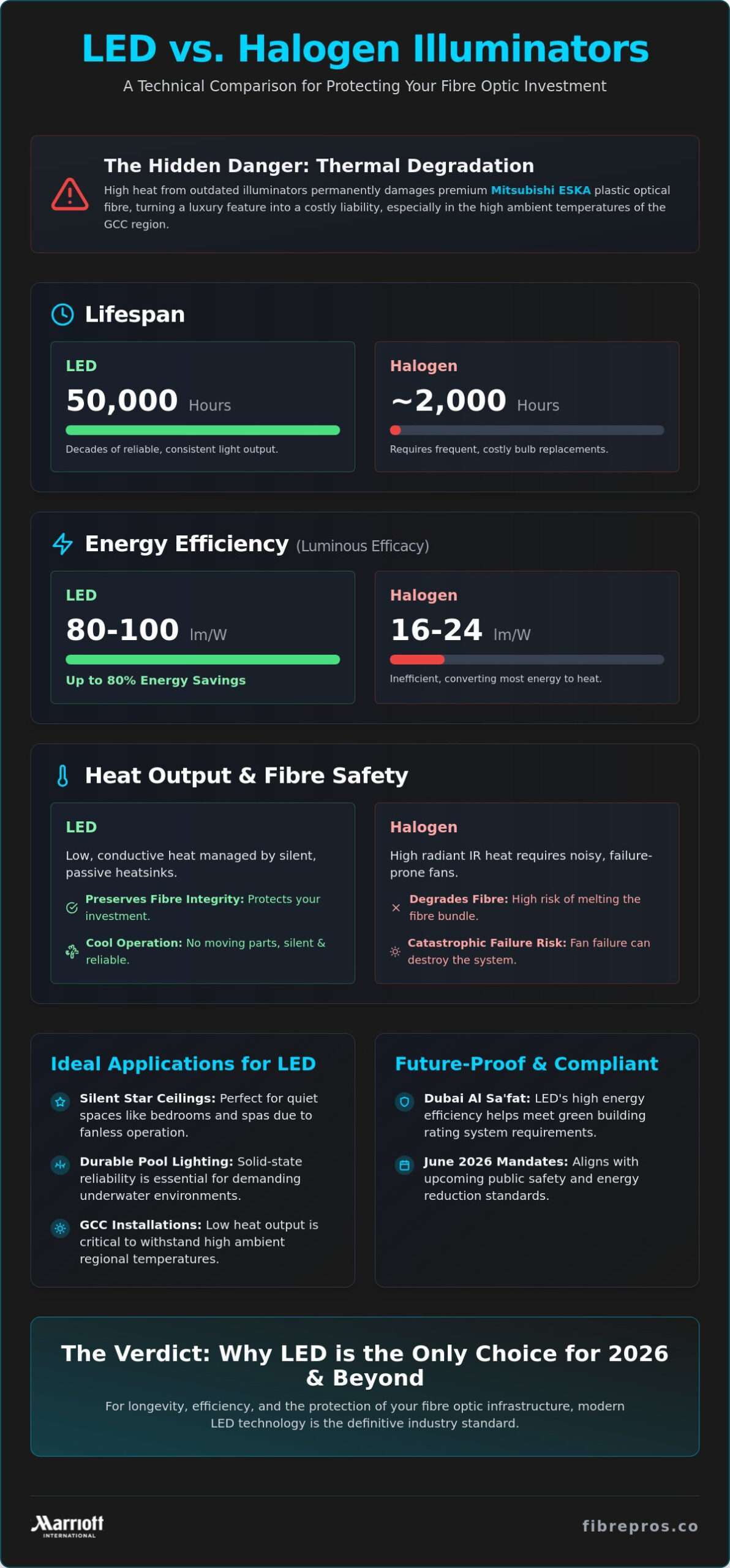
Comparing led vs halogen illuminators requires a look at the fundamental efficiency of light production. Halogen technology is inherently inefficient, converting only a small fraction of energy into visible light while the rest is lost as heat. Standard halogen units typically deliver 16 to 24 lumens per watt. In contrast, high-performance LED engines achieve 80 to 100 lumens per watt. For large-scale installations in Dubai, where lighting often runs 24/7, this efficiency gap translates into a 50% to 80% reduction in energy consumption, directly supporting the energy reduction plans mandated by Dubai Federal Decree-Law No. (11) of 2024.
Luminous Efficacy and Brightness
Luminous efficacy in the context of fibre optic coupling is the measure of how effectively a light engine converts electrical power into visible light that is successfully injected into the optical fibre bundle. Modern LED optics are engineered for this specific purpose. They produce a tighter, more coherent beam than the multi-directional output of a halogen bulb. This precision allows LED illuminators to power longer fibre runs with less signal attenuation. It ensures that the light reaching the end fittings remains crisp and vibrant, surpassing the perceived brightness of halogen systems which often struggle with light loss over distance.
Heat: The Silent Killer of Lighting Systems
Heat represents the single greatest threat to the reliability of a light engine. Halogen illuminators produce radiant infrared heat that penetrates the entire enclosure. This requires powerful cooling fans to prevent the internal electronics and the fibre connectors from melting. These fans are prone to dust buildup and mechanical failure, especially in the demanding environments of the GCC. When a fan fails, the resulting heat spike can cause catastrophic damage to both the unit and the connected fibre.
LED systems produce heat conductively, which is managed through passive heat sinks. This design eliminates the need for noisy, high-maintenance fans and significantly reduces the thermal load on building air conditioning systems. Meeting the Al Sa’fat Green Building Rating System often hinges on these thermal efficiencies. By reducing heat output, you lower the energy required to cool the room where the illuminator is housed. For those upgrading existing systems, choosing a specialized LED illuminator ensures compliance with 2026 energy mandates while protecting the longevity of the internal circuitry.
Fibre Longevity: How Halogen Heat Degrades POF
The material integrity of your lighting system depends entirely on thermal management at the source. When comparing led vs halogen illuminators, the most significant risk is not power consumption, but the permanent physical degradation of the fibre optics. Halogen systems produce intense infrared radiation. This heat is focused directly onto the coupling head where the fibres are gathered. For high-performance installations, this concentrated thermal energy acts as a slow but certain destructive force.
Thermal Stress on Mitsubishi ESKA Fibre
Plastic Optical Fibre (POF) is an engineered polymer designed for light transmission. High-performance brands like Mitsubishi ESKA Plastic Optical Fibre: The Gold Standard have specific safe operating temperatures. Halogen bulbs often exceed these thresholds at the point of contact. This leads to “browning” at the connector head, a sign that the polymer is carbonizing. Once this damage occurs, the fibre no longer transmits light efficiently. It begins to absorb energy, which generates even more heat, eventually melting the strands into a solid block of plastic.
Glass fibre can withstand higher temperatures, yet POF remains the standard for Dubai’s decorative and sensory projects due to its flexibility. LED technology solves the heat issue by emitting “cool” light. By keeping the fibre bundle at near-ambient temperatures, LEDs prevent the “tail” of the bundle from discolouring or becoming brittle. This protection ensures that expensive side-glow or end-glow installations maintain their factory-rated brightness for their entire service life without requiring the fibre to be cut back or re-polished.
Colour Rendering and Spectral Quality
A common myth in the led vs halogen illuminators debate is that only halogen can provide “warm” or “natural” light. While halogen has a perfect Colour Rendering Index (CRI) of 100, premium LED engines now achieve CRI ratings of 90 or higher. These modern LEDs provide excellent visual quality that is indistinguishable from traditional bulbs in most architectural settings. They also maintain this spectral consistency over 50,000 hours, whereas halogen bulbs shift their colour temperature as the tungsten filament thins over its much shorter lifespan.
LED engines also offer a technical advantage through RGBW (Red, Green, Blue, White) chips. Traditional halogen systems require mechanical colour wheels and motors to change hues. These moving parts are common failure points and create audible noise. LED technology manages colour mixing electronically. This allows for silent operation and seamless transitions between millions of colours. It is the superior choice for high-end star ceilings and luxury spa environments where technical reliability and acoustic comfort are equally prioritized.
Application-Specific Selection: Dubai and GCC Environments
Environmental conditions in Dubai and the wider GCC region place extreme stress on lighting hardware. When evaluating led vs halogen illuminators for these territories, ambient heat is the primary technical hurdle. Halogen units, which already operate at high internal temperatures, often struggle in outdoor enclosures where air temperatures can exceed 45°C. This combination leads to rapid bulb failure and housing deformation. LED technology remains the only logical choice for high-ambient environments because its thermal footprint is significantly smaller, ensuring the system remains stable throughout the hottest months of the year.
Pool and Underwater Lighting
Underwater installations require the light engine to be housed in external plant rooms or specialized enclosures. These spaces are often humid and poorly ventilated. Using a halogen source in these conditions creates a feedback loop of rising temperatures that can degrade the seals of the enclosure. For those specifying hardware for aquatic projects, LED engines provide the necessary reliability in saline and high-humidity environments. You can find more detail on selecting the right hardware in our guide to Underwater Lighting Fixtures for Luxury Pools.
Luxury Interiors and Star Ceilings
In high-end residential projects, acoustic performance is just as important as visual output. Traditional halogen illuminators require high-speed cooling fans that produce a constant hum, which is unacceptable for master bedrooms or private cinemas. Modern LED illuminators are often fanless, relying on passive cooling to remain silent. This makes them the preferred engine for Star Ceiling Kits in Dubai. These units also integrate seamlessly with smart home protocols like DMX or Bluetooth, allowing for precise control via centralized automation systems.
Beyond acoustics, maintenance logistics in the GCC have shifted. As of July 2026, sourcing high-quality halogen replacement bulbs has become increasingly difficult as manufacturers phase out older technologies in favor of solid-state lighting. An LED engine with a 50,000-hour lifespan eliminates the need for biannual maintenance visits, which is a critical advantage for commercial venues. For sensory rooms, the cool-to-the-touch nature of LED is a mandatory safety requirement, ensuring that even if a user comes into contact with the fibre bundle near the source, there is zero risk of thermal injury. If you’re ready to upgrade your infrastructure, you can view our range of LED light engines designed specifically for the Middle East market.
The Verdict: Why Fibrepros Recommends LED for 2026
The technical data gathered throughout this guide confirms that the choice between led vs halogen illuminators is no longer a matter of preference; it’s a matter of infrastructure protection. For modern installations in the Middle East, LED technology has replaced halogen as the professional standard. This shift isn’t just about following trends. It’s about securing a return on investment that halogen simply can’t match due to its inherent thermal and mechanical limitations.
Halogen systems carry significant hidden costs that emerge shortly after installation. Beyond the high energy consumption, the frequent need for bulb replacements creates a recurring maintenance expense. A standard halogen bulb may last only 1,000 to 10,000 hours, whereas professional LED engines provide over 50,000 hours of continuous operation. Most critically, the risk of heat-induced fibre degradation means that a halogen system could eventually require a full replacement of the Mitsubishi ESKA fibre bundle itself. This is a catastrophic expense that LED technology eliminates by maintaining safe, cool operating temperatures.
Retrofitting and Upgrades
Transitioning from an older light engine to a modern system is a straightforward process for most existing projects. Most fibre optic bundles are compatible with new LED light engines, provided the coupling head is correctly specified. When upgrading, we evaluate the diameter of your existing fibre bundle to ensure a precision fit. This ensures maximum light transmission and prevents the “browning” issues common with legacy hardware. For a detailed look at selecting your new hardware, see our guide on Choosing LED Illuminators for Fibre Optic Systems.
A seamless transition requires checking the current control protocols. If your existing system uses a mechanical colour wheel, we can often replace it with an RGBW LED engine that integrates directly with your current DMX or smart home setup. This upgrade not only improves light quality but also removes the noise and failure points associated with moving parts.
Next Steps for Your Project
Fibrepros remains committed to providing the highest standard of light engines for the GCC market. We specialize in hardware designed to withstand local ambient heat while delivering the technical precision required for luxury architectural lighting. Whether you’re designing a new underwater feature or retrofitting a star ceiling, selecting the right illuminator is the most important decision you’ll make for the system’s lifespan.
Our team can help you customize a light engine to meet specific lumen requirements and control options. We ensure every component meets the 2026 safety and energy standards mandatory for Dubai venues. Contact our specialists today for a technical consultation to secure the future of your fibre optic project.
Future-Proofing Your Fibre Optic Infrastructure
The technical shift in led vs halogen illuminators represents a critical advancement in how we protect and power architectural lighting. As established, the primary advantage of modern LED technology isn’t just the significant energy savings; it’s the preservation of the physical integrity of your Mitsubishi ESKA fibre optics. By eliminating the destructive infrared heat characteristic of halogen bulbs, you ensure that your side-glow or star ceiling installation remains as vibrant as the day it was commissioned.
Fibrepros has provided specialized Dubai-based expertise since 1995, helping clients navigate the transition to high-performance, solid-state light engines. Our current range of illuminators is fully DMX and Smart Home compatible, offering the precision control required for luxury GCC projects. We focus on delivering hardware that maintains operational accuracy despite the region’s challenging ambient temperatures.
It’s time to move beyond the high maintenance costs and thermal risks of legacy light engines. You can upgrade your lighting system with Fibrepros LED Illuminators to secure a more reliable and efficient infrastructure. We look forward to helping you achieve a technically superior lighting result that stands the test of time.
Frequently Asked Questions
Can I replace my halogen illuminator with an LED one using the same fibres?
Yes, you can typically replace a legacy halogen unit with a modern LED illuminator without changing your existing fibre cables. The critical step is ensuring the aperture of the new LED coupling head matches the diameter of your current fibre bundle. This retrofit allows you to upgrade your system’s efficiency and light quality while keeping your original infrastructure intact.
Are LED illuminators as bright as 150W halogen units?
Modern LED light engines often surpass the perceived brightness and functional output of 150W halogen units. While halogen bulbs produce high intensity, a large portion of that energy is wasted as infrared heat. LEDs focus their entire output into the visible spectrum, providing a crisper and more consistent light that travels more effectively through long fibre runs.
How long does a typical LED illuminator last compared to a halogen bulb?
A professional LED light engine generally provides a service life of 50,000 to 60,000 hours. In comparison, halogen bulbs typically require replacement every 1,000 to 10,000 hours depending on their intensity and the quality of the cooling system. For commercial installations in Dubai, this means an LED system can operate for years without the recurring cost of maintenance visits.
Why is my halogen fibre optic light engine getting so hot?
Halogen engines get hot because they create light through incandescence, a process that converts roughly 90% of electrical energy into heat. This radiant heat builds up inside the enclosure and must be managed by high-speed fans. In the led vs halogen illuminators comparison, halogen units are significantly more prone to overheating, which can eventually damage the internal electronics and the fibre bundle.
Do LED illuminators require cooling fans?
Many high-performance LED illuminators use passive heat sinks and don’t require internal cooling fans. This fanless design is a major advantage for residential star ceilings where total silence is required. While some ultra-high-output LED units may include a small fan, they operate at a much lower decibel level than the powerful cooling systems necessary for halogen bulbs.
What is the best colour temperature for a star ceiling in a luxury villa?
A colour temperature between 3000K and 4000K is the standard choice for luxury star ceilings. 3000K offers a warm, classic glow, while 4000K provides a neutral, modern appearance. Choosing specialized led vs halogen illuminators allows you to maintain a precise colour temperature over the system’s life, avoiding the yellowing or dimming that occurs as halogen filaments degrade.
Is LED lighting safer for underwater pool applications in Dubai?
LED technology is the safer choice for aquatic environments because it generates substantially less heat within the external enclosures. While the fibre optics carry no electrical current into the water, the light engine must be housed in a plant room or nearby box. LEDs reduce the thermal stress on these enclosures, preventing seal failure and protecting the hardware from the region’s high humidity.
Will switching to LED protect my Mitsubishi ESKA fibre cables?
Switching to an LED source is the most effective way to protect Mitsubishi ESKA fibre cables from permanent thermal damage. Halogen bulbs often produce enough heat at the coupling point to melt or discolour the polymer strands. By using a “cool” LED light source, you eliminate the risk of browning at the connector, ensuring your fibre maintains its factory-rated light transmission for decades.