
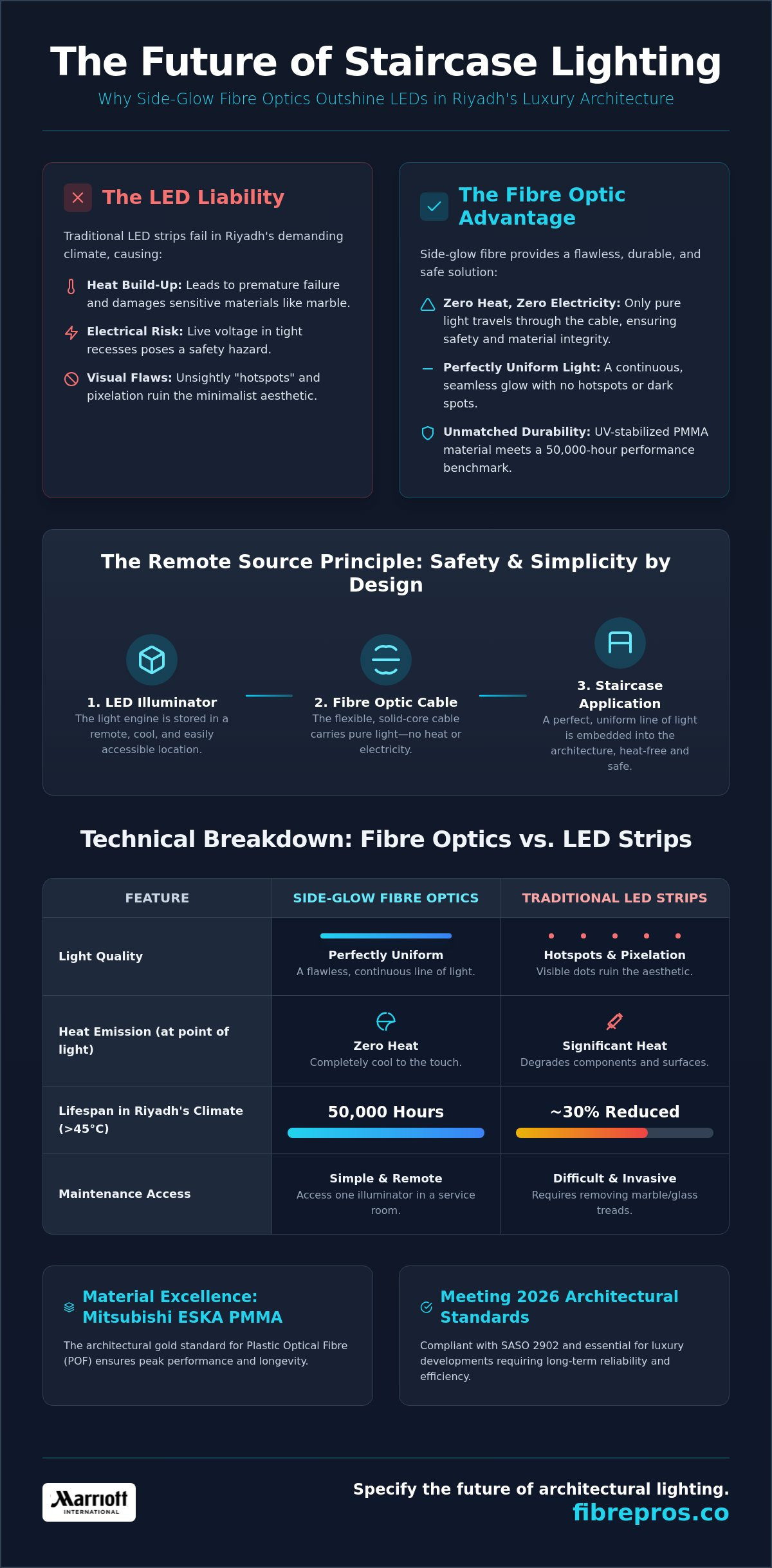
Why would you specify a lighting system that is practically guaranteed to lose 30% of its operational lifespan when Riyadh’s summer temperatures exceed 45°C? Traditional LED strips often struggle in the tight, enclosed recesses of luxury staircases, leading to unsightly hotspots on marble surfaces and premature failure due to heat build-up. It is a persistent challenge for developers who require both aesthetic perfection and technical reliability in high-traffic architectural features.
You can solve these issues by utilizing side glow fibre for staircase lighting Riyadh to create a perfectly uniform, heat-free line of light. This guide demonstrates how professional-grade Mitsubishi ESKA Plastic Optical Fibre achieves the “invisible architecture” look while ensuring the light source remains easily accessible for maintenance. We will examine the latest SASO 2902 standards, the 50,000-hour performance benchmarks required for 2026 projects, and the specific installation techniques that protect your investment from the harsh Saudi climate. Our specialized approach ensures that high-performance lighting remains a functional reality rather than a maintenance liability.
Key Takeaways
- Understand the remote source principle that separates electrical heat from the staircase structure, ensuring a safe and heat-free installation for high-traffic areas.
- Discover why PMMA materials like Mitsubishi ESKA Plastic Optical Fibre are essential for maintaining performance in Riyadh’s extreme temperatures.
- Master the integration of side glow fibre for staircase lighting Riyadh to achieve a perfectly uniform line of light without the visual distraction of LED hotspots.
- Identify the critical pre-construction routing and conduit requirements needed to seamlessly embed linear lighting into marble or glass architectural features.
- Learn how to select professional-grade LED illuminators and specialized components that meet the 2026 architectural standards for luxury developments.
What is Side Glow Fibre for Staircase Lighting?
Professional architectural lighting in Riyadh has moved beyond basic illumination. It’s now about precision and structural integration. Side glow fibre for staircase lighting Riyadh represents the pinnacle of this shift, acting as a linear lighting medium that emits a consistent glow along its entire length. Unlike traditional fixtures, this technology operates on a remote source principle. The light engine, or LED illuminator, sits in a remote, accessible location while the fibre optic cable carries only pure light to the staircase. Riyadh architects specify this system for luxury villas because it separates the light from the heat and electricity, protecting delicate materials like imported marble or custom glass.
There is a significant visual distinction between consumer-grade “neon” ropes and professional side-glow fibre optics. While cheap alternatives often look like plastic tubes with uneven brightness, professional fibre optics provide a sophisticated, architectural finish. This material allows for a seamless “hidden lighting” effect that highlights the textures of the staircase without revealing the source. It creates a soft, ambient glow that enhances safety without the harsh glare associated with exposed bulbs.
The Mechanism of Linear Light
The physics behind this effect involves a deliberate modification of total internal reflection. In standard data cables, light stays trapped inside to ensure signal integrity. In side-glow applications, the core is treated so that light “leaks” intentionally and uniformly through the sides. A protective outer cladding ensures the light path remains efficient while shielding the core from dust and moisture. Side-glow fibre is a solid-core or multi-strand polymer designed for uniform lateral light emission. Understanding how optical fibers work provides the technical foundation for why these systems maintain such high clarity over long distances without the voltage drop seen in electrical wiring.
Fibre Optic vs. LED Strips: The Riyadh Verdict
For high-end Riyadh projects, the comparison between fibre and LED strips usually ends in favor of optics. LED strips frequently suffer from “spotting” or “pixelation,” where individual diodes are visible through the diffuser. This ruins the minimalist aesthetic required for modern staircase designs. Side glow fibre for staircase lighting Riyadh eliminates this issue by providing a single, unbroken line of light that looks identical from every angle.
Safety and maintenance offer even stronger arguments for this technology. Because there is no electricity at the point of light, there is zero risk of heat build-up in enclosed recesses. This is critical for Riyadh’s climate, where trapped heat can degrade LED components rapidly. If a light source fails, you don’t need to remove marble treads or glass panels. You simply replace the light source in the remote LED illuminator. This ensures the architectural integrity of the staircase remains untouched while reducing long-term maintenance costs.
Technical Advantages of Professional Side Glow Fibre
Specifying side glow fibre for staircase lighting Riyadh requires a deep understanding of material science and environmental resilience. While glass fibre is often cited for its transmission properties, it’s typically too brittle for the intricate curves of bespoke staircases. Plastic Optical Fibre (POF), specifically high-grade PMMA, has become the industry standard. It offers superior bend radius flexibility, allowing it to navigate tight corners without the risk of fracturing. This durability is essential when embedding lighting into permanent structural elements like stone or glass treads where replacement is not an option.
Riyadh’s climate presents unique challenges that standard lighting components cannot meet. With summer temperatures frequently exceeding 45°C, thermal expansion and material degradation are constant threats. Professional-grade fibre optics are UV-stabilized to prevent the “yellowing” effect common in cheaper polymers when exposed to the intense Saudi sun through skylights or large windows. This stabilization ensures that the light remains crisp and white for the duration of its 50,000-hour performance benchmark. Energy-efficient lighting design principles also favor fibre optics, as a single high-efficiency LED illuminator can power multiple staircase runs, reducing the overall power consumption and heat load on the building’s cooling systems.
Mitsubishi ESKA: The Architectural Gold Standard
For high-end KSA projects, Mitsubishi ESKA Plastic Optical Fibre is the preferred choice for technical precision. It provides unmatched clarity and light distribution consistency, which prevents “dim spots” at the end of long staircase runs. While generic PMMA might suffer from significant light attenuation (brightness loss) after just a few meters, Mitsubishi ESKA maintains its intensity. This allows designers to plan continuous linear runs that wrap around multiple landings without losing visual impact. For those developing high-end residential projects, consulting with a technical specialist ensures the correct fibre diameter and illuminator power are specified from the outset.
Heat and Electrical Safety in Residential Design
Safety is a primary driver for adopting side glow fibre for staircase lighting Riyadh in family homes. Because the system carries only light and no electricity, it offers total isolation from electrical shorts. This is a critical consideration for staircases used by children and pets. There is zero heat emission at the point of light, which protects sensitive architectural materials like rare marble, wood veneers, or specialized adhesives from thermal stress. Because fibre optics carry only light, they are the only solution for lighting stairs with integrated water features. This separation of power from the fixture eliminates the risk of moisture-induced electrical failure, providing a reliable and maintenance-free solution for complex luxury designs.
Design Applications for Riyadh Luxury Staircases
Riyadh’s architectural landscape for 2026 demands a fusion of cultural tradition and futuristic precision. Side glow fibre for staircase lighting Riyadh offers the versatility needed to complement both minimalist modern villas and grand neoclassical estates. By embedding the fibre into the underside of stair treads, designers create a “floating” effect that makes heavy stone structures appear weightless. This technique highlights the architectural geometry without the visual clutter of bulky fixtures or visible wiring. It’s a specialized solution for those who prioritize clean lines and structural integrity.
For projects requiring a more ornamental finish, combining linear side-glow with crystal end fittings creates a hybrid luxury look. While the side-glow provides a continuous guide light along the length of the staircase, the crystal fittings add a point of brilliance at the start or end of the run. Handrail integration represents another critical application. By routing a slim channel along the underside of a rail, the fibre provides a glare-free, uniform light path. This improves safety for residents while maintaining a sleek, professional profile that standard LED strips cannot match due to their heat and thickness.
Lighting Materials: Marble, Glass, and Steel
The interaction between light and material is where professional side-glow fibre excels. When paired with translucent stones like Onyx or high-grade marble, the fibre can be installed behind or beneath the material to provide a soft, internal glow. In glass balustrades, the fibre creates a “ghost” light effect, where the light appears to originate from within the glass itself. A growing trend in Riyadh involves using RGBW LED illuminators for “Majlis” staircase transitions. This allows homeowners to switch from a classic warm white to a sophisticated ceremonial color for hosting guests, ensuring the lighting matches the social context of the space.
Zoning and Atmosphere Control
Lighting defines the architectural “spine” of a luxury home. Side-glow fibre serves as a visual connector between floors, guiding movement through the space with steady, purposeful illumination. The choice of color temperature is vital for local styles. Warm white (3000K) is typically specified for neoclassical interiors to enhance gold and stone tones. Conversely, cool white (5000K) suits the sharp lines of minimalist Riyadh villas. Most high-end developments in KSA now feature integrated smart home systems. Because the LED illuminators are the only electrical component, they are easily linked to DALI or KNX protocols for automated scene setting and total atmosphere control.
Installation Guide: Implementing Side Glow in Riyadh Projects
Successful implementation of side glow fibre for staircase lighting Riyadh begins during the shell and core phase of construction. Because architectural lighting is embedded into structural elements, pre-construction planning is mandatory. Architects must coordinate with stone masons and glass contractors to route precise channels and conduits for the fibre optic cables. These channels should be slightly wider than the fibre diameter to allow for thermal expansion, a critical factor given the regional climate. Unlike temporary DIY solutions, professional installations require permanent mounting techniques. Rigid track systems are used for straight, crisp lines on modern treads, while high-bond adhesive systems allow the fibre to follow the organic curves of bespoke neoclassical designs.
The placement of the light engine is a strategic decision. It must be located in a dry, ventilatable, and easily accessible area, such as a dedicated cabinet or a service room. This accessibility ensures that if the light source requires maintenance, the staircase’s structural integrity remains undisturbed. For complex projects, consulting with a specialist during the design phase prevents costly routing errors and ensures the system’s longevity.
The Role of the LED Illuminator
The LED illuminator functions as the heart of the entire system. It converts electrical energy into light and injects it into the fibre harness. Selecting the right LED illuminators is essential for ensuring consistent brightness across the required run length. For multi-floor staircases in large Riyadh villas, technical teams must calculate the specific wattage and lumen output to overcome light attenuation over distance. In grand foyers where multiple illuminators are used, syncing these units via DALI or KNX protocols is necessary to achieve a unified lighting effect. This ensures that every step and landing transitions between colors or brightness levels simultaneously.
Professional Finishing and Dust Protection
Riyadh’s environment presents a specific challenge: fine dust ingress. During installation, every fibre end must be sealed to prevent dust from entering the light path, which would otherwise diminish the system’s output over time. Professional installers use high-grit polishing techniques on the fibre tips at the source. This maximizes light entry and ensures the highest possible clarity. Before the final stone or glass cladding is applied, the entire system undergoes rigorous testing. Installers check for uniform glow, secure mounting, and proper thermal management within the illuminator housing. This disciplined approach ensures that the final result meets the 50,000-hour performance benchmark expected in high-end Saudi developments.
Sourcing Professional Fibre Lighting in the GCC
Sourcing side glow fibre for staircase lighting Riyadh requires moving beyond consumer-grade retail platforms. While online marketplaces often list “neon” cables or basic kits, these lack the technical certification and material longevity required for permanent architectural installations. Professional components are engineered to withstand the mechanical stresses of construction and the environmental demands of the Middle East. Choosing the wrong material leads to yellowing, light loss, and eventual system failure. For high-stakes luxury projects, reliability isn’t just a preference; it’s a structural requirement.
Local expertise in Riyadh and Dubai is critical for technical support. A supplier who understands the Saudi Building Code (SBC) and the latest SASO 2902 standards provides more than just hardware. They provide a guarantee of compliance and performance. Fibrepros has been supplying high-performance fiber optic lights across the GCC since 1995. This long-standing presence in the region ensures that architects and contractors receive components that have been proven to perform in the specific heat and dust conditions of the Saudi landscape.
Why Choose Fibrepros for Your Riyadh Project?
Architects and developers gain direct access to Mitsubishi ESKA Plastic Optical Fibre and industrial-grade LED illuminators. We don’t just ship products. We provide specialized knowledge of GCC architectural standards and the specific climate challenges discussed throughout this guide. Our team supports Riyadh designers from the initial concept phase to final commissioning. This ensures that the technical vision for the staircase is realized without the compromises often found in generic lighting solutions. We prioritize technical precision and operational success for every bespoke villa project.
Next Steps for Your Staircase Design
Moving from a design concept to a functional installation involves precise technical calculations. You can request a technical specification sheet to ensure your electrical and structural plans accommodate the necessary conduits and power requirements. Our specialists assist in determining the optimal fibre diameter and strand count for your specific light intensity goals. Whether your project is situated in Riyadh, Jeddah, or part of the emerging Red Sea developments, we provide the logistics and technical guidance to ensure a seamless delivery. Contact our technical team to discuss the specific requirements of your side glow fibre for staircase lighting Riyadh and receive a professional assessment of your project’s needs.
Advancing Riyadh’s Architectural Lighting Standards
The transition toward side glow fibre for staircase lighting Riyadh represents more than a stylistic choice; it’s a technical necessity for the modern Saudi luxury market. By isolating the light engine from the staircase structure, you eliminate the thermal risks associated with traditional LEDs and ensure the longevity of premium materials like marble and glass. This system provides a maintenance-free, perfectly uniform line of light that aligns with the “hidden lighting” trends of 2026.
Achieving this level of precision requires a partner who understands the unique environmental challenges of the region. As an authorized Mitsubishi ESKA supplier with specialized expertise in GCC luxury projects since 1995, we provide the industrial-grade components and technical support needed for operational success. Our heat-certified LED illuminators are specifically designed to maintain peak performance in Riyadh’s high-temperature climate. Consult with Fibrepros for your Riyadh Staircase Lighting Project to secure a lighting solution that combines elite craftsmanship with specialized technical mastery. We’re ready to help you transform your architectural vision into a durable, high-performance reality.
Frequently Asked Questions
Is side-glow fibre bright enough to be the primary light source for stairs?
Side-glow fibre provides sufficient illumination for guide lighting and architectural definition, but it’s typically used in conjunction with other sources. To meet the Saudi Building Code requirement of 150 lux for staircases, designers often pair fibre with overhead fixtures. The primary benefit is the uniform definition of each tread, which significantly improves safety in circulation areas without the glare of exposed bulbs.
Can I cut side-glow fibre optic cable to my own custom lengths?
You can cut side-glow fibre to any specific length required for your architectural layout. Because the cable is a passive polymer and contains no electrical circuits, it’s easily trimmed during installation. Professional installers use precision hot knives to ensure a clean, perpendicular end, which is vital for maximizing light transmission from the LED illuminator into the core of the side glow fibre for staircase lighting Riyadh.
How long does the light source (LED illuminator) last in the Riyadh heat?
High-performance LED illuminators are engineered to meet a 50,000-hour performance benchmark without degradation. While Riyadh’s summer temperatures often exceed 45°C, the light source is protected because it’s installed in a remote, ventilated interior location. This separation from the staircase structure prevents the typical 30% lifespan loss seen in standard LEDs that are directly exposed to high ambient heat.
Is side-glow fibre optic lighting waterproof for outdoor staircases?
Side-glow fibre is naturally waterproof because it carries only light and contains no electrical components or metal wiring. This makes it an ideal solution for outdoor staircases or features integrated with water. Only the remote LED illuminator requires protection from the elements, and it’s typically housed in an IP66-rated enclosure or placed within the building’s climate-controlled interior to ensure long-term reliability.
What is the maximum length a single side-glow fibre can run without losing brightness?
A single run of side glow fibre for staircase lighting Riyadh can typically maintain uniform brightness for up to 10 meters when powered from one end. For longer architectural runs, we recommend lighting the fibre from both ends using a dual-port illuminator. This technique allows for continuous runs of up to 20 meters while ensuring the center of the length remains as bright as the ends.
Does side-glow fibre require a special type of LED illuminator?
Side-glow systems require specialized LED illuminators that feature high-intensity emitters and precision lenses. These units are designed to focus light into a tight beam that enters the small diameter of the fibre core efficiently. Standard architectural LED drivers don’t have the optical housing necessary to transmit light into the polymer, so a dedicated fibre optic light engine is mandatory for performance.
Can I change the colour of my staircase lighting with a smartphone app?
You can control the color and intensity of your staircase lighting through smartphone apps or integrated smart home systems like DALI and KNX. Since the LED illuminator is the central control point, it can be equipped with RGBW chips and wireless receivers. This allows homeowners to automate lighting scenes or manually adjust the atmosphere of the staircase to match different social contexts or times of day.
How does the cost of side-glow fibre compare to high-end LED strips?
The initial hardware investment for side-glow fibre is generally higher than standard LED strips due to the cost of the remote illuminator. However, the long-term operational costs are significantly lower because you don’t need to replace failed strips embedded in stone or glass. Maintenance is restricted to the easily accessible light engine, making it a more cost-effective solution for permanent luxury infrastructure in Riyadh villas.