
Can a lighting system made of polymer truly withstand a decade of direct exposure to the 50°C heat and intense UV radiation of the Arabian Peninsula? The longevity of plastic optical fibre outdoors is a frequent concern for project managers who worry that high-intensity sunlight will lead to yellowing or material brittleness. It’s a valid anxiety, especially when coastal salinity and extreme thermal expansion are part of the daily operational reality for infrastructure in the Middle East.
We recognize that reliability is non-negotiable for your projects. You need the confidence that your architectural lighting won’t amber or fail after just a few seasons. This guide explains how high-grade plastic optical fibre survives the extreme heat, UV, and salinity of the GCC to provide decades of reliable lighting. We’ll detail the technical specifications of Mitsubishi ESKA materials, outline installation best practices for heat management, and show you why a 15 to 20 year lifespan is the expected standard for professional-grade systems. By focusing on polymer purity and UV-stabilized jacketing, you can eliminate the technical anxieties associated with outdoor fibre optics.
Key Takeaways
- Understand how UV Index 11+ and extreme thermal expansion cycles impact standard polymers and how to mitigate these environmental risks.
- Discover how molecular purity in PMMA ensures the longevity of plastic optical fibre outdoors by preventing premature light loss and ambering.
- Identify why Mitsubishi ESKA is the specified standard for GCC projects due to its superior double-clad protection against environmental ingress.
- Learn to select the correct jacketing materials and LED illuminator placements to maximize the operational life of your infrastructure.
- Gain confidence in the 20 year reliability and safety benefits of using high-grade POF for complex underwater lighting fixtures.
The GCC Stress Test: Environmental Factors Affecting POF Longevity
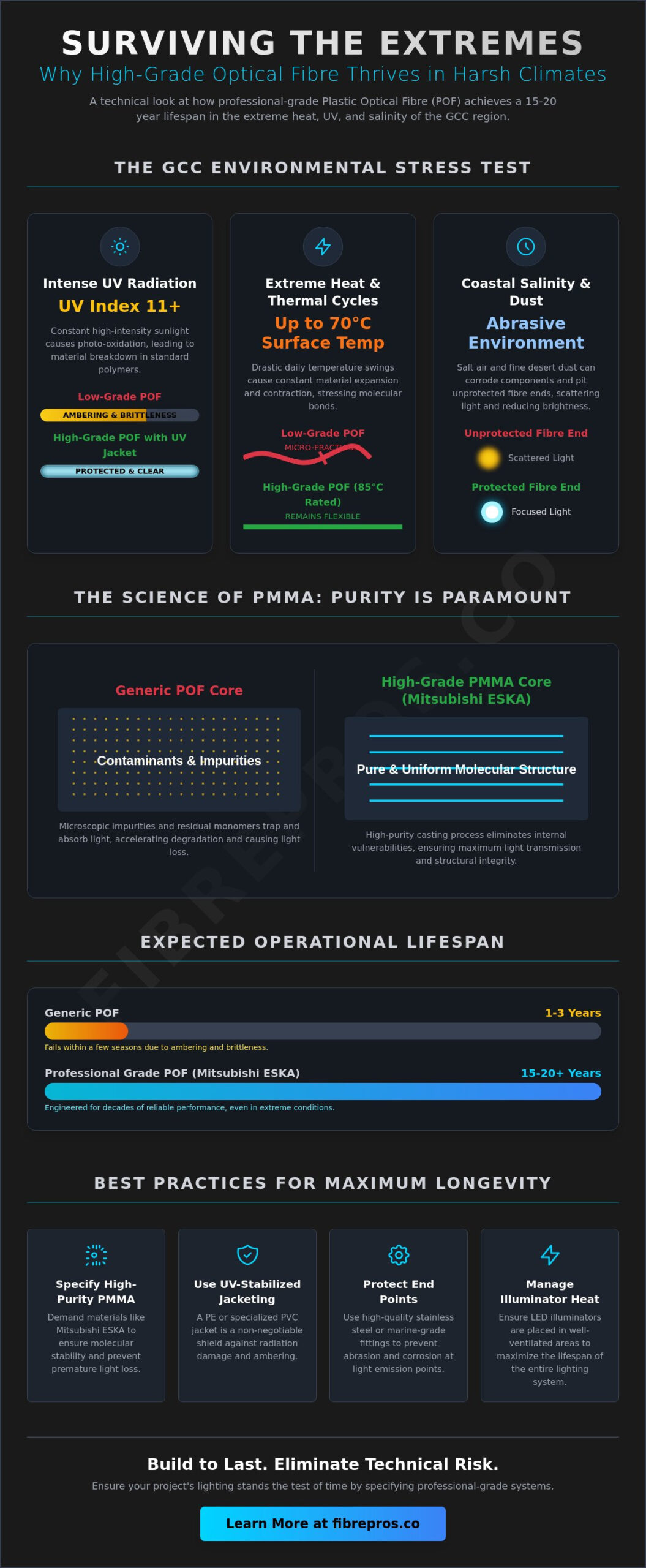
Middle Eastern climates are unforgiving for standard materials. When discussing the longevity of plastic optical fibre outdoors, we must look beyond theoretical lab tests. In cities like Dubai or Riyadh, infrastructure faces a relentless assault from UV radiation and extreme heat. Plastic optical fiber (POF) used for lighting is typically composed of a Polymethyl Methacrylate (PMMA) core. While PMMA is inherently more robust than many plastics, high-intensity UV exposure can degrade its molecular bonds. This degradation leads to a loss of clarity, directly impacting the light transmission efficiency of the entire system.
High UV Exposure and Polymer Yellowing
UV Index levels in the GCC frequently exceed 11. This intense radiation acts as a catalyst for photo-oxidation in low-grade polymers. The most visible symptom is yellowing, often called ambering. Instead of a crisp, white glow, the light shifts toward a warm, dull yellow. This isn’t just an aesthetic failure; it’s a sign of physical breakdown. To prevent this, professional installations require UV-stabilized jacketing. High-density polyethylene (PE) or specialized PVC jackets act as a shield, ensuring the inner core remains isolated from radiation damage. Without this barrier, the core is vulnerable to structural decay within just a few seasons.
Thermal Stability in Desert Heat
Temperature fluctuations in the desert are drastic. A surface can heat to 70°C in the sun and drop significantly at night. This cycle puts immense stress on the fibre. Every polymer has a Glass Transition Temperature where it becomes brittle. Standard POF might fail if it’s not rated for these extremes. Using fibres rated for 85°C operating temperatures is essential. This thermal headroom ensures the material remains flexible and maintains its structural integrity despite the relentless expansion and contraction cycles. High-grade PMMA maintains its optical properties across these shifts, whereas cheaper alternatives often crack under the strain.
Coastal projects in Jumeirah or along the Red Sea face an additional threat: salt air. Salinity can corrode generic lighting components, though the PMMA itself is chemically resistant. The real danger is the accumulation of salt and fine desert dust on the end-glow points. Over time, sand abrasion can pit the surface of the fibre ends, scattering light and reducing brightness. Using stainless steel fixtures and protective end fittings preserves the output quality. It’s about protecting the entire system, not just the cable. Proper maintenance and high-quality materials ensure the longevity of plastic optical fibre outdoors even in these harsh marine environments. PMMA’s inherent chemical resistance makes it ideal for these conditions, as it doesn’t react with salt or moisture like copper wiring might. When the system is engineered correctly, the fibre remains the most durable component of the entire lighting installation.
The Science of PMMA: Why High-Grade POF Outlasts Generic Alternatives
The core of high-performance plastic optical fibre is Polymethyl Methacrylate (PMMA), a transparent thermoplastic chosen for its exceptional optical clarity. However, not all PMMA is created equal. The longevity of plastic optical fibre outdoors depends almost entirely on the molecular purity of this core material. In low-grade alternatives, microscopic contaminants and residual monomers remain trapped within the polymer matrix. These impurities absorb light and accelerate the breakdown of the material when exposed to the high-energy photons of the Middle Eastern sun. Professional-grade fibres use a high-purity casting process that eliminates these internal vulnerabilities.
Molecular stability directly influences how the fibre handles physical stress. In the extreme heat of the UAE, materials become more pliable, but internal stresses from tight installation bends remain. High-grade PMMA maintains a consistent molecular structure that resists the formation of micro-fractures. Generic POF often develops tiny surface cracks, known as crazing, when subjected to thermal expansion while under tension. By ensuring a high molecular weight and purity, specialists can guarantee a tight bend radius that won’t fail over a 20-year operational lifecycle. This level of technical precision is why many engineers specify high-performance LED illuminators and fibre for critical infrastructure projects.
Light Transmission and Aging
Attenuation is the gradual loss of light intensity as it travels through the fibre, and this rate increases as the polymer matrix undergoes chemical aging over time. High-purity cores are engineered to maintain 90% or more of their original transmission efficiency even after decades of outdoor use. This performance differs between product types. End-glow fibre focuses on delivering a sharp point of light at the terminus, making it less sensitive to minor core clouding. In contrast, side-glow fibre relies on a consistent leakage of light along its length. If the polymer ages unevenly, the side-glow effect becomes blotchy or dim. High-grade materials ensure this aging process remains uniform and slow, preserving the intended aesthetic.
Chemical and Moisture Resistance
The Gulf’s summer humidity can reach 90%, creating a saturated environment that many materials can’t handle. PMMA is naturally hydrophobic, meaning it doesn’t absorb water that would otherwise cloud the optical path. Research into the Degradation Rates of Plastics confirms that high-quality polymers resist environmental stressors far better than recycled or low-purity resins. This resistance extends to harsh pool chemicals like chlorine and bromine. For luxury water features, POF is often the only viable choice because it remains chemically inert. Unlike glass fibre, which can be prone to stress corrosion in moist environments, PMMA thrives. It also offers superior performance in high-vibration outdoor settings, such as near heavy traffic or industrial equipment, where glass would eventually shatter. This mechanical resilience is a cornerstone of the longevity of plastic optical fibre outdoors.
Mitsubishi ESKA vs. Generic POF: A Longevity Comparison
Mitsubishi ESKA has become the specified gold standard for architectural projects in the UAE and Saudi Arabia. This reputation isn’t based on branding alone, but on a documented 20 year history of performance in the field. While generic fibres often degrade under the high UV and thermal stress of the GCC, ESKA retains its structural and optical integrity. The longevity of plastic optical fibre outdoors is fundamentally tied to the Double-Clad architecture used in Mitsubishi’s high-performance ranges. This design features a secondary cladding layer that acts as a physical barrier against environmental ingress, protecting the high-purity PMMA core from moisture and chemical pollutants.
Choosing high-grade fibre involves a higher initial investment, but a cost-benefit analysis reveals significant long-term savings. Replacing a failed lighting system in a completed landscape or water feature is an expensive, disruptive process. When labour, scaffolding, and potential damage to existing masonry are factored in, the cost of replacement far outweighs the price of premium materials. Installations across Dubai and Abu Dhabi using ESKA have reached two decades of service without needing major core replacements, proving the value of specifying the right material from the start.
The Mitsubishi ESKA Manufacturing Edge
The technical superiority of Mitsubishi ESKA Plastic Optical Fibre stems from its continuous casting process. Unlike batch processing, where consistency can vary between lots, continuous casting ensures a uniform molecular structure throughout the entire length of the fibre. This precision minimizes internal defects that could lead to light scattering. Additionally, the ESKA outdoor range incorporates proprietary UV-inhibitors directly into the polymer matrix, providing a level of protection that surface coatings simply cannot match.
Identifying Low-Quality Grey Market Fibres
Project managers should be wary of grey market products that lack clear branding or technical documentation. These low-quality fibres are often repurposed indoor-rated POF, which lacks the necessary UV stabilization for the Middle East. Warning signs include excessive stiffness out of the box, a milky or cloudy appearance in the core, and a lack of specific manufacturer markings. In the harsh GCC climate, these cheap alternatives often fail within 18 months, leading to brittle cables that snap under thermal expansion. Ensuring the longevity of plastic optical fibre outdoors requires verifying the source of the material to avoid these premature failures.
Best Practices for Maximizing Outdoor POF Lifespan
Specifying high-performance material is only half the battle. The longevity of plastic optical fibre outdoors depends heavily on the physical environment where it’s deployed and the precision of the installation. Even the most robust PMMA core can suffer if exposed to improper termination or excessive heat at the source. In the GCC, where surface temperatures regularly exceed 70°C, every installation choice must prioritize thermal management and moisture isolation. Following industry best practices ensures that your infrastructure remains operational for its intended 20-year lifecycle.
Material selection for jacketing is a critical first step. While PVC is a common choice for indoor applications, Polyethylene (PE) is often superior for outdoor Middle Eastern projects. PE offers better resistance to the plasticizer migration that occurs in high-heat environments, which can otherwise cause jackets to become brittle and crack. Additionally, the use of conduits is mandatory. Burying conduits provides a natural heat sink, maintaining a more stable temperature for the fibre. If surface mounting is unavoidable, using UV-rated black conduits is essential to shield the cable from direct solar radiation.
Installation Strategies for the UAE
- Step 1: House all fibres in UV-rated black conduits. This provides a secondary layer of protection against mechanical damage and radiation.
- Step 2: Use underwater lighting fixtures made of 316 stainless steel. This grade of steel is essential for resisting the high salinity found in coastal areas like Jumeirah or the Red Sea.
- Step 3: Seal termination points with marine-grade epoxy. This prevents moisture wicking, where humidity travels up the fibre core via capillary action, potentially damaging the illuminator.
Illuminator Protection and Heat Management
The longevity of plastic optical fibre outdoors is often compromised at the point of light injection. The LED illuminator must be installed in a ventilated, shaded area to prevent overheating. When an illuminator is trapped in a non-ventilated enclosure in the desert sun, internal temperatures can spike well beyond the safe operating limits of the polymer. This creates a heat sink effect at the fibre-to-illuminator interface, which can melt the fibre ends or cause significant light loss. Utilizing IP67 or IP68 rated enclosures is necessary for poolside or desert environments to keep dust and moisture out while allowing for adequate thermal dissipation. Proper airflow around the cooling fans of the illuminator is non-negotiable for system uptime.
Reliable performance starts with technical precision during the design phase. To ensure your project utilizes the correct materials and installation methods for the local climate, contact our specialist team for a technical consultation.
The Future of Outdoor Lighting: Why POF is the Reliable Choice
The longevity of plastic optical fibre outdoors represents more than just material durability; it’s a strategic choice for modern infrastructure. As architectural demands in the GCC evolve toward more complex and permanent installations, the limitations of traditional electrical lighting become clear. Plastic optical fibre provides a solution that combines aesthetic flexibility with a verified 20-year operational life. By centralizing the light source, developers can maintain high-performance lighting without the recurring costs and safety risks associated with distributed electrical components in harsh environments.
Safety remains the primary driver for POF adoption in luxury UAE water features. Because the fibre carries only light and no electricity, it’s the only 100% safe option for swimming pools and public fountains. This eliminates the risk of electrical faults in water, providing total peace of mind for property owners and consultants. Additionally, these systems are inherently future-proof. When lighting technology advances, you don’t need to excavate the fibre. Upgrading the system is as simple as replacing the centralized LED illuminator, allowing for new colours or higher brightness without ever disturbing the site’s physical infrastructure.
POF as a Sustainable Infrastructure Investment
Choosing a long-term lighting solution significantly reduces environmental impact. Most integrated LED fixtures require total replacement when the driver or diode fails, contributing to the growing problem of e-waste. In contrast, a POF system using high-grade PMMA lasts for decades. This durability maintains the property value of luxury developments by ensuring the lighting remains as crisp and vibrant as the day it was installed. The efficiency of a single, centralized light source also simplifies maintenance schedules, as technicians only need to access one ventilated location rather than dozens of individual outdoor fixtures across a large landscape.
Partnering with a Specialist in Dubai
The unique climate of the Middle East requires a partner who understands the specific technical challenges of the region. Fibrepros sources and tests materials specifically for their ability to withstand the extreme UV and thermal cycles of the GCC market. We ensure that every component, from the core fibre to the stainless steel fixtures, meets the highest professional standards. Our commitment to technical precision means we don’t just supply parts; we provide comprehensive infrastructure solutions designed for maximum uptime. We understand that in high-stakes commercial projects, reliability is the only metric that matters.
Contact Fibrepros for a technical consultation on your outdoor lighting project to ensure your next installation is engineered for the longevity of plastic optical fibre outdoors.
Engineering for Decades of Reliable Performance
Ensuring the longevity of plastic optical fibre outdoors requires a holistic approach that combines high-purity PMMA cores with rigorous regional installation standards. The difference between a three-year failure and a twenty-year success lies in specifying specialized materials like Mitsubishi ESKA and implementing precise thermal management strategies. These systems offer the only 100% safe solution for luxury water features while providing a future-proof foundation for architectural lighting. It’s about building infrastructure that survives the environment rather than just resisting it.
Since 1995, we’ve specialized in delivering GCC-compliant lighting solutions that stand up to the most extreme environmental conditions. As an authorized supplier of Mitsubishi ESKA Plastic Optical Fibre, we provide the technical precision required for high-stakes infrastructure and IP68-rated landscape systems. You shouldn’t leave your project’s durability to chance with generic alternatives that can’t handle the heat. Request a Technical Specification for Your Outdoor Project to ensure your lighting infrastructure is built to last. We’re ready to help you achieve total operational success.
Frequently Asked Questions
How many years does plastic optical fibre last outdoors in Dubai?
High-grade plastic optical fibre typically lasts between 15 and 20 years in the Dubai climate. This longevity of plastic optical fibre outdoors is achieved by using UV-stabilized polyethylene jacketing and protective conduits. While the desert environment is harsh, premium PMMA cores are engineered to maintain their structural integrity for decades without significant degradation when installed to professional standards.
Does the sun make plastic optical fibre turn yellow?
Low-grade plastics will yellow, but high-purity PMMA like Mitsubishi ESKA is highly resistant to ambering. Yellowing is caused by UV radiation breaking molecular bonds in inferior polymers. Premium fibres include proprietary UV-inhibitors and are protected by specialized jacketing, ensuring the light remains crisp and clear throughout the system’s operational life.
Can plastic optical fibre withstand the 50°C summer heat in the UAE?
Professional-grade POF can easily withstand 50°C heat; many systems are rated for operating temperatures up to 85°C. The longevity of plastic optical fibre outdoors in the UAE depends on proper heat management. You must house the fibre in conduits for buried runs and ensure the LED illuminator is placed in a ventilated, shaded enclosure to prevent thermal stress.
Is plastic optical fibre better than glass fibre for outdoor lighting?
POF is often superior for landscape and decorative lighting because it’s more flexible and durable than glass. Glass fibre can be prone to stress corrosion in high-humidity environments like the Gulf coast. PMMA remains chemically inert and handles high-vibration settings, such as areas near heavy traffic or machinery, without the risk of shattering.
What kind of maintenance does an outdoor POF system require?
Maintenance is minimal and focuses almost entirely on the centralized light source. You should periodically check the ventilation fans on your LED illuminator and ensure the area remains free of dust. Cleaning the fibre ends at the illuminator interface every few years ensures maximum light transmission efficiency and prevents heat buildup at the connection point.
Can I use POF for lighting a swimming pool safely?
POF is the only 100% safe choice for lighting swimming pools and water features. Because the cables carry only light and no electricity, there’s zero risk of electrical discharge in the water. This allows for creative underwater lighting fixtures that are both visually stunning and completely safe for residents and guests.
Does the light get dimmer as the plastic optical fibre ages?
Attenuation increases slightly over several decades, but high-quality cores maintain over 90% of their transmission efficiency throughout their lifespan. If a system appears significantly dimmer, the cause is usually dust accumulation on the illuminator lens or at the termination points. Regular cleaning of these interfaces typically restores the original brightness levels.
What is the best brand of POF for outdoor use in the Middle East?
Mitsubishi ESKA is the specified gold standard for architectural projects across the Middle East. Its double-clad architecture and specialized outdoor range are designed specifically to handle extreme UV and thermal cycles. Choosing a recognized brand ensures that the material meets the technical requirements for long-term reliability in the GCC climate.