
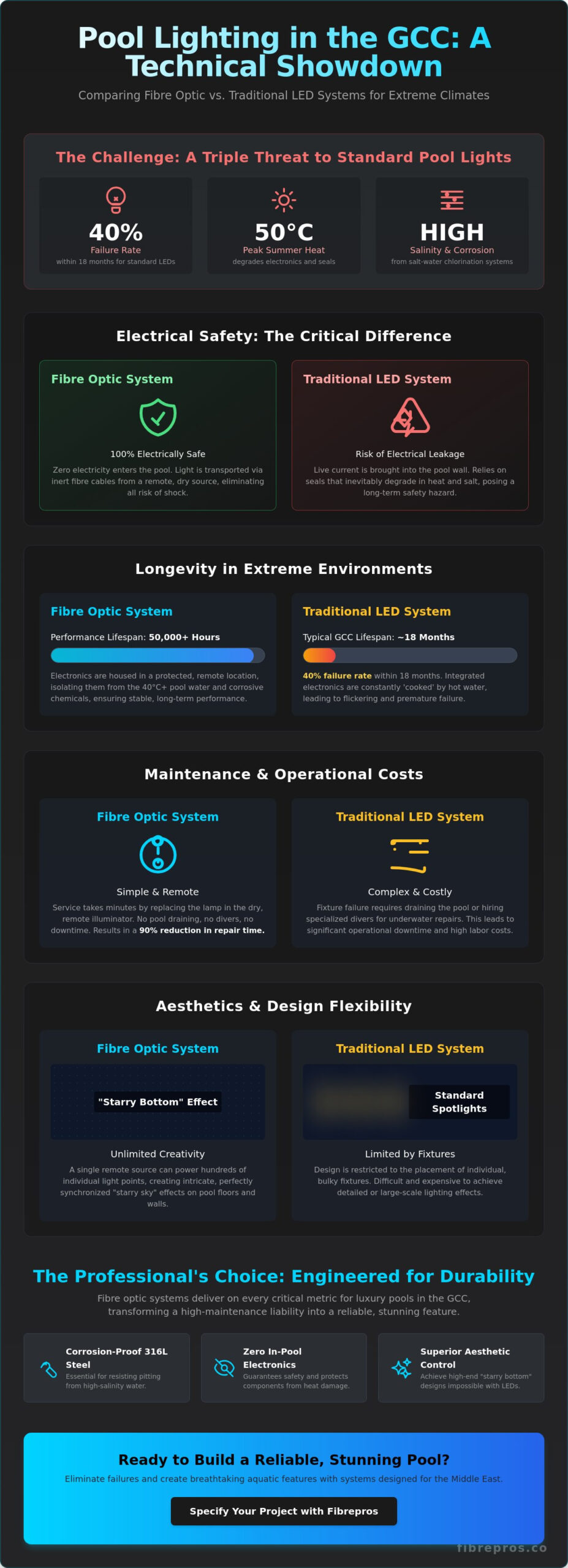
In the 50 degree Celsius peak of a Dubai summer, the average pool light faces a chemical and thermal assault that leads to a 40% failure rate within the first 18 months. You likely recognize that maintaining a luxury installation in the GCC is a constant battle against salt corrosion and relentless heat. It’s frustrating to invest in a high-end aesthetic only to deal with flickering bulbs or safety concerns regarding submerged wiring. This 2026 guide shows you how to select high-performance underwater lighting fixtures engineered with 316L stainless steel and advanced heat-dissipation technology. You’ll discover the specific technical requirements to achieve a maintenance-free setup that delivers 50,000 hours of performance while ensuring total electrical safety for every swimmer. We’ll examine the specialized infrastructure needed for elite effects like “starry bottom” pools and the precise hardware standards that withstand the Middle East’s extreme salinity levels. By following these technical benchmarks, you can transform a high-maintenance liability into a reliable, stunning architectural feature.
Key Takeaways
- Identify why 316 Stainless Steel is the essential material standard for resisting the extreme salinity and high temperatures of the UAE climate.
- Discover the critical safety advantages of fibre optic technology, which eliminates electrical risks by removing live current from your underwater lighting fixtures.
- Learn the professional design principles for calculating fixture density to achieve a high-end “Starry Bottom” aesthetic for luxury villas.
- Master the technical requirements for integrating corrosion-resistant terminals with high-output LED illuminators for a reliable, end-to-end pool lighting system.
The Challenge of Underwater Lighting Fixtures in Dubai’s Climate
Professional installation of underwater lighting fixtures involves more than simply placing a bulb behind glass. These systems comprise a complex assembly of specialized housing units, electrical terminals, and advanced light sources engineered for permanent submersion. In the high-stakes environment of Dubai luxury real estate, a failure in these components leads to expensive drainage and repair cycles. Understanding the fundamental mechanics of underwater lighting technology is the first step in protecting a multi-million dirham aquatic investment.
The UAE climate presents a unique set of stressors that quickly compromise standard equipment. High-performance underwater lighting fixtures must withstand a combination of intense UV radiation, extreme ambient heat, and high salinity levels. While a fixture might perform adequately in a temperate European climate for a decade, the same unit often fails within 18 months in the GCC if it isn’t specifically rated for these localized conditions. Reliability in this sector isn’t a luxury; it’s a technical requirement for operational uptime.
Corrosion and Salinity in the GCC
Salt-water chlorination systems are standard in 85% of new luxury pool builds in Dubai. These systems create a highly corrosive environment that accelerates the pitting of inferior metals. When standard brass or low-grade plastic housings interact with pool chemicals and salt, a galvanic reaction occurs that weakens the structural integrity of the seal. This often leads to water ingress at the terminal level. To ensure long-term durability, specifications must verify the use of 316 or 316L stainless steel. This grade contains molybdenum, which provides the necessary resistance to chloride-induced pitting that destroys 304-grade alternatives within a few seasons.
Heat Degradation and Electronics
Summer water temperatures in the GCC frequently exceed 40°C, creating a thermal management crisis for integrated LEDs. Most LED drivers are designed to operate in water that stays below 28°C. When the surrounding water is hot, it acts as an insulator rather than a coolant, causing the internal junction temperature of the LED to spike. This results in immediate flickering, color shifting, and eventual total failure of the driver. Utilizing remote-source lighting is the most effective way to remove sensitive electronics from the heat zone entirely. Thermal isolation is critical for UAE pool longevity because it prevents the 40°C ambient water temperature from overwhelming the internal circuitry and causing permanent diode degradation.
Maintaining older systems also reveals the risks of electrical leakage. As seals degrade due to heat and chemical exposure, the risk of moisture reaching the electrical terminals increases significantly. Modern installations prioritize low-voltage DC systems and advanced grounding protocols to eliminate safety hazards, but regular testing of the infrastructure remains a necessity for every project manager. High-quality fixtures use double-gasketed seals and potting compounds to provide a secondary line of defense against these inevitable environmental pressures.
Understanding Fibre Optic vs. Traditional LED Underwater Fixtures
The technical architecture of underwater lighting fixtures has shifted significantly toward safety and longevity. Traditional LED systems operate by bringing electrical current directly into the pool wall. Even with low-voltage transformers, these fixtures rely on seals and gaskets to prevent water from reaching live components. Fibre optic systems eliminate this risk entirely. They separate the light source from the water, using a remote illuminator located in a dry plant room or equipment cabinet. Light travels through flexible cables to the pool, ensuring that no electricity ever enters the water environment.
Maintenance cycles for these two technologies differ drastically. When a traditional LED fixture fails, the process often involves draining the pool or hiring specialized divers to access the niche. This creates operational downtime and increases labor costs. With fibre optics, you replace a single lamp or LED engine at the remote source. This process takes minutes and requires no contact with the water. In high-traffic hospitality environments, this 90% reduction in repair time is a critical operational advantage.
Aesthetic flexibility also favors fibre. A single remote source can power hundreds of individual points of light. This allows designers to create intricate “starry sky” effects on pool floors or precise perimeter highlights that stay perfectly synchronized. Traditional LEDs require individual wiring for every light point, which complicates the installation and increases the number of potential failure points in the waterproof shell.
The Anatomy of a Fibre Optic Underwater Fixture
A professional-grade installation relies on the quality of the transmission medium. We utilize Mitsubishi ESKA Plastic Optical Fibre to ensure maximum brightness and color accuracy. This fibre is housed within a protective conduit that runs from the plant room to the pool wall. The terminal end is secured by a fitting crafted from 316 stainless steel. This material is essential for GCC projects because it resists the corrosive effects of salt-water chlorination and high ambient temperatures. The stainless steel fitting protects the fibre ends while focusing the beam to achieve the desired illumination profile.
Traditional LED Fixtures: When to Use Them
Standard niche-mounted LEDs are still common in budget-conscious residential builds, but they present hidden long-term liabilities. The 45-degree heat of a Dubai summer accelerates the degradation of internal LED drivers and seals. When analyzing the total pool lighting cost Dubai, developers find that the frequent replacement of traditional units often exceeds the initial investment of a fibre system within four years. Luxury hospitality brands are responding to this reality. Data from 2025 indicates that 78% of new five-star developments in the UAE now specify fibre optics to ensure infrastructure reliability. If you’re planning a large-scale aquatic project, you can discuss your specifications with our technical team to ensure a future-proof installation.
Material Selection: Why 316 Stainless Steel is Essential for UAE Pools
Selecting the right material for underwater lighting fixtures determines the lifespan of a luxury pool installation in the GCC. While plastic is cost-effective, it lacks the thermal stability to withstand the 40°C+ water temperatures often reached in shallow UAE pools during peak summer. Brass, though traditionally popular, reacts poorly to the high-salinity and aggressive chlorination levels required for water safety in Dubai. 316-grade stainless steel stands as the professional standard because it contains 2% to 3% molybdenum. This specific element increases the alloy’s resistance to localized pitting and crevice corrosion caused by chloride ions prevalent in treated pool water.
Reliability in deep-water environments depends on structural density. 316 stainless steel provides a rigid frame that resists the hydrostatic pressure found at the bottom of 3-meter or 4-meter deep diving sections. It ensures the fixture remains flush against the pool wall, preventing the “fixture float” or warping often seen with lighter plastic alternatives. This material maintains its mirror-like finish for decades, resisting the dulling effect of pool chemicals and mineral deposits that typically degrade lesser metals within 24 months.
- Plastic: Prone to UV degradation and thermal cracking; typical lifespan of 3 to 5 years in GCC climates.
- Brass: Susceptible to dezincification and green oxidation in heavily treated or saline water.
- 316 Stainless Steel: High corrosion resistance with a projected service life exceeding 20 years in submerged conditions.
Stainless Steel vs. Brass in Saline Environments
Brass fixtures often turn green or tarnish within 12 months of installation in Dubai due to the chemical interaction between copper alloys and pool disinfectants. This oxidation isn’t just an aesthetic flaw; it indicates the metal is structurally breaking down. For high-end projects, stainless steel fixtures provide the structural superiority needed for permanent submersion without leaching metals into the water. Maintenance is straightforward. Periodically cleaning the faceplate with a non-abrasive cloth prevents calcium scale from hardening on the surface, ensuring the light output remains unobstructed and the aesthetic remains pristine.
IP68 Ratings and Submersion Depth
In the GCC, an IP68 rating signifies the highest level of protection against dust and continuous immersion. However, project managers must verify the specific depth rating, as a fixture rated for 1 meter will fail if installed at the 4-meter floor of a commercial water feature. High-quality underwater lighting fixtures utilize specialized resin potting or mechanical seals to protect the internal LED drivers from moisture ingress. It’s critical to remember that an IP68 rating is only as good as the cable entry seal. We prioritize fixtures with factory-molded cables to eliminate the risk of water wicking through the wire jacket and into the housing, a common cause of failure in 15% of substandard installations.
Designing Your Underwater Lighting Layout for Maximum Impact
Precision in placement defines the difference between a functional pool and a luxury architectural feature. For a standard 50-square-meter pool in Dubai, installing four to six high-output underwater lighting fixtures provides basic coverage. However, high-end residential projects often increase this density by 40% to achieve perfectly uniform illumination. We calculate the required lumens based on the interior finish; darker tiles absorb more light, necessitating higher wattage or tighter spacing to maintain visibility.
The “Starry Bottom” effect remains a top-tier choice for luxury villas in the GCC. This involves installing hundreds of 0.75mm to 1.5mm fiber optic points across the pool floor. Unlike traditional spot lighting, this method creates a celestial aesthetic that doesn’t overwhelm the senses. To define the pool’s architecture, we often integrate side glow fiber optic cable along the perimeter. This provides a continuous ribbon of light that highlights the edge profile and improves spatial awareness at night.
- Perimeter Lighting: Best for defining boundaries and ensuring the pool’s shape is visible from the villa.
- Spot Lighting: Used to highlight specific features like fountains, infinity edges, or submerged sculptures.
- Fixture Submergence: Standard practice involves placing underwater lighting fixtures 300mm to 400mm below the waterline for optimal light refraction and easy maintenance access.
Color Control and Mood Setting
Modern luxury pools rely on RGBW (Red, Green, Blue, and White) illuminators. Standard RGB systems often struggle to produce a “True White,” resulting in a muddy or blueish tint. We prioritize RGBW systems because the dedicated white chip highlights the natural color of high-end Italian tiles or marble finishes accurately. These systems connect via DMX 512 protocols to Dubai smart home hubs, allowing owners to schedule lighting scenes or change the atmosphere via smartphone. Automation ensures the pool transition from a bright, safe swimming environment at dusk to a subtle, ambient glow for late-night entertaining.
Safety and Visibility Standards
Safety is a technical requirement, not an afterthought. We position fixtures to point away from the main residence or seating areas to eliminate glare. Strategic lighting near steps, tanning ledges, and deep-end drops is mandatory to prevent accidents. For a detailed breakdown of regulatory compliance and technical myths, refer to our guide on safe pool lighting. Ensuring adequate lux levels at every entry point minimizes risk while maintaining the design’s integrity. Our team focuses on low-voltage solutions that exceed local safety standards while delivering maximum visual impact.
Ready to upgrade your pool’s technical infrastructure? Contact FibrePros for professional underwater lighting installation.
Premium Stainless Steel Underwater Fixtures by Fibrepros
Fibrepros manufactures a specialized range of 316L stainless steel underwater lighting fixtures designed specifically for the extreme environmental conditions of the Middle East. High salinity levels in coastal Dubai and the intense thermal fluctuations of the desert require materials that resist oxidation and structural fatigue. Our fixtures provide a marine-grade solution that maintains its aesthetic finish for years, even in high-temperature plunge pools or heavily treated commercial water features. These components are fully compatible with our high-output LED illuminators, ensuring a seamless interface between the light source and the water’s edge without the risk of electrical leaks.
Dubai’s most prestigious pool contractors trust us because we provide custom fabrication options. We don’t just supply standard parts; we engineer solutions for unique architectural water features across the UAE. If a project requires a specific flange diameter for a stone-clad infinity edge or a low-profile housing for a shallow reflecting pond, our workshop handles those modifications. This flexibility is why we remain the preferred partner for developers working on Palm Jumeirah and the World Islands. Our fixtures offer several key advantages:
- Resistance to pitting and crevice corrosion in high-chloride environments.
- Passive cooling designs that extend the life of the fibre optic cable.
- Custom mounting kits for concrete, liner, and tiled pool finishes.
- Polished or brushed finishes to match high-end pool hardware.
Installation Support and Regional Delivery
We provide comprehensive technical support to contractors across Riyadh, Doha, and Abu Dhabi. This includes providing detailed CAD blocks and wiring schematics that simplify the installation of underwater lighting fixtures during the shell construction phase. Every shipment follows strict packaging protocols. We use shock-absorbent materials and climate-controlled logistics to protect fragile fibre optic components from the intense GCC heat during transit. Our local presence allows us to offer a standard 24-month warranty, backed by a regional team ready to provide on-site technical audits if a project encounters complexity.
Requesting a Professional Lighting Schedule
Obtaining a precise fixture count is critical for project budgeting and visual performance. You can submit your pool drawings or architectural plans directly to our engineering team for analysis. We evaluate the dimensions, interior surface colors, and desired light intensity to create a custom lighting schedule. This ensures you don’t over-purchase equipment or end up with dark spots in the pool. The process moves from design consultation to final site delivery, typically within a 14-day window for standard components. If you’re ready to start your project, Contact Fibrepros for a bespoke underwater lighting quote to ensure your luxury pool meets the highest technical standards.
Future-Proof Your Luxury Pool Infrastructure
Building a high-end aquatic feature in Dubai requires engineering that withstands 50 degree Celsius summer peaks and extreme humidity levels. You’ve seen why 316 Marine Grade Stainless Steel is the only viable choice for structural longevity in the GCC. It’s the most effective defense against the rapid corrosion that often destroys standard pool components within 24 months. Precision-engineered underwater lighting fixtures are the cornerstone of this durability; they provide both safety and visual impact without compromising the pool’s watertight integrity. Fibrepros leverages over 25 years of GCC lighting expertise to deliver these results. We’re the exclusive distributor of Mitsubishi ESKA POF, ensuring your project uses the global gold standard for plastic optical fiber. This technical edge means your lighting system stays vibrant and functional for decades, not just seasons. Our team provides the specialized mastery needed to navigate the complex infrastructure requirements of 2026 luxury developments. It’s time to prioritize reliability and technical excellence in your next build.
Upgrade your pool with Fibrepros Stainless Steel Underwater Fixtures
Your vision deserves a foundation of professional-grade components that never fade.
Frequently Asked Questions
Is fibre optic underwater lighting safer than LED?
Fibre optic systems are inherently safer because they carry zero electricity into the pool water. The light travels from a remote illuminator through glass or polymer cables, ensuring a 100% separation between high-voltage components and the swimming area. This setup eliminates the risk of electrical leakage entirely. It’s the preferred choice for high-end hospitality projects in Dubai where guest safety is the top priority.
Will stainless steel fixtures rust in a salt-water pool?
Standard stainless steel will rust, but 316L marine-grade fixtures are specifically engineered for salt-water environments. This alloy contains 2% molybdenum, which provides critical resistance to chloride pitting and corrosion. We recommend 316L components for all GCC coastal installations to prevent oxidation. Regular maintenance ensures these fixtures maintain their structural integrity for over 15 years in harsh saline conditions.
How many underwater lighting fixtures do I need for a 10-meter pool?
A 10-meter pool generally requires 2 to 3 underwater lighting fixtures to achieve balanced illumination without dark spots. We recommend spacing units 3 meters apart and placing them 400mm below the waterline for the best results. This configuration ensures the beam spread covers the pool’s floor and walls effectively. For wider luxury pools, adding a third fixture prevents the “tunnel effect” often seen in poorly planned layouts.
Can I change the color of my underwater lights after they are installed?
You can change the color if your system uses RGB or RGBW technology with compatible controllers. Modern LED systems utilize DMX512 protocols to offer 16 million color combinations via a smartphone app or automation system. Fibre optic systems use a motorized color wheel inside the remote illuminator to cycle through 8 or more distinct shades. It’s a standard feature in 2026 luxury pool designs across the UAE.
What is the lifespan of a fibre optic underwater fixture compared to LED?
Fibre optic cables offer a lifespan of 20 to 25 years since they have no internal filaments to burn out. In contrast, high-quality LED underwater lighting fixtures typically provide 50,000 hours of operation before the light output diminishes. While the LED source eventually needs replacement, the fibre optic infrastructure remains permanent. This long-term reliability makes fibre optics a superior investment for large-scale commercial water features in the GCC.
Do I need to drain the pool to change the bulb in a fibre optic system?
You don’t need to drain the pool because the light source is located in a dry equipment room or plant box. Technicians simply replace the metal halide or LED bulb inside the remote illuminator housing. This process takes less than 10 minutes and avoids the 48-hour downtime associated with draining and refilling a 50,000-liter pool. It’s a major operational advantage for busy hotel facilities and private estates.
Are these fixtures suitable for fountains and waterfalls as well?
Professional fixtures are ideal for fountains and waterfalls due to their robust IP68 waterproof housing. High-pressure seals ensure the internal components remain dry even when subjected to the turbulent force of falling water. We’ve installed these units in decorative water features across Downtown Dubai where they withstand constant vibration and heat. Their compact design allows for seamless integration into narrow stone crevices or architectural channels.
What IP rating is required for underwater lighting in Dubai?
An IP68 rating is the mandatory standard for all permanently submerged lighting according to Dubai Municipality safety regulations. This rating confirms the unit is 100% dust-tight and capable of continuous immersion in water deeper than 1 meter. Using lower-rated equipment like IP67 leads to seal failure within 6 months due to local heat and pressure. Our team exclusively installs IP68-certified hardware to ensure long-term network reliability and safety.