
That 500 AED “bargain” LED fixture might actually cost you five times its value in maintenance before the 2026 season even begins. In the extreme climate of the UAE, where water temperatures often exceed 35 degrees Celsius, standard lighting components frequently fail within 12 months. It’s a common frustration for villa owners who expect their outdoor spaces to mirror the quality of a 5-star resort but end up facing constant repair bills and safety concerns.
We understand that you prioritize technical precision and long-term reliability over temporary fixes. This professional guide breaks down the true pool lighting cost Dubai for the 2026 market, comparing traditional LED units with high-performance fibre optic systems. You’ll discover how a specialized lighting infrastructure can provide zero electrical risk in the water while maintaining peak performance for over 10 years in saline conditions. We provide a clear roadmap to selecting a system that eliminates maintenance anxieties and delivers a significant return on your property investment through elite craftsmanship and specialized mastery.
Key Takeaways
- Understand how the extreme 50°C Dubai climate degrades standard hardware and why modern safety standards are phasing out traditional high-voltage underwater lighting.
- Evaluate the total pool lighting cost Dubai residents can expect when investing in professional-grade LED illuminators and Mitsubishi ESKA plastic optical fibre.
- Analyze the 5-year ROI by comparing initial capital expenditure with the reduced operational and maintenance costs of fibre optic technology in the UAE.
- Identify how specific pool geometries and luxury decorative features, such as integrated star ceiling kits, impact your technical lighting specifications.
- Learn why leading architects specify FibrePros for high-stakes projects requiring 30 years of specialized Middle East infrastructure expertise and reliability.
Understanding Pool Lighting Cost in Dubai: Market Realities
Dubai’s luxury pool sector operates under extreme environmental pressure. When calculating the pool lighting cost Dubai property owners face, the initial sticker price rarely reflects the true investment. In 2026, the “Dubai Climate Tax” remains a critical factor for villa owners in Emirates Hills and Jumeirah. This isn’t a government levy, but the inevitable financial toll of 50°C summer temperatures on standard hardware. Standard LED fixtures often degrade 40% faster in the UAE compared to European climates due to intense UV exposure and thermal stress.
FibrePros utilizes advanced optical fiber technology to bypass these thermal issues. By moving the light source to a controlled plant room, we eliminate the heat-sensitive electronics from the pool water entirely. This shift toward fiber optics has become the primary choice for high-end residential projects where reliability is non-negotiable. It transforms the lighting from a frequent maintenance headache into a permanent architectural feature. For many developers, the pool lighting cost Dubai is now viewed through the lens of total life-cycle value rather than just the purchase price.
Why Cheap Lights Fail in the UAE
Mass-market plastic fixtures suffer from severe thermal expansion. In Dubai, the temperature difference between a midday sun and a cooled pool causes micro-fissures in low-grade housings. When these seals fail, water ingress ruins the internal circuitry. Additionally, 304-grade stainless steel often corrodes in Dubai’s high-salinity environments. Professional installations require 316L marine-grade steel or specialized polymers. The cost of a single bulb replacement often exceeds 1,500 AED when you factor in professional drainage and resealing labor. Choosing cheap components leads to a cycle of expensive repairs.
Safety vs. Price: The Hidden Risk of Electricity
Traditional high-voltage underwater lighting is being phased out across the UAE. Modern safety regulations prioritize low-voltage systems or fiber optics. Fiber optic systems provide the ultimate safety profile because they carry light, not electricity, into the water. This setup removes the risk of electrical leakage, which is a primary liability concern for high-value residential projects. For owners of luxury developments, the peace of mind provided by a non-conductive system outweighs the lower entry price of legacy electrical components. Compliance with local safety standards ensures that property insurance remains valid and risk is minimized.
Cost Components of a Professional Fibre Optic System
Calculating the total pool lighting cost Dubai requires a technical breakdown of three core elements: the light source, the transmission medium, and the underwater fixtures. Each component directly impacts the long-term ROI and system reliability in the UAE’s high-salinity and high-temperature environment. A professional system is an engineered solution where every part must withstand extreme conditions without degrading in performance.
The Illuminator: The Heart of the Investment
The LED illuminator acts as the engine of the system. For large-scale Dubai infinity pools, high-lumen units are mandatory to ensure light reaches the center of the water. Professional-grade DMX-controllable units allow for seamless integration with smart home systems like Control4 or Crestron. These units utilize the energy efficiency of LED lighting to provide 50,000 hours of operation while consuming 80% less power than traditional halogen sources. We specify fan-cooled units for outdoor enclosures to prevent thermal throttling when ambient temperatures exceed 45 degrees Celsius during peak summer months.
Fibre Quality: ESKA vs. Generic
The choice of cable dictates how much light actually reaches the pool. Generic fibres often suffer from high attenuation, meaning brightness fades significantly over a 10-meter run. We prioritize Mitsubishi ESKA Plastic Optical Fibre because it’s specifically engineered for maximum light transmission and durability. Cheap alternatives often yellow or become brittle after a single summer due to poor UV resistance. Investing in ESKA ensures that side-glow or end-glow effects remain crisp for over a decade, whereas generic options may require replacement within 36 months.
Beyond the internal components, the external hardware and human expertise form the final cost pillars:
- Stainless Steel Fixtures: In saline environments like Palm Jumeirah, standard plastic or low-grade metal fixtures fail quickly. Professional installations require stainless steel fixtures that resist corrosion and chemical wear.
- Specialized Labour: Fibre optic pool lighting isn’t a standard electrical task. It requires specialized expertise for precise cable termination and illuminator calibration. A 1mm misalignment at the light port can result in a 30% loss in brightness.
- Control Systems: Smart RF and Bluetooth controllers add to the initial price but reduce long-term operational friction for the end user.
The complexity of these systems is why developers and homeowners in the region seek out specialists. If you’re planning a new build or a renovation, the team at FibrePros delivers the technical precision necessary to ensure your infrastructure remains functional and bright for years to come. Precision engineering at the start prevents expensive remedial work later.
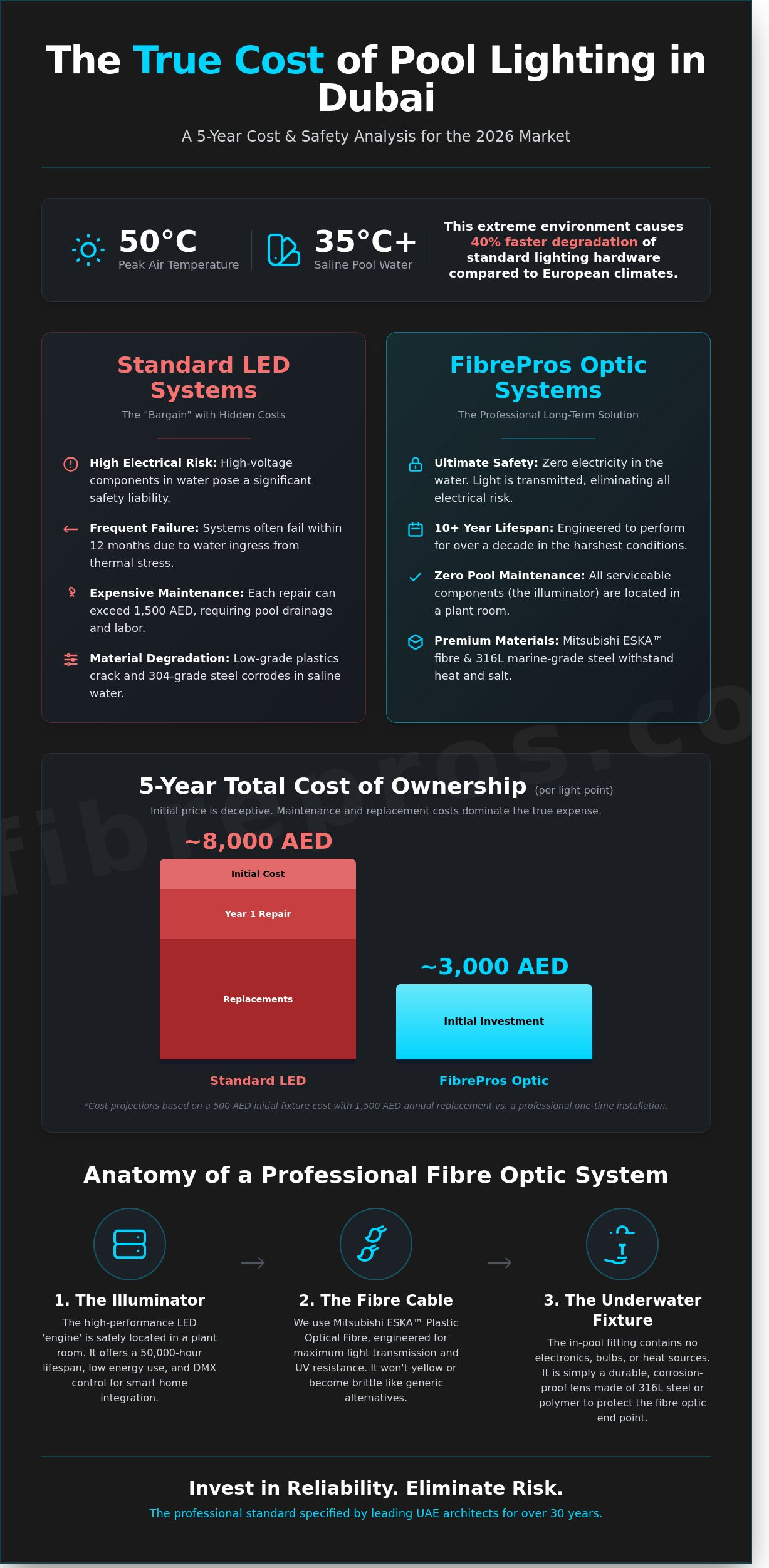
Fibre Optic vs. Traditional LED: A 5-Year Cost Comparison
Analyzing the long-term financial impact of pool illumination requires a shift from looking at purchase prices to evaluating the total lifecycle expense. While traditional LED fixtures often present a lower entry point, the environmental variables in the UAE, such as high soil salinity and extreme summer temperatures, dictate the actual pool lighting cost Dubai residents pay over time. A five-year comparison highlights how technical durability translates directly into saved dirhams.
Initial Investment Breakdown
For a standard 10m x 5m pool, the initial capital expenditure (CAPEX) involves more than just the lamps. Traditional LED setups require underwater lighting fixtures including waterproof niche housings, specialized transformers, and complex junction boxes to ensure safety. These hidden components can increase the hardware budget by 20% to 30%. Fibre optic systems centralize the electronics in a single remote illuminator located away from the water. This architecture requires less structural modification during the construction phase. Because no electricity enters the pool shell, contractors don’t need to install deep wall cavities or heavy-duty conduits, reducing specialized labor costs by approximately 15% during the shell casting stage.
Long-term Savings and ROI
Operational expenditure (OPEX) is primarily driven by DEWA consumption and routine maintenance. High-efficiency LED illuminators used in fibre optic systems offer 75% better energy performance than legacy halogen systems. While submersible LEDs are also efficient, they face a higher failure rate in Dubai’s 45°C heat, which often causes seal expansion and water ingress. Fibre optic cables contain no heat-sensitive electronics underwater, leading to a “No-Drain” advantage. This allows owners to avoid the massive expense of draining 75,000 liters of water and the subsequent chemical restocking required to replace a failed submersible bulb. For perimeter and border illumination specifically, side glow fiber optic cable delivers a perfectly uniform linear glow over distances exceeding 30 meters without the voltage drop or color shifting that causes traditional LED strips to fail prematurely in the UAE’s extreme climate.
Strategic lighting choices also impact the property’s market position. Real estate professionals in luxury sectors like District One and Dubai Hills note that professional lighting helps enhance the ambiance of the home, potentially increasing the total property valuation by 3% to 7%. Total Cost of Ownership for fibre optics is the sum of purchase, power, and zero-maintenance over ten years. By eliminating the need for periodic underwater repairs, fibre optics provide a more stable and predictable pool lighting cost Dubai profile for the discerning villa owner.
Factors That Influence Your Specific Lighting Quote
Every aquatic project presents unique technical challenges that dictate the final investment. Pool geometry and perimeter length directly impact the volume of side-glow fibre required. A complex, free-form pool with a 50-meter perimeter demands significantly more material than a standard rectangular lap pool. Because fibre optic cables carry light from a remote source, the total linear footage of the cable determines a large portion of the hardware budget.
Decorative additions like floor-integrated star ceiling kits transform the aesthetic but require specialized installation techniques. These systems aren’t simple “plug and play” components. They require precise drilling through the pool shell and careful cable management during the waterproofing and tiling phases. Integration with smart home hubs like Control4 or Crestron also affects the pool lighting cost Dubai. Professional automation requires DMX-compatible drivers and specialized programming to ensure your pool lighting syncs perfectly with your home’s exterior scenes.
The distance from the plant room to the pool is a critical cost driver. Long cable runs increase material usage and labor time for conduit placement. Keeping the illuminator within 10 to 15 meters of the pool perimeter ensures maximum light intensity and reduces electrical resistance. Projects that require the light source to be placed further away may need higher-wattage illuminators to maintain the desired brightness levels.
Perimeter vs. Point Lighting
Side-glow fibre creates a continuous “neon” border that defines the pool’s architectural shape. It’s a popular choice for modern, minimalist designs in the UAE. For a multi-layered luxury look, we often combine this with point lighting using crystal end fittings. These fittings refract light into sharp, brilliant patterns on the pool floor or walls. Mixing both techniques provides depth and visual interest that single-source systems can’t match.
Custom “Starry Floor” Effects
A realistic “starry floor” requires precise density planning. Most high-end Dubai projects utilize 50 to 100 points per square meter to achieve a convincing celestial effect. High-density patterns create a more immersive, galaxy-like appearance but involve more intricate cable routing. Installation complexity varies significantly between new builds and renovations. Retrofitting these systems into an existing pool floor is approximately 40% more labor-intensive than installing them during the initial shell construction. Planning for fibre optics early in the design phase is the most efficient way to manage your pool lighting cost Dubai.
Contact the expert team at FibrePros for a technical site survey and a detailed project estimate tailored to your pool’s specifications.
Securing a Professional Lighting Solution with FibrePros
Dubai architects and MEP consultants prioritize technical precision when evaluating the long-term pool lighting cost Dubai for high-end developments. They specify FibrePros because our systems provide a safe pool lighting solution that removes high-voltage components from the water entirely. With 30 years of Middle East lighting expertise, we’ve developed a reputation for reliability in a region where environmental factors often lead to equipment failure. Our end-to-end process covers everything from initial technical design to final regional delivery, ensuring that the infrastructure we build meets the highest industry standards for B2B clients.
Our Product Range and Quality Assurance
The quality of a fiber optic system depends on the purity of the light transmission. We utilize Mitsubishi ESKA POF (Plastic Optical Fiber) exclusively, which offers superior durability and clarity compared to generic alternatives. This material remains stable even when exposed to the high temperatures common in the GCC, preventing the yellowing or brittleness that compromises cheaper systems. Our custom-built LED illuminators are engineered specifically for the local climate, featuring specialized heat sinks and high-grade components that operate efficiently in ambient temperatures exceeding 50°C.
We provide specialized technical support for contractors and MEP consultants throughout the project lifecycle. This includes:
- Detailed wiring schematics and conduit placement guides.
- On-site consultation to ensure proper fiber handling and termination.
- Performance testing to verify light output across the entire network.
- Sourcing of specialized components for custom architectural features.
Getting Your Custom Quote
Securing an accurate quote for your 2026 pool project requires a data-driven approach. We don’t provide generic estimates because every luxury installation has unique technical requirements. To receive a professional proposal, our team needs pool dimensions, CAD drawings, and a clear description of your desired lighting effects. Whether you’re planning a “starry sky” floor or a perimeter glow, we need this information to calculate the exact fiber lengths and illuminator quantities required to manage the overall pool lighting cost Dubai effectively.
Our logistics network ensures fast turnaround times for supply across Dubai and the Northern Emirates, including Sharjah, Ajman, and Ras Al Khaimah. Most professional quotes are delivered within 48 to 72 hours of receiving the project specifications. This efficiency allows project managers to finalize their budgets and maintain strict construction schedules. It’s about providing a dependable solution that adds value to the property while minimizing long-term operational costs.
Secure the Future of Your Aquatic Lighting Project
Investing in high-performance illumination requires a focus on technical durability and long-term operational efficiency. Choosing a system that withstands the unique environmental challenges of the Middle East is the most effective way to manage your total pool lighting cost Dubai. Since 1995, we’ve delivered infrastructure that thrives in high-salinity conditions. As an authorised supplier of Mitsubishi ESKA POF, we provide the technical precision required for luxury installations. Our data shows that while initial outlays vary, the 5-year ROI on fibre optic systems consistently outperforms traditional LED alternatives because they eliminate underwater electrical risks and frequent bulb replacements.
You’re building an asset that should perform perfectly for decades. We’ve refined our processes over 30 years to ensure every project meets the highest professional standards. It’s time to move beyond standard lighting and install a system engineered for the specific demands of the region. Get a custom quote for your luxury pool lighting project and ensure your installation remains a centerpiece of your property for years to come.
Frequently Asked Questions
How much does it cost to install fibre optic pool lighting in Dubai?
Installation costs depend on your pool’s perimeter and the specific number of light points required for the design. According to 2024 regional construction benchmarks, specialized lighting systems typically account for 5% to 8% of a total luxury pool project budget. Your pool lighting cost Dubai varies based on the illuminator’s wattage and the total length of the fibre runs needed to reach the external equipment room.
Is fibre optic pool lighting more expensive than LED?
Upfront installation for fibre optic systems usually requires a 20% to 30% higher initial investment than standalone LED fixtures. This price difference covers the specialized light engine and the high-grade polymer cables used in the infrastructure. The long-term ROI is higher because you only replace one bulb in a dry location rather than multiple underwater fixtures that require draining the pool.
Can I retrofit fibre optic lighting into an existing Dubai pool?
You can retrofit fibre optic systems into existing structures, though it often requires specialized track mounting along the coping. In 90% of retrofit projects, technicians install a perimeter track to house the fibres without the need to drain the pool. This method avoids the structural risks associated with drilling new niches into an established concrete shell or compromising the waterproof membrane.
How long does fibre optic pool lighting last in the UAE heat?
High-quality fibre optic cables last 20 to 25 years in the UAE climate because they don’t carry electricity or generate heat. The light engine sits in a climate-controlled equipment room, protecting sensitive electronics from Dubai’s 50 degree Celsius summer peaks. This separation ensures the submerged components don’t degrade from thermal stress or intense UV exposure common in the region.
Does fibre optic pool lighting save money on electricity?
Fibre optic systems reduce electricity consumption by 40% compared to traditional halogen setups. A single 150-watt metal halide or LED illuminator can power dozens of light points simultaneously through the cable network. This efficiency lowers the pool lighting cost Dubai homeowners face monthly while providing consistent illumination across the entire water volume without multiple power draws.
Why is Mitsubishi ESKA fibre recommended for Dubai pools?
Mitsubishi ESKA is the industry standard because its PMMA core maintains 98% light transmission efficiency over long distances. It’s specifically engineered to withstand chemical exposure from chlorine and salt systems without yellowing or becoming brittle. Professional installers select this material for its 0.2 dB/m attenuation rate, ensuring the brightness remains uniform from the first light point to the last.
What is the maintenance cost for fibre optic pool lights?
Maintenance costs for fibre optic systems are 60% lower than traditional underwater lighting over a five-year period. You’ll only need to replace the single lamp in the illuminator every 3,000 to 5,000 hours, depending on the specific bulb type. Since there are no bulbs or gaskets underwater, you eliminate the need for divers or expensive draining procedures for routine repairs.
Are fibre optic pool lights safer than traditional systems?
Fibre optic systems provide 100% safety for swimmers because they carry no electrical current into the water. All electricity remains housed in the light source box located at least 3 meters away from the pool edge. This design completely eliminates the risk of electric shock, which is a critical safety requirement for both residential and commercial installations in Dubai.