
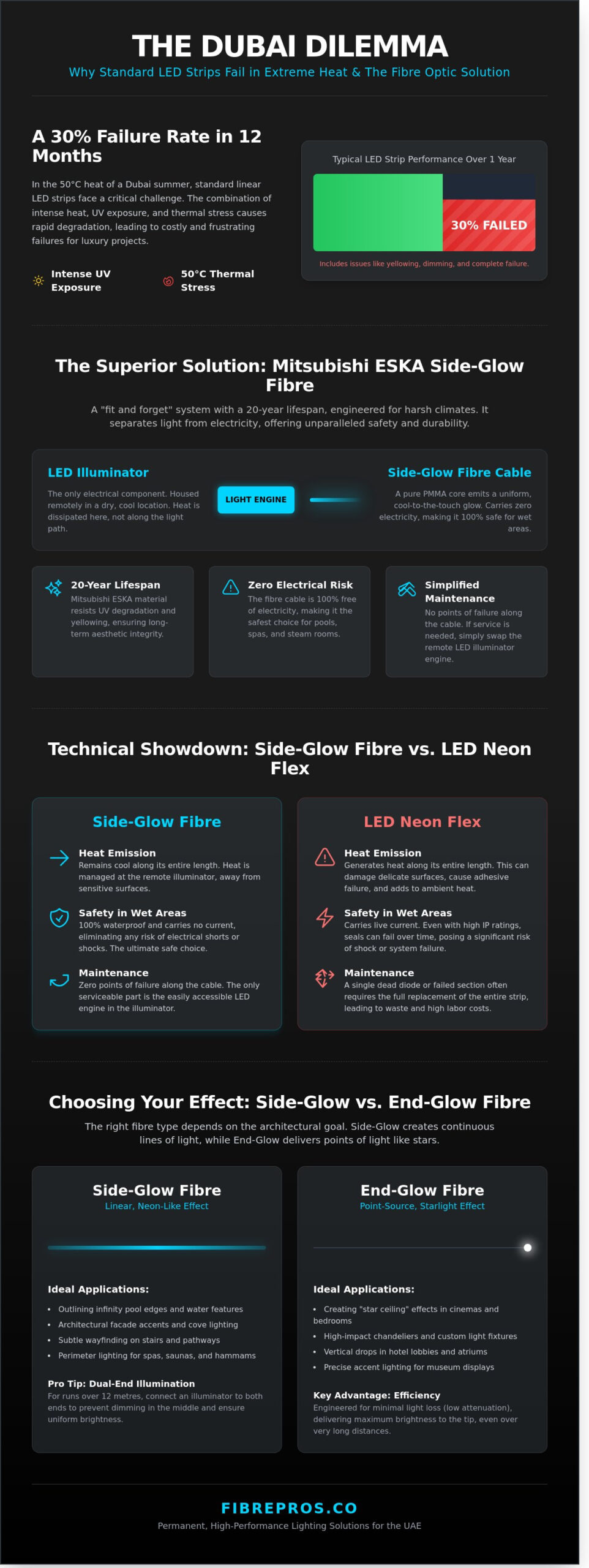
In the 50 degree heat of a Dubai summer, the standard linear LED strips often found in luxury pool perimeters and facade accents have a failure rate that can reach 30 percent within the first 12 months. It’s a frustrating reality for architects who demand longevity. You know that maintaining a high-end aesthetic in the UAE requires materials that don’t just look good on day one, but withstand intense UV exposure and thermal stress without degrading.
This guide provides a technical deep dive into side-glow fibre optics, specifically focusing on Mitsubishi ESKA materials that offer a 20 year lifespan even in harsh environments. You’ll discover exactly when to specify side-glow over end-glow to solve common power-run limitations and prevent the unsightly yellowing common in low-grade plastics. We will outline the engineering logic and design applications needed to ensure your next luxury lighting project remains a permanent, high-performance fixture of the Dubai skyline.
Key Takeaways
- Differentiate between linear light and point-source effects to ensure your lighting design aligns with specific architectural objectives.
- Evaluate the critical role of UV-stabilized materials in maintaining cable integrity against the high heat and salinity of the UAE environment.
- Explore luxury applications for side-glow fibre, from outlining infinity pool edges to providing subtle wayfinding in hospitality spaces.
- Master technical planning strategies, including dual-end illumination, to prevent dimming and ensure uniform brightness over extended cable runs.
- Optimize your installation by selecting the correct professional LED illuminators to achieve high-performance output and long-term reliability.
What is Side-Glow Fibre? Understanding Linear Light Technology
Side-glow fibre is a specialized optical cable engineered to emit light uniformly along its entire length. While traditional optical fiber technology focuses on transmitting data over long distances with minimal loss, side-glow systems do the opposite. They utilize a high-purity PMMA (Polymethyl methacrylate) core and a modified cladding to encourage controlled light leakage. This results in a continuous, neon-like glow that provides a soft, architectural accent without the harshness of direct LEDs.
Architects across Dubai favor this technology for its 100% electrical safety. Since the cable itself doesn’t carry current, it’s the most reliable option for wet environments. All electrical components, including the LED illuminator, are located in a remote, dry housing. This separation of light and electricity eliminates the risk of shorts or shocks in swimming pools, showers, and luxury steam rooms. It’s a “fit and forget” solution that prioritizes user safety and system longevity.
The Science of Controlled Light Leakage
Standard optical cables rely on Total Internal Reflection (TIR) to keep light trapped inside the core. In side-glow fibre, the boundary between the core and the cladding is intentionally disrupted. This allows a specific percentage of light to escape through the sides of the cable. The purity of the PMMA core determines the “throw” of the light; higher purity allows for longer runs without a visible drop in brightness. For complex Dubai villa designs, multi-strand fibre is often the better choice. It offers superior flexibility compared to thick, single-core cables, allowing it to wrap around architectural columns or tight joinery corners without snapping or losing structural integrity. To understand the complete technical process behind how do fiber optic lights work, including the role of light engines and optical transmission principles, architects can benefit from exploring the fundamental science that makes these systems so reliable in extreme climates.
Side-Glow vs. LED Neon Flex
LED Neon Flex is a common alternative, but it presents several challenges in the UAE’s high-temperature climate. LEDs generate heat at the point of light emission, which can degrade delicate joinery or cause adhesive failure in recessed installations. Fibre stays cool because the heat is dissipated at the remote illuminator. Maintenance is also more efficient. An LED strip with a single dead diode often requires a full replacement of the entire run, creating significant waste. With fibre, there are zero points of failure along the cable length. If the light fails, you simply swap the LED engine in the illuminator. This drastically reduces long-term maintenance costs and downtime for large-scale residential projects.
Side-Glow vs. End-Glow Fibre: A Direct Comparison
The choice between side-glow and end-glow fibre depends on the intended geometry of the light. Side-glow fibre functions as a continuous linear source, emitting light through its outer cladding along the entire length. End-glow fibre acts as a high-efficiency conduit, delivering the majority of the light source’s output to the very tip. This distinction dictates how architects approach illumination in high-end UAE developments.
Light loss, or attenuation, is a critical factor for Dubai projects covering large surface areas. Side-glow fibre naturally loses intensity as the distance from the light engine increases. To compensate for this in runs exceeding 12 metres, technical teams employ dual-end illumination. By connecting a light engine to both ends of the fibre, you ensure a uniform brightness level that doesn’t fade in the centre. End-glow fibre maintains its intensity much better over distance, making it the preferred choice for vertical drops in hotel lobbies.
From a cost-per-metre perspective, side-glow installations often require a higher initial investment in materials. However, they reduce total project costs by replacing dozens of individual LED fixtures with a single, manageable cable. In high-traffic commercial zones like DIFC, the durability of solid-core side-glow is a significant advantage. Its robust polymer construction resists UV degradation and mechanical stress better than the thin, multi-strand bundles typically used for end-glow applications.
When to Choose Side-Glow
Side-glow fibre is the superior choice for perimeter lighting in luxury pools, spas, and hammams. Since the fibre carries no heat or electricity, it’s safer than LED strips for submerged environments. Architectural and decorative lighting designs in Abu Dhabi gardens use these cables to highlight stairs and walkways with a soft, neon-like effect. They also provide a safe, tactile linear light source for specialized sensory rooms in educational facilities.
When to Choose End-Glow
End-glow remains the gold standard for star ceiling kits in Dubai home cinemas and luxury villas. It allows for the creation of “point-of-light” effects that mimic a natural night sky. This fibre is essential for high-density starry sky displays and bespoke chandeliers where light must be concentrated at specific termination points. If your project requires precision over linear coverage, end-glow is the technical solution. You can consult with our specialists to determine the exact strand count required for your specific ceiling dimensions.
Technical Specifications for the UAE: Heat, UV, and Salinity
Dubai’s climate presents a unique set of challenges that standard lighting components cannot meet. Ambient temperatures often peak at 52°C, while direct sunlight delivers a constant bombardment of UV radiation. Low-grade PMMA (Polymethyl methacrylate) fibres fail under these conditions; they undergo a chemical breakdown that results in severe yellowing and brittleness within 12 to 18 months. To prevent this, FibrePros specifies side-glow fibre encased in UV-stabilised PVC or high-performance Teflon jackets. These materials are engineered to withstand the 11+ UV index ratings common in the region, ensuring the cladding remains transparent and flexible for over a decade.
Light transmission efficiency is another critical factor. In extreme heat, the refractive index of lower-quality plastics can shift, leading to a 15% reduction in light output over a 5-metre run. High-specification fibres maintain their optical properties even when internal temperatures rise, ensuring your architectural accents remain vibrant during the hottest summer nights. For coastal installations and luxury pools, side-glow fibre offers total resistance to salinity and chlorine. It’s a non-conductive medium, meaning there’s zero risk of electrical leakage into the water, a common failure point for traditional submerged systems.
The Mitsubishi ESKA Advantage
Top UAE consultants almost exclusively specify Mitsubishi ESKA Plastic Optical Fibre for premium projects. This preference stems from the core’s exceptional purity, which allows for uniform light distribution over 10-metre or 15-metre runs without noticeable colour shifting. The flexibility is equally impressive; ESKA fibres support a tight bend radius of approximately 20mm. This allows architects to create sharp, clean curves without creating “hot spots” or stress fractures in the material, ensuring a smooth, neon-like glow across the entire installation.
IP Ratings and Outdoor Protection
It’s vital to distinguish between the fibre and the illuminator. The fibre itself is non-electric, making it inherently waterproof and suitable for IP68-style applications where water submersion is required. However, the system’s “engine,” the LED illuminator, contains sensitive electronics. To maximise the lifespan of a Dubai installation, we locate illuminators in ventilated, climate-controlled areas or specialised cool-boxes. This separation of light and power removes the electrical source from harsh outdoor elements, significantly reducing maintenance requirements compared to integrated LED fixtures.
Luxury Applications in Dubai and Abu Dhabi
Architectural standards in the UAE demand a level of precision that traditional LED strips often fail to meet. In cities like Dubai and Abu Dhabi, side-glow fibre provides a versatile solution for high-end developments, offering a continuous line of light that remains uniform over long distances. From the sleek corridors of the Burj Khalifa to private villas in Emirates Hills, this technology defines modern luxury through its subtlety and performance. Designers seeking broader inspiration can explore a comprehensive range of fibre optic lighting ideas for luxury Dubai interiors and landscapes that demonstrate how these systems integrate across both indoor and outdoor architectural contexts.
Hospitality groups across the region utilize this lighting for sophisticated wayfinding. In luxury hotel lobbies and expansive corridors, these systems create a soft, non-glare guide that enhances the guest experience without the harshness of direct light sources. Landscape architects also deploy these fibres to illuminate desert pathways and the trunks of palm trees. Because the light source is housed in a remote illuminator, the cable remains cool, protecting sensitive flora from the 50-degree Celsius heat common in the UAE summer. Inside the home, designers use recessed applications to highlight shelving, bar areas, and bespoke cinema rooms with a professional finish.
Underwater Pool Lighting Redefined
Standard pool lighting often relies on bulky, niche-mounted fixtures that create hot spots and require complex waterproofing. Modern installations replace these outdated systems with a seamless “halo” effect along infinity edges and submerged steps. This method is fundamentally safer; it carries zero electricity through the water. Only the light travels via the cable, while the electrical components stay in a dry, ventilated cabinet.
For a truly premium finish, architects often pair these installations with stainless steel fixtures. These components resist the high salinity and chlorine levels found in luxury Dubai spas, ensuring the system remains functional and aesthetically pleasing for years. The result is a crisp, linear glow that defines the pool’s geometry with surgical precision.
Sensory and Therapeutic Spaces
Beyond aesthetics, side-glow fibre serves a vital role in educational and medical facilities across the UAE. Special education schools in Abu Dhabi and Dubai use “crackled” fibre to create tactile sensory rooms. These fibres allow students to touch and hold the light safely. There is no heat and no glass; this makes it an ideal tool for therapeutic engagement in sensitive environments.
Control is managed through DMX-integrated illuminators, allowing staff to change colors and light intensity to suit the specific needs of the users. This level of customization helps create calming environments that can be adjusted at the touch of a button. It’s a reliable, low-maintenance solution for high-traffic public spaces that require both durability and safety.
Planning Your Side-Glow Installation: From Design to Delivery
Successful execution of a lighting design requires technical precision and a clear understanding of hardware limitations. When you specify side-glow fibre for a Dubai project, the transition from a concept to a functional installation depends on matching the cable diameter with the appropriate light source. A 3mm cable used for delicate accenting has vastly different power requirements than a 10mm solid-core cable intended for perimeter architectural outlines.
Selecting the Right Illuminator
The illuminator is the engine of your system. For high-end Dubai villas, architects often choose 45W to 100W units to ensure the light remains vibrant across the entire run. If you are installing 10mm cables, a high-output source is mandatory to maintain visibility against ambient city light. Choosing LED illuminators that offer dedicated 3000K warm white chips is superior to mixing RGB colors to approximate white; it provides a cleaner, more sophisticated glow that matches premium interior finishes.
Most luxury developments in the UAE now utilize advanced automation. Ensure your light source is compatible with local standards like KNX or Control4. This allows for seamless dimming and scheduling via a central smart home interface. Modern Bluetooth-enabled drivers also provide a reliable secondary control method for localized garden or pool installations.
Professional Mounting and Finishing
Precision mounting separates professional installations from DIY attempts. Using clear PVC or aluminum U-channel tracks ensures the side-glow fibre remains perfectly straight, preventing the “wavy” look that ruins architectural lines. These tracks also protect the cable from physical impact while maximizing light output by keeping the fibre in a fixed position.
- The Loop-Back Technique: For runs exceeding 7 meters, light intensity typically drops by 25% to 30% at the far end. To fix this, installers feed both ends of the fibre into the same illuminator port. This creates a continuous loop that ensures uniform brightness from start to finish.
- Heat Management: While the fibre itself carries no heat, the illuminator does. Place the light source in a ventilated, accessible enclosure to prevent thermal throttling and extend the unit’s 50,000-hour lifespan.
- Expert Procurement: Sourcing materials from a specialized Dubai-based fibre optic supplier ensures you receive UV-stabilized cables that won’t yellow or crack under the intense UAE sun.
Maintenance in the Middle East primarily involves dust management. While the fibre optic cable requires no electrical maintenance, you should clean the illuminator’s intake fans every 6 months to prevent overheating. If the light appears dim, a simple wipe of the fibre’s input tail with a lint-free cloth often restores 100% of the original luminosity. When planned correctly, these systems provide maintenance-free service for 20 years or more.
Precision Lighting for the UAE’s Demanding Environments
Achieving a seamless linear glow requires more than just a design concept; it demands hardware that survives the Gulf’s unique stressors. Side-glow fibre offers the professional-grade solution for architects who refuse to compromise on visual continuity or long-term reliability. Since 1995, we’ve supplied the UAE with infrastructure capable of withstanding 50°C ambient temperatures and high-salinity coastal air. Our role as an authorized Mitsubishi ESKA distributor means your project benefits from PMMA technology that resists UV degradation and maintains its clarity over decades. We understand that in Dubai’s luxury sector, technical precision is the only way to guarantee uptime.
By selecting materials engineered for high-heat environments, you ensure your installation remains a permanent landmark rather than a maintenance burden. Request a Technical Consultation for Your Side-Glow Project to begin your design phase. We look forward to helping you illuminate the region’s next iconic skyline project.
Frequently Asked Questions
Is side-glow fibre bright enough to replace traditional lighting?
Side-glow fibre isn’t intended to replace high-output functional lighting like 1000-lumen downlights. It functions primarily as a decorative accent or perimeter marker, delivering between 50 and 150 lumens per meter depending on the light engine’s wattage. Architects in Dubai use it to define architectural lines or safety paths rather than illuminating a whole room. It’s a specialized tool for aesthetic enhancement, not general illumination.
How long can a single piece of side-glow fibre be?
A single run of side-glow fibre typically maintains optimal brightness up to 15 meters when powered from one end. Beyond this distance, light attenuation causes a visible 20% drop in intensity at the far end. For longer installations, we recommend dual-port light engines to illuminate the cable from both ends, which effectively doubles the high-intensity run to 30 meters without losing clarity or visual impact.
Can I cut side-glow fibre optic cable myself?
You can cut side-glow fibre optic cable using a sharp utility knife or a specialized hot-knife tool. A clean, 90-degree perpendicular cut is essential to ensure maximum light transmission from the illuminator. Our Pros often use a polishing kit on the cut end to increase light entry efficiency by up to 15%. This precise finish prevents light scattering and ensures the cable glows evenly along its entire length.
Does side-glow fibre get hot during operation?
Side-glow fibre remains cool to the touch during operation because it carries only light and no electrical current. The heat is contained entirely within the remote light engine, which is typically housed in a ventilated cabinet. This makes it 100% safe for contact with heat-sensitive materials like fabrics or wood. It’s an ideal choice for recessed installations where airflow is limited to 5% or less.
Which is better for a swimming pool: LED strips or side-glow fibre?
Side-glow fibre is the superior choice for Dubai swimming pools because it eliminates the risk of electrical leaks in the water. While LED strips often fail within 24 months due to seal degradation, fibre optics contain no internal electronics to corrode. This system provides a reliable, low-maintenance solution for underwater perimeter lighting in high-salinity environments. It ensures 100% electrical safety for all pool users.
How do I power a side-glow fibre optic system?
You power the system using a dedicated light engine, also known as an illuminator, connected to a standard 220V power outlet. The side-glow fibre cable inserts into a port on the engine where a high-intensity LED source focuses light into the core. Our Pros team recommends placing the engine in a dry, accessible location within 2 meters of the start of the fibre run to minimize initial light loss.
Will the sun in Dubai damage the fibre optic cable?
High-quality side-glow fibre features a UV-stabilized PVC or Teflon jacket designed to withstand the 50-degree Celsius temperatures common in Dubai. Without this UV protection, lower-grade plastics turn brittle and yellow within 12 months. We specify materials that maintain 95% clarity even after 5,000 hours of exposure to the intense Middle Eastern solar radiation. This ensures the aesthetic remains crisp and professional for many years.
What is the lifespan of side-glow fibre in the Middle East?
The physical side-glow fibre cable has an operational lifespan of 15 years when installed correctly in Middle Eastern climates. The LED light engines powering the system are rated for 50,000 hours of continuous use. This longevity reduces replacement frequency by 300% compared to traditional outdoor rope lighting or low-grade LED alternatives. It’s a durable infrastructure investment for any high-end residential or commercial project in the region.