
Electricity and water are a lethal combination, yet many Dubai pool owners still rely on high-voltage systems that sit just inches from their families. In a climate where temperatures hit 50°C and saline corrosion degrades standard fixtures within 18 months, relying on outdated tech isn’t just inefficient; it’s a liability. You deserve a backyard oasis that prioritizes safety without compromising on visual impact. We understand that total peace of mind regarding safe pool lighting is your primary concern when upgrading your outdoor infrastructure.
This 2026 guide clarifies the dangerous myths surrounding traditional underwater LEDs and explains why fibre optic technology is the only solution that keeps 100% of the electricity out of the water. You’ll learn how to eliminate bulb failures caused by the UAE heat and prevent the corrosion typical of chlorinated systems. We’ll preview the technical advantages of remote light sources and show you how to achieve stunning aesthetic effects like starry night floors that remain 0-volt safe for every swimmer.
Key Takeaways
- Understand the technical requirements for meeting the UAE’s rigorous electrical safety standards in high-risk aquatic environments.
- Debunk common myths regarding low-voltage LED systems and discover why fibre optics provide the only 100% electricity-free solution for safe pool lighting.
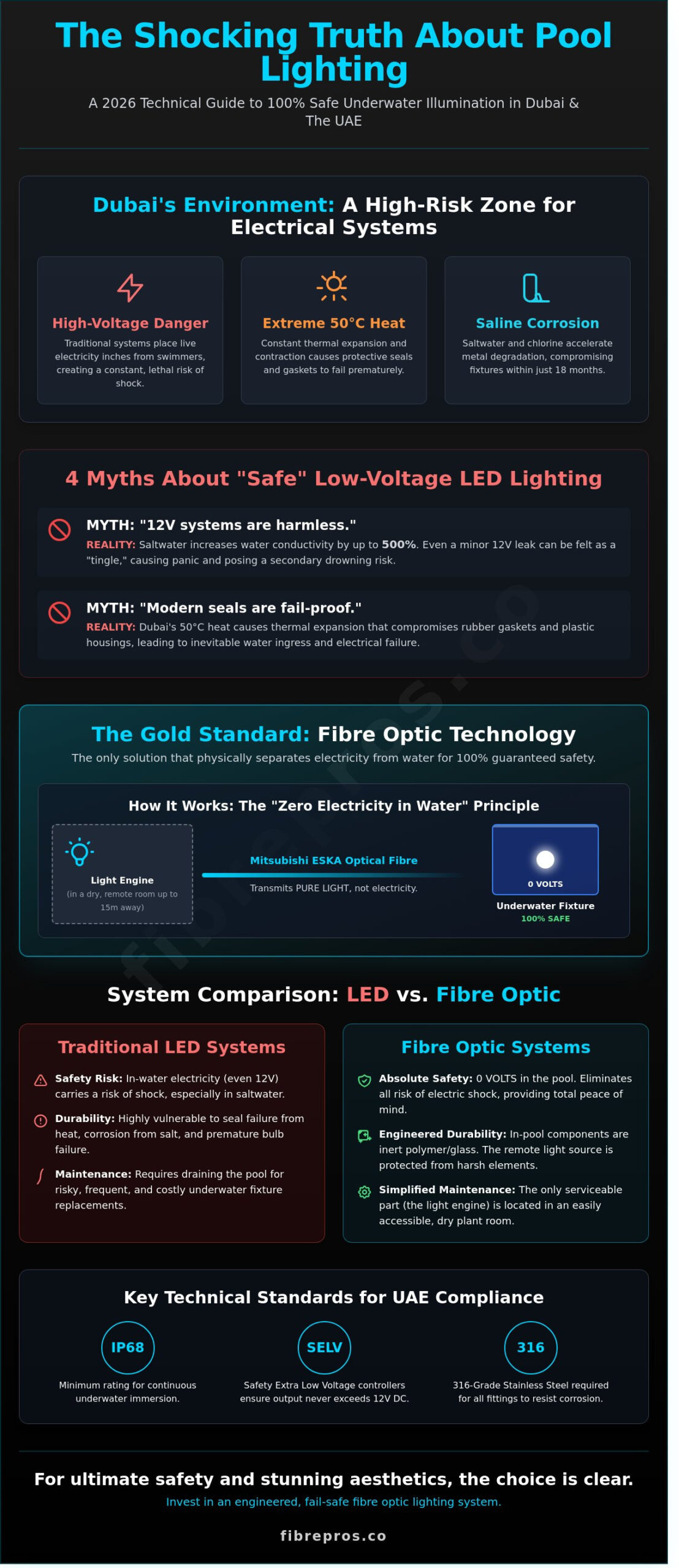
- Learn how the “Zero Electricity” principle utilizes Mitsubishi ESKA plastic optical fibre to completely isolate electrical current from the bather.
- Evaluate the necessity of 316-grade stainless steel and specialized cooling to ensure system durability against the GCC’s extreme heat and salinity.
- Gain insights into engineering fail-safe, end-to-end lighting infrastructures that combine architectural elegance with technical precision.
What Defines Truly Safe Pool Lighting in Dubai and the UAE?
Safe pool lighting in Dubai’s high-end residential sector relies on one fundamental principle: the absolute isolation of high-voltage electricity from the bather. In a region where ambient temperatures exceed 45°C and humidity levels often hit 90%, the degradation of electrical seals is a constant threat. True safety isn’t just about a working bulb; it’s about a system design that eliminates the possibility of current leakage into the water. This technical requirement is why the UAE Fire and Life Safety Code mandates strict adherence to low-voltage protocols for all wet-area installations. Professional engineers prioritize systems where no active electrical components reside within the pool shell itself.
The psychological impact of this safety cannot be overstated for luxury real estate in the GCC. High-net-worth investors in areas like Emirates Hills or Palm Jumeirah view “invisible safety” as a core asset value. When a system is engineered to be inherently incapable of delivering a shock, it removes the long-term liability associated with underwater electrical maintenance. This peace of mind is a silent selling point that increases property valuation by ensuring the leisure environment remains a zero-risk zone.
The Anatomy of an Underwater Lighting System
A professional installation distinguishes between the light source and the delivery mechanism. In traditional wet-niche systems, the lamp and its wiring sit inside a submerged housing, relying on rubber gaskets to keep the water out. Conversely, fiber optic systems place the light engine in a dry, ventilated plant room up to 15 meters away. Understanding how fiber optic technology works reveals why this is the superior choice for safe pool lighting. Because the system transmits light via total internal reflection through glass or polymer strands, there’s zero electrical current in the pool. The transformer’s location remains the most critical factor; it must be housed in a controlled environment to prevent the corrosive effects of salt and chlorine from compromising the circuit.
Standard Safety Ratings You Need to Know
Every underwater component must carry an IP68 rating at a minimum. This Ingress Protection code signifies that the equipment is dust-tight and protected against continuous immersion in water under specific pressure conditions. In Dubai, safe pool lighting must also comply with CE and local ESMA (Emirates Authority for Standardization and Metrology) certifications. As we approach 2026, standards for smart home integration have evolved to require Safety Extra Low Voltage (SELV) controllers. These units ensure that even if a control system fails, the output voltage never exceeds the 12V DC threshold. These rigorous 2026 benchmarks reflect a 15% increase in safety overhead requirements compared to the previous decade, forcing a shift toward more reliable, fiber-based infrastructure.
4 Common Myths About LED Pool Lighting Safety Debunked
Many facility managers and homeowners believe that modern LED systems have solved all risks associated with underwater illumination. This assumption often leads to a false sense of security. While LEDs are an improvement over older incandescent bulbs, they still rely on electricity being delivered directly into the pool structure. In the harsh climate of the Middle East, standard assumptions about safe pool lighting often fail to account for local environmental stressors.
The Reality of Low Voltage in Saltwater
The belief that 12V or 24V systems carry zero risk is a common misconception. In Dubai, where saltwater chlorination is a standard choice for luxury builds, the risk profile changes significantly. Saltwater increases water conductivity by up to 500 percent compared to fresh water. This high conductivity means that even a minor current leak can be felt by swimmers as a “tingle” effect, which often causes panic and secondary drowning risks. You should review the standards for general pool electrical safety to understand how grounding remains a critical failure point in these installations. Electrolysis in LED pool fixtures occurs when stray electrical currents pass through the water, causing accelerated metal corrosion and chemical degradation of the unit.
Why Seals Fail in the Middle East
Dubai’s ambient temperatures frequently reach 50°C during the summer, creating a brutal environment for underwater hardware. This heat causes significant thermal expansion. Rubber gaskets and plastic housings expand at different rates, which eventually compromises the integrity of the seal over a typical 24-month period. Once the seal is breached, pool chemicals begin to eat away at the internal light engine.
- Chemical Degradation: High chlorine concentrations required for heat-heavy climates turn cheap rubber seals brittle in less than two seasons.
- The Wicking Effect: When a seal fails, water doesn’t just sit in the housing; capillary action draws moisture up through the copper power cables, leading to systemic failure of the driver.
- Material Fatigue: Plastic housings often marketed as “corrosion-proof” become brittle and crack under the combined stress of UV exposure and internal heat generation.
It’s also a mistake to assume that standard garden LEDs are suitable for aquatic use if they’re labeled as “waterproof.” Most landscape lighting is rated for rain or temporary splashes, not the sustained atmospheric pressure of being submerged two meters deep. These units typically fail within 90 days due to pressure-induced seal collapse. For a truly robust solution, consulting with professional installers about fiber optic alternatives ensures that no electrical components ever enter the water, providing the highest standard of safe pool lighting available today.
Why Fibre Optics are the Gold Standard for Underwater Safety
The “Zero Electricity” principle is the foundation of safe pool lighting. In a traditional setup, 12V or 120V cables run directly into a niche behind the pool wall. Fibre optic systems function differently. They use a remote light source, known as an illuminator, to generate light. This light then travels through flexible strands of plastic or glass to the pool. Because the cable itself contains no metal or electrical current, there’s a 0% risk of electrical leakage into the water. This physical separation provides a level of security that even the most advanced LED seals cannot match.
Material quality dictates long-term safety. We exclusively use Mitsubishi ESKA Plastic Optical Fibre (POF). While cheaper glass fibres can become brittle and snap over a 5 to 7 year period, Mitsubishi ESKA’s high-performance PMMA core remains flexible for 20 years or more. It resists the corrosive effects of chlorine and salt water, ensuring the structural integrity of your pool’s lighting infrastructure remains intact for decades.
How Fibre Optic Systems Eliminate Risk
The remote illuminator is the heart of the system. We typically install this unit in a dry plant room or cabinet located 5 to 10 metres away from the water’s edge. This distance ensures that high-voltage components are nowhere near the pool. This configuration easily exceeds the National Electrical Code (NEC) requirements for low-voltage isolation and luminaire placement. For Dubai’s popular infinity edges and glass-walled pools, fibre optics aren’t just a luxury; they’re a necessity. You don’t have to worry about drilling large holes for bulky niches that could compromise the pool’s waterproofing or structural glass. Maintenance is also safer. Technicians change the 50,000-hour LED source in a dry, ventilated room. They don’t need to drain the pool or handle electrical components while standing in water.
Side-Glow vs. End-Glow for Pool Safety
Safety in safe pool lighting also involves visibility and glare reduction. We use two specific types of fibre to achieve different safety goals:
- Side-Glow Fibre: This creates a continuous “neon” effect along the perimeter or steps. It provides 360-degree illumination that highlights transitions in depth without blinding swimmers with the localized glare common in traditional spot lamps. For perimeter and architectural applications beyond the pool itself, side glow fiber optic cable delivers uniform linear light across distances exceeding 30 meters without the voltage drop or color shifting seen in copper-based systems.
- End-Glow Fibre: This is used for “starry night” floor effects. By using 0.75mm to 1.5mm strands, we can install up to 50 points of light per square metre. These points are flush with the floor, creating no trip hazards or protrusions.
In terms of efficiency, Mitsubishi ESKA POF maintains 96% light transmission over a 15-metre run. This means your pool stays bright and visible from end to end. You get a reliable, high-performance system that focuses on protecting the people inside the pool while delivering a world-class aesthetic.
Durability in the GCC: Managing Heat, Humidity, and Salinity
Dubai’s environmental conditions are aggressive. Ambient temperatures often exceed 50°C during July and August, creating a punishing environment for underwater infrastructure. This heat, combined with humidity levels reaching 90%, accelerates the degradation of standard electrical components. Fibre optics separate the light source from the water, placing the sensitive electronics in controlled, ventilated environments. This physical separation is a fundamental requirement for safe pool lighting in the Middle East.
Material Science for the Desert Climate
Fibrepros utilizes Mitsubishi ESKA plastic optical fibre for all regional installations. This material maintains its structural integrity at temperatures up to 70°C, which prevents the “yellowing” or clouding common in lower-grade cables exposed to the Arabian sun. For coastal properties in areas like Palm Jumeirah or JBR, we mandate the use of Grade 316 stainless steel fixtures. Unlike 304-grade steel, the 316 variant contains molybdenum. This specific chemical addition provides critical resistance to chloride-induced “tea staining” and pitting corrosion caused by high salinity. For a comprehensive breakdown of how to select underwater lighting fixtures engineered with 316L stainless steel and advanced heat-dissipation technology, our 2026 guide covers the precise hardware standards that withstand the Middle East’s extreme conditions.
Protecting the system from the “shamal” dust storms is equally vital. We implement several protective measures:
- IP65-Rated Enclosures: These housings ensure fine sand doesn’t compromise internal cooling fans or optics.
- Active Ventilation: We install LED illuminators in custom-ventilated enclosures to prevent heat soak.
- Thermal Management: If internal temperatures exceed 85°C, an LED’s lifespan can drop by 40%. Our configurations prioritize airflow to maintain peak performance.
The Hidden Cost of ‘Cheap’ Lighting in Dubai
Initial savings on budget LED systems disappear quickly when faced with Dubai’s soil salinity and heat. A 2022 retrofit project for a luxury villa in Jumeirah Golf Estates demonstrated this clearly. The client had replaced their entire underwater LED system three times in 48 months due to seal failures and driver burnout. By switching to a single fibre optic illuminator, they eliminated the need for underwater electrical maintenance entirely. This transition provided the owner with a more reliable and safe pool lighting solution that won’t require a full overhaul for at least 15 years.
The ROI for fibre optics typically stabilizes within 36 months. While a standard LED fixture might cost less upfront, the labor costs for draining a pool to replace a failed unit in 45°C heat are substantial. Our Dubai-based team provides the specialized expertise needed to ensure your system remains operational through every season. We focus on end-to-end reliability so your investment remains protected from the elements.
Contact us to upgrade your pool infrastructure with marine-grade materials today.
Implementing a Fail-Safe Lighting System with Fibrepros
Fibrepros engineers safety directly into the architectural blueprint of every project. We eliminate the risk of electric shock by locating the power source in a dry plant room, typically 15 to 20 meters away from the water’s edge. This physical separation is the foundation of safe pool lighting. By using non-conductive polymer or glass strands to carry light instead of electricity, we remove the hazards associated with traditional underwater wiring. Our approach focuses on technical precision, ensuring that the light reaching your pool is bright, consistent, and entirely disconnected from the electrical grid.
For residential spas and wellness suites, our custom star ceiling kits offer an immersive sensory experience. We utilize over 450 individual fibre points to create realistic constellations that are safe to touch and moisture-proof. Upgrading your existing pool lighting is a straightforward process. Our technicians often use your current conduits to pull through new fibre bundles, replacing dangerous 240V or 12V copper cables with inert materials. This transition modernizes your facility while providing a permanent solution to the risk of current leakage.
Our Specialized Components for Luxury Pools
Our LED illuminators deliver up to 100 lumens per watt and feature full DMX512 compatibility for integration with smart home systems like Control4. We use 316L marine-grade stainless steel for all underwater lighting fixtures, ensuring they withstand the high salinity and heat of the Dubai climate. Precision-cut crystal end fittings add a diamond-like shimmer to underwater steps, improving visibility and design depth without any electrical components entering the water. For exterior architectural features surrounding the pool, professional-grade side glow fiber optic cable extends the same electricity-free safety principle to perimeter walls, water features, and landscape borders across your entire estate.
Start Your Safe Pool Project Today
Architects and developers can request a comprehensive technical specification and CAD drawings to ensure safe pool lighting is integrated during the initial design phase. We maintain a reliable logistics network that guarantees delivery to sites in Dubai, Abu Dhabi, and the wider GCC within 3 to 5 business days. Our team provides end-to-end support, from the initial light map to the final lux level testing. Contact the Fibrepros team for a safe pool lighting consultation to secure the technical integrity of your next project.
Secure Your Investment with Advanced Fibre Optic Infrastructure
Prioritizing safe pool lighting in Dubai means moving past common LED myths to adopt a genuine zero-voltage aquatic environment. Since 1995, Fibrepros has delivered specialized lighting solutions across the Middle East that withstand 50 degree Celsius heat and high salinity levels. By utilizing Mitsubishi ESKA Plastic Optical Fibre, we ensure that no electrical current ever enters your pool water. Our use of specialized 316-grade stainless steel underwater fixtures prevents the corrosion common in standard installations. These technical choices create a fail-safe system that outlasts traditional alternatives by over 15 years. You deserve an infrastructure that combines visual excellence with total technical precision. Our experts handle the end-to-end implementation to guarantee your peace of mind and long-term reliability. It’s time to elevate your property with the gold standard of underwater safety.
Secure your luxury pool with the UAE’s fibre optic experts at Fibrepros
We look forward to helping you build a safer, more brilliant aquatic space today.
Frequently Asked Questions
Is fibre optic pool lighting safer than LED?
Fibre optic systems are inherently safer than LED because they carry zero electricity into the water. While standard LEDs operate at 12V or 24V, fibre optics use a remote illuminator located up to 15 metres away from the pool edge. This physical separation eliminates the risk of electrical shock in the water. It provides the most safe pool lighting solution for residential and commercial installations in Dubai.
Can I change my existing pool lights to fibre optics?
You can replace existing traditional or LED fixtures with a fibre optic system through a professional retrofit process. Technicians pull the fibre cables through your existing conduits, which usually measure 20mm or 25mm in diameter. This conversion removes all high-voltage components from the pool structure. A typical 10x5m pool upgrade is completed within 72 hours, ensuring minimal downtime for your facility.
How much does safe pool lighting cost in Dubai?
High-quality safe pool lighting installations in Dubai typically range from 4,500 AED for basic kits to 15,000 AED for large-scale architectural projects. These costs include the light source, PMMA fibre cables, and professional installation. While the initial investment is 20% higher than basic LED setups, the reduction in long-term maintenance and electrical hazards provides a superior return on investment for property owners. For a detailed breakdown of costs and long-term savings, see our comprehensive guide on pool lighting cost Dubai for 2026.
What is the best IP rating for underwater pool lights in the UAE?
An IP68 rating is the mandatory standard for any underwater lighting component in the UAE. This specific rating ensures the equipment is hermetically sealed against dust and permanent submersion in water deeper than 1 metre. Fibre optic cables don’t require an IP rating themselves because they don’t contain electrical parts. However, the illuminator box must maintain an IP65 or higher rating to withstand Dubai’s humidity.
How long does a fibre optic pool lighting system last in the heat?
Fibre optic cables are designed to last over 20 years even in Dubai’s 50°C summer temperatures. Since the cables are made of PMMA plastic or glass, they don’t degrade from heat or UV exposure like traditional rubber seals. The LED illuminator, kept in a ventilated pump room, carries a service life of 50,000 hours. This longevity reduces the need for frequent underwater repairs or component replacements.
Do fibre optic pool lights require a lot of maintenance?
Maintenance requirements are significantly lower than traditional systems because there are zero bulbs to change underwater. You only need to service the illuminator, which is located in a dry, accessible area. We recommend a single annual inspection of the cooling fan and light source to ensure peak performance. This setup eliminates the need to drain your pool or hire divers for routine light repairs.
Are star ceiling kits safe for pool floors?
Star ceiling kits are perfectly safe for pool floors and walls because the strands are non-conductive and emit no heat. These kits use 0.75mm to 1.5mm PMMA fibres that are polished flush with the pool surface. Because no electricity flows through the floor, there’s no risk to swimmers. FibrePros installers have used these kits in over 100 luxury Dubai villas to create stunning, hazard-free underwater effects.
Can I control my pool lights from my phone in a safe way?
You can safely manage your lighting through a dedicated smartphone app connected to the remote illuminator via 2.4GHz Wi-Fi or Bluetooth. This control system remains entirely separate from the water, operating through a low-voltage controller at the light source. It allows you to select from 16 million colours and set automated schedules. This digital interface ensures you never have to interact with high-voltage panels to adjust your pool’s atmosphere.