
Did you know that a high-performance 150W LED fixture can deliver the same brilliance as a 400W metal halide unit while significantly lowering your building’s thermal load? In the luxury architecture sector of Dubai, precise energy planning is now a technical necessity rather than a choice. You’re likely concerned about how led illuminator power consumption will impact your DEWA bills, especially when trying to reconcile high-end design with the UAE’s stringent 2026 energy reduction mandates. It’s common to feel confused by the gap between standard bulb ratings and the actual draw of professional fibre optic hardware.
We understand that reliability and operational efficiency are your top priorities. This guide provides the technical clarity you need to calculate exact running costs in AED and choose the right hardware for the Emirates’ climate. You’ll learn how to differentiate between various illuminator sizes, understand the impact of heat on system longevity, and gain a clear framework for maintaining a sustainable, high-performance lighting installation that meets current federal standards.
Key Takeaways
- Identify the three critical components of an illuminator that contribute to total power draw, including the LED chip, driver, and active cooling systems.
- Compare the high-efficiency output of 2026 LED hardware against traditional metal halide units to achieve energy savings of up to 70%.
- Apply a precise calculation framework to determine led illuminator power consumption and estimate monthly AED costs using current DEWA residential slab rates.
- Understand how premium Mitsubishi ESKA plastic optical fibre maximises transmission efficiency, ensuring your system delivers peak brightness with minimal energy waste.
- Optimise your installation for the UAE climate by using stainless steel fixtures that facilitate superior heat dissipation and long-term hardware reliability.
Understanding LED Illuminator Power Consumption in Fibre Optic Systems
In professional fibre optic systems, the LED illuminator acts as the “engine” that drives the entire installation. Unlike traditional light fixtures where the bulb is the final output point, an illuminator concentrates light into a port for transmission through optical fibres. It’s vital to recognize that led illuminator power consumption represents the actual electricity drawn from your circuit, not the “equivalent” brightness often seen on consumer packaging. For luxury projects in Dubai, calculating this load accurately is the first step toward meeting 2026 energy efficiency standards.
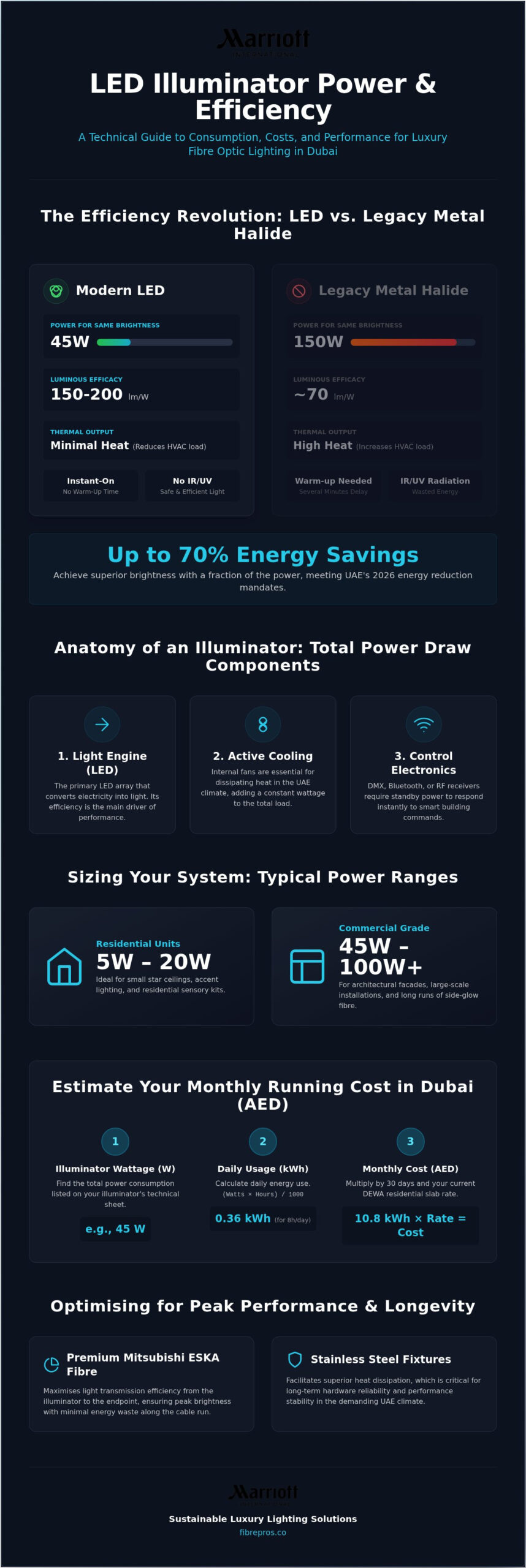
Residential units typically operate between 5W and 20W, which is sufficient for small star ceilings or sensory kits. In contrast, commercial-grade illuminators for architectural facades or large-scale installations often range from 45W to over 100W per unit. This higher draw supports the intensity required to push light through long runs of side-glow fibre or dense cable harnesses. Understanding these ranges helps project managers plan electrical circuits with technical precision.
The Components of Power Draw in an Illuminator
A professional illuminator is a complex piece of hardware. The total power draw isn’t just the LED chip itself. It involves several integrated systems that ensure reliability and performance. These include:
- The Light Engine: This is the primary LED array. Its efficiency depends heavily on modern LED lamp technology, which converts electricity into visible light with minimal waste.
- Internal Cooling: High-output LEDs generate concentrated heat. In the UAE climate, where ambient temperatures can stress electronics, active cooling fans are necessary. These fans add a small but constant wattage to the total consumption.
- Control Electronics: Professional systems often include DMX512, Bluetooth, or RF receivers. These components require a steady “standby” power to remain responsive to smart building commands.
Luminous Efficacy: Lumens per Watt
To understand efficiency, we look at luminous efficacy. Luminous efficacy is defined as the ratio of luminous flux to the total power consumed by the system. Modern LED illuminators are engineered for high efficacy, often achieving 150 to 200 lumens per watt. This is a massive leap over older metal halide or halogen discharge lamps, which usually operate at significantly lower levels. By switching to high-standard LED hardware, you can expect an energy reduction of 70% to 80% while maintaining or even increasing the perceived brightness of your fibre optic installation. This technical superiority ensures that luxury designs remain sustainable under Dubai’s evolving public safety and energy laws.
LED vs. Metal Halide: The Efficiency Revolution
Comparing legacy metal halide technology to modern LED units reveals a significant performance gap. A traditional 150W metal halide illuminator, once the industry standard for commercial displays, can now be replaced by a 45W LED unit without sacrificing light output. This transition directly impacts led illuminator power consumption by reducing the base load of a lighting system by over 70%. Unlike older discharge lamps that require several minutes to warm up and strike, LED systems offer “instant-on” capability. This immediate response is essential for smart home integration and dynamic lighting scenes in Dubai’s luxury residences, where lighting must respond instantly to user commands.
Efficiency also extends to the quality of light produced. Metal halide and halogen lamps emit significant amounts of infrared (IR) and ultraviolet (UV) radiation. This energy is essentially wasted because it doesn’t contribute to visible brightness. Modern LED technology provides an energy efficiency of 80-90 percent compared to traditional lighting. This efficiency means more power is converted into usable light and less into ambient heat. In the UAE, where indoor climate control is a major operational expense, reducing the heat generated by lighting systems directly lowers the load on HVAC units. Lowering the thermal footprint of your lighting design is a practical strategy for reducing total building energy costs.
Energy Consumption Comparison Table
| Technology | Typical Wattage | Annual kWh (Est.) | Heat Output | Lifespan (Hours) |
|---|---|---|---|---|
| Halogen | 250W | 730 kWh | Very High | 2,000 |
| Metal Halide | 150W | 438 kWh | High | 6,000 |
| High-Output LED | 45W | 131 kWh | Low | 50,000+ |
*Estimates based on 8 hours of operation per day.
The “Hidden” Efficiency: Thermal Management
Maintaining peak performance in the UAE requires advanced thermal management. When LEDs overheat, they experience “droop,” a technical phenomenon where luminous efficacy drops as temperatures rise. High-quality illuminators use engineered heat sinks and stainless steel housings to dissipate thermal energy effectively. This protection is critical for outdoor installations in Dubai, where high ambient temperatures can accelerate hardware degradation. When choosing LED illuminators for fibre optic systems, prioritizing thermal design ensures the unit maintains its rated wattage efficiency over its entire lifespan. Using marine-grade stainless steel fixtures further aids in durability and heat transfer, especially in coastal or underwater applications. If you’re designing a high-end project, it’s worth reviewing your technical specifications to ensure they meet current efficiency standards. Consult with our specialists to optimize your hardware selection for the specific demands of the Middle Eastern climate.
Calculating Running Costs for Fibre Optic Lighting in Dubai
Calculating operational expenses for luxury lighting in the UAE requires a shift from guesswork to technical precision. To determine the financial impact of your installation, you must use a standard electrical formula: (Wattage x Hours) / 1000 = Daily kWh. By multiplying this result by your specific DEWA tariff, you can forecast monthly expenditures with total accuracy. Because LED technology is constantly improving in efficiency and quality, these costs are often significantly lower than project managers anticipate. High-performance hardware ensures that led illuminator power consumption remains a manageable variable in your building’s energy budget.
Consider a typical luxury villa scenario in Emirates Hills. If you install a high-output 45W illuminator for a decorative feature that runs for 8 hours every night, the daily consumption is 0.36 kWh. Over a 30 day month, this totals 10.8 kWh. Using the 2026 DEWA residential slab rate of 0.230 AED per kWh plus the 0.060 AED fuel surcharge, the monthly cost is approximately 3.13 AED excluding VAT. Even when accounting for the negligible standby power required for RF or DMX receivers, the impact on your utility bill remains minimal. This data allows owners to enjoy premium lighting effects without the anxiety of escalating utility costs.
Step-by-Step Cost Calculation
Follow these three steps to audit your system’s energy footprint:
- Step 1: Identify the actual wattage listed on your Fibrepros illuminator label. Don’t use the “equivalent” wattage often found in marketing materials.
- Step 2: Estimate your daily usage. For example, a star ceiling kit in a home cinema might run for 6 hours per day.
- Step 3: Multiply the daily kWh by 30 days and then by the current DEWA rate (including fuel surcharges and 5% VAT) to find your monthly total.
The Impact of Dimming on Power Consumption
Integrating smart controls is the most effective way to optimize led illuminator power consumption. Unlike older lighting technologies that may maintain a high power draw even when dimmed, LED drivers are highly efficient. Dimming an LED linearly reduces its power consumption. A 50% dimming level roughly halves the LED power draw. By automating your lighting through a building management system, you can schedule lower intensity levels during late-night hours. This not only extends the lifespan of the LED chip but also provides an additional layer of energy savings for large-scale architectural projects.
Factors Influencing Energy Efficiency in Architectural Lighting
Total system efficiency in fibre optics is a product of both the light source and the transmission medium. While the led illuminator power consumption is a primary metric, the quality of your optical fibre determines how much of that energy is actually converted into visible light. Using high-performance Mitsubishi ESKA plastic optical fibre minimizes attenuation, which is the loss of light intensity over distance. When transmission loss is low, you can achieve the desired brightness with a lower-wattage illuminator, effectively reducing your building’s total energy footprint.
The type of fibre used also dictates the power requirements. Side-glow fibre, which emits light along its entire length, naturally requires a higher luminous flux to remain visible compared to end-glow fibre. This means side-glow installations often necessitate more powerful illuminators. To enhance the perceived brightness without increasing wattage, designers often use crystal end fittings. These fittings use refractive optics to concentrate the light into a brilliant “sparkle,” providing a luxury aesthetic while maintaining a low electrical load. Ambient light levels in the installation area also play a role. A dark home cinema requires a much lower power draw to create a vivid star ceiling than a brightly lit commercial lobby.
Fibre Quality and Luminous Flux
Low-quality or generic fibres suffer from high attenuation rates, meaning they “leak” light before it reaches the end fixture. This inefficiency forces project managers to select higher-wattage illuminators to compensate for the loss. Premium plastic optical fibre (POF) allows for longer cable runs with lower-wattage sources, maintaining technical precision across large-scale projects. Achieving maximum light transfer also depends on the termination quality. A clean, professional cut on the fibre end ensures that nearly 100% of the light enters the strand. A rough or poorly polished cut can cause significant reflection and light loss right at the source, wasting energy before it even travels a meter.
Smart Controls and Scheduling
Modern LED illuminators integrate seamlessly with smart building management systems. Using DMX512 protocols allows for precision scheduling in commercial projects, ensuring that power is only used when the building is occupied or for specific events. In residential settings, Bluetooth app control provides real-time energy monitoring and dimming capabilities. For outdoor and landscape lighting in the UAE, astronomical timers are an essential component. These timers automatically adjust to the seasonal changes in sunset and sunrise in Dubai, preventing the system from running during daylight hours. This level of control is fundamental for meeting 2026 energy reduction mandates while preserving the luxury experience. To ensure your system is engineered for maximum efficiency, view our range of high-performance LED hardware today.
Optimising Your Energy Footprint with Fibrepros Solutions
Fibrepros provides engineered lighting solutions that prioritise technical precision and long-term operational success. Our commitment to high-efficiency LED hardware ensures that every component in your system is selected to minimise led illuminator power consumption while delivering superior luminous flux. By focusing on the synergy between professional-grade illuminators and premium Mitsubishi ESKA fibre, we help architects and project managers achieve a high return on investment. Investing in quality hardware from the outset prevents the frequent maintenance cycles and high energy waste associated with sub-standard components.
Thermal management is particularly critical for specialised applications like underwater lighting fixtures. In the high-temperature environment of the UAE, effective heat dissipation is the only way to preserve LED efficacy. We utilise marine-grade stainless steel fixtures that act as efficient heat sinks, drawing thermal energy away from the light source. This engineering choice prevents the “droop” effect where LEDs lose brightness as they heat up, ensuring your pool or water feature remains brilliant without requiring additional power input. We invite consultants and developers to discuss “lumens-per-dirham” optimisation to ensure large-scale builds remain both visually stunning and commercially viable.
Custom System Design for Maximum Efficiency
A common mistake in lighting design is over-specifying the power of an illuminator. Fibrepros avoids this by precisely matching the illuminator output to the specific fibre harness length and cable density of your project. This tailored approach ensures you aren’t paying for unused energy. In many large-scale architectural projects, we recommend using multiple low-power units rather than a single, massive high-power unit. This strategy reduces the risk of voltage drop and allows for more granular control over different zones. Proper driver placement further ensures that electrical resistance is kept to a minimum, directly improving the overall led illuminator power consumption profile of the building.
The Fibrepros Expert Advantage
Since 1995, we’ve served as a specialist partner for high-stakes infrastructure projects across Dubai and the wider GCC. Our status as a supplier of Mitsubishi ESKA plastic optical fibre gives our clients direct access to materials that offer the highest light transmission rates in the industry. This technical edge means your illuminators don’t have to work as hard to achieve the desired effect, resulting in lower utility costs and extended hardware life. Our team takes pride in building the vital infrastructure that defines the modern UAE skyline. If you’re looking to verify the efficiency of your current plans or require a technical consultation for a new build, contact Fibrepros for an energy-efficient lighting audit and professional guidance.
Future-Proofing Your Luxury Lighting Strategy
Transitioning to high-efficiency LED technology is a technical requirement for the UAE’s 2026 energy landscape. By mastering the specifics of led illuminator power consumption, you can design lighting systems that deliver maximum brilliance with minimal electrical draw. You’ve seen how the combination of precision-engineered LED engines and high-quality Mitsubishi ESKA fibre eliminates energy waste and reduces the thermal load on your building’s HVAC system. These technical choices ensure that luxury aesthetics don’t come at the cost of operational inefficiency or high utility bills.
Fibrepros has served as a dedicated UAE specialist since 1995. As an official supplier of Mitsubishi ESKA POF, we provide the high-efficiency LED engines and durable components required for the most demanding luxury interiors. We take pride in the infrastructure we help build and remain committed to the highest industry standards. Consult the Fibrepros experts for energy-efficient lighting solutions to ensure your next build is both sustainable and spectacular. We’re ready to provide the technical mastery and specialized hardware your project deserves.
Frequently Asked Questions
Does an LED illuminator use more power than a standard LED bulb?
Professional illuminators generally draw more electricity than standard household bulbs because they contain additional industrial components. While a typical LED bulb might use 9W, an architectural illuminator often ranges from 45W to 100W. This is because the unit must power high-intensity LED arrays, internal cooling fans, and complex DMX or Bluetooth control drivers. Consequently, led illuminator power consumption reflects a complete integrated system rather than just a single light-emitting chip.
How much does it cost to run a star ceiling in Dubai per month?
Monthly costs for a standard residential star ceiling are typically less than 5 AED. Based on 2026 DEWA residential rates of 0.230 AED per kWh and the 0.060 AED fuel surcharge, a 45W illuminator running eight hours daily consumes approximately 10.8 kWh per month. This results in a monthly expenditure of roughly 3.13 AED plus VAT. These figures confirm that high-end fibre optic features remain an affordable luxury for Dubai homeowners.
Do LED illuminators get hot during operation in the UAE summer?
LED illuminators generate internal heat but operate at significantly lower temperatures than legacy metal halide systems. High-standard hardware incorporates active cooling fans and engineered heat sinks to manage thermal loads effectively. In the UAE summer, where ambient temperatures can reach 50°C, these cooling systems are vital. They prevent the LED chip from overheating, which maintains the unit’s efficiency and prevents the premature degradation of the internal electronics.
Can I reduce power consumption by dimming my fibre optic lights?
Dimming your system provides a linear reduction in the power consumed by the LED light engine. If you dim your illuminator to 50% brightness, the energy draw of the LED chip itself roughly halves. This makes smart control integration an excellent strategy for managing led illuminator power consumption in large commercial projects. Automated scheduling ensures your system operates at peak intensity only when necessary, further extending the hardware’s operational lifespan.
Is it worth upgrading my old metal halide illuminator to LED?
Upgrading to LED is highly recommended due to the immediate 70% reduction in energy usage and significantly lower maintenance requirements. A 45W LED unit provides comparable brightness to a legacy 150W metal halide illuminator while lasting up to 50,000 hours. Older units require frequent lamp replacements every 6,000 hours and generate excessive heat. Switching to modern hardware ensures compliance with the UAE’s 2026 energy reduction mandates for lighting systems.
Does the length of the fibre optic cable affect power consumption?
Cable length doesn’t change the wattage drawn by the illuminator, but it does impact the system’s overall efficiency. Longer runs of low-quality fibre suffer from high light attenuation, which might tempt you to use a more powerful, energy-hungry light source. By using premium Mitsubishi ESKA plastic optical fibre, you maximise light transmission. This allows you to achieve brilliant results with lower-wattage illuminators, effectively keeping your total energy footprint as small as possible.
What is the typical lifespan of a Fibrepros LED illuminator?
Our professional-grade LED illuminators are engineered to last between 50,000 and 100,000 hours. In a typical residential setting where lights run for eight hours a day, this equates to over 17 years of reliable service. This longevity far exceeds traditional lighting technologies, which often fail after 10,000 hours. Choosing high-durability hardware reduces the total cost of ownership by eliminating the need for frequent component replacements and specialised technical call-outs.
Do I need a special transformer for LED illuminators in the UAE?
Most modern LED illuminators feature integrated drivers designed specifically for the UAE’s 230V/50Hz electrical grid. You don’t usually require an external transformer; however, we recommend connecting your system to a stable, surge-protected circuit. High-quality drivers are engineered to handle minor voltage fluctuations, but protecting the electronics from power spikes is essential for long-term reliability. Always ensure your installation complies with the latest Dubai public safety standards for electrical hardware.