
Most luxury pool owners believe that a dimming display indicates a total system failure, but the reality is that your illumination is likely just suffocating under the intense GCC thermal load. You’ve probably noticed your once-vibrant pool floor looks duller this season, or perhaps the persistent hum of an overheating illuminator fan is disrupting your evening ambiance. It’s frustrating to invest in premium fibre optic pool lighting kits Dubai only to see the performance drop as the 2026 season approaches.
We understand that maintaining a high-end aquatic environment requires technical precision rather than guesswork. This guide provides the professional protocols needed to restore original brilliance and extend the operational lifespan of your Mitsubishi ESKA fibre. You’ll learn how to manage illuminator heat effectively and ensure your system remains fully compliant with the July 2026 Dubai Municipality swimming pool safety guidelines. From polishing cloudy fibre ends to optimizing fan airflow, we’re outlining the exact steps to keep your infrastructure performing at peak efficiency without the need for costly full-system replacements.
Key Takeaways
- Learn why separating the light source from the water is the ultimate safety standard and how routine maintenance preserves this critical operational integrity.
- Discover the specialized ventilation and filtration requirements for high-performance fibre optic pool lighting kits Dubai to prevent thermal failure during peak summer months.
- Understand how to maintain the optical clarity of Mitsubishi ESKA plastic optical fibre and protect side-glow cladding from UV-induced yellowing.
- Identify the technical indicators that signal a need for an LED illuminator upgrade to improve energy efficiency and system brightness for the 2026 season.
- Implement a structured seasonal maintenance checklist focused on fan performance and end-point polishing to extend the lifespan of your luxury pool infrastructure.
Essential Maintenance for Fibre Optic Pool Lighting in the UAE
Maintaining high-performance fibre optic pool lighting kits Dubai requires a shift in perspective from traditional electrical repair to optical path management. The core advantage of these systems is the total separation of electricity from the water. Since the light source sits in a remote illuminator, only light travels through the cable. This inherent safety is a primary reason for their popularity in luxury GCC developments. However, the absence of underwater electricity doesn’t mean the system is maintenance-free. Neglecting the system leads to dimming and component failure that could have been easily avoided.
Proper care ensures that the principle of operation, specifically total internal reflection, remains efficient over years of use. If the optical path becomes compromised by heat or debris, the brilliance of your pool will fade. Maintenance protocols in the UAE must prioritize the protection of the remote light projector from environmental stress to prevent the degradation of internal components. Regular servicing preserves the long-term investment in your underwater lighting fixtures and keeps the visual output at its original factory standard.
Why Maintenance Differs from Traditional Pool Lights
Traditional pool lighting involves submerged bulbs and gaskets that eventually fail and leak. With fibre optics, you don’t have to drain the pool or replace seals to fix a light. The focus shifts entirely to the optical path transparency. You aren’t checking for water ingress in the lamp; you’re checking for clarity at the connection point. Thermal management of the remote illuminator becomes the most critical task. If the illuminator stays cool and the fibre ends stay clean, the system can last decades. It’s a matter of maintaining a clean light channel rather than managing underwater electrical seals.
The Impact of the Middle Eastern Climate
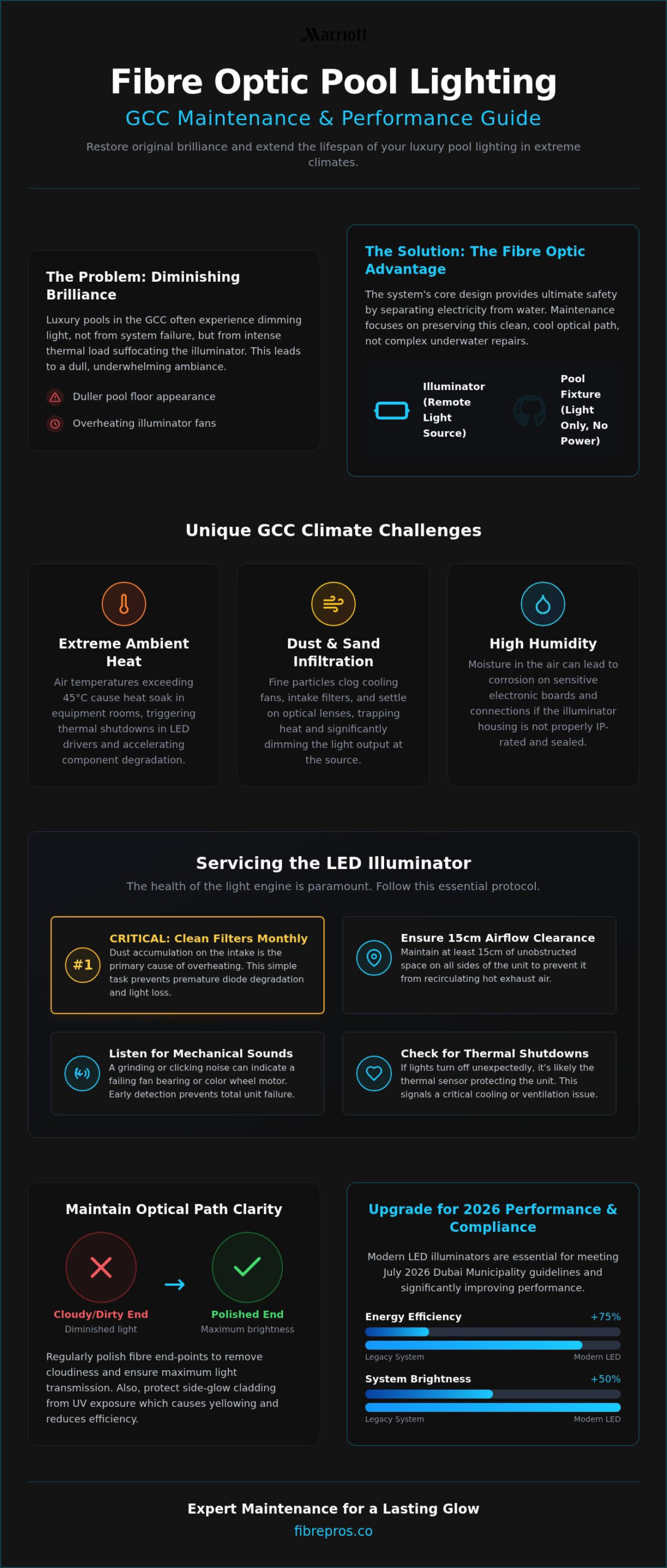
The GCC climate presents unique challenges that standard maintenance guides often ignore. Extreme ambient temperatures lead to heat soak within equipment enclosures. When the air outside is 45°C, a poorly ventilated pump room can reach temperatures that trigger thermal shutdown in LED drivers. Dust and fine sand are equally problematic. These particles clog cooling fans and settle on optical lenses, creating a layer of insulation that traps heat and dims light output. Humidity also plays a role, potentially corroding electronic boards if the illuminator isn’t properly IP-rated for the environment. Consistent care prevents these regional factors from shortening the lifespan of your fibre optic pool lighting kits Dubai.
Servicing the LED Illuminator: The Core of Your Pool Lighting
The illuminator serves as the engine for the entire system, containing the only active mechanical and electronic components. While the fibre itself is passive, the light engine requires consistent technical oversight to maintain peak output. Modern LED illuminators are significantly more efficient than legacy metal-halide units, but they’re sensitive to thermal fluctuations. High-performance L70 lumen maintenance standards depend heavily on how well the heat sink and cooling system function. In the context of fibre optic pool lighting kits Dubai, where ambient temperatures often exceed 40°C, the cooling fan’s health is paramount.
Monthly filter cleaning is the most critical task for any pool owner or facility manager. Dust accumulation on the intake prevents the light engine from shedding heat, leading to premature diode degradation. Beyond the electronics, you must listen for changes in the system’s acoustic profile. A grinding or clicking sound often indicates a failing colour wheel motor or a worn bearing in the cooling fan. Catching these mechanical issues early prevents a cascading failure that could require a complete unit replacement.
Ventilation and Thermal Protection
Proper installation requires at least 15cm of unobstructed clearance on all sides of the illuminator. Without this buffer, the unit recirculates its own exhaust air, creating a heat loop. Most high-end units feature thermal shutdown sensors that cut power when internal temperatures reach critical levels. If your pool lights are turning off unexpectedly during a Dubai summer afternoon, it’s likely a thermal protection trigger. Always verify the fan is spinning freely and isn’t obstructed by debris or loose wiring.
Optical Port Maintenance
The interface where the fibre bundle meets the light engine is a high-stress point. You should clean the glass condenser lens every quarter using lint-free wipes and high-purity isopropyl alcohol. This removes the film of “fog” that naturally builds up over time. During this inspection, examine the common end of the fibre bundle for any signs of browning or melting. This discoloration is a clear indicator of excessive heat or a misaligned optical path. Ensuring the fibre bundle is seated firmly and flush against the port prevents light leakage and heat buildup. For those noticing a drop in brilliance, a professional maintenance assessment can often restore original performance levels without needing new hardware.
Managing Optical Clarity and Fibre End-Point Degradation
While the LED illuminator provides the source, the optical transmission medium determines the final brilliance of your pool. High-quality Mitsubishi ESKA plastic optical fibre is engineered for durability, but its efficiency relies on maintaining clean, clear end-faces. In the harsh environment of Dubai, several factors can compromise this clarity. For side-glow fibre, prolonged UV exposure can eventually lead to yellowing of the outer cladding, which shifts the color temperature and reduces brightness. Similarly, the chemical balance in your pool water directly impacts the clarity of your protective fixtures and underwater lenses.
Biological growth and calcium deposits are the primary enemies of underwater light output. Algae can form a film over the lens, while high calcium levels in local water supplies often result in a white, chalky residue. These issues are especially prevalent when using premium fibre optic pool lighting kits Dubai, as the intricate lighting effects rely on precise light dispersion. Regular inspection of the underwater components ensures that these environmental factors don’t diminish the luxury aesthetic of your facility.
Trimming the Fibre Common End
A common misconception is that a dimming system requires a full fibre replacement. Often, the issue is simply a “burnt” common end where the fibre bundle meets the illuminator. Excessive heat or dust can cause the fibre ends to cloud or brown, blocking light entry. To fix this, you must trim the bundle. This isn’t a job for standard scissors. You need a professional hot knife to achieve a clean, perpendicular cut that doesn’t shatter the plastic core. After trimming, polishing the end-face with fine-grit optical film restores the smooth surface necessary for maximum light transmission into the bundle.
Cleaning Underwater Fittings
Your crystal end fittings and stainless steel fixtures require delicate handling to avoid scratches that diffuse light incorrectly. Use a soft-bristle brush to remove calcium deposits and bio-growth. If you’re using side-glow fibre, inspect the protective jacket for any signs of cracking or water ingress. Moisture inside the jacket can cause internal reflections that trap light rather than emitting it. Keeping these fittings clean and the jackets intact ensures your pool maintains its crisp, uniform glow throughout the 2026 season.
Seasonal Maintenance Checklist for GCC Luxury Pools
Preventative maintenance is the only reliable method to ensure your lighting system survives the environmental extremes of the Arabian Peninsula. A structured approach prevents catastrophic failure during the peak swimming season when temperatures and usage are at their highest. For owners of high-performance fibre optic pool lighting kits Dubai, consistency is the difference between a ten-year lifespan and a two-year failure. By implementing a tiered inspection schedule, you reduce the need for emergency technical call-outs and preserve the visual continuity of your luxury pool infrastructure.
High-usage periods, typically from April to October, place the greatest strain on the mechanical components of the system. During these months, the illuminator cooling system works overtime to combat ambient heat. Neglecting a simple filter check during this window can lead to a thermal event that compromises the internal LED engine. Conversely, the cooler winter months provide the ideal window for major refurbishments, such as fibre trimming or fixture upgrades, without disrupting the primary swimming season. Following a documented checklist ensures that no critical component is overlooked during these transitions.
Monthly Quick-Checks
A ten-minute monthly inspection can identify the majority of potential system issues before they escalate. Follow these three steps to maintain operational stability:
- Step 1: Visual inspection. Observe all light points at night. Look for uniform brightness across the entire pool. Dimming in specific areas usually indicates a dirty underwater lens or a loose fibre fitting.
- Step 2: Acoustic monitoring. Listen to the illuminator. A healthy unit should produce a consistent, low-level hum. Any rattling, grinding, or high-pitched whining indicates a failing fan or colour wheel motor that requires immediate attention.
- Step 3: Ventilation clearing. Use a soft brush or compressed air to clear debris from the illuminator intake and exhaust grilles. Dust buildup is the leading cause of overheating in the GCC.
Bi-Annual Deep Maintenance
Every six months, a more technical review is required to maintain optical integrity. This is best scheduled just before and just after the peak summer heat to evaluate the impact of thermal stress.
- Step 1: Fibre bundle inspection. Disconnect the fibre bundle from the illuminator port. Inspect the common end for any signs of heat damage or browning, as discussed in our previous section on optical clarity.
- Step 2: Submerged lens cleaning. Clean all underwater lenses using a non-abrasive, pool-safe solution. This removes the calcium and bio-film that naturally accumulate over time and dim the light output.
- Step 3: Control system testing. Test all remote controls and DMX integrations. Ensure that color transitions are smooth and that the system responds accurately to automation commands.
If you identify inconsistencies during these checks, it’s often more cost-effective to address them immediately rather than waiting for a total failure. For specialized technical support or component replacement, you can consult with our expert team to schedule a professional system audit.
Troubleshooting and Upgrading Outdated Pool Lighting Systems
Identifying the root cause of a lighting failure requires a systematic approach to differentiate between electronic component fatigue and optical degradation. In many cases, what appears to be a total system failure is simply a serviceable fault within the illuminator. However, if you’ve inherited an older installation, you might be dealing with legacy metal-halide technology that lacks the efficiency of modern fibre optic pool lighting kits Dubai. Understanding whether to repair or replace is the first step toward restoring your pool’s visual impact for the 2026 season.
A failed lamp is the most common issue, but a failed fibre run is more complex. You can usually identify a fibre-specific problem if only one section of the pool has dimmed while others remain bright. This often points to a physical break or internal crystalline fracture within the PMMA core. These fractures occur when the fibre is subjected to extreme mechanical stress or has reached the end of its operational life after decades of heat exposure. If the fibre itself has become brittle and opaque throughout its length, a complete bundle replacement is the only way to restore original luminosity.
Common Troubleshooting Scenarios
- Lights are on but very dim: If you’ve already cleaned the lenses and trimmed the common end as detailed in previous sections, the issue is likely lumen depreciation of the LED source. It’s time to evaluate the driver’s output.
- Lights stuck on one colour: This indicates a mechanical or sensor failure within the colour wheel assembly. The motor might be stalled, or the optical sensor that tracks the wheel’s position could be obscured by dust.
- No light at all: Start at the power source. Check the primary fuse and the low-voltage transformer. If the fan is spinning but there’s no light, the LED engine itself has likely reached its end-of-life.
The Path to a Modern Upgrade
Upgrading from legacy metal-halide illuminators to modern LED engines is the most significant improvement you can make to an existing system. LED retrofits offer superior colour saturation, reduced noise, and significantly lower heat output, which is vital for the UAE climate. These modern units also allow for seamless integration with smart home protocols. You can now manage your pool lighting through DMX or mobile applications, synchronizing your underwater effects with other features like star ceiling kits in adjacent pool houses or pergolas.
For systems installed more than a decade ago, a comprehensive 2026 system audit is recommended. A specialist can determine if your existing fibre optic pool lighting kits Dubai can support a high-output LED upgrade or if the optical path has degraded beyond the point of efficiency. Modernizing your controls and light source not only improves the aesthetic but also ensures your facility remains compliant with current energy and safety standards. Investing in technical precision now prevents the recurring costs associated with maintaining obsolete hardware.
Securing Your Aquatic Infrastructure for the 2026 Season
Preserving the brilliance of your facility requires more than occasional cleaning; it demands a commitment to technical precision. As we’ve explored, the longevity of your lighting relies on effective thermal management of the LED engine and the optical clarity of the fibre path. Implementing these professional protocols ensures that your investment in fibre optic pool lighting kits Dubai continues to deliver a high-end aesthetic while meeting the latest 2026 safety standards.
Fibrepros serves as your dedicated partner for specialized technical support in the UAE. As an authorized Mitsubishi ESKA supplier and experts in high-heat lighting environments, we provide the industrial-grade components and expertise necessary to keep your infrastructure operational. Proactive maintenance is always more cost-effective than emergency repairs or total system replacements.
Don’t let environmental stress diminish your pool’s visual impact. Request a Professional Maintenance Audit from Fibrepros to ensure your system is optimized for the year ahead. With expert oversight, your luxury lighting will remain a vibrant and reliable feature for many seasons to come.
Frequently Asked Questions
How long do fibre optic pool lights typically last in Dubai?
The Mitsubishi ESKA plastic optical fibre itself is incredibly durable and can last over 20 years when protected from mechanical damage. Modern LED illuminators are typically rated for 50,000 hours of operation. In the Dubai climate, the actual lifespan depends on the quality of the thermal management and housing. Regular maintenance of the cooling fans is essential to ensure the electronics reach their full decade-plus potential despite the extreme ambient heat.
Why are my fibre optic pool lights getting dimmer over time?
Dimming is usually caused by optical path interference rather than a failure of the light source itself. Calcium deposits on underwater lenses or dust accumulation on the illuminator’s internal condenser lens are the most common culprits. If the light loss is significant, it may indicate a “burnt” common end where the fibre bundle meets the light engine. Trimming and polishing the bundle end often restores the system to its original factory brightness.
Can I change the bulb in my pool light illuminator myself?
Modern fibre optic pool lighting kits Dubai utilize integrated LED light engines rather than traditional bulbs. These units don’t have a user-replaceable lamp; instead, they require a professional technician to service the internal driver or LED board if a failure occurs. If you’re still using an older metal-halide system with a replaceable bulb, we recommend upgrading to a modern LED illuminator to improve energy efficiency and reduce heat-related maintenance issues.
Is it safe to clean underwater fibre optic lenses while the pool is full?
It is entirely safe to clean these lenses while the pool is occupied or full because there’s no electricity present in the water. Fibre optic systems use a remote light source, meaning only light travels through the cables to the pool wall. You can safely scrub the stainless steel fixtures and crystal end fittings with a soft brush to remove algae or calcium without any risk of electrical shock or needing to drain the pool.
What is the best way to clean a burnt fibre optic common end?
The only effective way to “clean” a burnt common end is to trim the damaged section away. You must use a professional hot knife to create a clean, perpendicular cut across the entire fibre bundle. Using standard cutters will shatter the plastic cores and significantly reduce light transmission. Once trimmed, the end-face should be polished with fine-grit optical film to ensure a smooth surface for maximum light entry from the LED engine.
How often should I service my pool lighting illuminator in the UAE?
We recommend a monthly quick-check and a comprehensive bi-annual service. The monthly check involves clearing dust from the ventilation grilles and ensuring the cooling fans are operational. The bi-annual service should be performed before and after the peak summer season to inspect the fibre common end and deep-clean all underwater lenses. This schedule is vital in the GCC to prevent the fine desert sand from compromising the system’s mechanical components.
Can I upgrade my old fibre optic system to work with my smartphone?
Yes, you can easily modernize an existing installation by retrofitting the illuminator. By replacing your old light engine with a modern LED unit that features DMX or Wi-Fi connectivity, you can control your pool lighting via a smartphone app or smart home system. This upgrade allows you to manage colours, brightness, and schedules without needing to replace the fibre optic pool lighting kits Dubai already installed behind your pool walls.
Does the salt level in my pool affect the fibre optic cables?
Salt and pool chemicals have no effect on the plastic optical fibre itself, as it’s non-corrosive and chemically inert. However, the fixtures that hold the fibre in place must be high-quality. We utilize 316-grade stainless steel fixtures specifically to withstand the saline and chlorinated environments common in Dubai luxury pools. While the fibre remains clear, you must still clean the fixtures regularly to prevent mineral buildup from obscuring the light output.