
Standard LED strips are often the weakest link in Qatar’s high-performance architectural designs. While rigid components frequently snap or produce visible hotspots, professional fibre optic lighting for curved surfaces Doha offers a seamless, uniform glow that withstands the region’s extreme ambient temperatures. It’s frustrating to watch complex installations fail because heat causes diodes to burn out or rigid tracks to pull away from tight architectural contours. This technical limitation often compromises the aesthetic integrity of Doha’s most ambitious curved structures.
You can achieve a perfectly uniform line of light by using side-glow fibre and LED illuminators that isolate heat-generating electronics from the physical light delivery medium. This guide details how these systems align with the updated April 2026 Qatar building specifications and QCS requirements for engineering excellence. We’ll preview the technical advantages of Mitsubishi ESKA plastic optical fibre, which allows for tight bend radii and high temperature tolerance. You’ll discover how to ensure your curved lighting remains maintenance-free and structurally sound in Doha’s demanding environment by using professional-grade components designed for architectural precision.
Key Takeaways
- Identify why fibre optic lighting for curved surfaces Doha eliminates the hotspots and mechanical stress that lead to premature LED circuit failure.
- Master the technical application of Mitsubishi ESKA Plastic Optical Fibre to achieve a perfectly uniform line of light on complex architectural bends.
- Learn how to optimize system lifespan by isolating heat-generating LED illuminators from the passive, heat-resistant fibre optic cables.
- Discover specialized techniques for integrating side-glow fibre into traditional Majlis arches and organic pool perimeters using professional-grade underwater fixtures.
- Understand the operational benefits of custom harness manufacturing and centralized maintenance for high-stakes architectural projects in Qatar.
The Challenge of Architectural Curves: Why Traditional Lighting Fails in Doha
Doha’s architectural landscape is defined by its ambitious organic forms, from sweeping majlis arches to the fluid lines of modern residential domes. While these curves are aesthetically striking, they present a significant technical hurdle for standard lighting systems. Most contractors attempt to use flexible LED strips, but these often fall short of the precision required for high-end projects. Implementing fibre optic lighting for curved surfaces Doha has become the preferred standard for architects who prioritize both visual uniformity and long-term reliability.
The core issue lies in the fundamental design of traditional lighting. Rigid or semi-flexible components aren’t engineered for the complex, multi-axis bends found in contemporary Qatari design. When a linear light source is forced into a curve, it creates mechanical and thermal stresses that lead to rapid system degradation. Unlike active electronic components, the principles of optical fiber allow light to be guided through a passive medium. This creates a distinct advantage because the light delivery system remains cool and flexible while the heat-generating electronics are housed elsewhere.
Understanding the Limitations of Flexible LED Strips
Flexible LED strips rely on a “diode-to-diode” layout. On a flat surface, this is rarely an issue. However, once you apply them to a curved profile, the gaps between these diodes become visible. This results in the “hotspot” problem, where the light appears as a series of bright dots rather than a continuous, ethereal glow. This inconsistency is particularly noticeable when viewed from the multiple angles common in winding staircases or arched entryways.
Mechanical failure is another frequent complication. LED strips utilize copper PCB traces that are susceptible to fatigue. Repetitive bending during the installation process often compromises these traces, leading to intermittent flickering or total circuit failure. In a high-stakes architectural environment, these failures are costly and difficult to rectify once the finishing work is complete.
The Doha Factor: Heat and Architectural Complexity
Doha’s climate introduces an additional layer of risk. Ambient heat accelerates the degradation of LED chips. When these chips are trapped in tight, unventilated curved recesses, the heat cannot escape. This thermal buildup causes the diodes to shift in color or burn out prematurely. Using fibre optic lighting for curved surfaces Doha solves this by using LED illuminators located in climate-controlled areas, delivering light through heat-resistant Mitsubishi ESKA plastic optical fibre.
Qatari architecture often features intricate domes and curved pool perimeters that require a remote-source approach. By separating the light source from the point of emission, you ensure that the delicate architectural features remain cool. This “passive” delivery is essential for maintaining the structural integrity of sensitive materials and ensuring the lighting system lasts as long as the building itself.
Mastering Bend Radius: The Science of Mitsubishi ESKA POF on Curves
Achieving a flawless arc of light requires more than just high-quality components. It demands a deep understanding of material physics. Mitsubishi ESKA Plastic Optical Fibre (POF) has become the industry benchmark for fibre optic lighting for curved surfaces Doha because it manages the balance between flexibility and light transmission efficiency. Unlike glass fibres that are prone to fracturing under mechanical stress, POF utilizes high-performance polymers specifically engineered for architectural contouring. This allows designers to push the boundaries of organic shapes without risking system failure.
Mitsubishi ESKA POF: Flexibility Meets Durability
The polymer core of Mitsubishi ESKA POF provides a resilience that rigid lighting simply cannot match. This material science is detailed in the Mitsubishi ESKA POF pillar, highlighting why these fibres are the preferred choice for high-stakes GCC projects. Because the fibre has a physical “memory,” it holds its shape along a curve without the recoil issues common in cheaper, generic materials. Scientific research into Plastic Optical Fibers confirms their suitability for these applications, noting that their ductility allows for installation in spaces where traditional electronics would fail. This durability is vital for Doha’s intricate architectural features where access for repairs is often limited.
Calculating Bend Radius for Doha Installations
Precision in fibre optic lighting for curved surfaces Doha depends on respecting the minimum bend radius. A reliable rule of thumb for Mitsubishi ESKA is a radius of at least 10 times the fibre’s diameter. For instance, a 1mm fibre requires a minimum 10mm bend radius to prevent light leakage through the cladding. If you bend the fibre too sharply, you risk attenuation, where light escapes rather than reflecting through the core. This leads to dim spots and reduced brightness at the end of the run.
For larger architectural curves, such as grand domes or winding staircases, we recommend using multi-strand harnesses. These bundles distribute the mechanical load and allow for a smoother, more uniform glow across long distances. Project managers should verify these calculations during the design phase to ensure the final result meets the high standards expected in Qatar’s luxury sector. If you’re planning a complex installation, consulting with a specialist on custom harness configurations can prevent costly errors during the fit-out stage.
Choosing the right fibre type is the final step in the process. Side-glow fibre emits light along its entire length, making it ideal for highlighting the perimeter of a curved pool or a traditional arch. End-glow fibre focuses light at the tip, which is perfect for creating star-like patterns on curved ceilings. Both types maintain their efficiency when contoured correctly, provided the LED illuminator is powerful enough to drive the system. Our comprehensive approach ensures that every component works in total harmony with your architectural vision.
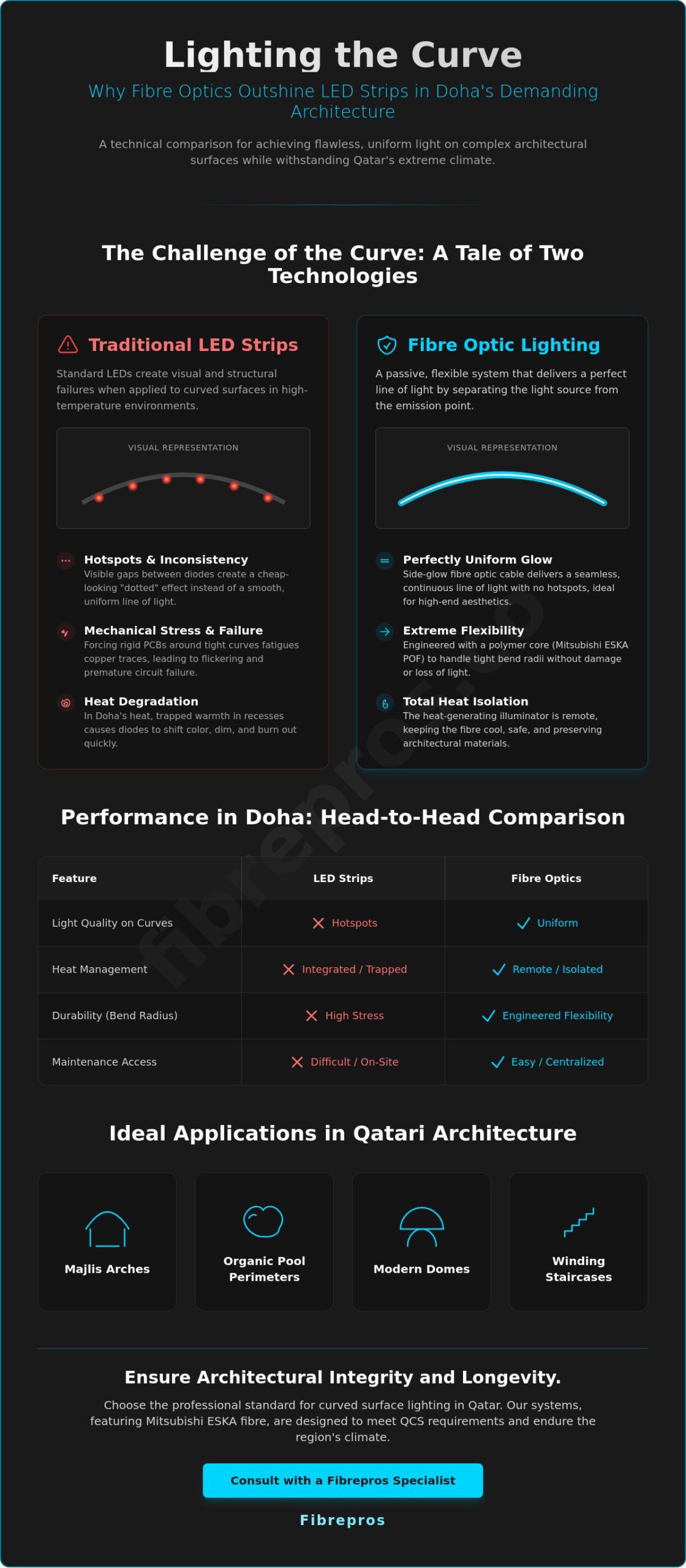
Fibre Optics vs. LED Strips: A Performance Comparison for Doha
Doha’s climate demands lighting solutions that prioritize thermal stability and mechanical resilience. While LED strips are often marketed as flexible, they remain high-maintenance components when installed in curved architectural recesses. Choosing fibre optic lighting for curved surfaces Doha provides a fundamental engineering advantage: the separation of light emission from electronic heat. This remote-source configuration ensures that the delicate architectural curve remains passive, while the active components are protected in controlled environments.
The operational cost of lighting in Qatar is often overlooked during the initial build. Replacing a failed LED strip inside a curved cove or behind a finished wall is an invasive, expensive process. In contrast, professional fibre optic systems utilize Mitsubishi ESKA POF with a projected 20-year lifespan. The fibre itself is a passive polymer that doesn’t burn out. If a light source fails, technicians simply replace the single illuminator in the accessible maintenance area. There’s no need to touch the architectural curve itself. This maintenance-free delivery makes it the most cost-effective solution for Qatar’s 2030 vision projects.
Thermal Isolation: The Remote Source Advantage
The primary failure point for traditional lighting in Doha is heat-induced diode degradation. By utilizing a high-performance LED illuminator, project managers can locate the light source up to 30 metres away from the actual curve. This allows the electronics to reside in an AC-controlled maintenance closet or a ventilated ceiling void. This setup completely removes UV and IR heat from the installation point. It’s particularly critical when lighting sensitive materials or narrow organic shapes where airflow is non-existent.
Uniformity and Aesthetic Control
Consistency is the hallmark of luxury design. LED strips often struggle with “scalloping” or visible gaps between diodes, especially on tight radii. Side-glow fibre offers a full 360-degree output, creating a perfectly continuous “neon” effect that remains uniform from every viewing angle. Because the entire run is powered by a single source, the colour temperature remains identical across the entire geometry. This level of control is why prestigious projects often reference a case study of fibre-optic sculpture in architectural design when planning large-scale installations.
For designers requiring dynamic effects, these systems integrate seamlessly with DMX controls. This allows for synchronized colour changes across complex fibre optic lighting for curved surfaces Doha installations. Whether you’re illuminating a grand hotel lobby or a private majlis, the result is a smooth, flicker-free transition that maintains its integrity over decades of use. This reliability is a direct result of moving the complexity away from the curve and into a manageable, centralized location.
Practical Applications: From Arched Majlis to Curved Pools in Doha
Doha’s architectural identity relies heavily on sweeping curves and intricate geometries. Applying fibre optic lighting for curved surfaces Doha allows these features to be illuminated with a level of precision that rigid systems cannot replicate. From the grand entrance domes of West Bay villas to the intimate majlis spaces of traditional Qatari homes, the application of side-glow and end-glow fibre transforms structural elements into focal points. These systems provide a continuous, hotspot-free glow that emphasizes the fluidity of the design rather than distracting from it.
Residential Luxury: The Arched Majlis
Islamic arches are a cornerstone of regional design, requiring a lighting approach that respects their craftsmanship. To achieve a soft, ethereal glow, we recommend recessing side-glow fibre directly into the plasterwork or architectural moulding. This technique hides the fibre start and end points, ensuring the light appears to emanate from the structure itself. By pairing these runs with dimmable LED illuminators, you can create specific mood scenes tailored for social gatherings or quiet reflection. The result is a clean arc of light that remains perfectly uniform across the entire radius of the arch.
Aquatic Curves: Winding Pools and Water Features
Freeform pools and organic water features present a unique challenge for standard lighting due to moisture and complex shapes. Using underwater lighting fixtures integrated with side-glow fibre provides a safe, 100% electricity-free light delivery system. Since no power reaches the water, these systems are inherently safer for Doha’s luxury residential sector. For a truly celestial effect, star ceiling kits can be adapted for pool floors, creating winding starlight curves that follow the organic shape of the basin without the risk of circuit failure.
Grand entrances often feature soaring domes that require specialized lighting strategies. Spiraling end-glow fibre along the interior radius creates a celestial pattern that draws the eye upward without the clutter of visible fixtures. This same principle applies to curved cabinetry in luxury retail environments across Doha. Subtle accent lighting with side-glow fibre provides a continuous line of light that highlights joinery details without the heat buildup that could damage high-end finishes or sensitive products. This versatility ensures that fibre optic lighting for curved surfaces Doha remains the gold standard for high-end fit-outs.
For project managers looking to implement these specialized applications, selecting the right components is critical. You can explore our full range of fibre optic lighting solutions to find the ideal match for your specific architectural radius.
Implementing Your Curved Lighting Strategy with Fibrepros Doha
Executing a successful lighting project in Qatar requires more than just high-quality materials. It demands a partner with a deep understanding of regional architectural standards and the technical challenges posed by the local climate. With 30 years of specialized GCC lighting expertise, our team provides the technical precision necessary to turn complex designs into reality. Implementing fibre optic lighting for curved surfaces Doha involves a rigorous process that moves from conceptual CAD design to precise on-site commissioning. This ensures that every arc of light meets the high-performance benchmarks required for Qatar’s 2030 vision developments.
Precision is non-negotiable in luxury fit-outs. We don’t rely on generic, one-size-fits-all solutions because every architectural curve has a unique radius and luminous requirement. Our engineers calculate the exact strand count and fibre diameter necessary to maintain luminous intensity across the entire architectural arc. This level of specialization distinguishes a professional installation from a DIY attempt that might fail under Doha’s environmental stressors.
Bespoke Harness and Kit Design
Off-the-shelf kits rarely account for the specific geometry of a bespoke curved majlis or a grand entrance dome. We manufacture custom harnesses tailored to the exact dimensions of your project. This process eliminates waste and ensures that light transmission remains efficient from the illuminator to the furthest point of the curve. For projects requiring an extra layer of refinement, we offer crystal end fittings that provide a decorative termination for end-glow fibres. These fittings enhance the aesthetic impact of the installation while maintaining the structural integrity of the light path.
Local Support for Doha Projects
Accountability is a core part of our brand promise. While international competitors might offer design services from abroad, we provide direct support for projects across Doha and the wider Qatar region. This local presence is vital for project managers who need responsive technical guidance during the critical phases of construction. We exclusively utilize Mitsubishi ESKA POF because its reliability in high-stakes architectural projects is well-documented. This choice of material, combined with our specialized manufacturing, ensures that your fibre optic lighting for curved surfaces Doha remains operational and maintenance-free for decades.
Our technical support team is available to assist with everything from initial specification to the final handover. We understand the pressure of high-profile Qatari developments and work to alleviate technical anxieties through total competence. If you’re ready to elevate your architectural design with a solution that prioritizes both form and function, we are ready to assist. Contact our expert team to discuss your curved lighting project today.
Future-Proofing Your Architectural Vision in Qatar
Achieving a seamless glow on organic architectural forms requires a shift from traditional rigid electronics to passive light delivery. We’ve explored how isolating the light source protects your installation from Doha’s extreme heat while ensuring a perfectly uniform radius. By mastering bend radius calculations and selecting side-glow fibre over standard LED strips, you eliminate the hotspots and mechanical failures that compromise high-stakes projects. These systems provide the thermal stability and aesthetic precision necessary for the region’s most ambitious designs.
As an authorized Mitsubishi ESKA distributor with over 30 years of GCC experience, we specialize in heat-resistant lighting solutions that meet Qatar’s rigid building specifications. Our team provides the technical precision needed to integrate fibre optic lighting for curved surfaces Doha into complex domes, arches, and aquatic features. We ensure your design remains maintenance-free and visually striking for decades by utilizing high-performance polymers and custom-engineered harnesses. Your next landmark project deserves a lighting system that matches its structural ambition.
Request a Technical Consultation for Your Doha Project to begin specifying a custom solution tailored to your specific architectural radius. We look forward to helping you realize a flawless, celestial glow in your next development.
Frequently Asked Questions
Can fibre optic lighting be used on very tight curves?
Yes, fibre optic lighting is highly effective on tight curves provided you respect the minimum bend radius. For Mitsubishi ESKA plastic optical fibre, the standard rule is a radius of at least 10 times the fibre’s diameter. This ensures the polymer core remains structurally sound and prevents light from leaking through the cladding. It’s a far more resilient solution than rigid LED components that often snap under similar mechanical stress.
Is side-glow fibre bright enough for architectural accent lighting in Doha?
Side-glow fibre provides high-intensity illumination when paired with professional-grade LED illuminators. It creates a perfectly uniform, neon-like effect that’s ideal for highlighting the sweeping curves of Qatari majlis arches or building perimeters. The final brightness depends on the illuminator’s output and the strand count within the harness. Using fibre optic lighting for curved surfaces Doha ensures a continuous glow without the visible hotspots common in traditional strip lighting.
How do I hide the LED illuminator in a curved wall installation?
You should place the LED illuminator in a remote, ventilated location such as a ceiling void, maintenance closet, or accessible cabinet. Because the fibre can carry light up to 30 metres from the source, the active electronics don’t need to be near the curve itself. This remote-source approach keeps the architectural surface clean and ensures that maintenance teams can access the equipment without disturbing the finished wall or decorative plasterwork.
What is the maximum length of a curved fibre optic run?
The maximum effective length for a side-glow run is typically 30 metres before light attenuation becomes noticeable. For longer architectural curves, we implement a “dual-feed” configuration where an illuminator powers the fibre from both ends. This technique maintains uniform brightness across the entire installation. Our engineers calculate these requirements during the design phase to ensure consistent luminosity regardless of the project’s scale or complexity.
Are fibre optics safer than LEDs for curved pool lighting in Doha?
Fibre optics are significantly safer for aquatic environments because they carry no electricity or heat to the water. Only the passive, polymer fibre is installed within our underwater lighting fixtures. The light source remains in a dry, remote location, which completely eliminates the risk of electrical shock. This makes it the preferred choice for luxury freeform pools in Doha where safety and reliability are the primary concerns.
How do I maintain curved fibre optic lighting systems?
Maintenance is simplified because it’s centralized at the remote LED illuminator. The fibre optic cables themselves are passive components that require no upkeep once installed. You only need to access the illuminator for occasional fan cleaning or LED replacement. This ensures that the curved architectural features remain untouched, avoiding the need for invasive repairs or the removal of decorative elements to fix a failed light source.
Does the Doha heat affect the flexibility of the plastic optical fibre?
Mitsubishi ESKA POF is engineered to withstand operating temperatures between -55°C and 70°C. This rating ensures the fibre remains flexible and structurally sound even in Doha’s high-ambient-temperature environments. Unlike standard LED strips that may become brittle or suffer from heat-induced circuit failure, plastic optical fibre maintains its integrity. It’s a robust solution designed to survive the thermal stresses of the Middle Eastern climate without degrading over time.
Can I control curved fibre optic lighting with my smart home system?
Yes, our LED illuminators integrate seamlessly with major control protocols including DMX, Dali, and 0-10V systems. This allows you to manage your fibre optic lighting for curved surfaces Doha through a centralized smart home interface. You can easily program dimming levels, colour changes, and automated schedules. This level of control ensures your architectural lighting responds dynamically to the time of day or specific social occasions while maintaining technical precision.