
The intense heat of the UAE doesn’t just challenge your cooling systems; it’s the primary silent killer of high-end architectural lighting. When a star ceiling in a luxury lobby dims or an underwater fixture fails, the immediate assumption is often a total system collapse. We understand that high specialist repair costs and the pressure of maintaining high-visibility areas make these failures particularly stressful for facility managers. You need a functional, bright system that meets the 2024 Abu Dhabi Dark Sky Policy without the expense of a full overhaul.
This guide simplifies troubleshooting fibre optic lighting Abu Dhabi by focusing on the thermal and mechanical issues unique to our region. You’ll learn to distinguish between lighting fibre and communication fibre while identifying why your LED illuminators might be underperforming. We’ll provide a clear diagnostic path to restore your lighting and explain how Mitsubishi ESKA standards protect your investment from future heat-related degradation. We’ll cover everything from LED component checks to the proper shielding of stainless steel fixtures to ensure your property remains compliant and visually stunning.
Key Takeaways
- Identify specific failure symptoms like total power loss or yellowing to isolate whether the fault lies in the light source or the fibre itself.
- Follow a professional diagnostic path for troubleshooting fibre optic lighting Abu Dhabi, focusing on thermal shutdowns and fan failures common in regional attic spaces.
- Compare the resilience of Mitsubishi ESKA fibre against generic materials to prevent UV degradation and light loss in outdoor landscapes.
- Implement strategies to protect internal LED illuminator components from fine dust ingress caused by seasonal Shamal winds.
- Determine the most efficient time to upgrade legacy halogen systems to cool-running LED illuminators for improved reliability and performance.
Identifying Common Symptoms of Fibre Optic Lighting Failure
Effective troubleshooting fibre optic lighting Abu Dhabi begins with a systematic observation of the failure state. Unlike standard electrical fixtures, fibre optic systems separate the light source from the delivery point. This means a dark star ceiling or a dim pool perimeter doesn’t always indicate a broken cable. Identifying the specific symptom is the first step toward restoring a functional, bright system without unnecessary replacement costs.
- Total blackout: This usually indicates a complete failure of the LED illuminator’s power supply or internal driver. If the unit doesn’t power on, the issue is likely electrical.
- Dimming or ‘Yellowing’: A loss of intensity or a shift toward a muddy yellow hue often results from heat-induced degradation. This is common when the fibre ends are exposed to excessive temperatures.
- Flickering: Intermittent light output is typically linked to electrical instability within the driver or a loose connection in the external AC/DC adapter.
- Noisy Operation: Audible grinding or buzzing suggests the internal cooling fan is failing. In the UAE climate, fan failure leads to immediate thermal shutdown.
- Individual strand failure: If specific ‘stars’ are dark while others remain bright, the issue is mechanical damage to individual fibre strands rather than the light source.
This diagnostic process is essential for troubleshooting fibre optic lighting Abu Dhabi in high-stakes commercial environments where downtime impacts the aesthetic value of the property.
Visual vs. Mechanical Failures
Distinguishing between a dead light source and damaged fibre cables is critical for cost-effective repairs. A foundational step in understanding optical fiber technology reveals that while the cables themselves are passive, they’re susceptible to physical stress. You should first check the ‘port’ where the fibre bundle connects to the illuminator. In high-heat environments, ‘burn-back’ can occur at this junction. This happens when the common end of the fibre bundle melts or discolours, effectively blocking light from entering the strands. If the fibre ends look charred, they’ll need professional re-termination.
The Role of the LED Illuminator
The LED illuminator acts as the engine of your lighting system. In Abu Dhabi villas, these units are the most frequent point of failure because they’re often installed in unventilated attic spaces or ceiling voids. When ambient temperatures rise, the internal electronics struggle to dissipate heat. Before you attempt to open any electrical housing, perform basic safety checks. Ensure the power is fully disconnected. Most modern LED light engines use specialized drivers that require technical precision to test. If the illuminator is receiving power but the LED isn’t firing, the internal component has likely reached its thermal limit.
Diagnosing the LED Illuminator: Troubleshooting the Light Source
The LED illuminator is the heart of the system. When troubleshooting fibre optic lighting Abu Dhabi, you must recognize that this component houses the only active electronics in the entire installation. While the fibre cables themselves are passive, the light engine is susceptible to electrical fluctuations, environmental heat, and mechanical wear. If your star ceiling or pool lighting has failed, the illuminator is the most logical place to start your diagnostic work.
Professional standards, such as those promoted by The Fiber Optic Association (FOA), emphasize the need for clean, stable power environments for optical systems. In the UAE, high ambient temperatures and electrical surges can quickly degrade internal components. Identifying whether the fault is a simple power issue or a complex thermal shutdown will save hours of unnecessary labor.
Power and Driver Issues
Start by testing the voltage output from the external AC/DC adapter or the internal driver. LED drivers often underperform before they fail completely, leading to dimming or flickering. Surge damage is a common reality after Abu Dhabi seasonal thunderstorms, which can spike the local grid and fry sensitive circuitry. If the unit shows no signs of life, use a multimeter to verify that power is reaching the LED chip. For project managers looking to replace a failed unit with a more resilient model, choosing LED illuminators specifically rated for high-specification architectural projects is essential for long-term reliability.
Cooling Systems and Dust Ingress
Fan failure is the primary cause of system death in the Middle East. Most professional illuminators use high-speed fans to pull heat away from the LED chip. Dust ingress from seasonal Shamal winds can seize these fans in weeks if filters aren’t maintained. Once a fan stops, the unit enters a thermal shutdown loop to prevent a fire. Cleaning the intake filters and ensuring the unit isn’t buried under insulation in a ceiling void can resolve many “intermittent” failure issues. Proper ventilation is a core requirement for troubleshooting fibre optic lighting Abu Dhabi installations that operate 24/7.
Smart home integrations add another layer of complexity. If your system is stuck on one color or won’t respond to commands, the issue might lie in the DMX control logic rather than the light source itself. Finally, inspect the common end of the fibre bundle where it meets the illuminator. Excessive heat from a failing LED chip or a poorly focused lens can melt the tips of the fibre. This “burnt end” prevents light from entering the cable. If your light engine is beyond repair, sourcing high-spec LED illuminators from a specialist ensures your infrastructure meets the latest performance standards.
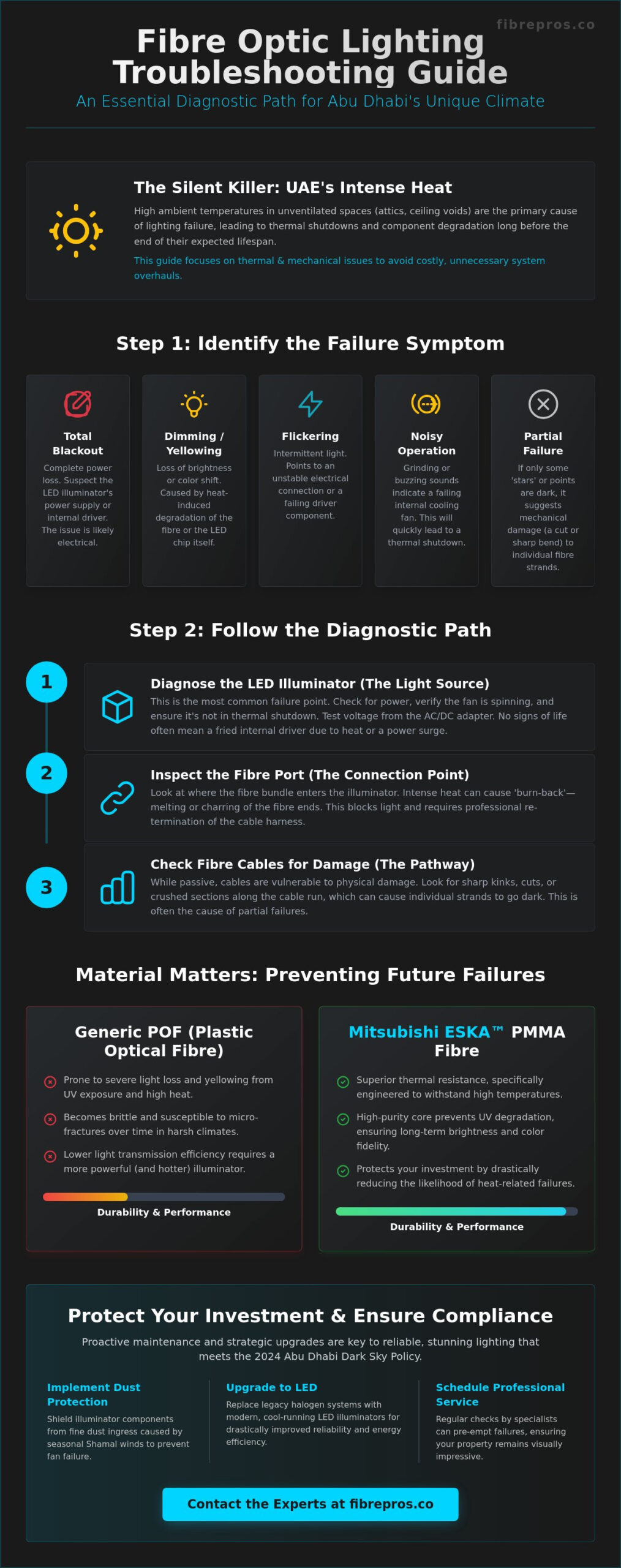
Inspecting Fibre Optic Cables: Mitsubishi ESKA vs. Generic POF
Troubleshooting fibre optic lighting Abu Dhabi involves a detailed inspection of the physical transmission medium. While the light engine generates the illumination, the quality of the Plastic Optical Fibre (POF) determines the final output. High-visibility failures in Abu Dhabi landscapes often stem from physical trauma or environmental degradation rather than electronic faults. Understanding the Fundamentals of Fiber Optic Lighting is necessary to identify how light loss occurs within these strands. Unlike glass fibre used in telecommunications, POF is designed for flexibility and safety in architectural applications, but it remains sensitive to improper handling.
Physical damage is a frequent culprit in failed installations. Kinks or sharp bends in the cable disrupt the internal reflection of light, leading to “hot spots” or dark sections. Crushed strands, often caused by tight cable ties or heavy construction debris during villa fit-outs, permanently damage the core. In Abu Dhabi’s outdoor installations, UV degradation is a significant threat to generic side-glow fibres. Prolonged sun exposure causes the outer cladding of unbranded cables to become brittle and opaque, which severely reduces light transmission and ruins the aesthetic effect.
Moisture ingress and chemical exposure present unique challenges for underwater lighting fixtures. Poorly sealed connections allow water to “wick” up the fibre bundle through capillary action. If the installation uses low-grade unbranded fibre, pool chlorine can eat through non-specialised jackets, causing the fibre to cloud or crack. This leads to a dull, ineffective lighting system that fails to meet the operational standards expected in high-end B2B environments. Identifying these material failures early prevents the cost of replacing the entire illuminator when only the fibre is compromised.
The Mitsubishi ESKA Advantage
Standard POF often fails under the intense thermal loads found at the illuminator port. Mitsubishi ESKA Plastic Optical Fibre is engineered to resist the ‘yellowing’ that plagues inferior products in the UAE. Its high thermal threshold allows it to maintain clarity even when positioned close to high-output LED chips. Mitsubishi ESKA provides superior durability and light transmission stability in high-ambient-temperature environments. This resilience ensures that the system maintains its colour temperature and brightness over years of operation, even in the most demanding Abu Dhabi heat.
Repairing Damaged Fibre Bundles
You don’t always need to replace an entire system when a fault is found. If the damage is localized near the illuminator, a bundle can often be re-terminated. This process involves “hot-knifing” the bundle to create a clean, flat common end, followed by meticulous polishing. Professional termination requires specific tools, including high-grit polishing films and specialized cutting jigs. When executed correctly, re-termination restores maximum light transmission and extends the lifecycle of the existing fibre infrastructure. This approach is a core part of troubleshooting fibre optic lighting Abu Dhabi efficiently and sustainably.
Environmental Impacts on Abu Dhabi Lighting Installations
Abu Dhabi’s climate presents a unique set of challenges that standard European or American lighting guides fail to address. When troubleshooting fibre optic lighting Abu Dhabi, one must account for ambient temperatures that frequently exceed 50°C during peak summer months. This extreme heat is the primary catalyst for premature component failure in luxury villas and commercial properties alike. Standard electronics are often rated for 40°C; in unventilated attic spaces or ceiling voids, temperatures can soar well beyond these limits, causing thermal runaway in the light engine.
Fine desert dust, carried by seasonal Shamal winds, is another critical factor. While many believe a standard IP65 rating is sufficient, the reality of Abu Dhabi’s environment requires a more robust approach. Dust penetrates the smallest gaps, coating the internal optics of illuminators and reducing light output significantly. High humidity levels, particularly in coastal areas, accelerate corrosion on non-specialized components. This is a primary concern for underwater lighting fixtures, where saline environments can degrade seals and lead to moisture wicking. Additionally, rodents in ceiling voids often target the soft cladding of unprotected fibre bundles, causing physical breaks that are difficult to locate without specialized equipment.
Managing Thermal Loads in the UAE
Heat management is non-negotiable for system longevity. High-wattage LED engines must utilize oversized heat-sinks and active cooling fans to survive the regional climate. We recommend the strategic placement of illuminators in climate-controlled areas or dedicated ventilated enclosures to ensure consistent airflow. Over-driving an LED engine to achieve more brightness during summer leads to permanent lumen loss and eventual chip failure. This proactive approach prevents the thermal throttling that often prompts a call for troubleshooting fibre optic lighting Abu Dhabi.
Dust Protection and IP Ratings
For architectural lighting, protection goes beyond water resistance. Airtight enclosures are sometimes necessary to keep fine particulates away from the light engine’s focal point. Regular maintenance cycles should include cleaning crystal end fittings, as mineral buildup from water features can obstruct light and cause heat to reflect back into the fibre tip. Ensuring your system uses high-quality Stainless Steel Fixtures will further mitigate the risks of corrosion and environmental wear.
Professional Maintenance and System Upgrades
While basic tasks like cleaning intake filters can be handled by on-site facility teams, complex troubleshooting fibre optic lighting Abu Dhabi requires a specialist’s precision. Identifying the difference between a simple power failure and a deeper optical issue prevents costly mistakes. Many older properties in the UAE still rely on legacy halogen illuminators. These units generate extreme heat, which often leads to the ‘burn-back’ issues discussed earlier. Upgrading to modern, cool-running LED illuminators is the most effective way to ensure system longevity and operational reliability in the local climate.
The return on investment for high-quality materials is significant. Replacing generic, unbranded fibre with Mitsubishi ESKA Plastic Optical Fibre reduces the frequency of maintenance calls. Generic fibres often yellow or become brittle within 24 months of exposure to UAE heat, whereas ESKA maintains its clarity for years. For commercial properties and hotels, a preventative maintenance checklist is essential. This should include monthly airflow checks, quarterly fan inspections, and an annual audit of the fibre common ends to ensure maximum light transmission. Professional troubleshooting fibre optic lighting Abu Dhabi often reveals that legacy systems are simply ill-equipped for the performance standards required by the 2024 Abu Dhabi Dark Sky Policy.
Modernising Your Star Ceiling
Upgrading your light engine provides more than just reliability; it introduces modern control capabilities. Many clients are now moving toward Bluetooth or DMX-controlled systems that allow for precise dimming and colour sequencing. Integrating legacy star ceiling kits with modern smart home platforms like Control4 or KNX ensures your lighting remains a functional part of the building’s ecosystem. This modernisation also addresses colour consistency. Newer LED engines offer higher Color Rendering Index (CRI) values, ensuring that the light remains crisp and true to the original design intent across large-scale installations.
Sourcing Genuine Components in the UAE
The risks of using non-standard or counterfeit components are high in technical projects. Low-grade LEDs or generic fibres don’t just underperform; they can pose thermal risks in enclosed ceiling voids. We ensure that every component, from Mitsubishi ESKA fibre to high-output LED illuminators, meets rigorous performance standards. The UAE lighting market is projected to grow at a CAGR of 15% between 2026 and 2035, driven largely by this shift toward high-efficiency, energy-compliant technology. Sourcing authentic hardware is the only way to protect your infrastructure investment from the unique environmental pressures of the GCC. If your current system is underperforming or requires a professional audit, contact us for a technical consultation on your Abu Dhabi lighting project.
Restoring Operational Excellence to Your Lighting Infrastructure
Maintaining architectural lighting in the UAE requires a shift from reactive repairs to technical precision. You now have the diagnostic framework to identify whether a failure stems from a seized cooling fan, thermal shutdown of the light engine, or UV degradation of generic cables. Prioritizing high-thermal-threshold materials like Mitsubishi ESKA Plastic Optical Fibre ensures your system remains resilient against 50°C ambient temperatures.
Effective troubleshooting fibre optic lighting Abu Dhabi is about more than a quick fix; it’s about engineering for the local climate. Since 1995, we’ve operated as specialist suppliers and the official Mitsubishi ESKA POF distributor, providing the technical mastery needed for high-stakes projects. From commercial star ceilings to luxury pools featuring specialized stainless steel underwater fixtures, we provide the hardware and expertise to eliminate downtime. Contact Fibrepros for Professional Fibre Optic Troubleshooting in Abu Dhabi to restore your system to its original brilliance. Reliable, bright lighting is entirely achievable with the right specialist partner.
Frequently Asked Questions
Why are my fibre optic lights much dimmer than when they were first installed?
Light loss usually occurs due to dust accumulation on the illuminator lens or heat induced degradation of the fibre ends. In the Abu Dhabi climate, unbranded fibres can yellow over time, which severely restricts light transmission. You should also check the LED chip for lumen depreciation if the unit has been running at high temperatures for several years without adequate ventilation. Regular cleaning of the optical port often restores significant brightness.
Can I replace the light bulb in my fibre optic illuminator myself?
Modern fibre optic illuminators use integrated LED chips rather than traditional user replaceable bulbs. If the light source fails, the entire LED module or the internal driver typically requires professional replacement. Attempting to swap internal components without technical training can void warranties and compromise the thermal management system of the unit. It is safer to have a specialist diagnose whether the driver or the chip itself has failed.
Why is the fan in my star ceiling box making a loud grinding noise?
Grinding noises indicate that the cooling fan bearings are failing, often due to fine dust ingress from seasonal Shamal winds. This is a critical issue for troubleshooting fibre optic lighting Abu Dhabi because a seized fan leads to immediate thermal shutdown. You must replace the fan immediately to prevent the LED chip from overheating and sustaining permanent damage. Keeping the area around the illuminator dust free helps extend the life of these mechanical parts.
What is ‘burn-back’ and how can I prevent it from ruining my fibre bundle?
Burn-back occurs when the intense heat from the light source melts or discolours the common end of the fibre bundle. You can prevent this by using high quality Mitsubishi ESKA fibre, which has a higher thermal threshold than generic plastic. Ensuring your LED illuminator is properly focused and well ventilated also reduces the risk of heat concentrating at the fibre tips. If burn-back has already occurred, the bundle must be professionally re-terminated and polished.
How do I know if the problem is the LED illuminator or the fibre optic cables?
You can isolate the fault by disconnecting the fibre bundle from the illuminator port while the unit is powered on. If the illuminator port is emitting a bright, steady light, the issue lies within the fibre cables or the end fittings. If the port is dark or flickering, the fault is located within the light engine’s electronics or the LED chip itself. This simple test is the first step in troubleshooting fibre optic lighting Abu Dhabi effectively.
Is it safe to use fibre optic lighting in my Abu Dhabi swimming pool?
Yes, it is one of the safest methods for pool lighting because there is no electricity or heat present in the fibre cables themselves. The light is generated in a remote illuminator and carried to the water through passive strands. Using specialized underwater lighting fixtures with stainless steel housings ensures the system remains durable in saline and chlorinated environments. This separation of electricity and water makes fibre optics an ideal choice for luxury pool projects.
Can heat in the attic cause my fibre optic lights to stop working?
Extreme attic temperatures in Abu Dhabi frequently cause LED illuminators to enter a protective thermal shutdown mode. When ambient heat exceeds the unit’s operating range, internal sensors cut power to prevent circuit failure. Relocating the illuminator to a climate-controlled area or improving ventilation in the ceiling void is often necessary for consistent performance during summer months. High wattage units are particularly susceptible to these heat induced interruptions if they lack proper airflow.
Do I need to replace the entire star ceiling if one strand goes dark?
You don’t need to replace the entire system for a single dark strand. Individual fibre failures are usually caused by mechanical damage or a loose end fitting at the ceiling surface. Professional technicians can often identify the specific break or re-seat the strand without disturbing the rest of the installation. If the majority of the stars are functional, the issue is localized and does not indicate a failure of the light engine or the main fibre bundle.