
The greatest threat to an artifact in a sealed enclosure isn’t the external desert heat, but the thermal energy trapped by the lighting system inside the glass. In Saudi Arabia’s expanding museum sector, maintaining a stable environment while providing high-visibility illumination is a constant technical challenge for curators. You’re likely already aware that even a slight temperature spike or UV exposure causes irreversible damage to organic materials like textiles or ancient parchment. This guide details how to implement museum display case lighting Riyadh experts use to meet rigorous SASO 2902 standards and international conservation benchmarks.
You’ll discover how advanced fibre optic lighting solutions, specifically Mitsubishi ESKA Plastic Optical Fibre, isolate heat and UV radiation away from the objects. We’ll show you how to achieve a zero-heat lighting environment and a Color Rendering Index (CRI) of Ra >97 for true color representation without risking your collection’s integrity. From managing the 54 lux limit for sensitive materials to simplifying maintenance through remote access illuminators, this 2026 guide provides the technical roadmap for world-class conservation in the Kingdom.
Key Takeaways
- Understand how Riyadh’s heritage sector expansion under Vision 2030 necessitates advanced environmental controls to combat extreme ambient temperatures.
- Learn why fibre optic museum display case lighting Riyadh solutions are the industry gold standard for eliminating heat and UV radiation within sensitive enclosures.
- Identify the technical advantages of using Mitsubishi ESKA Plastic Optical Fibre and high-CRI LED illuminators for superior color rendering and artifact safety.
- Explore design techniques using end-glow fibre and crystal end fittings to achieve precise, elegant illumination without compromising conservation standards.
- Discover how to optimize long-term maintenance through remote illuminator placement and coordination with specialist installers in the Riyadh region.
The Evolution of Museum Lighting in Riyadh’s Cultural Landscape
Riyadh’s cultural infrastructure is undergoing a rapid transformation. Driven by Saudi Vision 2030, the city is becoming a global hub for heritage and the arts. Major developments like Diriyah Gate and the expansion of the National Museum have elevated the technical requirements for local exhibitions. We’ve moved past the era of simple illumination. Today, museum display case lighting Riyadh projects must meet international benchmarks for both aesthetic impact and long-term preservation. Curators and project managers now demand systems that provide elite craftsmanship while adhering to the rigorous safety standards required for high-value artifacts.
Vision 2030 and the Rise of World-Class Museums
The Museums Commission under the Ministry of Culture has established clear mandates for artifact preservation. These regulations ensure that every new gallery in the Kingdom operates at a world-class level. High-end Riyadh galleries now use lighting as a primary storytelling tool. It creates focus, depth, and emotional resonance for the visitor. However, this visual excellence cannot come at the cost of the object. Modern installations prioritize Conservation science principles to prevent irreversible damage. As the sector grows, the demand for specialized lighting systems that align with the updated SASO 2902 standard has become the new baseline for professional museum design.
The Thermal Challenge: Riyadh’s Climate vs. Exhibit Safety
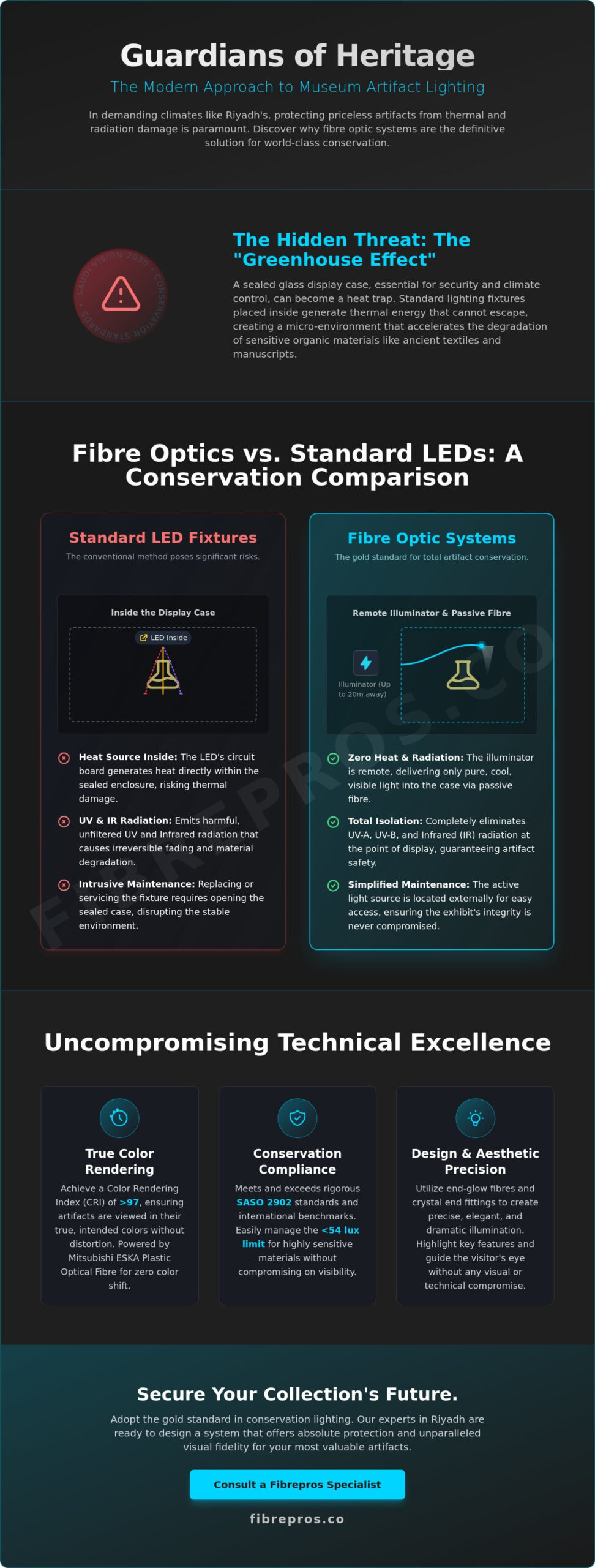
Riyadh’s extreme ambient temperatures present a unique set of challenges for interior displays. Even with advanced building HVAC systems, a sealed glass display case can easily become a heat trap. This “greenhouse effect” is a significant threat to delicate organic materials like ancient manuscripts and textiles. Standard LED fixtures often fail in this environment. While they’re more efficient than legacy bulbs, the heat generated at the circuit board still transfers into the display volume if the light source is located inside the case.
Effective museum display case lighting Riyadh strategies now focus on total thermal isolation. By separating the light source from the display volume, we eliminate the risk of temperature spikes. This approach protects the artifacts from molecular degradation and reduces the load on climate control systems. Professional curators no longer accept the compromise of internal heat sources. They opt for optical systems that deliver pure light while keeping the heat-generating components in a remote, accessible location. This transition is essential for any institution serious about maintaining the integrity of its collection in the Central Province’s climate.
Why Fibre Optic Lighting is the Gold Standard for Conservation
Professional conservation requires a complete separation of light and heat. Standard lighting solutions often fail because they place electrical components inside the exhibit, which creates localized hot spots. For high-stakes museum display case lighting Riyadh projects, fibre optic systems are the only viable solution for total thermal and UV isolation. By utilizing a remote LED illuminator, you ensure that only pure, filtered light reaches the artifact. This setup removes the risk of heat-induced expansion or contraction in delicate materials. It’s a technical necessity for any institution housing irreplaceable Saudi heritage.
Fibre Optics vs. LED: A Conservation Comparison
Standard LEDs are frequently marketed as heat-free, but this is a technical half-truth. While the beam is cool, the diode itself generates significant heat at the circuit board. In a sealed display, this energy has nowhere to go. Fibre optic systems solve this by keeping the light source up to 20 meters away. This configuration eliminates UV-A, UV-B, and Infrared (IR) radiation at the point of display. Standard museum practice limits UV radiation to 10 microwatts per lumen or less; fibre optics achieve this through integrated filtration at the illuminator. Thermal isolation is the primary defense against the chemical degradation of organic materials in the Saudi climate.
The Science of Light Transmission in Museums
Quality light transmission depends on the purity of the conduit. Systems using Mitsubishi ESKA Plastic Optical Fibre maintain light quality without the color shifting common in lower-grade materials. This is critical for achieving a Color Rendering Index (CRI) of Ra >= 95, which is the international target for fine art. For highly sensitive materials like textiles and papers, where light levels are capped at 54 lux, the precision of fibre optics allows for focused illumination without spilling excess light. This creates a high-contrast, visually stunning exhibit without exceeding the annual lux-hour budget.
These systems also remove electronic noise and flicker from the case environment. This creates a stable, visually superior exhibit that respects the delicate nature of historical manuscripts. If you’re designing a new gallery, exploring advanced fibre optic lights can significantly reduce your long-term risk. Remote illuminator placement also simplifies maintenance. Instead of opening a sealed case and risking the internal micro-climate, technicians access the light source from a dedicated maintenance corridor or floor-level cabinet. This is particularly valuable in Riyadh’s high-ceiling museum halls where access is otherwise difficult.
Technical Components: Mitsubishi ESKA POF and High-CRI Illuminators
The reliability of a museum lighting system depends on the quality of its individual components. For high-performance museum display case lighting Riyadh installations, we prioritize the integration of world-class optical conduits with precision-engineered light sources. This combination ensures that the light delivered to the artifact is as pure as the light generated at the source. By selecting components designed for technical precision—a standard of craftsmanship also exemplified by Australian Made Vision in the optical lens industry—curators can achieve the exact visual balance required for high-stakes exhibitions while maintaining the strictest conservation standards.
The Mitsubishi ESKA Advantage for Saudi Museums
Selecting Mitsubishi ESKA Plastic Optical Fibre is a strategic decision based on transmission efficiency and long-term durability. In the demanding GCC climate, high-purity PMMA cores outperform generic alternatives by maintaining light clarity over years of operation. Generic fibres often suffer from yellowing or increased attenuation, which alters the perceived color of the artifacts. ESKA’s superior bend radius allows for seamless integration into the tightest display corners without compromising light output.
We offer various fibre diameters to suit different exhibition scales:
- 0.75mm to 1.0mm for fine, pinpoint accenting of jewelry or small manuscripts.
- 1.5mm to 2.0mm for broader wash lighting and larger 3D objects.
- Multi-core bundles for high-intensity requirements where distance from the illuminator is a factor.
Choosing the Right Illuminator for Remote Placement
The light source is the engine of the system. In Riyadh, fine airborne dust is a constant threat to sensitive electronics. We recommend using LED illuminators with appropriate IP ratings to ensure the internal optics remain pristine. For public galleries, silent operation is mandatory. Convection-cooled units are ideal for quiet environments, while high-output fan-cooled models are suited for remote maintenance rooms where noise isn’t a concern.
Modern museum management requires granular control. Our illuminators integrate with DMX and Bluetooth protocols, allowing curators to adjust brightness and color temperature remotely. This flexibility is vital for dynamic exhibitions where light levels must be tuned to the specific needs of rotating collections. By using DMX-controlled systems, museum display case lighting Riyadh projects can achieve sophisticated fading and scene transitions that enhance the visitor’s journey through the gallery. This level of control ensures that every object is presented in its best possible light without the need for manual adjustments inside the case.
Design Strategies for Riyadh’s High-End Exhibition Cases
Effective design in Riyadh’s premier cultural spaces relies on the principle of the invisible light source. The visitor should focus entirely on the historical narrative of the artifact rather than the hardware providing the illumination. Achieving this requires a strategic balance between the ambient gallery environment and the specific internal lighting of the case. By using advanced optical layouts, designers can highlight intricate textures while maintaining the strict conservation standards required for irreplaceable Saudi heritage. This approach ensures that the visual impact is maximized without compromising the safety of the collection.
End-Glow vs. Side-Glow in Museum Design
Selecting the correct type of fibre is essential for achieving the desired exhibition effect. End-glow fibre is the primary choice for spot-lighting three-dimensional objects. It allows for tight, controlled beams that emphasize the fine details of ancient coins or the intricate craftsmanship of traditional jewelry. For museum display case lighting Riyadh projects involving large-scale dioramas or architectural models, side-glow fibre provides a necessary linear wash. This creates a soft, uniform glow that defines the edges of the display without creating harsh shadows. In tall vertical cases, we often combine both types to ensure that light reaches every level of the exhibit uniformly.
Aesthetic Integration of Fittings
The choice of fittings must complement the museum’s overall architectural language. Crystal end fittings offer a sophisticated solution for light dispersion, blending seamlessly into high-end interiors while providing precise beam control. These components allow for subtle, elegant light distribution that enhances the artifact’s natural colors. Stainless steel fixtures provide a durable, modern finish that maintains its integrity in high-traffic public galleries. These materials are selected not just for their appearance, but for their ability to provide long-term reliability without off-gassing or degrading over time.
Minimizing visual clutter is a hallmark of elite craftsmanship. In Riyadh’s rapidly evolving museum landscape, temporary and rotating galleries are common. We utilize adjustable ferrules that allow curators to re-aim light as exhibit layouts change. This flexibility is vital for institutions that update their collections frequently. The goal is always to hide the fibre entry points and focus the viewer’s eye exclusively on the heritage piece. If you are currently designing a new exhibition space, you can consult with our lighting specialists to determine the optimal fitting configuration for your specific display requirements. This ensures your project meets the highest international standards for both design and conservation.
Implementing Specialized Lighting Solutions in Riyadh
Successful implementation of museum display case lighting Riyadh projects requires a shift from standard electrical layouts to specialized optical engineering. The physical installation process must prioritize both the immediate visual output and the long-term accessibility of the system. In Riyadh’s high-stakes heritage sector, the difference between a functional display and a world-class exhibition often lies in the precision of the final integration. Professional curators and architects now focus on systems that allow for seamless operation without compromising the artifact’s micro-climate.
Maintenance and Longevity in the Saudi Market
Long-term operational efficiency is a core requirement for any institution in the Kingdom. We recommend placing LED illuminators in dedicated maintenance corridors or accessible floor-level cabinets rather than inside the display volume. This strategy enables “no-entry” maintenance, allowing technicians to service the light source without ever opening the sealed exhibit. By keeping the illuminator in a separate service area, technicians never have to break the case’s environmental seal to change a light source, which eliminates the risk of physical impact or temperature fluctuations for the artifacts.
The durability of the materials used is equally critical. Mitsubishi ESKA POF is engineered for a 20-year lifespan when installed in stable interior environments. Unlike lower-grade plastics that may become brittle or yellow over time, high-purity PMMA ensures that the light quality remains consistent for decades. This longevity reduces the total cost of ownership and ensures that the museum display case lighting Riyadh institutions invest in today will continue to meet international conservation standards well into the future. It is a reliable infrastructure choice for the city’s growing cultural landscape.
Partnering for Success in KSA
Precision installation requires a deep understanding of both local architectural standards and international conservation science. Working with specialist contractors in Riyadh and Jeddah ensures that every fibre bundle is polished and seated correctly to maximize light transmission. These specialists understand the nuances of the Central Province’s climate and the specific technical demands of the Museums Commission. A collaborative approach between designers, curators, and technical specialists is the only way to ensure a project’s success.
Fibrepros serves as a dedicated partner for the GCC region, providing the technical expertise and high-performance components required for elite exhibitions. We offer comprehensive consultation services to help architects and project managers navigate the complexities of museum-grade optics. If you are developing a heritage project in the Kingdom, Contact Fibrepros for a technical specification review. Our team ensures that your lighting system provides total artifact protection while delivering the high-CRI performance expected in modern Saudi galleries. We take pride in building the vital infrastructure that showcases and preserves the Kingdom’s history.
Advancing Cultural Preservation in the Central Province
The successful display of high-value artifacts in Saudi Arabia requires a technical commitment to environmental stability. We’ve detailed how museum display case lighting Riyadh professionals use fibre optic systems to achieve total thermal and UV isolation. By prioritizing high-purity conduits like Mitsubishi ESKA POF and high-CRI LED illuminators, curators can deliver true color representation while adhering to international conservation benchmarks. These systems provide the necessary infrastructure to protect organic materials from the chemical degradation caused by trapped heat and optical radiation.
Fibrepros has operated as a specialist supplier of Mitsubishi ESKA POF since 1995, bringing decades of expertise to high-stakes GCC architectural projects. As an authorized distributor for museum-grade LED illuminators, we provide the technical precision required for the Kingdom’s most sensitive heritage sites. Request a Technical Lighting Consultation for Your Riyadh Museum Project to ensure your exhibition meets the highest standards of elite craftsmanship. Let’s work together to build a legacy of preservation that safeguards the Kingdom’s history for future generations.
Frequently Asked Questions
Is fibre optic lighting safer than LED for museum artifacts?
Fibre optic lighting is inherently safer than standard LEDs because it removes the heat-generating diode from the display environment. While LEDs are efficient, the heat produced at the circuit board can still raise temperatures in a sealed case. Fibre optics deliver filtered, “cold” light with zero UV or IR radiation at the point of contact. This isolation is a critical requirement for museum display case lighting Riyadh institutions use to protect high-value heritage items.
Can I control Riyadh museum display lighting via DMX or Bluetooth?
You can fully integrate these systems with DMX, Bluetooth, or Dali control protocols. This allows curators to adjust brightness levels and color temperatures remotely without manual intervention. Wireless Bluetooth control is particularly useful for temporary exhibitions where lighting scenes need frequent updates. DMX remains the standard for large-scale galleries requiring synchronized effects across multiple display cases.
How do I maintain museum display lighting without opening the cases?
Maintenance is simplified by installing the LED illuminator in an accessible location outside the display case. You can place the light source in a maintenance corridor, floor-level cabinet, or ceiling void. This “no-entry” approach means technicians can replace an LED engine or clean filters without disturbing the case’s micro-climate. It eliminates the risk of accidental damage to artifacts during routine servicing.
What is the best CRI for lighting historical Saudi textiles?
The international standard for historical textiles requires a Color Rendering Index (CRI) of Ra >= 95. Specifically, the R9 value should be >= 90 to ensure the rich tones of traditional Saudi weaving are represented accurately. Because textiles are highly light-sensitive, we recommend keeping illumination levels at or below 54 lux. This balance of high color quality and low intensity is essential for long-term conservation.
Does the heat in Riyadh affect the performance of fibre optic cables?
Riyadh’s external ambient heat doesn’t impact the performance of fibre optic cables when they’re used within climate-controlled museum interiors. Mitsubishi ESKA POF is designed for thermal stability in standard exhibition environments. However, the remote LED illuminator should be placed in a well-ventilated area to ensure the electronic components operate efficiently. This prevents heat buildup at the source from affecting the light output quality.
Can fibre optic lighting be retrofitted into existing museum cases in Riyadh?
Fibre optic systems are highly adaptable and can be retrofitted into most existing display cases. The small diameter of the individual fibres allows them to be routed through narrow gaps or integrated into existing shelving. This makes them an ideal choice for upgrading older museum display case lighting Riyadh galleries currently have in place. The process typically involves minimal structural changes to the original case design.
What is the lifespan of Mitsubishi ESKA fibre in a museum environment?
Mitsubishi ESKA fibre has a documented lifespan of approximately 20 years in stable interior environments. The high-purity PMMA core prevents the yellowing and attenuation that often affects generic plastic fibres. This durability ensures that the light remains neutral and consistent over decades of use. It’s a long-term infrastructure investment that maintains its optical clarity without requiring frequent replacement.
How many light points can I run from a single LED illuminator?
The number of light points depends on the diameter of the fibre used and the size of the illuminator’s output port. A standard 30mm port can accommodate approximately 300 points of 0.75mm fibre or about 40 points of 2mm fibre. This flexibility allows a single light source to illuminate multiple artifacts within a large case or across several smaller adjacent displays. It’s an efficient way to manage power and maintenance costs.