
In the high-salinity waters of the Arabian Gulf, a standard waterproof rating is often a recipe for expensive failure. For luxury waterfront properties in The Pearl-Qatar or vessels docked at Lusail Marina, the combination of salt and summer temperatures exceeding 50°C transforms minor technical oversights into total system blackouts. If you’ve dealt with the frustration of water ingress or corroded housings, you already know that selecting marine grade underwater lights Doha is a matter of survival for your infrastructure, not just an aesthetic upgrade.
We agree that frequent fixture replacement and high maintenance costs are unacceptable for professional-grade projects. This 2026 professional guide promises to clarify the exact technical standards, from 316L stainless steel requirements to Kahramaa and QCS compliance, needed for install-and-forget reliability. You’ll gain a clear understanding of why specialized fibre optic systems and high-quality LED housings are the industry standard for Doha’s most demanding coastal environments, along with a breakdown of the 5% import duty and international safety certifications required for your next installation.
Key Takeaways
- Identify the specific salinity and heat thresholds that differentiate true marine-grade equipment from standard waterproof fixtures in the Arabian Gulf.
- Master the technical requirements of 316L stainless steel and molybdenum to prevent pitting corrosion in high-salinity environments.
- Evaluate the safety and maintenance advantages of fibre optic systems where zero electricity in the water is a non-negotiable priority.
- Explore specialized applications for marine grade underwater lights Doha across luxury yachts in Lusail and residential pools in The Pearl.
- Align your lighting project with Kahramaa and Qatar Construction Specifications (QCS) using proven material standards and professional installation practices.
What Defines Marine Grade Underwater Lights in Doha?
Marine grade isn’t just a marketing label; it’s a technical classification for equipment engineered to survive indefinite submersion in high-salinity environments. While standard waterproof fixtures might handle a garden pond, they’ll fail rapidly in the Arabian Gulf. A true marine-grade fixture utilizes specific alloys and sealing techniques to prevent the chemical breakdown of the housing and the internal electronics. In a high-stakes environment like the Doha coastline, selecting marine grade underwater lights Doha ensures your infrastructure survives the aggressive electrochemical reactions common in our waters.
The distinction between “waterproof” and “marine grade” is critical for project longevity. A waterproof rating, such as IP67, only guarantees protection against temporary immersion. Professional marine-grade units require an IP68 or IP69K rating, signifying they can withstand permanent submersion at specific depths and high-pressure cleaning. Modern underwater lighting technology has evolved to include sophisticated thermal management systems that are essential for the Middle East. Without these, the heat generated by the LEDs, combined with high ambient water temperatures, will cause the internal components to cook themselves within a single summer season.
The Environmental Challenges of the Persian Gulf
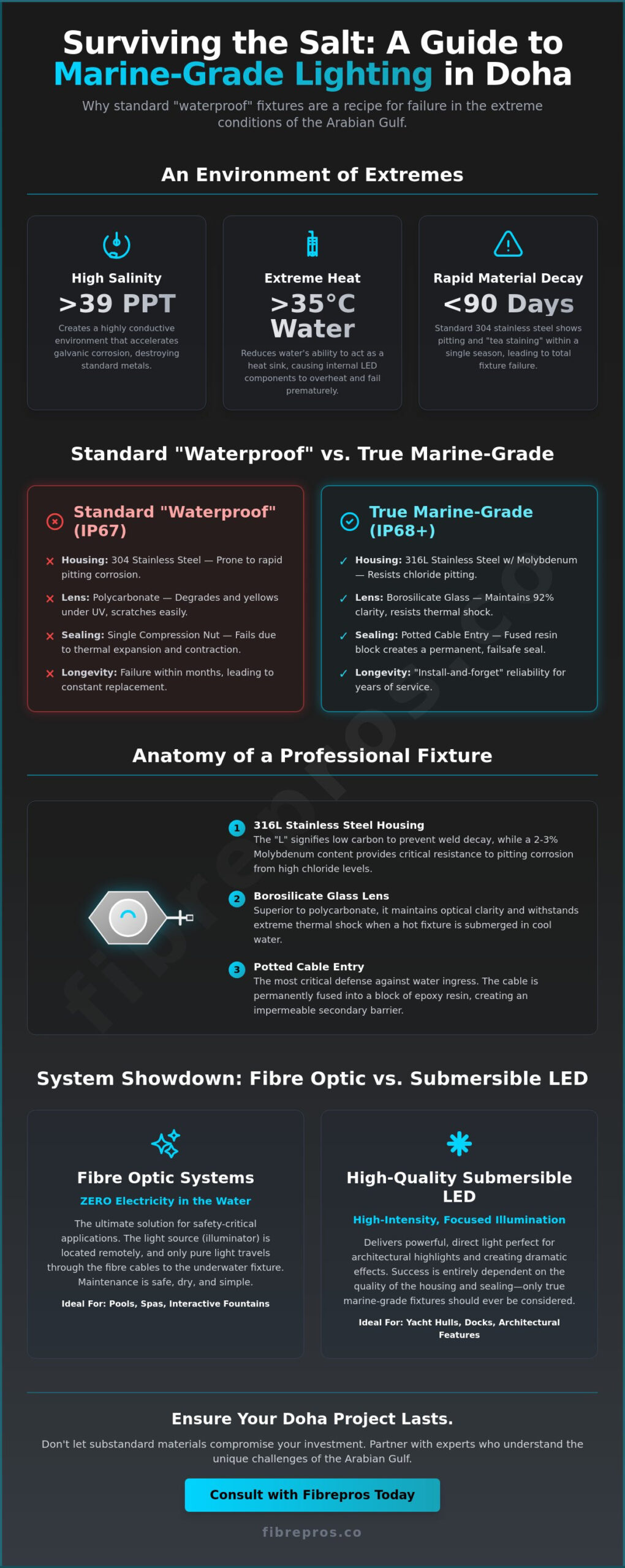
Doha’s coastal salinity is significantly higher than that of the Atlantic or Mediterranean. Salinity levels in the Gulf can exceed 39 parts per thousand, creating a highly conductive environment that accelerates galvanic corrosion. Standard 304 stainless steel fixtures often show signs of pitting and “tea staining” within 90 days of installation. Furthermore, Doha’s summer water temperatures frequently surpass 35°C. This reduces the effectiveness of the water as a heat sink, which is how most LEDs maintain their 50,000-hour lifespan. High UV exposure also threatens any non-submerged components, such as cable entries and gaskets, requiring specialized polymer coatings to prevent brittleness and eventual water ingress.
Certification Standards for Doha Projects
For large-scale developments in West Bay or luxury yachts in Lusail, certifications from bodies like Lloyd’s Register or the American Bureau of Shipping (ABS) provide a necessary layer of accountability. These certifications verify that the marine grade underwater lights Doha can handle the structural pressures of deep-water mounting. We prioritize fixtures that address galvanic corrosion through the use of sacrificial anodes or complete isolation of dissimilar metals. This technical precision prevents the housing from becoming the “weak link” in a vessel or pool’s electrical system, ensuring that your investment remains aesthetically superior and functionally reliable for years rather than months.
Technical Specifications: 316L Stainless Steel and Beyond
Selecting marine grade underwater lights Doha requires a deep dive into metallurgy. While most hardware stores stock 304-grade stainless steel, this alloy fails within months in the Persian Gulf. We specify 316L stainless steel as the non-negotiable minimum for all underwater housings. The “L” stands for low carbon, which prevents carbide precipitation during welding, but the real hero is molybdenum. This element comprises 2% to 3% of the alloy’s weight, providing essential resistance to pitting corrosion in high-chloride environments like the waters surrounding The Pearl.
Lens selection is equally critical for long-term clarity. We prioritize borosilicate glass over polycarbonate for high-output fixtures. While polycarbonate is shatter-resistant, it’s susceptible to UV degradation and scratching over time. Borosilicate glass maintains 92% light transmission even after years of exposure to salt and heat. It also manages thermal shock more effectively when a hot fixture is suddenly submerged. These specifications align with rigorous U.S. Coast Guard standards for marine lighting, ensuring that every component is built for heavy-duty maritime service.
The most frequent failure point in any installation isn’t the housing or the lens; it’s the cable entry. Sub-standard fixtures rely on a single compression nut that eventually loosens due to thermal expansion. Professional-grade units use potted cable entries where the wire is fused into a resin block, creating a secondary barrier against water ingress. If you’re planning a high-end coastal project, consulting with a specialist in professional lighting infrastructure ensures these technical details aren’t overlooked.
Material Science: Why 316L Stainless Steel Wins
316L stainless steel undergoes a critical process called passivation. This involves treating the surface with a mild oxidant to remove free iron and enhance the protective chromium oxide layer. In Doha’s extreme humidity, this invisible shield is what prevents rust. We recommend a monthly rinse with fresh water for any exposed stainless steel components to prevent salt crusting, which can eventually breach the passivated layer and lead to structural compromise.
Sealing and Gasket Technology
Sealing systems must withstand Doha’s 50°C summer peaks without warping. We prefer silicone gaskets over EPDM because silicone retains its elasticity at higher temperatures and resists UV breakdown more effectively. High-end fixtures utilize a “Double O-Ring” philosophy, providing a redundant seal that ensures the internal cavity remains dry even if the primary gasket is compromised. Professional fixtures are factory-filled with dry nitrogen to displace all moisture-laden air, which effectively prevents internal condensation when the light cools down in the water.
Fibre Optic vs. Submersible LED: A Doha Comparison
Many project managers assume integrated LED fixtures are the only modern choice for marine grade underwater lights Doha. This is a misconception. While submersible LEDs have improved, they still require electrical current to travel through cables into a submerged housing. Fibre optic systems eliminate this risk entirely. By keeping the electricity in a dry plant room and only sending light through the cables, you achieve a level of safety and reliability that integrated electronics can’t match. This distinction is vital in the 2026 market, where uptime and safety are paramount for luxury developments.
Longevity in the Persian Gulf depends on minimizing the number of components exposed to salt water. Integrated LEDs contain sensitive circuit boards and drivers within the submerged unit. Even with 316L stainless steel housings, the internal electronics are vulnerable to thermal stress. In contrast, using Mitsubishi ESKA Plastic Optical Fibre ensures that the only material in the water is a durable, non-conductive polymer. This material doesn’t corrode, doesn’t leak electricity, and maintains its light transmission properties for decades.
The Safety Advantage of Fibre Optics
Safety is the primary driver for high-end residential and commercial installations. Fibre optics separate the light source from the water by using a remote light engine. There’s no risk of electrical leakage or short-circuiting in the pool or around the yacht hull. This architectural approach aligns with the spirit of the International Maritime Organization (IMO) SOLAS standards, which emphasize the necessity of robust, fail-safe electrical systems in marine environments. To power these systems, we utilize high-performance LED illuminators that stay protected in climate-controlled environments, far away from Doha’s corrosive humidity and salt spray.
Total Cost of Ownership in Qatar
Maintenance costs in Qatar can spiral if your lighting requires specialized divers for simple bulb changes. With a fibre optic system, all maintenance happens in a dry plant room. You don’t drain the pool or hire a dive team to swap a failed component. While the initial investment for marine grade underwater lights Doha using fibre optics might be higher, the 10-year total cost of ownership is significantly lower. One illuminator can power dozens of underwater points, making the system highly energy efficient. Upgrading your lighting is also simpler; you can change the light color or intensity by simply swapping the illuminator in the plant room without ever pulling new cables through the water.
Designers in West Bay and The Pearl often request a “starry night” effect for luxury pools. This involves hundreds of tiny points of light, a feat impossible with bulky LED housings. Fibre optics allow for these intricate designs using end-glow cables and crystal fittings. This level of technical precision creates architectural focal points that integrated LEDs simply can’t replicate.
Applications: From Doha Corniche Yachts to Luxury Villa Pools
High-end infrastructure in Qatar demands more than basic illumination. Whether it’s a superyacht docked at the Doha Corniche or a private infinity pool in West Bay, the application of marine grade underwater lights Doha defines the architectural character of the property. For civic projects and commercial fountains, the reliability of the lighting system directly impacts the public’s perception of the facility’s quality. We focus on providing solutions that integrate seamlessly with the surrounding environment while withstanding the aggressive conditions of the Gulf.
Public fountains and waterfront walkways along the Lusail Marina require lighting that can withstand constant salt spray and high foot traffic. Side-glow fibre is an ideal solution for outlining walkways and bridges. It provides a continuous line of light without the hot spots or maintenance issues associated with traditional LED strips. This integration ensures a cohesive nightscape that matches the prestige of Doha’s developing waterfront infrastructure. If you’re managing a large-scale project, you can request a professional lighting consultation to ensure your specifications meet these high-stakes requirements.
Maritime Lighting for Doha Yachts
Vessels navigating Doha Bay require precise lighting to cut through the varying turbidity of coastal waters. RGBW control allows owners to sync their hull illumination with the shifting colors of the Lusail skyline during night cruises. We provide technical consultation on selecting the correct underwater lighting fixtures for custom hull mounts. Narrow beam angles work best for deep-water penetration, while wider spreads create a soft glow ideal for social gatherings at anchor. These fixtures must be mounted with precision to ensure the structural integrity of the hull is never compromised.
Architectural Pool Lighting in The Pearl-Qatar
In luxury residential developments like The Pearl, standard pool lighting is often insufficient for high aesthetic standards. Designers now utilize fibre optics to create immersive environments. By installing star ceiling kits on the pool floor, we achieve a “Starry Night” effect that remains perfectly safe for swimmers. Adding crystal end fittings enhances this further, refracting light into shimmering patterns that dance across the pool surface. This approach highlights water features without visible hardware, maintaining the clean lines of modern architecture while ensuring the light source remains easily accessible in a dry location.
Why Fibrepros is the Trusted Partner for Doha Marine Lighting
Choosing a partner for marine infrastructure requires more than a product catalog. It requires a specialist who understands the unique chemical and thermal stressors of the Persian Gulf. With over 30 years of lighting experience in the Middle East, Fibrepros provides the technical precision necessary for high-stakes installations. Our commitment to marine grade underwater lights Doha is built on a foundation of material science and field-tested reliability. We don’t just supply parts; we provide the engineering expertise that ensures your lighting system remains a long-term asset rather than a maintenance liability.
We don’t compromise on material specifications. Every project we support utilizes 316L stainless steel and high-grade optics to ensure long-term uptime. As an end-to-end solution provider, we supply everything from Mitsubishi ESKA plastic optical fibre to the specialized LED illuminators required for a robust system. This holistic approach distinguishes us from generalists who may not account for the specific 5% import duties or Kahramaa regulations that govern professional installations in Qatar. Our focus remains on delivering install-and-forget reliability for the most demanding coastal environments.
The “Pros” Standard of Professionalism
The “Pros” identity reflects our commitment to technical accuracy across every touchpoint. We provide no-nonsense advice on which fixtures will survive the 39 parts per thousand salinity of Doha’s waters and which will fail within a season. Our team supports local contractors by providing the invisible but vital infrastructure that powers luxury pools and yacht marinas. We focus on results, ensuring that once our components are installed, they deliver consistent performance. This local accountability makes us a dependable expert in an industry where accuracy is critical for project success.
Ready to Light Your Doha Waterfront?
Large-scale architectural projects in The Pearl or Lusail require a streamlined supply chain and expert design input. We maintain a steady inventory of marine-grade components ready for GCC delivery, ensuring that project timelines are met with efficiency. Whether you’re designing a private villa pool or a commercial fountain for a Qatar National Vision 2030 project, our team provides the specialized mastery your infrastructure deserves. Contact the Fibrepros team for a technical consultation on your Doha project today.
Secure Your Waterfront Infrastructure with Professional Standards
Achieving long-term reliability in the Arabian Gulf requires moving beyond standard waterproof ratings. By prioritizing 316L stainless steel construction and the safety of fibre optic technology, you eliminate the common failures caused by Doha’s extreme salinity and 50°C summer heat. This guide has detailed why these technical specifications are non-negotiable for anyone installing marine grade underwater lights Doha in 2026. Investing in the right materials today prevents the high maintenance costs and system blackouts that plague sub-standard installations. Choosing a specialist ensures your infrastructure remains operational when it matters most.
As a Mitsubishi ESKA authorized supplier serving the GCC since 1995, we understand the technical precision required for high-stakes maritime and architectural projects. Our team provides the end-to-end expertise needed to transform your pool or yacht into a durable architectural focal point that matches the prestige of West Bay or Lusail Marina. Upgrade to Marine Grade Reliability with Fibrepros and ensure your lighting project stands the test of time. Your waterfront deserves the quiet confidence that only expert craftsmanship and proven materials can provide.
Frequently Asked Questions
Is 316L stainless steel necessary for pools in Doha?
Yes, 316L stainless steel is essential for any pool within 5 kilometers of the Doha coastline. The high chloride levels in the air and water cause standard 304-grade steel to tea-stain and pit within 90 days of exposure. Using 316L ensures your fixtures withstand the aggressive electrochemical reactions common in The Pearl and West Bay developments where salinity levels often exceed 39 parts per thousand.
What is the difference between IP67 and IP68 for underwater lights?
IP68 is the only acceptable rating for permanent underwater installation. An IP67 rating only guarantees protection against temporary immersion for 30 minutes at a 1-meter depth. For marine grade underwater lights Doha, we specify IP68 or IP69K to ensure the housing remains hermetically sealed under the constant hydrostatic pressure of deep-water mounting or high-pressure cleaning cycles common in luxury marinas.
Can I install fibre optic lighting in an existing Doha pool?
You can retrofit fibre optic lighting into existing pools using specialized conduit systems or slim-line tracks. While easier during new construction, these surface-mounted tracks for side-glow fibre allow owners to upgrade to a safer environment without major structural demolition. This process typically takes less than 48 hours and provides a zero-electricity underwater solution that eliminates the risk of electrical leaks in older pool structures.
How long do marine grade LED underwater lights last in Qatar?
High-quality marine-grade LEDs typically last 50,000 hours under laboratory conditions. However, in Qatar, where summer water temperatures exceed 35°C, that lifespan can drop by 25% if the fixture lacks advanced thermal management. Professional-grade units use integrated heat sinks and thermal throttling to maintain performance and prevent internal components from overheating during the peak July and August heat cycles.
Do I need a special transformer for underwater yacht lights?
Yes, you require a stabilized DC power supply that meets maritime safety standards. These transformers must handle the voltage fluctuations common in yacht electrical systems and provide galvanic isolation to prevent hull corrosion. We recommend using IP67-rated power enclosures located in ventilated areas to ensure the electronics don’t fail due to the 90% humidity levels frequently recorded in Doha’s coastal marinas.
What causes underwater lights to flicker or fail in Doha?
Most failures stem from water ingress at the cable entry point or voltage drops in long cable runs. In Doha, the extreme thermal expansion of gaskets during 50°C days can compromise seals. If a fixture isn’t nitrogen-filled, internal condensation forms as the light cools, leading to short circuits. Using marine grade underwater lights Doha with potted cable entries effectively eliminates this primary cause of system failure.
Are fibre optic lights brighter than traditional LEDs underwater?
Traditional LEDs often provide higher raw lumens per single fixture, but fibre optics offer superior light distribution for architectural effects. By using a high-output LED illuminator, you can power multiple points of light that create a uniform glow without the harsh glare of a single bulb. The primary advantage is the trade-off between the intense spot of an LED and the safe, maintenance-free elegance of a fibre system.
How do I prevent algae growth on my underwater light lenses?
Preventing biofouling requires regular physical cleaning and the use of non-porous lens materials like borosilicate glass. Smooth glass surfaces are significantly harder for algae to grip compared to standard polycarbonate. We recommend a soft-brush cleaning every 30 days during the summer months when high water temperatures and 12-hour sunlight cycles accelerate organic growth in Doha’s coastal pools and marinas.