
Did you know that 20% is the mandatory energy reduction target for all new Dubai buildings under the Al Sa’fat 2.0 regulations? As of June 1, 2026, compliance isn’t just a design choice; it’s a legal prerequisite for every building permit issued by the Dubai Municipality. For luxury projects, the challenge lies in maintaining aesthetic brilliance while meeting these strict thermal and safety codes. Developing a precise fibre optic lighting specification for architects in Dubai is now a critical risk-mitigation exercise. You’ve likely seen high-end installations fail when cheap data-fibre imitations yellow or crack under the intense UV and 50°C plus ambient temperatures of the UAE.
We understand that your reputation depends on the longevity of the infrastructure you design. This guide provides the technical framework you need to specify fail-safe systems using master-grade Mitsubishi ESKA™ polymer. You’ll learn how to leverage the BH series’ 105°C thermal resistance and the 0.15 dB/m attenuation of high-performance SK fibre to bypass heat stress entirely. We’ll preview the mandatory TDRA certifications and Al Sa’fat Silver standards that will define Dubai’s architectural landscape throughout 2026 and beyond.
Key Takeaways
- Learn how to draft a comprehensive fibre optic lighting specification for architects in Dubai that mitigates the risk of system failure in extreme GCC heat.
- Understand why high-purity PMMA, specifically Mitsubishi ESKA™, is the mandatory material standard for preventing fibre yellowing and brittleness.
- Master the “Remote Source” design strategy to create 100% electrically safe pool and wet zone installations while keeping LED engines in climate-controlled areas.
- Identify the technical requirements for 316-grade stainless steel fixtures and active cooling systems to ensure long-term performance in coastal Dubai environments.
- Discover how to avoid the “Substitution Trap” by verifying local supplier credentials and ensuring contractor compliance with your high-performance material specs.
The Architect’s Framework for Fibre Optic Lighting in Dubai
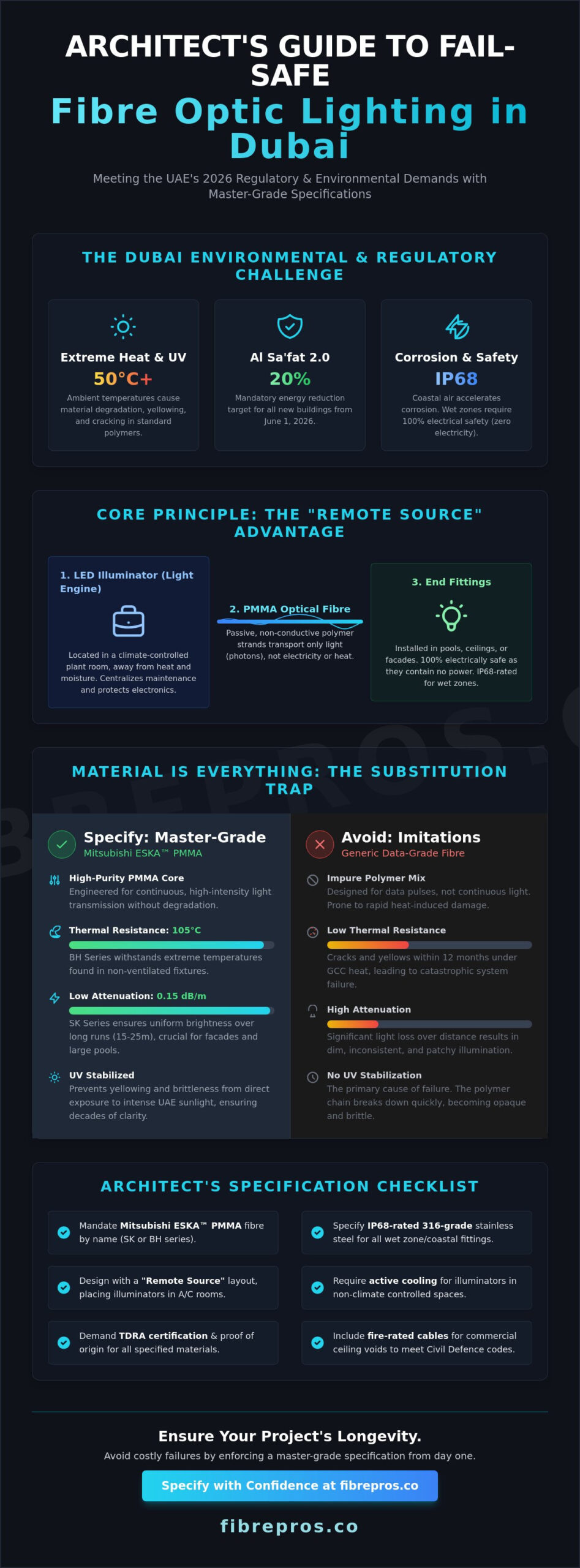
Architects in Dubai face a unique set of environmental and regulatory hurdles that standard lighting solutions often fail to clear. A robust fibre optic lighting specification for architects in Dubai begins with understanding the “Remote Source” advantage. Unlike traditional luminaires where the light source is located at the fixture, fibre optics separate the light engine from the emission point. This separation is the foundation of high-performance architectural lighting in the GCC. It allows designers to place sensitive electronics in climate-controlled environments while the light itself travels through non-conductive polymer strands to the target area.
Grasping the technical principles of how fibre optic lighting works is essential for specifying materials that can survive local conditions. A complete system consists of three core components that must be specified as a unified infrastructure. These include the LED illuminator, the optical cable, and the end-fittings. In Dubai’s luxury residential sector, safety is the primary driver for this technology. Fibre optics offer the only 100% electrically safe solution for pool wet zones and underwater features because no electricity ever reaches the water. The system only transports photons, eliminating the risk of electrical leakage in high-traffic swimming areas.
Sustainability is also a critical factor. The Al Sa’fat 2.0 regulations, mandatory as of January 2026, require a 20% energy reduction compared to the ASHRAE 90.1 baseline. Fibre systems support these targets by centralizing maintenance. For hard-to-reach luxury facades or high-rise accents, a single illuminator can power dozens of points. This reduces the need for expensive high-access maintenance equipment and ensures the building’s aesthetic remains intact for years.
Environmental Durability in the GCC
Dubai’s climate is a brutal testing ground for building materials. Ambient temperatures regularly exceed 50°C, and coastal salinity accelerates the corrosion of standard LED components. Specifying a fibre optic lighting specification for architects in Dubai ensures that sensitive LED drivers remain in temperature-controlled plant rooms. High-purity polymers like Mitsubishi ESKA™ are required to resist UV degradation. Without UV stabilization, side-glow polymers will yellow and become brittle within 12 months of exposure to direct desert sunlight. High-performance grades must be specified to maintain an attenuation rate of 0.15 dB/m for uniform brightness.
Regulatory Compliance and Safety
Compliance with Dubai Law No. (2) of 2026 on public safety is mandatory as of June 1, 2026. This law establishes new frameworks for equipment standards in public venues. Fibre optic systems naturally align with Civil Defence requirements by ensuring zero electricity at the emission point. Architects must specify fire-rated cables for commercial ceiling voids to meet local fire codes. For submerged applications, only IP68-rated 316-grade stainless steel fixtures should be included in the specification to prevent corrosion in high-salinity water environments.
Material Specifications: Why Mitsubishi ESKA™ is Mandatory
Material selection is where most lighting designs live or die in the GCC. A high-performance fibre optic lighting specification for architects in Dubai must prioritize material purity to prevent the rapid degradation seen in lower-quality installations. While generic data-grade fibres are often mis-sold for architectural use, they lack the chemical stability required for high-lumen lighting. We specify Mitsubishi ESKA Plastic Optical Fibre because its high-purity Polymethyl Methacrylate (PMMA) core ensures long-term clarity. Unlike data-fibre, which is designed for short-burst pulses, ESKA is engineered for continuous light saturated at high intensities.
The technical difference lies in the core-to-cladding ratio. To maximize light transmission over the 15 to 25-meter runs common in Dubai villas, the fibre must maintain a precise refractive index. Mitsubishi’s SK series, for instance, achieves an attenuation rate of just 0.15 dB/m at 650nm. This ensures that the light intensity at the end-fitting matches the intensity at the illuminator. When you specify these materials, you’re choosing a polymer chain that resists the “Substitution Trap” often attempted by contractors looking to cut costs with inferior imports that lose 30% of their brightness within the first year.
Polymer Optical Fibre (POF) Standards
Architects must distinguish between “End-Glow” and “Side-Glow” polymers early in the design phase. End-glow fibre is the standard for star ceilings, with diameters ranging from 0.25mm for delicate points to 3.0mm for bold accents. Conversely, side-glow fibre uses a specialized cladding to “leak” light along its length, creating neon-like lines for pool perimeters or facade detailing. For a successful fibre optic lighting specification for architects in Dubai, you must also define the minimum bend radius. For a 1.0mm core, a radius of less than 25mm can cause micro-fractures in the cladding, leading to permanent light loss and “hot spots” along the cable run.
Thermal Resistance Ratings
Dubai’s rooftop environments and plant rooms present extreme thermal challenges. Standard polymer fibres typically have an operating limit of 70°C, which is insufficient for fibres installed near HVAC exhausts or under direct metal roof sheets. For these high-stress areas, we specify the Mitsubishi BH series, which offers a thermal threshold of 105°C. Low-grade polymers typically begin to yellow and turn brittle once they exceed a sustained thermal threshold of 60°C. If your project involves high-wattage LED illuminators, ensure the spec includes heat-resistant jackets to protect the fibre head from the concentrated thermal output of the light engine. To ensure your project meets these rigorous standards, you can consult with our technical team for a material audit.
LED Illuminators and Control Protocols for Commercial Projects
The illuminator is the mechanical heart of any fibre optic system. When drafting a fibre optic lighting specification for architects in Dubai, you must look beyond raw LED wattage. What matters is the effective lumen output delivered at the fibre head after passing through the optical port. High-efficiency illuminators in 2026 utilize precision-machined port collars to minimize light spill. This ensures that a 100W LED engine provides the same visual impact as a traditional 250W metal halide source, supporting the 20% energy reduction targets mandated by Al Sa’fat 2.0 regulations.
Active cooling is another critical specification. In Dubai’s plant rooms, ambient temperatures often exceed 40°C even with standard ventilation. Passive heat sinks aren’t enough for high-output commercial engines. You must specify illuminators with dual-bearing active cooling fans and integrated thermal cut-off sensors. These sensors should trigger at 70°C to protect the Mitsubishi ESKA™ fibre from heat-induced attenuation or permanent melting. Refer to our guide for choosing LED illuminators to find detailed performance benchmarks for professional systems.
Port capacity also dictates the uniformity of the final installation. For a star ceiling with 400 points, a single port must accommodate the total aggregate diameter of the fibre bundle without overcrowding. Overcrowded ports lead to localized heat buildup and uneven light distribution across the strands. Proper specification requires calculating the fibre density per port to ensure each strand receives an equal share of the luminous flux.
Output and Efficiency Parameters
Luxury retail and gallery projects in Dubai require high-fidelity light that doesn’t distort colors. Specify a Color Rendering Index (CRI) of 90 or higher to ensure architectural finishes and merchandise appear as intended. For long-term reliability in commercial environments, require a lumen maintenance rating of L70 at 50,000 hours. This guarantees that the system maintains at least 70% of its initial brightness for over a decade of standard use. In residential master suites, specify a fan noise limit of 25 dB to ensure the cooling system remains inaudible during nighttime operation.
Integration with Building Management Systems (BMS)
Modern Dubai developments rely on sophisticated automation. Your fibre optic lighting specification for architects in Dubai should include DMX512 protocols for any installation requiring dynamic color changes or synchronized “twinkle” effects. DMX allows for 512 channels of control, which is perfect for large-scale hotel facades or immersive sensory rooms. For luxury hospitality projects, DALI-2 compatibility is the standard. It allows the lighting to integrate directly into room management systems for centralized dimming and scene control. Standalone residential villas may utilize Bluetooth or RF mesh controls, allowing owners to adjust their star ceilings or pool lights via mobile applications without complex control wiring.
Application-Specific Spec Sheets: Pools and Star Ceilings
Moving from material science to practical application requires a shift in how you draft tender documents. A generic lighting schedule often fails to capture the nuances of fibre optic systems; leading to poor contractor substitutions and subpar light levels. A precise fibre optic lighting specification for architects in Dubai must account for the specific environmental stresses of the intended zone. Whether you’re detailing a submerged aquatic feature or a high-end residential master suite, the technical parameters must be performance-based to ensure the 20-year lifespan expected in the luxury sector.
Luxury Pool & Spa Specifications
For pool and spa environments, the specification must prioritize chemical and saline resistance. While 304-grade steel is common in other regions, it’ll fail in Dubai’s high-salinity pool environments. You must specify 316-grade stainless steel for all underwater fixtures to prevent tea-staining and structural corrosion. The optical cable itself requires a Polyethylene (PE) jacket rather than standard PVC; as PE offers superior protection against chlorine and saline ingress. When calculating light loss for a 3-meter deep pool, ensure your spec requires an illuminator with enough luminous flux to overcome both the water’s absorption and the 0.15 dB/m attenuation of the fibre. Explore our technical guide on underwater lighting fixtures to see how to maintain the remote-source advantage in aquatic zones.
Star Ceiling Parameters for Luxury Interiors
Creating a realistic “Celestial Star Ceiling” requires more than just poking holes in a plasterboard. To achieve depth and perspective, specify mixed diameters of Mitsubishi ESKA™ fibre. A ratio of 60% 0.5mm, 30% 0.75mm, and 10% 1.0mm strands creates a natural near-and-far effect. Premium finishes require a density of 30 to 50 points per square meter. Lower densities often look sparse and fail to meet the luxury expectations of Dubai’s residential market. For inspiration on residential projects, see our star ceiling kits guide. Your specification should also mandate that the illuminator be placed in a ventilated, accessible location such as a hallway cupboard or plant room, ensuring that future maintenance doesn’t require dismantling the ceiling itself.
Beyond luxury aesthetics, these same principles apply to sensory rooms in UAE healthcare and educational facilities. Fibre optics are the preferred choice for these environments because the polymer strands don’t carry heat or electricity. This allows patients and children to interact directly with the light source without risk. If you’re designing a high-salinity aquatic environment or a sensitive healthcare space, contact Fibrepros for custom fixture engineering to ensure your specification is technically sound.
Navigating the Dubai Supply Chain: Ensuring Specification Compliance
The most significant risk to a project’s longevity occurs during the procurement phase. Ensuring your fibre optic lighting specification for architects in Dubai remains intact during the tender process requires more than just naming a brand. Contractors often fall into the “Substitution Trap,” attempting to swap high-performance Mitsubishi ESKA™ for generic data-grade polymers to reduce costs. These substitutes lack the chemical stability needed for the UAE’s thermal environment. They typically fail within 12 to 18 months. To prevent this, your specification must mandate that all optical components are supplied with verifiable material origin certificates.
Precision is best achieved through pre-terminated harnesses rather than on-site termination. By specifying factory-made harnesses, architects eliminate the variables of on-site dust contamination and improper polishing techniques that often plague Dubai construction sites. Factory termination ensures a perfect 90-degree optical face, which is essential for maximizing light transmission. Fibrepros acts as a technical partner throughout this process. We provide everything from initial LUX calculations to final site testing, ensuring the installed system matches your original design intent.
Quality Assurance and Certification
A rigorous fibre optic lighting specification for architects in Dubai must include a clause for on-site verification. We recommend specifying light meter testing at the furthest emission point after the installation is complete. This confirms that the attenuation levels match the 0.15 dB/m benchmark set by high-performance Mitsubishi fibre. In the UAE lighting market, local warranty support isn’t just a benefit; it’s a critical safeguard against the logistical delays of international shipping and ensures immediate technical response if adjustments are needed during the commissioning phase.
Design Support for Architects
Successful execution relies on accurate data during the RIBA Design Stages. We provide architects with custom photometric data and Revit/CAD files to integrate fibre systems into the wider building model. For high-end Dubai projects, we also offer mock-up services. A physical sample allows clients to see the vibrance of the light and the quality of the fixtures before full-scale procurement begins. Review our guide on crystal end fittings for bespoke chandelier specifications to see how high-purity glass can enhance your fibre optic designs. By leveraging our specialized engineering support, you can ensure your project meets the highest standards of Dubai’s luxury architectural sector.
Future-Proofing Your Dubai Lighting Design
Mastering a fibre optic lighting specification for architects in Dubai ensures your projects remain vibrant long after the 2026 Al Sa’fat building permits are issued. By prioritizing material purity and remote-source illumination, you’ve removed the primary causes of system failure in the GCC. We’ve explored how Mitsubishi ESKA™ polymers resist the 50°C plus temperatures that destroy generic alternatives; and how DMX and DALI-2 protocols provide the precision control needed for modern luxury interiors. Your reputation depends on specifying materials that won’t yellow or crack under the intense desert sun.
Reliable infrastructure is built on technical precision and local accountability. As an authorized Mitsubishi ESKA™ specialist with a dedicated Dubai-based technical support team, we help you translate complex design concepts into fail-safe installations. Our engineers specialize in 50°C plus heat-resistant lighting systems that meet every local safety and energy mandate. You don’t have to navigate these technical hurdles alone. Request a Technical Consultation for Your Dubai Project to secure your design’s future and ensure your vision stands the test of time.
Frequently Asked Questions
What is the maximum cable run for a fibre optic lighting system before light loss occurs?
The maximum recommended cable run for polymer optical fibre (POF) is 25 meters. While light can travel further, the attenuation rate of 0.15 dB/m in high-grade Mitsubishi ESKA™ fibre ensures that brightness remains uniform up to this limit. For runs exceeding 25 meters, you’ll notice a significant drop in intensity. Architects should plan illuminator locations strategically to keep runs within this 25-meter threshold for optimal visual performance.
How do I specify the twinkle effect for a star ceiling in a commercial lobby?
To specify a twinkle effect, include a motorized twinkle wheel within the LED illuminator’s optical port. This mechanical wheel periodically interrupts the light path to create a natural shimmering effect across the fibre ends. For commercial lobbies requiring more sophisticated control, specify DMX-controlled engines. This allows the twinkle speed and intensity to be adjusted via the building’s central lighting console, ensuring the effect matches the desired ambiance.
Can fibre optic lighting be integrated into a DALI or KNX building control system?
Yes, fibre optic systems integrate seamlessly into DALI or KNX building control systems. You must specify an LED illuminator equipped with a DALI-2 compatible driver. This allows the remote light engine to be addressed as a standard luminaire on the network. It enables centralized dimming, scene scheduling, and fault reporting, which is essential for meeting the energy management standards required in modern Dubai developments.
What IP rating is required for fibre optic fittings in a Dubai outdoor landscape?
Outdoor landscape fixtures in Dubai require an IP67 rating to protect against fine desert dust and high-pressure irrigation. For submerged applications in ponds or fountains, an IP68 rating is mandatory. Because the illuminator is housed in a remote, protected location, only the end-fittings and fibre need to withstand the external environment. This simplifies the fibre optic lighting specification for architects in Dubai by reducing the number of sensitive electrical points outdoors.
How does Mitsubishi ESKA fibre compare to standard glass fibre for architectural lighting?
Mitsubishi ESKA™ PMMA fibre is the preferred choice over glass for architectural applications due to its superior flexibility and durability. Glass fibre is prone to shattering if bent too tightly and requires specialized termination tools. Polymer fibre allows for a tighter bend radius and can be cut on-site with high-precision blades. It’s specifically engineered to maintain clarity in the high-UV and high-temperature conditions common across the UAE.
Is it possible to dim fibre optic lighting systems for hospitality environments?
Dimming is entirely possible and highly recommended for hospitality environments. Most professional LED illuminators support Pulse Width Modulation (PWM) or 0-10V dimming protocols. This allows hotel operators to transition from bright daytime settings to intimate evening scenes. When writing your fibre optic lighting specification for architects in Dubai, ensure the LED driver is flicker-free to maintain visual comfort in high-end guest suites and restaurants.
What maintenance is required for a remote-source fibre optic system in the UAE?
Maintenance for remote-source systems is remarkably low compared to traditional lighting. You only need to service the illuminator, typically located in an accessible, climate-controlled plant room. Every 12 months, technicians should clean the air filters and check the active cooling fans to prevent dust buildup. Because there are no lamps or drivers at the emission points, you won’t need high-access equipment to maintain facade or ceiling lights.
How do I prevent the fibre ends from melting in high-wattage LED illuminators?
To prevent fibre ends from melting, specify illuminators with integrated thermal management and glass “common ports.” These ports act as a thermal barrier between the high-wattage LED and the polymer fibre. Additionally, the engine must include a thermal cut-off sensor set to 70°C. This safety feature automatically dims or shuts down the LED if the internal temperature exceeds the safe operating limit of the Mitsubishi ESKA™ strands.