
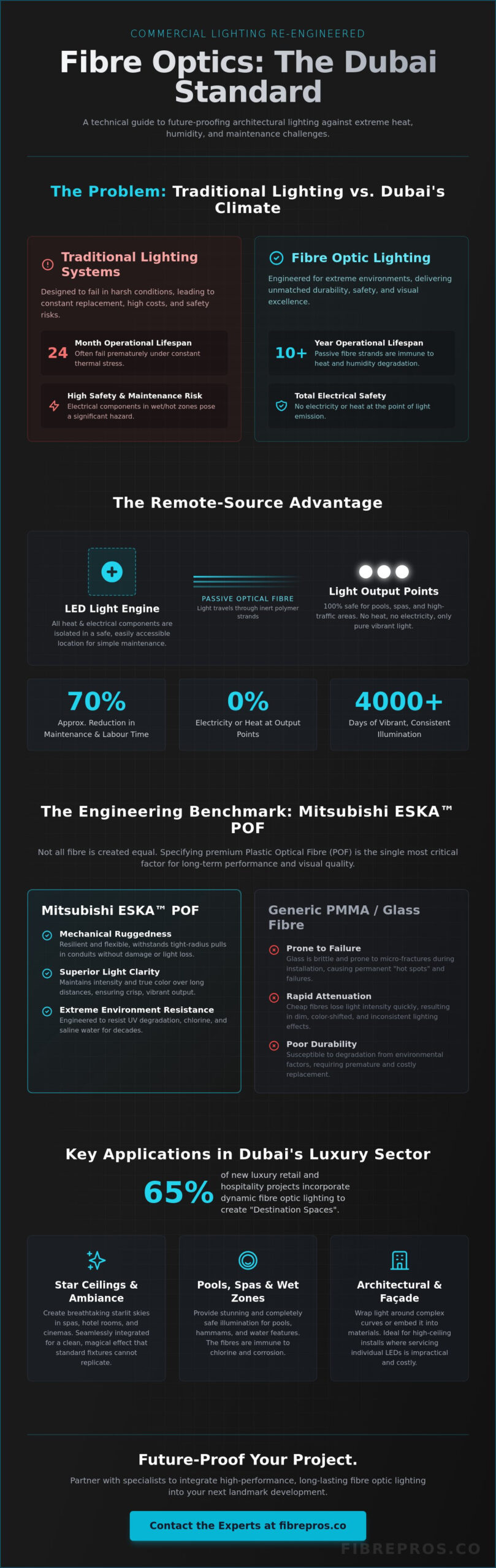
In a climate where summer temperatures frequently exceed 50°C and humidity levels regularly hit 90 percent, traditional lighting systems are often designed to fail within 24 months. You’ve likely seen the high costs and safety risks associated with standard fixtures in Dubai’s demanding commercial environments. It’s a common frustration for project managers who need both visual excellence and long-term durability. Integrating commercial fibre optic lighting Dubai isn’t just a design choice; it’s a strategic engineering decision to future-proof your infrastructure against the elements.
We understand that reliability is your primary concern when commissioning high-end architectural features. This professional 2026 guide promises to reveal how Mitsubishi ESKA fibre technology provides a 10 plus year operational lifespan while maintaining total safety in wet or high-heat zones. We’ll examine the technical requirements for heat-resistant light engines, the precision of professional splicing, and the specific installation methods that define luxury standards in the UAE. You’ll gain the technical clarity needed to deliver high-performance lighting that remains as vibrant on day 4,000 as it was on day one.
Key Takeaways
- Understand why Mitsubishi ESKA Plastic Optical Fibre (POF) is the engineering benchmark for flexibility and durability in complex commercial installs.
- Learn how to specify commercial fibre optic lighting Dubai for high-humidity zones like luxury hammams to ensure total electrical safety.
- Master the technical selection of LED illuminators and IP ratings required to withstand Dubai’s 2026 climate extremes.
- Discover how a professional end-to-end methodology guarantees a 10 plus year operational lifespan and exceptional visual quality.
The Rise of Architectural Fibre Optic Lighting in Dubai’s Commercial Sector
Commercial fibre optic lighting Dubai is defined as a remote-source illumination system where the light source is physically separated from the output point. This architecture allows light to travel through flexible strands to the desired location, leaving the heat and electrical components in a controlled, accessible environment. In Dubai’s 2026 architectural landscape, this technology has evolved from a niche decorative tool into a primary infrastructure requirement for luxury developments. The shift toward “light as art” in the hospitality sector demands systems that can integrate seamlessly into high-end finishes without the bulk of traditional fixtures.
Because no electricity or heat exists at the output point, these systems are inherently safer for public spaces. Project managers are increasingly abandoning traditional LEDs for high-ceiling installations and complex façades. Replacing a single light engine at floor level is far more efficient than deploying scaffolding to service 100 individual LED chips 15 meters in the air. This focus on uptime and specialized mastery is what distinguishes modern commercial builds from older, high-maintenance structures.
Why Dubai Architects are Choosing Fibre over Traditional LED
Reliability in extreme temperatures remains the biggest driver for adoption. While standard LED components often struggle with the 50°C plus temperatures of a UAE summer, fibre strands are passive and don’t degrade under thermal stress. Maintenance teams save approximately 70 percent on labor time because the illuminator is the only serviceable part of the system. The inherent properties of optical fiber technology also provide a level of design flexibility that rigid fixtures cannot match. Designers can now wrap light around complex architectural curves or embed it within structural elements that were previously inaccessible.
The Aesthetic Impact on Luxury Hospitality and Retail
Dubai’s commercial sector thrives on creating “Destination Spaces” that encourage social media engagement. By 2026, over 65 percent of new luxury retail interiors are incorporating dynamic lighting to influence brand mood. Using a mix of end-glow and side-glow fibres allows developers to create everything from subtle, starlit ceilings in spas to bold, linear accents in flagship stores. These systems integrate perfectly with premium materials like Italian marble or brushed stainless steel. The result is a clean, minimalist look where the light appears to emerge directly from the architecture itself, providing a sophisticated finish that standard track or spot lighting can’t replicate.
Technical Superiority: Why Mitsubishi ESKA POF is the Commercial Standard
Specifying the correct material is the most critical factor in the long-term success of commercial fibre optic lighting Dubai. While glass fibre has its uses, Mitsubishi ESKA Plastic Optical Fibre (POF) has emerged as the definitive benchmark for large-scale installations. The primary advantage of POF lies in its mechanical ruggedness. Unlike glass, which is prone to micro-fractures during tight-radius pulls in concrete or steel conduits, POF remains flexible and resilient. This durability is essential in complex commercial environments where cabling must navigate narrow architectural voids without losing light transmission efficiency.
Cheap, generic PMMA fibres often suffer from rapid attenuation, meaning the light loses intensity and shifts in color over short distances. High-performance Mitsubishi ESKA fibre maintains superior clarity, ensuring that the light reaching the final output point is as crisp as the source. Investing in premium POF reduces the total cost of ownership by eliminating the need for premature cable replacement. When you consider the labor costs of re-installing several kilometers of fibre in a finished hotel lobby, the ROI of using a professional-grade material becomes clear. Adhering to rigorous engineering principles similar to NASA’s workmanship standards ensures that every termination remains stable under load for decades.
Durability and Lifespan in High-Traffic Environments
Commercial pool and spa settings present a hostile environment for lighting infrastructure. Mitsubishi ESKA fibre is engineered to resist UV degradation and the corrosive effects of chlorine or saline water. Its tight bend radius allows installers to create intricate patterns without risking “hot spots” or fibre failure. Mitsubishi ESKA is the only POF with a 30-year proven track record in the UAE. This longevity is a result of a high-purity core that doesn’t become brittle over time. If you’re planning a large-scale project, our team at Fibrepros can provide a technical audit of your specifications to ensure maximum durability.
Optical Performance and Light Uniformity
Maintaining color consistency is a major challenge in large hotel lobbies where runs can reach 50 meters. Inferior systems often exhibit a “yellowing” effect as the light travels, which compromises the luxury aesthetic of a brand. High-quality fibre prevents this spectral shift, delivering uniform white light or vibrant RGB colors across the entire network. You can find more technical data on these performance metrics in our Mitsubishi ESKA Plastic Optical Fibre guide. By choosing the right core diameter and cladding, engineers can guarantee that every starlight point or side-glow line maintains a consistent 2026 standard of excellence.
Commercial Applications: From Luxury Spas to Iconic Arabian Tents
While technical specifications ensure longevity, the application of commercial fibre optic lighting Dubai determines its architectural impact. In the UAE, this technology is frequently deployed in culturally significant structures and high-moisture environments where traditional systems fail. Lighting an iconic Arabian Tent, for instance, requires a delicate balance of aesthetics and safety. Traditional incandescent or LED bulbs generate heat that can degrade expensive fabrics over time. Fibre optic starlight systems provide a cool-to-the-touch solution, using 0.75mm and 1.0mm diameter points to mimic the desert sky without any thermal risk to the structure.
In high-humidity Hammams and treatment rooms, electrical safety is the primary concern for operators. Because the light engine is housed in a remote, dry plant room, the humid area contains only inert polymer strands. This setup eliminates the possibility of short circuits in 100 percent humidity zones. By 2026, vertical “Starfield” walls have also emerged as a major trend for luxury lobby interiors. These features provide a tactile, immersive experience that traditional wall-washers cannot achieve. Many developers now prioritize energy-efficient lighting solutions to comply with UAE Green Building Regulations, and centralizing the light source is a key strategy in reducing the cooling load on HVAC systems.
Safe Underwater Lighting for Commercial Pools
Public safety in hotel swimming pools is non-negotiable. Fibre optic systems offer a “zero-voltage” advantage because no electricity enters the water. We recommend using 316L marine-grade stainless steel fixtures to combat the high salinity levels found in Dubai’s coastal projects. These components ensure that the installation remains free from tea-staining and corrosion for over a decade. For a detailed breakdown of component selection, consult our underwater lighting fixtures guide.
Starfield Ceilings for High-End Venues
Scaling a star ceiling for a 1,000-square-meter ballroom requires a modular approach to maintain light uniformity. We often utilize specialized star ceiling kits to streamline the installation process in large-scale commercial venues. To achieve a premium “Dubai-style” finish, designers frequently integrate Swarovski crystal end-fittings. These crystals refract the light from the fibre, creating a shimmering effect that adds a layer of sophistication to cinemas and VIP lounges. This combination of modular efficiency and high-end materials ensures a result that is both visually stunning and technically sound.
Engineering for Excellence: Planning and Technical Specifications
Engineering a successful installation for commercial fibre optic lighting Dubai requires more than just high-quality strands. It demands a rigorous approach to system architecture. Architects must account for the specific environmental stresses of the UAE, where ambient temperatures in non-conditioned plant rooms can reach 55°C. Selecting the wrong enclosure or failing to plan for ventilation leads to premature component failure. Precise planning during the early design phase prevents these costly technical oversights.
In high-dust environments, an IP65 rating is the minimum requirement to prevent ingress from seasonal sandstorms. For submerged features, IP68 is mandatory. Integration into smart building ecosystems is now a standard 2026 requirement. Most modern commercial projects utilize DMX512 or Bluetooth Mesh to coordinate complex color-changing sequences across multiple zones. This level of control ensures the lighting remains an active, dynamic part of the brand experience. If you’re currently in the design phase, consult with our engineering team to finalize your technical specifications.
Architects should follow this foundational checklist during the schematic design stage:
- Identify dedicated plant room space within 15 meters of the furthest light output point.
- Specify active cooling or ventilation for enclosures housing high-wattage illuminators.
- Verify that all cable paths avoid sharp 90-degree bends to maintain light transmission efficiency.
- Ensure the control protocol (DMX, 0-10V, or RF) is compatible with the central Building Management System.
Choosing the Right LED Illuminator
Matching the wattage of your light source to the total fibre bundle size is essential for maintaining brightness. A bundle containing 400 points of 0.75mm fibre requires a significantly more powerful engine than a small decorative feature. Selecting the correct LED illuminators ensures consistent luminosity across the entire run. Because the UAE climate puts extra strain on electronics, we only specify engines with robust heat-sinking and high-reliability fan units.
End Fittings and Crystal Accessories
The choice of end fitting dictates how light is dispersed within a space. In retail environments, crystal end fittings are often used to create a wide-angle sparkle that catches the eye of shoppers. For permanent architectural installations, we recommend 316-grade stainless steel fittings. These components offer superior resistance to corrosion and physical impact. Maintenance remains simple because the remote source is always accessible; there’s no need to disturb the architectural finish to service the system.
Partnering with Fibrepros for End-to-End Solutions
Successful execution of commercial fibre optic lighting Dubai requires a partner who understands the intersection of high-end aesthetics and rigorous engineering. Fibrepros brings a 30-year legacy of specialized expertise to the UAE market, positioning us as pioneers in remote-source illumination. Our “Pros” methodology ensures every project moves through a structured lifecycle from initial technical design to final commissioning. We don’t dilute our focus by installing communications or network fibre. We dedicate 100 percent of our resources to lighting mastery, ensuring that your architectural vision is backed by absolute technical precision.
Our regional support network extends across the GCC, providing local accountability in Abu Dhabi, Riyadh, and Doha. This physical presence allows us to respond quickly to the shifting demands of large-scale construction schedules. We take pride in the invisible but vital infrastructure we build, ensuring that the systems we commission today will continue to perform well beyond the 2030s. By acting as a specialist partner rather than a generalist contractor, we alleviate the technical anxieties of B2B clients and deliver a level of elite craftsmanship that general lighting suppliers can’t match.
Our Commercial Design and Supply Process
We work in close collaboration with MEP contractors and interior designers to integrate fibre systems into the earliest stages of a project. Our facility provides custom bundle manufacturing, where we tailor fibre lengths and diameters to your specific LUX requirements. For large-scale developments, we provide on-site technical support and specialized training for your installation teams. This hands-on approach ensures that every termination and splicing point meets our internal quality standards, reducing the risk of light loss or mechanical failure during the final handover.
Requesting a Professional Quotation
To provide an accurate commercial tender, our engineering team requires detailed CAD drawings and a clear definition of your zone types. We analyze your LUX requirements and environmental factors to specify the correct IP-rated enclosures and Mitsubishi ESKA fibre diameters. Our team understands the pace of the GCC market and offers a fast turnaround for complex commercial bids. When you’re ready to define luxury and durability in your next development, Contact the Fibrepros for your commercial lighting project. We’ll provide the technical clarity and end-to-end support needed to turn your architectural concepts into a high-performance reality.
Future-Proofing Your Commercial Infrastructure for 2026 and Beyond
Implementing a high-performance lighting system requires a shift from short-term aesthetics to long-term engineering resilience. You’ve seen how Mitsubishi ESKA technology and specialized IP-rated planning eliminate the maintenance failures common in the UAE’s extreme climate. By prioritizing a remote-source architecture, you ensure total safety in high-humidity zones while achieving a visual quality that defines luxury standards. The successful deployment of commercial fibre optic lighting Dubai depends on this technical precision and a commitment to using materials with a proven 30-year track record.
Fibrepros has operated as a UAE pioneer since 1994, delivering specialized lighting solutions for the region’s most iconic developments. As exclusive suppliers of Mitsubishi ESKA POF with over 30 years of regional project experience, we provide the technical mastery your project deserves. Our team manages every detail from schematic design to final commissioning to guarantee operational excellence. Contact the Fibrepros for a Professional Commercial Consultation to secure a durable, world-class finish for your next development. We look forward to helping you build the invisible but vital infrastructure that defines Dubai’s future skyline.
Frequently Asked Questions
Why is fibre optic lighting preferred for commercial pools in Dubai?
Fibre optic lighting is the primary choice for commercial pools because it carries zero electrical voltage into the water. This provides absolute safety for guests in hotel and resort settings. Since the light source is located in a remote plant room, maintenance teams don’t need to drain the pool or use specialized divers to service the electronics.
How long does a commercial fibre optic lighting system last in the UAE?
A high-quality commercial fibre optic lighting Dubai system typically lasts between 15 and 20 years when installed to professional standards. The Mitsubishi ESKA fibre strands are passive and don’t degrade over time like standard LED chips. Modern LED illuminators provide over 50,000 hours of operation before the light engine requires attention.
Can fibre optic lighting be integrated into a DMX building management system?
Yes, all professional fibre optic systems are compatible with DMX512, Bluetooth Mesh, and 0-10V building management protocols. This allows facility managers to synchronize lighting effects across the entire property from a central console. You can program complex color-changing sequences or schedule dimming levels to meet specific 2026 energy-saving targets.
What is the maintenance schedule for a large-scale commercial installation?
Maintenance is remarkably minimal and only involves the remote light engine. We recommend an annual inspection to clean the air filters and ensure the cooling fans are operating at peak efficiency. The actual fibre optic network is a “fit and forget” solution that requires no servicing for its entire 10 plus year operational lifespan.
Is Mitsubishi ESKA fibre worth the extra cost for commercial projects?
Mitsubishi ESKA fibre offers a significant return on investment by eliminating the frequent replacement costs associated with generic PMMA. It maintains superior light transmission and color accuracy over runs exceeding 30 meters. Most commercial projects see a 70 percent reduction in long-term maintenance labor compared to traditional lighting architectures.
How does fibre optic lighting handle the extreme heat of Dubai summers?
Fibre optics handle the 50°C plus heat of Dubai summers by physically separating the light output from the heat-generating electronics. The passive strands don’t conduct thermal energy or suffer from the heat-induced degradation that plagues standard outdoor LEDs. This separation ensures the system remains stable even during peak summer humidity levels.
Can you retrofit fibre optic lighting into an existing commercial space?
Retrofitting is highly feasible because the flexible 0.75mm to 2.0mm fibres can navigate existing architectural voids where rigid conduits won’t fit. You can install a centralized light engine in a utility closet and run the strands to various output points with minimal disruption. It’s an efficient way to upgrade a property’s aesthetic without a full structural renovation.
What is the difference between side-glow and end-glow for retail signage?
End-glow fibre focuses light at the tip to create pinpoint starlight effects, while side-glow fibre emits light along its entire length to mimic neon. Retailers use side-glow for bold linear accents and signage to define brand borders. End-glow is better suited for high-detail displays or shimmering “starfield” features in luxury boutiques.