
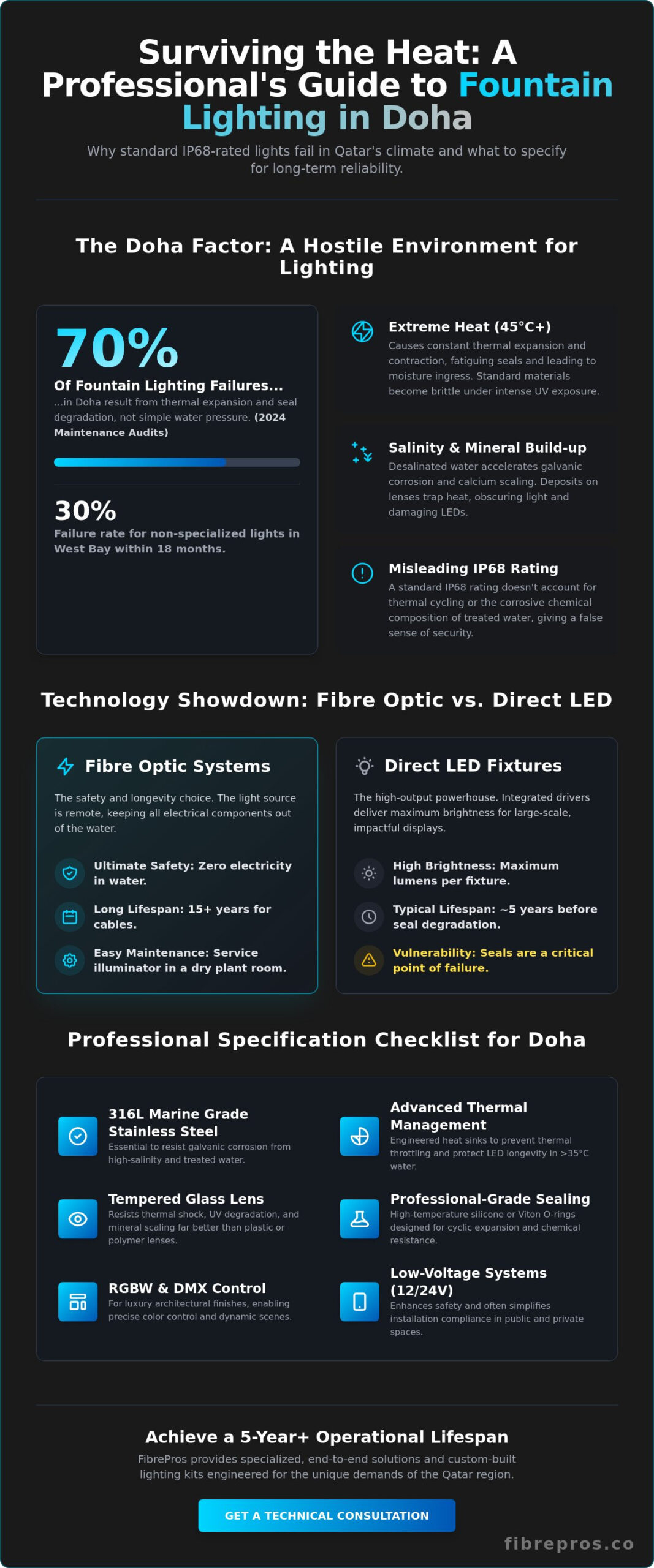
In the harsh climate of Qatar, a standard IP68 rating is often a misleading metric for reliability. Maintenance audits from 2024 indicate that 70% of fountain lighting failures in Doha result from thermal expansion and seal degradation rather than simple water pressure. You’ve likely experienced the frustration of cheap underwater LED lights for fountains Doha that fail within months due to water ingress or corrosion from treated water. It’s a common issue for project managers who require infrastructure that delivers consistent uptime and technical precision.
This 2026 professional guide provides the technical roadmap you need. We’ll show you how to select high-performance systems specifically engineered to withstand 45°C ambient temperatures and high-salinity conditions. You’ll learn how to achieve a five-year operational lifespan through precision-grade 316L stainless steel and advanced thermal management. We’ll examine the technical specifications for low-voltage systems and professional-grade sealing techniques that ensure your fountain remains a stunning, low-maintenance asset.
Key Takeaways
- Master the technical requirements for thermal management to prevent lighting failure during Doha’s extreme 45°C+ summer heat.
- Compare the safety of remote-source fibre optic technology against the high-intensity output of direct LED systems for your specific installation.
- Ensure long-term durability by specifying 316L Marine Grade Stainless Steel and tempered glass to resist galvanic corrosion and UV degradation.
- Elevate fountain aesthetics using professional underwater LED lights for fountains Doha featuring RGBW chips and DMX control for luxury architectural finishes.
- Identify specialized end-to-end solutions for custom-built lighting kits engineered to withstand the unique environmental demands of the Qatar region.
The Doha Factor: Why Fountain Lighting Fails in Qatar
Doha’s climate presents a hostile environment for architectural water features. While standard installations might survive in temperate regions, the 45°C+ summer temperatures in Qatar demand a specialized approach to underwater LED lights for fountains Doha. Many commercial projects fail because they rely on equipment designed for European or North American climates. These consumer-grade fixtures, often housed in plastic or low-grade polymers, cannot withstand the intense UV exposure and thermal stress characteristic of the Gulf region.
Professional projects require more than a standard IP68 rating. While IP68 signifies protection against total immersion, it doesn’t account for the chemical composition of the water or the cyclic thermal expansion of the seals. In Doha, the high humidity levels and mineral-rich fountain water create a perfect storm for galvanic corrosion. This process occurs when dissimilar metals come into contact through an electrolyte, such as the desalinated water used in local landscapes. For 2026, the standard for reliability has shifted toward high-grade alloys that resist these specific chemical reactions.
The failure rate for non-specialized lighting in the West Bay area often reaches 30% within the first 18 months. This isn’t just a hardware issue; it’s a failure of thermal management. When fixtures aren’t engineered for the Middle Eastern heat profile, they become liabilities rather than assets. High-performance systems must be built to endure the unique atmospheric pressures and salinity levels found in Qatari coastal developments.
Thermal Challenges in Shallow Fountains
Shallow fountains, often less than 40cm deep, struggle to dissipate heat effectively. High-wattage LEDs generate internal heat that must be transferred to the surrounding water. When ambient water temperatures exceed 35°C during peak summer months, the cooling gradient narrows significantly. This causes constant expansion and contraction of the fixture’s seals, eventually leading to moisture ingress. Thermal Throttling is the automatic reduction of light output by an LED driver to prevent permanent hardware damage when internal temperatures exceed safe operating limits.
Salinity and Mineral Build-up
Most fountain water in Doha originates from desalination plants, carrying a specific mineral profile that accelerates calcium scaling. These deposits form a hard crust over the lens, obscuring light output and trapping heat against the diode. To maintain performance, fixtures must utilize 316L stainless steel or marine-grade bronze with smooth, anti-fouling surfaces. Technical precision is required when integrating these fixtures with a DMX512 lighting control protocol, as signal integrity can degrade if the hardware fails under mineral stress. Choosing underwater LED lights for fountains Doha that feature low-friction surfaces reduces maintenance cycles by 40% over a standard five-year operating period.
Fibre Optic vs. Direct LED: Which is Better for Doha Fountains?
Doha’s 2026 fountain projects require a strategic choice between direct LED and fibre optic systems. Each technology serves a specific purpose based on the site’s hydraulic architecture and public access levels. Direct LED fixtures offer high lumens and integrated drivers. They deliver maximum punch for large-scale displays. However, they remain vulnerable to water ingress over time. Fibre optic systems differ by keeping the light source remote. This removes all electrical components from the water entirely.
Maintenance cycles differ significantly between these two configurations. Fixing a direct LED often requires draining the pool or sending a technician into the water. Repairing a fibre optic system involves simply swapping a lamp or servicing an illuminator in a dry, air-conditioned plant room. In the GCC region, extreme heat acceleration affects underwater seals. Direct underwater LED lights for fountains Doha typically offer a 5-year lifecycle before seal degradation becomes a factor. In contrast, fibre cables can last 15 years or more because they don’t contain sensitive electronics or heat-generating components submerged in the fountain.
The Safety Advantage of Fibre Optics
Safety is the primary driver for fibre optic adoption in Qatari residential and public spaces. Because these systems carry only light, they eliminate the risk of electrical shock. This meets the most stringent underwater electrical safety codes. Using Mitsubishi ESKA Plastic Optical Fibre ensures that heat stays in the plant room. It removes thermal stress from the water. This makes fibre the superior choice for interactive dry fountains or splash pads where children come into direct contact with the nozzles.
Direct LED for High-Impact Displays
Large features in Lusail or West Bay often require the intense brightness that only direct underwater LED lights for fountains Doha can provide. These high-output fixtures are designed for deep water submersion and long-throw illumination. When integrating LED illuminators or direct lamps, engineers must ensure driver compatibility with the 240V Qatari power grid. This prevents premature component failure caused by voltage fluctuations. Direct LED systems are ideal for massive plumes where light needs to travel 10 meters or more through the air.
For those planning a new installation, consulting with specialized infrastructure partners ensures the right choice for your specific water chemistry and project goals.
Technical Specifications for Professional Fountain Fixtures
Specifying underwater LED lights for fountains Doha requires an uncompromising approach to material science. The saline environment and high ambient temperatures, often exceeding 45°C in summer months, demand 316L marine-grade stainless steel. This specific alloy contains approximately 2% to 3% molybdenum, providing essential resistance to pitting and crevice corrosion that standard 304 steel cannot withstand. Using inferior metals leads to structural failure within 12 to 18 months in Qatar’s coastal conditions.
Professional fixtures utilize tempered glass lenses rather than acrylic alternatives. Tempered glass resists UV degradation and maintains optical clarity against the abrasive effects of wind-blown sand. Behind these lenses, the core technology relies on advancements studied by the Solid State Lighting & Energy Electronics Center, ensuring high luminous efficacy and thermal stability. Cable glands represent the primary point of failure in 85% of underwater systems. We specify nickel-plated brass or stainless steel glands with double-O-ring seals to prevent capillary action from drawing moisture into the housing through the cable jacket.
Safety and control standards dictate a shift to 12V or 24V DC power. Low voltage systems eliminate the risk of electric shock in public water features. They also allow for precise pulse-width modulation (PWM) dimming, which is necessary for the complex light shows found in Lusail and Msheireb Downtown. These DC systems provide smoother color transitions and more reliable synchronization across large-scale underwater LED lights for fountains Doha projects.
Understanding IP68 and Beyond
The IP68 rating is frequently misunderstood. It doesn’t guarantee indefinite submersion at any depth. A professional specification defines the maximum depth, typically 3 to 5 meters, and the duration of testing. Cheap manufacturers often test for only 24 hours. For permanent installations, look for UL or CE certifications that verify long-term performance under pressure. Submersible is a temporary designation; Permanent Underwater Use is the requirement for Doha’s landmark fountains.
Beam Angles and Optical Precision
Optical control defines the visual impact of a fountain. Narrow beams of 10° to 15° are required for vertical jets to track the water column without light spill. Wide 60° floods are better suited for cascades and waterfalls. In high-traffic public walkways, anti-glare snoots or honeycombs are essential to prevent blinding pedestrians. To add a layer of luxury, crystal end fittings can be integrated into the design to create shimmering sparkle effects that standard LED diodes cannot replicate alone.
Designing the Aesthetic: RGBW and DMX Control in Doha
Static lighting no longer meets the standard for high-end Qatari developments. Modern underwater LED lights for fountains Doha projects now rely on RGBW technology to deliver professional results. Standard RGB fixtures often struggle to produce a crisp white, usually resulting in a muddy or blue-tinted output. Dedicated white chips provide a pure, architectural light that highlights the structural details of the fountain without color distortion. High-end villas and commercial plazas in Lusail utilize these 4-in-1 chips to achieve a sophisticated look during formal events where precision is non-negotiable.
DMX512 for Dynamic Water Features
Synchronized displays require a DMX512 protocol. This digital communication standard allows for precise control over every individual fixture in the network. We use “daisy chaining” to link multiple lights via a single data line, ensuring that color transitions happen in perfect unison across 50 or more jets. For specialized occasions like Qatar National Day on December 18, DMX systems allow operators to program specific Maroon (Hex #8A1538) sequences with the touch of a button. Professional-grade DMX decoders are mandatory in Doha because they provide the thermal protection needed to handle 45°C ambient temperatures and high humidity levels without signal degradation.
The Psychology of Color in Doha Landscapes
Lighting choices directly impact the perceived temperature of an outdoor space. During the peak summer months from June to September, cool blues and teals create a psychological “cooling” effect that makes outdoor seating areas feel more inviting. Conversely, warm ambers ranging from 2700K to 3000K better complement traditional Majlis-style architecture and natural stone finishes. A light temperature between 4000K and 5000K is ideal for maximizing the visual “clearness” of the water, as it mimics natural daylight and minimizes the visibility of suspended particles. Selecting the wrong Kelvin rating can make even the cleanest water look murky under high-intensity underwater LED lights for fountains Doha.
Integration with smart home systems like Control4 or Crestron is now a standard requirement for Doha residences. You can manage your entire aquatic display from a tablet or smartphone, allowing for scheduled lighting scenes that adjust based on the time of day. This level of automation ensures your infrastructure remains efficient while providing a high-impact visual experience. Our team focuses on the technical precision of these installations to ensure 100% uptime for your luxury features.
Ready to upgrade your aquatic infrastructure with precision-engineered controls? Contact FibrePros for professional fountain lighting solutions today.
FibrePros: Your Specialized Partner for Doha Fountain Projects
FibrePros supplies the high-specification underwater lighting fixtures required for Qatar’s most demanding architectural projects. We don’t just sell components; we provide the technical infrastructure needed to ensure your water feature remains operational during 50°C summer peaks. Many developers in the GCC start with consumer-grade “quick fixes” that fail within six months due to heat degradation or chemical corrosion. Our role is to facilitate the transition to professional-grade underwater LED lights for fountains Doha projects, focusing on longevity and MEP compliance.
We provide technical support for architects and MEP consultants across the GCC, ensuring that every kit is tailored to the specific thermal and chemical profile of the installation site. By moving away from standalone retail units toward integrated lighting networks, you reduce maintenance cycles and eliminate the risk of electrical faults in submerged environments. Our systems utilize remote-mounted illuminators, keeping the electrical components in cool, dry plant rooms while the light travels safely through fibre optics to the water’s edge.
Our Inventory and Expertise
Our warehouse maintains a consistent stock of Mitsubishi ESKA fibre, the industry standard for optical clarity and durability. We pair these with high-lumen illuminators designed to punch through the high-salinity water often found in Qatar’s coastal developments. Our technical team has extensive experience managing the unique challenges of the region, including high-temperature soil conditions and humidity.
In a 2024 project for a luxury water feature in Doha’s West Bay, we implemented a custom fibre optic array that replaced a failing 12V LED system. The result was a 40% reduction in heat-related failures and a significantly sharper light output that remains visible against the district’s bright ambient skyline. Our expertise includes:
- Splicing and termination of high-core-count fibre bundles.
- Thermal management strategies for illuminator housings.
- Custom lens fabrication for specific fountain spray patterns.
- Integration with DMX and smart city control protocols.
Get Started on Your Fountain Design
You can request a technical consultation for your project today. We provide detailed submittals for MEP consultants, including photometric data and cable schedules. Our logistics team manages rapid delivery timelines for Doha and the wider Qatar region, ensuring that project milestones are met without the delays common in international shipping. Whether you’re retrofitting an existing feature or designing a new landmark, we provide the specialized underwater LED lights for fountains Doha requires for 2026 standards.
Contact FibrePros today for a professional fountain lighting quote to ensure your project benefits from industrial-grade reliability and expert GCC-wide support.
Future-Proofing Your Doha Fountain Infrastructure
Building a world-class water feature in Qatar requires more than standard equipment. It demands hardware engineered for the 45°C+ GCC climate where standard components often fail within 12 months. Success in 2026 depends on using 316 Stainless Steel fixtures and authorized Mitsubishi ESKA POF systems to ensure thermal stability. These specialized materials provide the necessary resistance against high salinity and extreme heat, protecting your investment from premature degradation.
Selecting the right underwater LED lights for fountains Doha projects is a technical decision that determines your system’s uptime and aesthetic precision. Our team focuses on delivering high-performance installations that integrate RGBW and DMX controls to meet the rigorous demands of Qatar’s architectural standards. You don’t have to worry about technical failures when your infrastructure is built on proven performance and elite craftsmanship.
Ready to secure your project’s reliability? Request a Professional Fountain Lighting Consultation for Your Doha Project today. It’s time to bring your vision to life with technical mastery and local expertise.
Frequently Asked Questions
Can I use standard outdoor LED lights in my fountain in Doha?
No, you can’t use standard outdoor lights because they lack the IP68 immersion rating required for constant underwater pressure. Standard fixtures typically carry an IP65 or IP67 rating, which only protects against rain or temporary splashing. In Doha, where summer water temperatures often exceed 40 degrees Celsius, specialized underwater LED lights for fountains Doha are necessary to prevent seal failure and internal condensation caused by thermal expansion.
How do I prevent my fountain lights from turning yellow or cloudy?
You prevent yellowing by selecting fixtures that utilize 316L marine-grade stainless steel and tempered glass lenses instead of plastic or polycarbonate. Plastic components degrade rapidly under Qatar’s high UV index, which often hits 11+ during the summer months. Professional LED units use UV-stabilized resin potting to protect the internal diodes from the 1,200 ppm total dissolved solids frequently found in the local desalinated water supply.
Is it safe to have high-voltage lights in a residential fountain?
It’s not safe to use 220V AC lighting in any water feature; you should only install low-voltage 12V or 24V DC systems. This follows the IEC 60364-7-702 international safety standard for swimming pools and fountains to eliminate the risk of lethal electric shock. Every professional installation requires a dedicated RCD with a 30mA trip threshold to ensure the power cuts off instantly if the system detects a ground fault.
What is the lifespan of professional underwater LED lights in Qatar?
Professional-grade LEDs offer a rated lifespan of 50,000 hours, which equals about 11 years of operation if used for 12 hours every night. However, Doha’s extreme heat can accelerate lumen depreciation if the fixtures don’t have adequate heat sinking. We specify units with an L70 rating, meaning they’ll maintain at least 70 percent of their original brightness after 50,000 hours of use in 45 degree Celsius water conditions.
How many lights do I need for a 3-meter diameter fountain?
A 3-meter diameter fountain typically requires between 3 and 6 underwater LED lights for fountains Doha to achieve balanced illumination. If your central water jet reaches a height of 2 meters, you’ll need three 9-watt fixtures with a narrow 30-degree beam angle. For multi-tier displays, adding three peripheral 3-watt lights ensures the outer basin remains visible without creating dark spots or uneven shadows across the water surface.
Can fountain lights be integrated with my existing swimming pool controller?
Yes, you can integrate fountain lighting with most modern pool automation systems using the DMX512 protocol or 0-10V analog signals. This setup allows you to synchronize color changes and operating schedules through a single smartphone app or wall panel. Our technicians use 2.4GHz wireless bridges or RS-485 wired connections to link the fountain’s driver to your existing hub, ensuring 100 percent compatibility with your current landscape infrastructure.
What happens if a single LED fails in a synchronized DMX system?
If a single LED fails in a professional system, the rest of the lights continue to function normally because the fixtures are wired in parallel. Modern DMX systems use RDM technology to identify the exact fixture that’s malfunctioning from the control panel. This allows maintenance teams to replace the specific 24V unit without disrupting the data signal or power flow to the other 20 lights in the synchronized sequence.
Do you provide installation services for fountain lighting in Doha?
FibrePros provides full turnkey installation services across Doha, including cable trenching, waterproof splicing, and final DMX programming. Our team handles the entire technical setup to ensure every junction box meets KAHRAMAA regulations for outdoor electrical installations. Every project includes a mandatory 24-hour continuous operation test to verify seal integrity and power stability before we finalize the handover to the client.