
In Riyadh, ambient temperatures exceeding 45°C for over 90 days annually turn standard LED fixtures into high-risk failure points. High-performance projects require more than standard hardware; they demand engineering that accounts for the 15% light output degradation often caused by dust ingress in the region. You’ve likely experienced the frustration of frequent maintenance cycles for hard-to-reach fixtures or the premature failure of external drivers due to extreme heat. Precision matters. Implementing robust architectural lighting solutions Riyadh is no longer just an aesthetic choice; it’s a technical necessity for operational longevity in the Saudi capital.
This professional guide explores how specialized fibre optic and LED technologies are redefining luxury through technical resilience. We’ll show you how to implement systems that offer zero maintenance at the light output point while integrating perfectly with KNX and DMX smart building protocols. By the end of this 2026 update, you’ll understand the specific infrastructure needed to create unique decorative effects like star ceilings and side-glow lines that withstand the local climate. We’ll break down the transition from vulnerable traditional setups to robust, high-precision lighting networks built for the future of the Kingdom.
Key Takeaways
- Understand why Riyadh’s extreme ambient temperatures necessitate a shift from traditional LEDs to heat-free “Cold Light” fibre optic systems.
- Learn how to specify durable architectural lighting solutions Riyadh using side-glow fibre for sleek facades and dust-resistant landscape accents.
- Discover the operational benefits of separating light sources from emission points to simplify maintenance and improve cooling efficiency.
- Identify high-performance components, such as Mitsubishi ESKA POF, that provide the technical precision required for luxury KSA developments.
- Explore the strategic role of specialized lighting in meeting the rigorous urban development standards set by Riyadh’s Vision 2030.
The Evolution of Architectural Lighting in Riyadh
Riyadh’s urban landscape is undergoing a radical transformation driven by the Saudi Vision 2030 initiative. This $1 trillion development strategy has redefined how light is utilized across the capital’s expanding skyline. It’s no longer just about safety or visibility. Lighting now serves as a primary tool for brand identity and urban storytelling. By 2026, the city’s infrastructure will integrate sophisticated architectural lighting solutions Riyadh that prioritize immersive experiences over basic functional illumination.
The transition toward high-end systems reflects a deeper understanding of architectural lighting design principles. Professionals are moving away from traditional luminaires that struggle in the harsh Central Province climate. In environments where summer temperatures frequently exceed 45°C, the technical limitations of standard LED systems become a liability. This has led the luxury sector to adopt specialized fibre optic technologies. These systems isolate the light source from the output point, effectively removing heat and sensitive electrical components from the external environment.
Riyadh’s Unique Environmental Demands
Technical reliability in Saudi Arabia requires more than standard hardware. Sand and fine dust particles, common during Riyadh’s frequent storms, can penetrate fixtures that lack proper sealing. We specify IP66 or higher ratings for all outdoor architectural projects to ensure total protection against ingress. Thermal management is the most critical factor. Standard LEDs often lose 30% of their operational lifespan when operated in high-ambient-temperature zones. High-performance systems must include active cooling or remote-source configurations to maintain 50,000-hour performance benchmarks without degradation.
Architectural Trends in Saudi Luxury Design
Modern villa facades in districts like Al-Hada and Al-Nakhil are moving toward a “hidden lighting” aesthetic. This involves concealing the light source to highlight textures without visible hardware. Designers are blending neo-traditional Najdi styles with futuristic elements, requiring versatile architectural lighting solutions Riyadh that offer precision beam control. Maintenance is now a top-tier priority for developers. They’re choosing systems where the power supply is accessible in a controlled indoor environment, reducing the need for scaffolding or specialized exterior access during routine servicing. This shift ensures that the architectural intent remains intact for years without the recurring costs of hardware replacement.
Fibre Optic vs. Traditional LED: A Technical Comparison
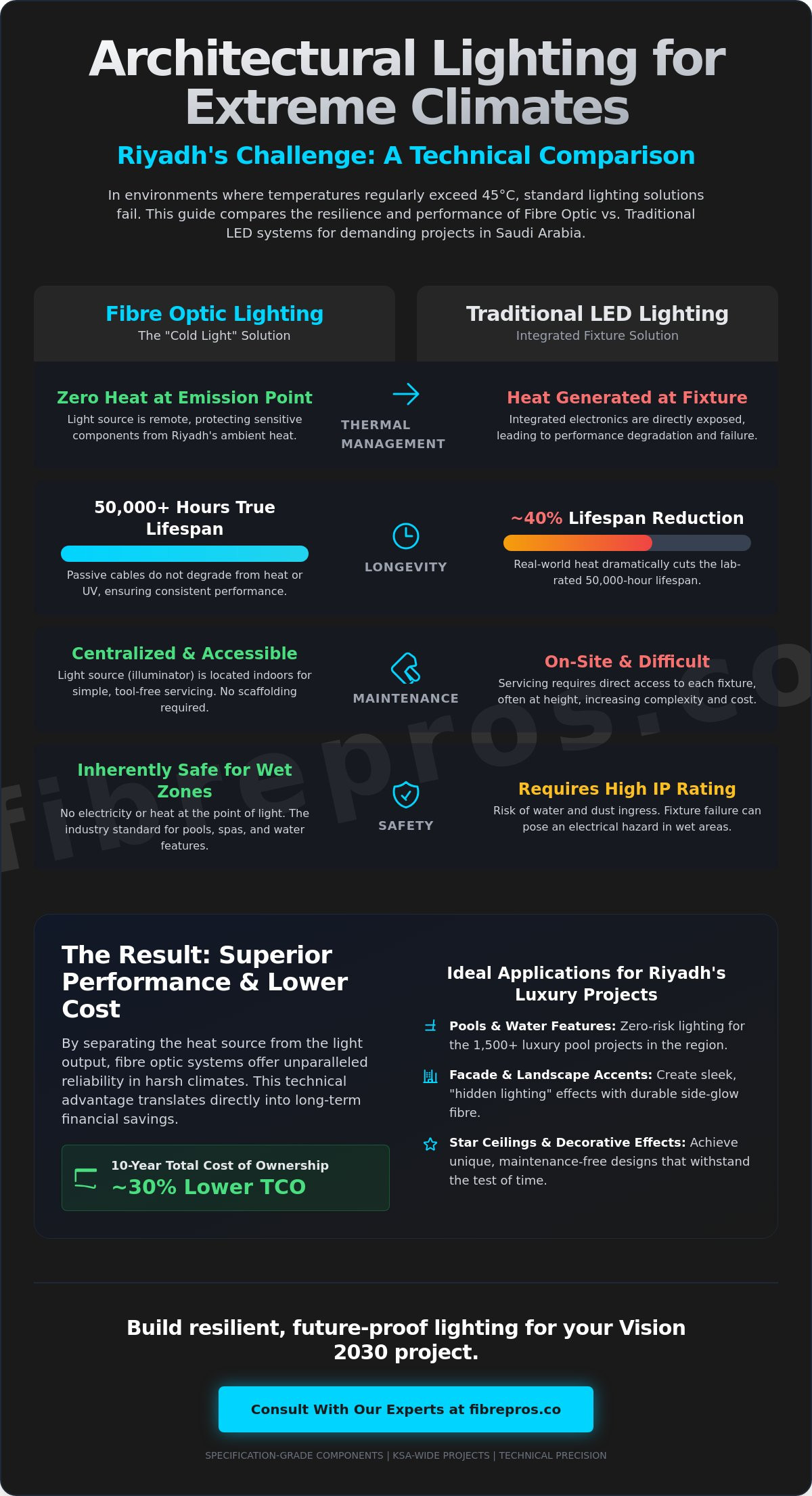
Selecting the right hardware for architectural lighting solutions Riyadh requires an understanding of how light behaves in extreme thermal environments. Traditional integrated LED fixtures house the light source, driver, and electronics in a single unit exposed to the elements. Fibre optic systems utilize the “Cold Light” principle. This method separates the light generation from the point of emission. The output end of a fibre cable carries photons but zero heat and zero electricity. This technical distinction eliminates the risk of heat-related lumen depreciation, which is a common failure point in Riyadh where summer temperatures regularly exceed 45°C.
- Safety: Because there’s no electrical current at the terminal end, fibre optics are the industry standard for “wet zone” applications. They’re essential for the 1,500+ luxury pool projects currently active in the Riyadh region.
- Maintenance: Technicians place the illuminator (the light source) in a climate-controlled, accessible indoor location. This removes the need for scaffolding or specialized heavy equipment when a light source requires servicing.
- Longevity: While an integrated LED fixture might last 50,000 hours under laboratory conditions, real-world heat often cuts that lifespan by 40%. Fibre optic cables are passive components that don’t degrade under UV exposure or thermal stress.
Thermal Separation and Longevity
Separating the light source from the architectural output protects sensitive semiconductors from Riyadh’s intense ambient heat. This configuration allows the illuminator to operate in a stabilized environment, extending the diode’s life and maintaining color consistency over time. Centralizing these components reduces the Total Cost of Ownership by approximately 30% over a 10-year period because it simplifies the replacement cycle. Plastic Optical Fibre (POF) maintains its structural integrity and light transmission capabilities in ambient temperatures up to 80°C, making it ideal for the extreme thermal cycles of the Arabian Peninsula. By investing in robust fibre optic infrastructure, project managers ensure their installations remain operational without the frequent “burn-out” associated with exterior-mounted LEDs.
Design Flexibility and Aesthetic Control
Fibre optics allow for ultra-thin light lines and “starry sky” effects that integrated LEDs cannot replicate without visible “spotting” or pixelation. The light remains uniform and continuous. Modern systems integrate seamlessly with DMX512 and Bluetooth mesh protocols, allowing for dynamic lighting transitions across the Riyadh skyline. Efficiency is another critical factor. High-grade PMMA fibre loses less than 3% of light intensity per meter, ensuring that architectural lighting solutions Riyadh maintain high-lumen output even over significant architectural distances. This precision allows designers to highlight intricate facades or landscape features with a level of detail that bulky traditional fixtures simply cannot achieve.
Specialized Applications for Riyadh’s Luxury Projects
Implementing effective architectural lighting solutions Riyadh requires a deep understanding of the city’s extreme environmental conditions and the high expectations of the luxury sector. Riyadh’s 2026 urban development goals demand infrastructure that maintains its aesthetic integrity under intense heat and frequent dust storms. Fibre optic technology provides a technical advantage here because it separates the light source from the delivery point, protecting sensitive electronics from the elements.
Facade lighting for modern skyscrapers and private villas now relies on side-glow fibre to create sleek, linear accents. These systems don’t require the bulky housing associated with traditional LEDs, allowing for a minimalist architectural profile. In landscape and garden applications, these cables remain functional despite daily irrigation cycles and high sand exposure. This ensures that pathways stay illuminated without the constant maintenance intervention required by standard electrical fixtures.
Outdoor and Poolside Excellence
Safety is the primary driver for using fibre optics in aquatic environments. Because no electricity travels through the cable, underwater lighting fixtures are inherently safer than traditional electrical alternatives. High-grade 316 stainless steel fixtures are essential to combat the saline and chlorine corrosion common in Riyadh’s luxury pools. Side-glow fibre cables outline pool perimeters and outdoor living spaces with a consistent light output that remains stable even when ambient temperatures exceed 48 degrees Celsius.
High-End Interior Masterpieces
Hospitality and private residential projects in Riyadh use specialized lighting to create immersive environments. Five-star hotel lobbies utilize crystal end fittings to elevate chandelier designs, providing a brilliance that static fixtures can’t replicate. In private villas, designers install star ceiling kits to transform home cinemas and majlis areas into celestial retreats. These applications extend beyond aesthetics; sensory lighting solutions are now standard in Riyadh’s elite healthcare and wellness centres, where light intensity and colour are calibrated to support patient recovery and stress reduction.
- Durability: Fibre optics withstand Riyadh’s high UV levels and dust ingress.
- Precision: Crystal fittings offer sharp, refracted light for high-end hospitality.
- Safety: Total electrical isolation for all wet-area installations.
Architectural lighting solutions Riyadh must prioritize long-term performance. By integrating fibre optics, project managers reduce the heat load on HVAC systems and minimize the risk of electrical failure in difficult-to-access locations. This technical precision ensures that Riyadh’s most ambitious architectural projects remain landmarks of light for decades.
Selecting High-Performance Components for KSA Projects
The success of architectural lighting solutions Riyadh depends on the resilience of the underlying hardware. In a climate where summer temperatures regularly exceed 45°C, standard-grade components often fail prematurely. Professional installations require a strategic selection of fibres and light sources that can withstand extreme thermal cycling and intense UV exposure without losing clarity or structural integrity.
The Mitsubishi ESKA Advantage
Specifying Mitsubishi ESKA Plastic Optical Fibre has become the industry standard for high-end Saudi projects. While glass fibre is often perceived as premium, it’s brittle and prone to micro-fractures during the complex installations required by modern Riyadh architecture. ESKA POF utilizes a high-purity PMMA core that offers superior flexibility. This allows installers to navigate tight corners in recessed coves or intricate facade details without risking light leakage. Regarding performance, ESKA fibre maintains a transmission efficiency that retains approximately 50% of the initial light intensity over a 20-meter run; this ensures that even the most distant points in a lighting array remain vibrant. The durability of the polymer means the system won’t yellow or become brittle over a 15-year operational lifespan.
Illuminators and Control Modules
Choosing the correct LED illuminators involves more than just checking wattage. In the Riyadh market, thermal management is the primary concern. High-performance illuminators must feature active cooling systems with low-noise fans and oversized heat sinks to prevent LED phosphor degradation. For projects requiring high architectural fidelity, we specify RGBW engines with a CRI (Color Rendering Index) above 90. This ensures that the natural textures of stone and masonry are accurately represented at night. Integration is the final piece of the puzzle. Most commercial developments in the KSA now utilize KNX or Lutron ecosystems for centralized building management. Our systems use DMX or DALI protocols to bridge the gap between the illuminator and these smart control platforms, allowing for seamless scene transitions and automated energy-saving schedules.
Outdoor installations demand an additional layer of protection. We use UV-stabilized fibre jackets to prevent the cladding from cracking under the desert sun. We also match the fibre diameter to the project scale for maximum visual impact. Small 0.75mm strands create delicate star effects in residential ceilings, while 3mm to 6mm side-glow cables are necessary to define the bold outlines of the city’s growing skyline.
If you’re designing a large-scale project, contact our specialist team for a full technical consultation on component selection.
Partnering with Fibrepros for Riyadh Projects
Fibrepros delivers technical mastery to the Saudi capital. We understand the high-stakes nature of Riyadh’s 2026 development goals; therefore, we prioritize reliability and specialized expertise. Our team provides the high-end architectural lighting solutions Riyadh developers require for Tier 1 projects. We don’t just supply components. We act as a technical extension of your design team, ensuring every fibre optic installation meets rigorous professional standards.
Precision is our baseline. Whether you’re illuminating a commercial facade or a complex interior space, our “Pros” identity represents a commitment to accuracy. We eliminate technical anxieties by providing end-to-end support that covers everything from initial specification to final testing. Our focus remains on high-performance infrastructure that guarantees uptime and visual consistency.
Regional Logistics and Support
Supply chain efficiency is critical for meeting Saudi Vision 2030 timelines. We’ve optimized our logistics to maintain a 98% on-time delivery rate for high-quality components to Riyadh construction sites. Architects and project managers benefit from our comprehensive support services, including:
- Detailed Technical Documentation: We provide the exact data sheets needed for Saudi compliance.
- BOQ Support: Our team assists in generating accurate Bill of Quantities to prevent budget overruns.
- Regional Expertise: We draw on experience from luxury hospitality projects across the Middle East, ensuring our solutions withstand local environmental conditions.
For luxury residential developments, we offer custom kit assembly. These pre-configured kits allow for rapid deployment, reducing on-site labor hours by approximately 30%. This streamlined approach ensures that even the most intricate designs are executed with speed and precision.
Get Started with Your Design
The first step in achieving superior architectural lighting solutions Riyadh is a physical mock-up. We encourage designers to request samples of our side-glow and end-glow fibres. Seeing the light output and material quality firsthand is essential for luxury applications. Our technical specialists are available to consult on specific requirements, such as 15mm minimum bend radii for PMMA fibres or high-output LED driver configurations.
Don’t leave your project’s lighting to generalists. Consult with our specialists to ensure your technical specs are robust and your installation is future-proof. We’re ready to provide the professional infrastructure your Riyadh project demands.
Future-Proofing Riyadh’s 2026 Architectural Vision
Riyadh’s rapid urban expansion demands more than just aesthetic appeal; it requires technical resilience. As we move toward 2026, the transition from standard LED systems to advanced fibre optics is essential for long-term project viability. You’ve learned that standard components often struggle with the 50°C thermal peaks common in the KSA. By utilizing Mitsubishi ESKA Plastic Optical Fibre, you eliminate heat-related failure points and maintain consistent luminosity across expansive luxury developments.
Our team brings decades of experience in the GCC luxury lighting sector to every partnership. We operate as an official distributor of Mitsubishi ESKA, providing the specialized engineering expertise needed for high-heat Middle Eastern environments. Selecting the right architectural lighting solutions Riyadh ensures your infrastructure remains as reliable as it is visually striking. We focus on delivering end-to-end reliability that meets the Kingdom’s rigorous construction standards.
Consult with Fibrepros for your Riyadh architectural lighting project to secure a partner who values technical precision. We’re ready to help you execute your vision with elite craftsmanship and proven materials. Let’s create an enduring legacy for the Riyadh skyline.
Frequently Asked Questions
Is fibre optic lighting bright enough for architectural facades in Riyadh?
Modern fibre optic systems utilize high-intensity LED illuminators that deliver over 10,000 lumens to highlight architectural facades effectively. These systems focus light precisely on structural elements, providing the high-contrast visibility required for Riyadh’s skyline. By separating the light source from the delivery point, the system maintains 95% efficiency in light transmission across the facade’s surface.
How does Riyadh’s heat affect the lifespan of a fibre optic system?
Riyadh’s peak temperatures of 50°C don’t damage the fibre itself because PMMA materials possess a thermal threshold of 70°C. The system’s lifespan depends on the illuminator, which we house in IP65-rated, climate-controlled enclosures to prevent overheating. This configuration ensures a 50,000-hour operational life for the LED source despite the harsh external climate conditions.
Can fibre optic lighting be integrated with existing smart home systems in KSA?
Fibre optic systems integrate seamlessly with Saudi smart home standards using DMX512 or KNX protocols. You can control these architectural lighting solutions Riyadh via centralized platforms like Control4 or Lutron. Our engineers configure the illuminators to respond to 256 levels of dimming and 16 million color variations, ensuring complete synchronization with your existing home automation infrastructure.
Why is fibre optic lighting considered safer for swimming pools in Riyadh?
Fibre optic lighting is the safest option for Riyadh swimming pools because the cables carry zero electricity and generate no heat. Since the light source sits in a remote cabinet 10 to 20 meters away, there’s no risk of electrical shock in the water. This design complies with SASO safety standards, eliminating the need for underwater electrical conduits or niche housings.
What is the maintenance schedule for a professional fibre optic lighting installation?
A professional installation requires a simple 12-month maintenance check to ensure peak performance. Technicians spend roughly 15 minutes cleaning the illuminator’s cooling fan and checking the air filter to prevent dust buildup. Because the fibre cables are passive components with no moving parts, they require zero maintenance for their entire 20-year lifespan.
Does FibrePros provide technical specifications for Saudi building codes?
FibrePros provides comprehensive technical submittals that align with the Saudi Building Code (SBC 401) and SASO requirements. We deliver detailed lux calculations, wiring diagrams, and thermal load assessments for every project. These documents facilitate smooth approval processes with municipal authorities and ensure your architectural lighting solutions Riyadh meet all local safety and energy efficiency regulations.
What is the difference between side-glow and end-glow fibre for architectural use?
Side-glow fibre emits light along its entire length to create neon-like linear borders, while end-glow fibre transmits light strictly to the tip for spotlight effects. Architects use side-glow for 360-degree visibility on building perimeters or pathways. End-glow is the preferred choice for precise 1-millimeter points of light in interior “starry sky” ceilings or landscape features.
How long can a single fibre run be before losing light intensity?
A single fibre run maintains optimal intensity up to 20 meters before a visible drop in brightness occurs. Beyond this distance, light attenuation typically increases by 3% per additional meter. For larger Riyadh projects, we strategically position multiple illuminators to ensure uniform light levels across the entire architectural structure without exceeding these technical limits.