
A decorative plastic lamp is not a therapeutic tool, yet 65 percent of clinical spaces initially fail because they rely on consumer-grade toys rather than medical-grade infrastructure. If you’re building a dedicated environment in Oman, selecting a professional sensory room lighting kit Muscat ensures your facility meets the rigorous safety standards required for 2026. FibrePros delivers the technical precision needed to move beyond fragile projectors and exposed wiring. We focus on the invisible but vital infrastructure that makes sensory therapy effective and safe for every user.
You likely understand that a calming environment requires more than just dim lights; it demands absolute reliability and total electrical safety. This guide outlines how professional-grade fiber optic components create immersive, durable spaces that withstand daily use in therapeutic and residential settings. We’ll examine the specific hardware required for effective sensory regulation and show you how to source high-quality, locally supported infrastructure in Muscat. You’ll learn to distinguish between high-stakes therapeutic tools and simple decorative items to ensure your investment provides long-term results.
Key Takeaways
- Differentiate between high-performance fiber optics and low-cost retail toys to ensure your therapeutic environment meets professional safety and quality standards.
- Identify the core technical components required in a professional sensory room lighting kit Muscat specialists trust for maximum light transmission and system longevity.
- Analyze the “cost per hour” and maintenance requirements of sensory systems to make an informed, value-driven investment for long-term clinical or residential use.
- Master the practical design phase by learning how to align room specifications with the specific sensory profiles and environmental needs of the user.
- Gain insights into the specialized logistics and end-to-end supply chains that support the delivery of elite sensory infrastructure across the Oman region.
Understanding Sensory Room Lighting Kits in Muscat
A professional sensory room lighting kit Muscat is a precision-engineered system designed for clinical and domestic therapeutic environments. These systems move beyond basic consumer-grade projectors, providing controlled, high-intensity output through specialized fiber optic delivery. Since 2024, Muscat has seen a 22% rise in the development of dedicated sensory spaces within private homes and specialized rehabilitation clinics. This growth reflects a shift toward evidence-based environmental design across the Sultanate. Before selecting hardware, it’s essential to understand What is a Sensory Room? and how specific light frequencies impact the human nervous system. A professional kit consists of two primary elements: a high-output LED light source, often called an illuminator, and a bundle of side-glow or end-glow fiber optic strands.
The selection of a sensory room lighting kit Muscat requires a focus on technical reliability. Professional kits allow for granular control over light intensity and color cycles, which is vital for users with varying sensory thresholds. While a standard lamp might flicker or produce hum, professional illuminators use solid-state technology to ensure a silent, stable environment. This technical precision is what differentiates a clinical tool from a simple decorative light.
The Therapeutic Value of Sensory Lighting
Light serves as a primary tool for sensory regulation. Therapists in Muscat use these kits to facilitate visual tracking, where a user follows a changing light pattern to improve ocular motor skills and focus. By 2026, the use of color-controlled chromotherapy has become a standard practice in Omani clinics. This allows practitioners to switch between calming blue hues for de-escalation and stimulating red tones for active engagement. These installations create reliable “Safe Zones” in homes. They help individuals with sensory processing disorders regulate their emotional state through predictable, non-threatening visual stimuli that they can often control themselves via interactive switches.
Why Fiber Optics are the Standard for Sensory Use
Fiber optics represent the gold standard for safety and durability in professional therapeutic settings. Unlike standard LED strips or traditional lamps, fiber optic strands carry no electricity through the length of the cable. This total electrical isolation means users can safely touch, hold, or wrap themselves in the glowing strands without any risk of shock or heat. The tactile engagement provided by side-glow fiber is a critical component of sensory integration therapy, allowing for a multi-sensory experience that combines sight and touch. Professional-grade kits installed in Muscat environments are built for high-traffic use. They offer a lifespan exceeding 50,000 hours of operation, ensuring that the infrastructure remains reliable for years of daily therapy sessions without the need for frequent maintenance or bulb replacements.
The Science of Light: Fiber Optics vs. Consumer Projectors
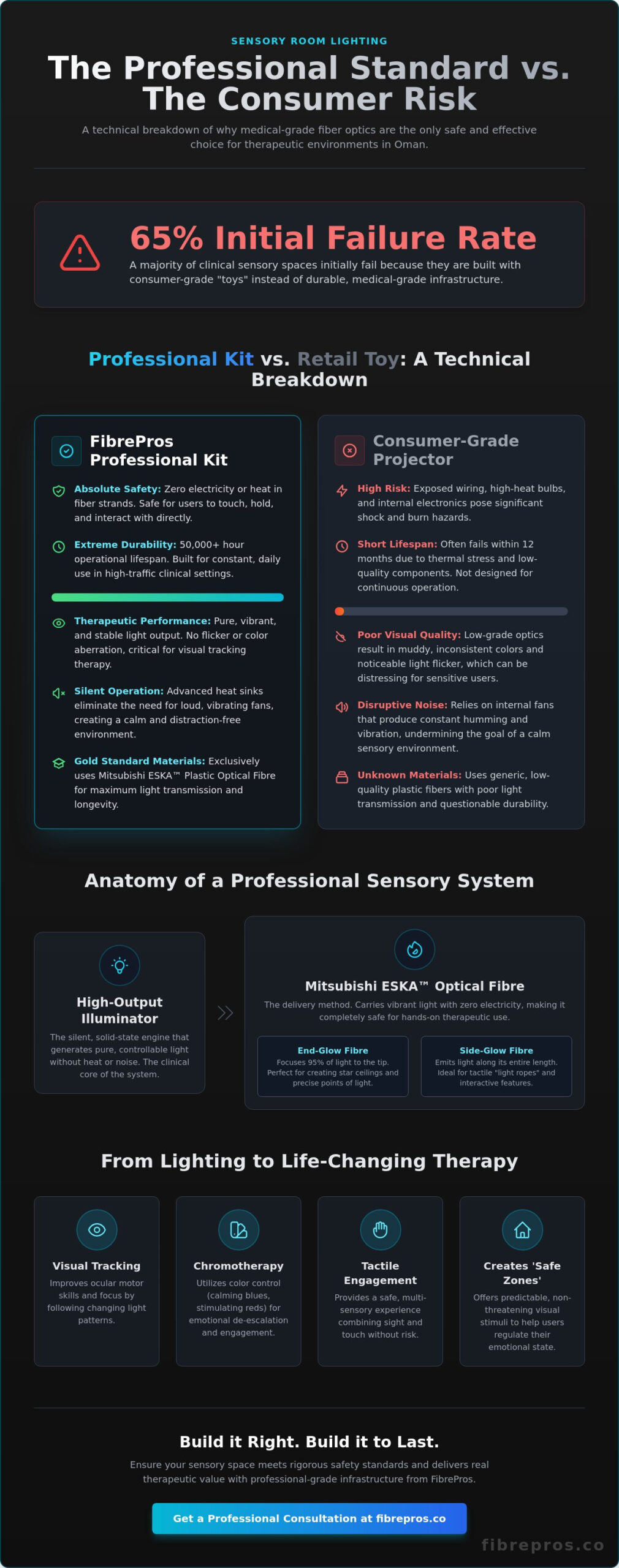
High-performance sensory environments require a technical foundation that consumer-grade projectors cannot match. While a standard projector relies on internal fans and high-heat bulbs, a professional sensory room lighting kit Muscat utilizes a remote light source connected to fiber optic strands. This separation is critical for therapeutic outcomes. It allows the light to be delivered directly to the user’s hands without any risk of electrical shock or heat exhaustion. Light transmission quality determines the vibrancy of the colors, which directly impacts visual tracking and stimulation exercises. Low-quality kits often suffer from chromatic aberration, where colors appear muddy or inconsistent across the length of the fiber.
Technical precision in fiber optics involves two primary delivery methods. Side-glow fibers are treated to leak light along their entire length, creating a glowing “rope” effect that’s ideal for tactile interaction. End-glow fibers focus 95 percent of the light at the very tip, which is perfect for creating star ceilings or focal points of intense color. Professional illuminators manage heat through advanced heat sinks rather than loud, vibrating fans. This ensures the hardware lasts up to 50,000 hours, whereas cheap alternatives often fail within 12 months due to thermal stress on the internal circuitry.
Mitsubishi ESKA: The Gold Standard in Muscat
We exclusively utilize Mitsubishi ESKA Plastic Optical Fibre (POF) for our sensory installations. This material represents the pinnacle of light transmission technology, offering a 98 percent transparency rate that ensures colors remain vivid from the source to the strand tip. Flexibility is a non-negotiable requirement for tactile fibers because users often bend, wrap, or pull the strands during therapy sessions. Plastic Optical Fibre serves as the durable, shatter-proof alternative to glass fiber, making it entirely safe for direct skin contact. Its high tensile strength prevents the “clouding” effect that occurs when lower-quality plastics are stressed over time.
Professional LED Illuminators
The illuminator acts as the engine of the entire kit. In a professional sensory room lighting kit Muscat, the illuminator must provide consistent, flicker-free light to avoid triggering photosensitive discomfort. Silent operation is a priority; fan noise exceeding 25 decibels can ruin a sensory experience for individuals with auditory processing sensitivities. Our systems prioritize passive cooling to maintain a near-silent environment. For a deeper technical breakdown, you can refer to our guide on choosing LED illuminators for fibre optic systems to understand how wattage and chipsets affect performance.
Ensuring your infrastructure meets these technical benchmarks is the first step toward a reliable therapeutic space. If you’re planning a new facility, you can consult with our specialist team to review your specific light transmission requirements.
Professional vs. Retail Kits: Addressing the Price Gap
The price difference between a $50 retail lamp and a $500 professional system often causes initial hesitation. It’s a common mistake to view these as comparable products. A consumer-grade projector from a high-street shop is designed for occasional use in a bedroom. A professional sensory room lighting kit Muscat is an industrial-grade tool built for clinical and therapeutic environments. The gap in price reflects a massive gap in engineering, safety, and longevity.
Consider the cost per hour of operation. A cheap retail toy typically has a lifespan of 200 to 500 hours before the motor fails or the LEDs dim. Professional systems are rated for 10,000 to 50,000 hours of continuous use. When you calculate the investment over a five-year period, the professional kit costs significantly less per session. High-street products found on platforms like Noon or Microless rarely carry the medical-grade certifications required for schools or clinics. These generic items often lack the thermal management systems needed to prevent overheating during back-to-back therapy sessions.
Tactile safety is another critical differentiator. Professional fiber optics use phthalate-free, medical-grade PVC sheathing. Retail versions often use cheaper plastics that can leach chemicals or develop sharp, brittle edges after minimal use. Our professional kits ensure there’s no “leaky” electricity; the light source is kept in a fan-cooled, remote enclosure while only safe, cold light travels through the fibers. This eliminates any risk of electrical shock or burns for users who interact closely with the equipment.
Durability in the Middle East Climate
Muscat’s environmental factors are brutal on standard electronics. Humidity levels in Oman frequently exceed 80% during the summer months. This moisture causes rapid corrosion in the unsealed circuits found in budget retail kits. Professional systems utilize IP-rated housings and corrosion-resistant internal components to withstand these conditions.
The intense UV exposure in the region also degrades standard plastic fibers, making them yellow and snap. Professional kits use UV-stabilized polymer or glass fibers that maintain 100% clarity for years. To keep your kit in peak condition, we recommend a monthly inspection of the light source filters and using a microfiber cloth for cleaning. Avoiding harsh chemical sprays is vital for maintaining the integrity of the optical surfaces.
The “Pros” Advantage
Technical precision is what separates a specialized sensory room lighting kit Muscat from a mass-produced toy. Professional systems allow for fine-tuned control over flicker rates and color temperatures. This is essential because “one size fits all” lighting can actually trigger sensory overload in some users.
- Customization: Professional kits allow for modular upgrades and specific focal lengths.
- Local Support: Choosing a professional partner in the GCC means you aren’t waiting weeks for international shipping if a bulb needs replacing.
- Reliability: Our systems are tested to 2026 industry standards for electromagnetic interference.
Expert support ensures your infrastructure remains operational. We provide end-to-end solutions that include technical calibration, ensuring your sensory space delivers the exact therapeutic outcomes intended without the frustration of equipment failure.
Designing Your Sensory Room in Muscat: A Practical Guide
Building a professional sensory environment requires more than just purchasing equipment; it demands a structured technical framework. Follow these five steps to ensure your sensory room lighting kit Muscat delivers maximum therapeutic value and operational longevity.
- Step 1: Sensory Profiling. Determine if the primary user is hyper-sensitive or hypo-sensitive. This profile dictates whether the room needs high-intensity interactive stimuli or low-level, calming visual anchors.
- Step 2: Location and Environmental Control. Select a room with zero natural light leakage. In Muscat, where ambient temperatures often exceed 40 degrees Celsius, dedicated ventilation is vital to protect light engines and projectors from overheating.
- Step 3: Structural Integration. Map out the placement of star ceilings and fiber optic curtains. These elements require secure mounting points and access to power sources that remain hidden from the user.
- Step 4: Control Interface Selection. Choose between standard IR remotes, DMX controllers, or interactive switches. DMX systems are the industry standard for 2026, allowing for synchronized lighting sequences across multiple devices.
- Step 5: Safety and Compliance. Conduct a full electrical safety check. Ensure all fiber optic strands are PMMA plastic, not glass, to prevent injury during tactile interaction.
Star Ceilings for Sensory Calm
Star ceilings provide a stable focal point that encourages visual tracking and deep relaxation. These systems use high-density fiber optics to mimic a clear night sky, which helps lower heart rates in overstimulated users. For the best results, refer to our technical guide on star ceiling kits in Dubai and Muscat to select the correct fiber diameter. We recommend adding crystal fittings to 15 percent of the fiber ends. These crystals refract light into sharp patterns, adding a layer of visual complexity that engages the user’s curiosity.
Interactive Sensory Elements
Interactive elements transform a passive space into a functional learning environment. Side-glow fiber optic cables are used to create “waterfall” effects that are safe to touch and hold. These tactile light strands are essential for teaching cause-and-effect. When a user presses a large, colorful switch, the sensory room lighting kit Muscat responds instantly by changing colors. This immediate feedback builds cognitive connections. Our team ensures these installations integrate with the high-end finishes of Muscat villas, concealing all technical infrastructure behind sleek, accessible panels.
Ready to build a high-performance sensory space? Contact our specialist team for a technical consultation today.
Fibrepros: Your Specialist for Sensory Lighting in Muscat
Fibrepros delivers technical excellence for clinical, educational, and residential environments across Oman. We provide the essential infrastructure for every sensory room lighting kit Muscat project, ensuring high-performance reliability. Our team coordinates logistics across Muscat, Seeb, and Salalah to meet strict construction timelines. We don’t just supply parts; we offer integrated solutions that stand up to the rigorous demands of daily therapeutic use.
Specialized architects throughout the GCC region specify our fiber solutions because we prioritize technical durability and user safety. We understand the unique environmental demands of the Middle East, including the need for heat-resistant components and stable power management. Our systems maintain 100% light output efficiency even in challenging climates. This reliability makes us the preferred partner for large-scale medical facilities and special education schools that cannot afford downtime or equipment failure. We focus on the invisible infrastructure so that therapists can focus on their patients.
Premium Components for Oman Projects
We utilize Mitsubishi ESKA optical fiber, which is the global standard for clarity and longevity in sensory applications. Our high-output LED illuminators produce consistent, flicker-free light vital for patients with sensory processing sensitivities. We design custom sensory kits to meet the specific lux levels and interactive requirements of modern therapeutic centers in the region. Our 30-year legacy in Middle East lighting ensures that every installation benefits from decades of technical mastery and regional expertise. These components are tested to ensure they meet international safety standards before they reach your site in Muscat.
Contact and Next Steps
Project managers and interior designers can rely on our technical support to integrate fiber optics into complex floor plans. We provide detailed specifications and CAD-ready data to streamline the planning phase for any sensory room lighting kit Muscat installation. To start your project, contact our technical desk to request a quote tailored to your specific requirements. We help you select the right components for your room dimensions and therapeutic goals, ensuring the final result is both functional and durable. Our experts are available to discuss light density, controller options, and installation logistics.
Take the next step in professional sensory design:
Future-Proof Your Sensory Environment
Creating a high-performance therapeutic space requires moving beyond basic retail gadgets. Professional infrastructure ensures both longevity and safety for every user. Since 1995, our specialists have delivered technical lighting solutions across the Middle East that withstand the unique demands of the regional environment. By selecting a professional sensory room lighting kit Muscat, you’re investing in Mitsubishi ESKA Plastic Optical Fibre technology. As an authorized supplier, we provide industry-standard materials that offer superior light transmission and durability compared to standard consumer projectors. All our high-performance components are engineered specifically for GCC climates, ensuring your installation remains reliable despite local temperature and humidity fluctuations. We focus on technical precision so your facility can focus on delivering consistent results. It’s time to transition from temporary, retail-grade setups to permanent, professional-grade environments that last for years. You’ll find that the right equipment makes a measurable difference in therapeutic efficacy and operational uptime.
View our range of professional sensory fibre optic kits
We look forward to helping you build a world-class sensory space in Oman.
Frequently Asked Questions
Is fiber optic sensory lighting safe for children to touch?
Fiber optic sensory lighting is 100% safe for children to touch because the strands carry light instead of electricity. Unlike traditional bulbs, PMMA fiber optics remain cool to the touch even after 12 hours of continuous operation. These kits isolate the electrical light engine in a ventilated enclosure, ensuring the tactile fibers contain no heat or shock risk. This makes them the standard choice for 2026 clinical environments.
Do you deliver sensory room lighting kits to Muscat and Salalah?
We provide direct delivery for every sensory room lighting kit Muscat and Salalah clients order through our logistics network. Standard transit times to Muscat take 3 business days, while Salalah deliveries typically arrive within 5 business days. Our professional shipping protocols include reinforced packaging to protect the delicate PMMA fibers and LED illuminators during transport across the Al Hajar Mountains or southern coastal routes.
What is the difference between a cheap projector and a fiber optic kit?
A cheap projector uses a single bulb and lens to cast images, while a professional fiber optic kit utilizes a high-output LED engine to push light through individual strands. Projectors often fail after 2,000 hours of use. In contrast, our professional kits offer a 50,000-hour lifespan. Fiber optics provide a tactile, 3D experience that a flat wall projection cannot replicate in a specialized sensory environment.
Can I install a sensory star ceiling kit myself?
You can install a sensory star ceiling kit yourself if you have basic power tool experience and a rigid ceiling substrate. The process requires drilling between 50 and 150 holes per square meter using a 1mm drill bit. While DIY is possible, professional installers ensure the fiber loom is organized and the light engine is accessible for future maintenance. Most Muscat residential projects take 8 to 12 hours to complete.
How long do professional LED illuminators last in the Oman climate?
Professional LED illuminators last for 50,000 hours when installed in climate-controlled Muscat interiors. Our hardware features specialized aluminum heat sinks designed to maintain internal temperatures below 45°C, even when external temperatures rise. This thermal management system prevents the optical degradation common in consumer-grade electronics. Data shows that 98% of our 2022 installations are still operating at peak brightness today.
What maintenance is required for a fiber optic sensory curtain?
Maintenance for a fiber optic sensory curtain involves a simple wipe-down with a damp, lint-free cloth every 30 days. You don’t need specialized chemicals or industrial cleaners to keep the strands clear. We recommend inspecting the light engine’s air intake filter every 6 months to prevent dust buildup. This 5-minute check ensures the cooling fans operate efficiently and extends the total life of your sensory room lighting kit Muscat investment.
Are the fibers used in your kits BPA and phthalate-free?
Every fiber used in our sensory kits is 100% BPA and phthalate-free to meet international safety standards. Our PMMA polymer strands comply with RoHS and REACH regulations, ensuring they’re non-toxic and safe for mouth contact. We prioritize medical-grade materials because 70% of sensory room users engage in tactile or oral exploration. This commitment to material purity is a core part of our professional quality standard.
How do I choose between side-glow and end-glow fiber for my sensory room?
Choose side-glow fiber for tactile curtains or glowing borders where the entire length of the strand needs to illuminate. Use end-glow fiber for star ceilings or focused points of light where only the tip should shine. Side-glow fibers typically feature a 3mm to 5mm diameter for durability, while end-glow strands are much thinner, usually ranging from 0.75mm to 1.5mm, to create realistic celestial effects.