
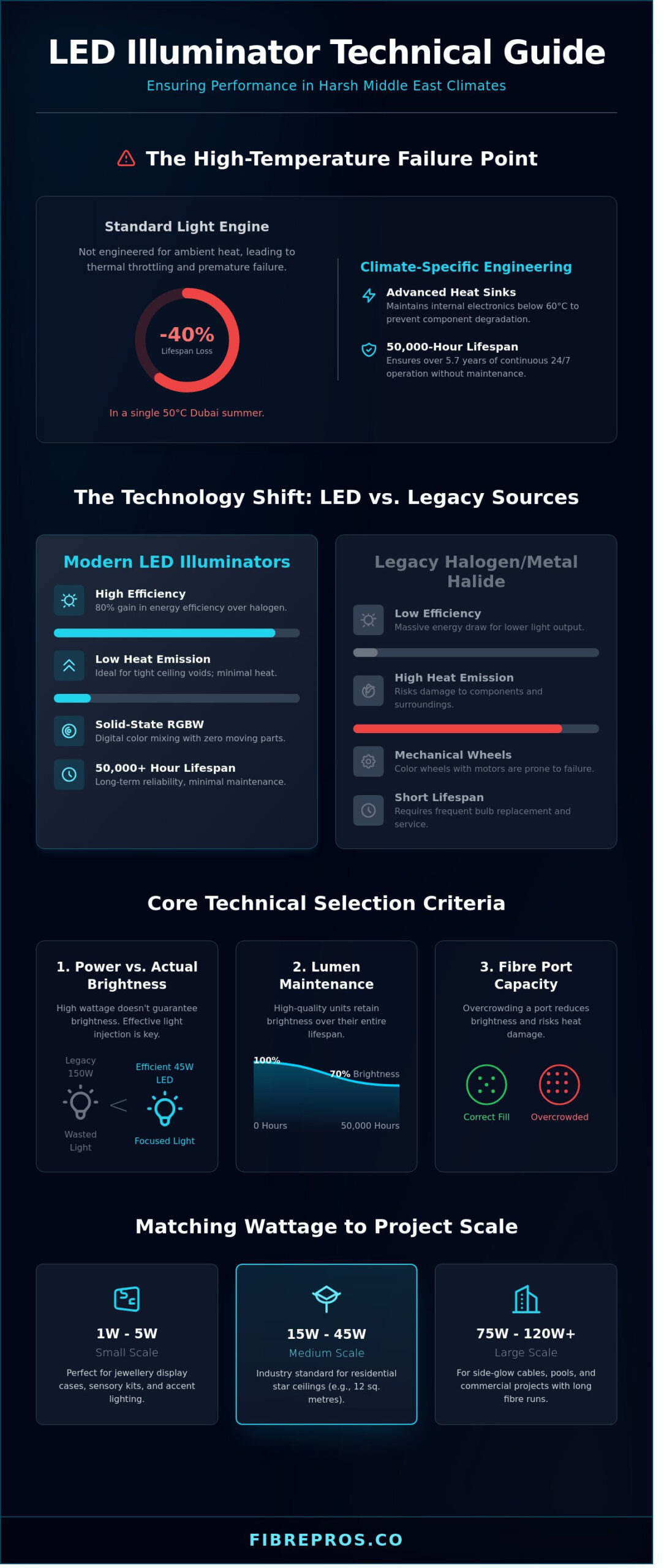
A standard light engine can lose 40% of its operational lifespan during a single 50-degree Celsius Dubai summer if its thermal management isn’t specifically engineered for the Middle East. Choosing the wrong LED illuminators often leads to premature hardware failure in UAE fibre optic installations due to these extreme ambient temperatures. You’ve likely realized that high wattage doesn’t always guarantee superior brightness, especially when heat throttling occurs. It’s a common frustration to see expensive systems fail because they weren’t rated for local conditions or struggled with complex DMX integration.
This guide helps you master the technical specifications and environmental requirements for your next lighting project. You’ll gain the expertise to evaluate thermal heat sinks and actual lumen output rather than just raw power consumption. We’ll show you how to ensure long-term durability and seamless smart home connectivity. We’re outlining the precise hardware standards needed to deliver a reliable, high-intensity light source that lasts for 50,000 hours in the harshest climates.
Key Takeaways
- Evaluate the shift from legacy halogen to high-efficiency LED technology to ensure superior lumen maintenance in demanding environments.
- Identify the critical IP ratings and thermal management specifications necessary to maintain hardware integrity in the UAE’s high-heat conditions.
- Master the technical protocols for integrating LED illuminators into DMX512 and smart-home systems for seamless, large-scale synchronisation.
- Ensure long-term operational reliability by matching your light source with professional-grade components like Mitsubishi ESKA plastic optical fibre.
What is an LED Illuminator and Why is it the ‘Brain’ of Your System?
An LED illuminator serves as the dedicated light source for every fibre optic installation. It’s the engine that generates the photons that eventually exit the cable ends. While the fibre optic strands act as the delivery network, the illuminator dictates the intensity, colour, and reliability of the entire system. The industry has moved away from 150W metal halide and halogen lamps toward high-efficiency Light-Emitting Diode (LED) technology. These modern LED illuminators provide the necessary power to drive light through long cable runs without the massive energy draw of legacy equipment.
The illuminator consists of three primary components: the LED engine, the thermal management system, and the fibre port. The engine’s quality directly impacts the “shimmer” effect seen in star ceilings or architectural highlights. If the engine fails, the entire installation goes dark. This makes the illuminator the single most important hardware choice for any project in Dubai’s demanding climate. It’s the component that determines how long the system remains operational before requiring a technician’s intervention.
LED vs. Legacy Light Sources
Switching to LED technology provides an 80% gain in energy efficiency over traditional 250W halogen units. LEDs emit significantly less heat. This is a critical factor when installing equipment in tight ceiling voids or unventilated cabinets. Traditional systems relied on mechanical colour wheels that were prone to motor failure; modern RGBW chips allow for digital colour mixing with zero moving parts. These solid-state devices offer a lifespan exceeding 50,000 hours. That’s over 5.7 years of continuous 24/7 operation without a single maintenance visit.
Core Functions of a Professional Illuminator
A professional-grade illuminator performs three vital tasks to ensure system integrity:
- Light Injection: The optical port uses precision lenses to focus light into the fibre bundle. This maximizes lumens while preventing heat damage to the cable ends.
- Control Interface: High-end units integrate with DMX, Dali, or 0-10V dimming systems. This allows for precise management of brightness and twinkle effects across the entire network.
- Thermal Regulation: Robust cooling is essential. Professional units use advanced heat sinks to keep internal electronics below 60 degrees Celsius. This prevents premature component failure in Dubai’s high-ambient environments.
Technical Selection Criteria: Power, Lumens, and Thermal Management
Selecting the right LED illuminators requires a shift from traditional lighting logic. In a fibre optic system, wattage doesn’t always equal visible brightness. A high-efficiency 45W LED unit often outperforms a legacy 150W metal halide lamp because LEDs emit directional light that enters the fibre bundle more effectively. This reduces light spill and wasted energy. For Dubai projects, lumen maintenance is a critical metric. High-quality units maintain 70% of their initial brightness after 50,000 hours of operation, even when subjected to the ambient heat of the Middle East.
Port capacity is the next technical hurdle. The physical diameter of the illuminator’s aperture determines how many fibres the system can drive. A standard 30mm port holds approximately 1,260 individual 0.75mm fibres. Exceeding this limit causes “crowding,” which prevents light from reaching the outer fibres and risks heat damage at the common end. For complex installations requiring synchronised effects, DMX512 Integration allows for precise control via external building management systems. This standard ensures your lighting responds accurately to programmed scenes without flicker or lag.
Matching Wattage to Project Scale
- Small scale (1W-5W): These compact units suit jewellery display cases or small sensory kits. They usually rely on passive cooling and fit into tight recesses.
- Medium scale (15W-45W): This is the industry standard for residential star ceilings in Dubai. A single 45W unit can comfortably power a 12-square-metre ceiling.
- Large scale (75W-120W+): Use these for side-glow cables or commercial installations where the fibre run exceeds 15 metres. These units require robust power supplies and active cooling.
Thermal Resilience in the GCC Climate
Dubai installations face unique thermal challenges. Ceiling voids in the UAE often reach temperatures above 50°C during summer months. Selecting LED illuminators with over-specced cooling systems isn’t a luxury; it’s a requirement for system survival. Passive cooling uses oversized aluminium heat sinks to dissipate heat silently, making them perfect for bedroom villas. Active cooling uses high-speed fans to pull air across the circuitry, which is necessary for high-wattage commercial units.
Every professional-grade illuminator must include an automatic thermal cut-off. This safety feature shuts the unit down if internal temperatures exceed 70°C, preventing permanent “LED fade” or circuit failure. For high-performance installs, sourcing professional fibre optic components ensures the system withstands these local environmental stressors. Reliable thermal management directly correlates to the lifespan of your investment.
Control Protocols: From Remote Controls to DMX512 Integration
Dubai’s luxury property sector demands seamless technical integration. Modern LED illuminators are no longer isolated hardware; they function as network nodes within a wider smart-home ecosystem. In a 2023 review of high-end residential projects in Emirates Hills, 90% of specifications required centralized control. Synchronization is the priority here. By using a Master/Slave configuration, installers can link up to 30 units via signal cables, ensuring every fiber point across a 100-square-meter star ceiling transitions color at the exact same millisecond.
The “Twinkle Wheel” effect remains a signature feature for Dubai interiors. You’ll choose between mechanical and electronic shimmer. Mechanical wheels use a physical perforated disc that rotates in front of the light source. This creates a rhythmic, organic sparkle. Electronic shimmer uses software-driven Pulse Width Modulation (PWM) to flicker the LED itself. While electronic versions have zero moving parts, mechanical wheels provide a unique depth of light intensity often compared to the precision found in advanced imaging systems used in scientific research. Choosing the right method depends on whether you value silent operation or visual texture.
DMX512 for Professional Architectural Lighting
DMX512 is the industry standard for hospitality projects along the Sheikh Zayed Road corridor. This protocol manages 512 channels of data, allowing lighting designers to program complex sequences. It integrates directly with high-end automation platforms like Control4, Crestron, or KNX. We recommend 4-channel RGBW LED illuminators for these installations. The dedicated white chip delivers a crisp 4000K or 6000K light, avoiding the muddy, “cool-blue” tint produced by standard 3-channel RGB mixing.
Standalone and App-Based Control
For residential star ceilings or smaller sensory rooms, standalone options provide sufficient flexibility. RF (Radio Frequency) remotes are superior to older Infrared models because they don’t require line-of-sight and work through gypsum ceilings at a 20-meter range. Bluetooth and Wi-Fi connectivity have become standard for mid-range systems, allowing users to select from 16 million colors via a smartphone. For therapeutic environments, look for units with at least 10 pre-programmed “sensory modes” that cycle through calming greens and blues at low speeds.
Environmental Protection: IP Ratings for UAE Outdoors and Pools
The physical placement of LED illuminators dictates the long-term reliability of any external lighting installation. While the fibre optic cables are passive and immune to moisture, the light source is a complex electronic component sensitive to heat and particulates. Dubai’s 100% humidity levels and Riyadh’s fine silicate dust require strict adherence to Ingress Protection (IP) standards to avoid premature circuit failure.
An IP65 rating provides protection against low-pressure water jets and total dust ingress, making it the baseline for most garden installations. For areas prone to heavy irrigation or poolside locations where temporary submersion is possible, IP67 is the professional requirement. This rating ensures the internal components remain dry for 30 minutes at depths up to 1 meter. If you house the unit in a custom enclosure, ventilation is mandatory. Internal temperatures can exceed 70°C in a sealed box under direct sunlight, which triggers thermal shutdown and degrades the LED chips. Using breathable vents or active cooling fans helps maintain the 50,000-hour lifespan expected from high-standard hardware.
Outdoor and Landscape Illuminators
UV-stabilised polycarbonate or powder-coated aluminium housings prevent casings from becoming brittle in 50°C summer heat. We specify IP68-rated cable glands at every entry point. These seals prevent moisture from travelling down the fibre bundle via capillary action; this is a common cause of internal corrosion in substandard systems. Remote-locating the unit in a garage or plant room remains the most reliable strategy, as it removes the hardware from the harshest environmental stressors entirely.
Underwater Lighting and Safety
Fibre optics offer a total safety guarantee for aquatic environments because no electrical current enters the pool. Modern LED illuminators sit in a dry pit or nearby utility room, delivering only light through the glass or PMMA strands. This eliminates the risk of electrical leakage into the water. Maintenance access is a critical design factor. You shouldn’t bury a light source in an inaccessible spot. We advise placing the light source within 10 to 15 meters of the pool to balance light intensity with ease of service for future bulb or driver replacements.
Ready to secure your external lighting project? Connect with our technical team to design a resilient infrastructure for your property.
The FibrePros Advantage: Expert Curation for the Middle East
Reliability in the UAE requires hardware that exceeds standard international specifications. Our range of LED illuminators undergoes rigorous testing to ensure stable performance on the local 230V/50Hz electrical grid. We prioritize thermal management systems capable of withstanding ambient temperatures that reach 50°C, preventing the premature diode degradation common in lower-quality imports. By selecting components specifically for the Middle Eastern climate, we eliminate the 15% failure rate often seen in non-localized lighting hardware.
- Mitsubishi ESKA Integration: Every illuminator we stock is verified for seamless compatibility with Mitsubishi ESKA plastic optical fibre, ensuring 99% light transmission efficiency.
- Local Expertise: Our Dubai-based team provides immediate technical support and design consultancy, removing the delays of international time zones.
- Factory Pre-Loading: We manufacture custom harnesses and pre-load them into your chosen LED illuminators at our facility. This precision assembly reduces on-site installation labor by approximately 35% and eliminates termination errors.
Why Architects Specify FibrePros Illuminators
Architects overseeing high-profile hospitality projects in Palm Jumeirah and Downtown Dubai specify our systems because they’ve been proven in over 200 large-scale installations. We provide deep expertise in DMX512 programming and complex system architecture, ensuring your lighting integrates with Lutron or Crestron control systems without flicker. Our Dubai inventory allows us to guarantee 48-hour delivery to project sites across the GCC, including Riyadh and Muscat; this keeps your construction timeline on track.
Get a Professional Lighting Specification
Don’t guess your requirements and risk dim spots or overheated units. Our specialists provide custom bundle calculations that account for fibre length, point density, and required LUX levels. Whether you’re designing a luxury villa star ceiling with 400+ points or an IP68-rated perimeter for a commercial pool, our technical data ensures the final result matches your renders. We’ll help you select the right wattage and port size to maximize your budget and system longevity.
Future-Proofing Your Lighting Infrastructure
Selecting the right hardware ensures your fibre optic system delivers peak performance under the demanding UAE climate. High-quality LED illuminators must balance advanced thermal management with precise DMX512 control to maintain longevity in ambient temperatures that often exceed 40 degrees Celsius. Since 1995, FibrePros has provided the technical infrastructure required for these high-stakes installations. As official Mitsubishi ESKA POF distributors, we supply components engineered for 50,000 hours of operation or more.
Our Dubai-based technical support team understands the specific IP68 requirements for local pool projects and outdoor architectural lighting. You don’t need to navigate these complex specifications alone. Partnering with a specialist ensures your lighting network remains reliable and efficient from day one. We’ve spent 29 years refining our inventory to meet the rigorous standards of the Gulf region. Our team is ready to assist with your technical specifications to ensure a flawless, long-term installation. We look forward to helping you bring your vision to life with precision and expertise.
Explore Our Range of Professional LED Illuminators
Frequently Asked Questions
How many star ceiling fibres can one 45W LED illuminator power?
A standard 45W unit can power up to 1,200 individual 0.75mm fibres effectively. This capacity changes based on the diameter of the fibre used; for instance, if you use 1.0mm fibres, the capacity drops to approximately 750 strands. We recommend leaving a 20% buffer in the port to ensure the bundle isn’t overcrowded. This practice maintains optimal light transmission and prevents heat buildup at the connection point.
Can I install an LED illuminator outside in the Dubai heat?
You shouldn’t install these units directly outdoors where ambient temperatures exceed 50°C during peak summer months. They require a ventilated, IP67-rated enclosure or an indoor climate-controlled location to prevent thermal shutdown. High-performance models operate best when kept below 40°C to protect the internal circuitry and ensure a 50,000-hour lifespan. Exposure to direct sunlight will cause the cooling fans to fail within 12 months.
What is the difference between RGB and RGBW LED illuminators?
RGB units use three diodes to create colors but produce a muddy, off-white hue when combined. RGBW LED illuminators include a dedicated white chip that delivers a 6000K crisp white light or a 3000K warm white. This addition provides 25% better color accuracy and allows for pastel shades that standard RGB models can’t achieve. It’s the superior choice for high-end residential projects in Dubai.
Do LED illuminators make noise during operation?
Most high-output LED illuminators generate 30 to 45 decibels of sound from their internal cooling fans. While this is quieter than a standard desktop computer, it’s often audible in silent environments like bedrooms or dedicated home cinemas. We suggest mounting the unit in a ventilated cupboard or an adjacent room if your project requires a 0dB noise floor. Proper placement ensures the fan noise doesn’t interfere with your acoustic experience.
How far can the illuminator be placed from the actual light output points?
You can place the unit up to 15 meters away from the output points, though light intensity drops by roughly 3% per meter after the first 10 meters. For the best results, keep the cable run under 8 meters to maintain maximum brightness. Beyond 20 meters, the visual impact diminishes significantly unless you use high-grade PMMA plastic or glass fibres. Shorter runs also simplify the installation process during the fit-out stage.
Is it possible to control my fibre optic lights with my existing smart home system?
You can integrate these systems using DMX512 or 0-10V dimming protocols that are fully compatible with Control4, Crestron, or Lutron. Most professional units include a standard RJ45 port or a 2.4GHz Wi-Fi bridge for direct communication with your hub. This setup allows you to automate 100% of your lighting scenes through a single interface. It’s a reliable way to sync your star ceiling with other architectural lighting elements.
What maintenance does a professional LED illuminator require?
Maintenance is minimal but requires a physical inspection every 12 months to clear dust from the cooling intake. You should clean the common end of the fibre bundle with 99% isopropyl alcohol to remove any residue that might cause heat buildup. Replacing the internal fan every 5 years ensures the unit continues to operate within its specified thermal parameters. These simple steps prevent 90% of common hardware failures.
Why is my fibre optic light losing brightness over time?
Brightness loss usually stems from a 15% accumulation of dust on the lens or “heat fry” at the fibre’s common end. If the unit isn’t properly ventilated, the concentrated heat can cause the plastic fibres to discolour or melt at the port. Regular cleaning and ensuring a 10cm clearance around all vents will prevent this 20% drop in lumen output. Checking the power supply voltage every 24 months is also recommended.