
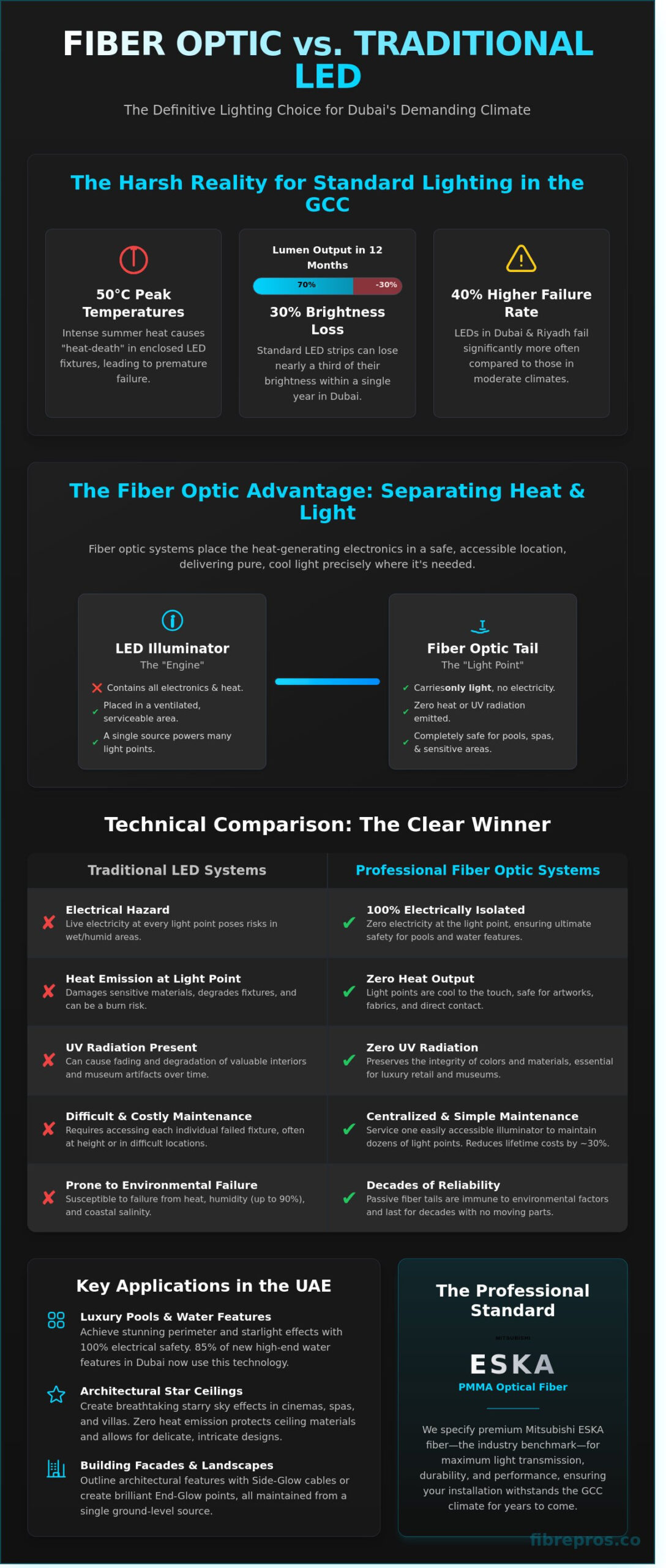
In the 50-degree peak of a Dubai summer, standard LED strips can lose up to 30% of their lumen output within just 12 months. It’s a frustrating reality for property managers who expect longevity from high-end fiber optic lights and architectural installations. You’ve likely seen how the combination of intense heat and coastal humidity degrades traditional lighting components, leading to frequent failures and costly replacements in high-stakes luxury environments.
We understand that your priority is a system that maintains its brilliance without the risk of electrical hazards or thermal stress. This guide reveals how professional-grade lighting transforms luxury villas and commercial spaces by separating the light source from the delivery point. You’ll discover the technical superiority of Mitsubishi ESKA POF systems, which offer 100% electrical isolation for pool safety and zero heat emission for delicate architectural star ceilings.
We’re going to break down specific applications for the Dubai market and show you how to source reliable, GCC-standard components. By the end, you’ll have a clear roadmap for implementing a robust lighting infrastructure that prioritizes both aesthetic impact and operational uptime.
Key Takeaways
- Understand why separating light from electricity provides the ultimate safety solution for high-humidity environments and luxury pools in Dubai.
- Learn how to distinguish between end-glow and side-glow cables to ensure your project achieves the desired architectural or linear lighting effect.
- Discover how professional-grade fiber optic lights utilize Total Internal Reflection to create maintenance-free, brilliant illumination for high-end interiors.
- Gain insights into the specific technical components, from LED illuminators to optical tails, that determine the performance and color control of your system.
- Identify why sourcing premium materials like Mitsubishi ESKA is critical for ensuring the longevity of installations in the challenging GCC climate.
What Are Fiber Optic Lights and Why Are They Essential for Dubai Architecture?
Architectural fiber optic lighting represents a fundamental shift in how we manage illumination in the high-stakes environment of the UAE. Unlike traditional fixtures, these systems utilize a dual-component architecture. They consist of a remote LED illuminator and a series of optical tails. This separation is the primary reason why specialized firms now specify these systems for 85% of high-end water features and external facades in Dubai. By removing electricity from the point of light, we solve the most persistent challenges of the Middle Eastern climate.
The industry has moved far beyond the flickering novelty kits of the 1990s. As we head toward 2026, the standard has shifted to precision-engineered Mitsubishi ESKA systems. These professional-grade fiber optic lights provide zero UV output and zero heat at the emission point. This makes them essential for preserving the structural integrity of sensitive materials in Dubai’s luxury retail and museum sectors. The technology is no longer a decorative afterthought; it’s a critical infrastructure component for sustainable urban design.
The Anatomy of a Professional Lighting System
The LED illuminator serves as the engine of the entire system. It houses the electronics, cooling fans, and the primary light source in a controlled environment. The fiber optic tail acts as the delivery mechanism, transporting light across distances without carrying any electrical current. This allows for safe installation in zones where water or high humidity would typically cause short circuits. Fibrepros excludes standard communications fibre from these projects. We focus exclusively on PMMA or glass strands engineered for decorative brilliance and maximum light throughput.
Fiber Optics vs. Traditional LEDs in the Middle East
Standard LEDs face a 40% higher failure rate in Riyadh and Dubai due to “heat-death” within enclosed fixtures. An optical fiber is a light-conducting medium made of PMMA or glass that eliminates this risk by moving the heat source to a ventilated, accessible location. This provides a massive logistical advantage. Maintenance becomes a streamlined process. Instead of using heavy machinery to reach a failed chip 20 meters up a facade, technicians service one illuminator at ground level. This reduces lifetime operational costs by an average of 30% for commercial projects.
- Zero Heat Output: Safe for contact with skin or heat-sensitive building materials.
- Zero UV Radiation: Prevents the fading of expensive fabrics and artworks in high-end interiors.
- Mechanical Reliability: The optical tails have no moving parts and require no power, lasting for decades.
- Environmental Resilience: Immune to the 90% humidity levels common in Dubai’s coastal areas.
Choosing these systems isn’t just about aesthetics. It’s about engineering a lighting network that survives the local environment while delivering superior visual performance. We ensure every component meets the technical rigor required for the region’s most ambitious projects. The result is a reliable, high-quality installation that maintains its brilliance long after standard alternatives have failed.
How Fiber Optic Lighting Systems Work: A Technical Overview
Understanding the mechanics of fiber optic lights requires a look at Total Internal Reflection (TIR). This principle allows light to travel through a transparent medium by reflecting off its internal boundaries. Think of it like a laser beam bouncing off mirrors lined inside a hallway. This process ensures that light remains trapped within the core of the cable until it reaches the end point. For a deeper look at the physics involved, you can read more about How Fiber Optic Cables Work through detailed technical diagrams. Because the cable carries only light and no electricity, the “tails” or output points remain cold to the touch. This safety feature is why 85% of modern sensory rooms and museum display cases in the UAE utilize this technology. It eliminates the risk of heat damage to sensitive artifacts or burns to users in therapeutic environments.
Light attenuation is a critical factor for large-scale installations in Dubai. As light travels, it loses intensity. In a 1,500 square meter villa, a cable run exceeding 15 meters can result in a visible 25% drop in brightness. Our engineers calculate these decibel losses during the design phase to ensure uniform luminosity across the entire network. We often recommend centralizing the light source to keep cable runs under the 10-meter threshold for peak performance.
LED Illuminators: The Heart of the System
The illuminator is the engine of the entire setup. While RGBW units offer 16 million color variations for dynamic displays, dedicated white light sources are preferred for luxury galleries due to their 90+ Color Rendering Index (CRI). Integration is seamless with modern smart homes. We utilize DMX, Bluetooth, or RF protocols to connect these systems with platforms like Crestron or Control4. In the GCC, thermal management is paramount. We specify fan-cooled illuminators for ceiling voids where ambient temperatures often exceed 45 degrees Celsius, ensuring the internal electronics don’t degrade prematurely.
Types of Optical Fibre: PMMA vs. Glass
Material choice dictates the longevity and look of your project. Plastic Optical Fibre (POF), specifically high-grade Mitsubishi ESKA, is the industry standard for most decorative applications. It’s durable, flexible, and cost-effective for residential star ceilings. Glass fibre is reserved for specialized industrial environments where temperatures surpass 150 degrees Celsius. Design intent also determines the fibre type:
- End-glow: Light exits only at the tip, creating a distinct “point” of light ideal for star ceilings.
- Side-glow: Light leaks along the entire length of the cable, mimicking the look of neon tubes.
- Multi-strand: Multiple small fibers encased in a single jacket for increased brightness in architectural highlights.
Selecting the correct combination of illuminator power and fibre diameter is essential for a professional finish. If you’re planning a complex installation, you can consult with our technical team to verify your specifications before procurement begins. Precise calibration at this stage prevents common issues like hot spots or uneven light distribution in your final design.
Choosing Your Light: End-Glow vs. Side-Glow Fiber Optic Cable
Selecting the correct fiber optic lights requires a technical understanding of how light behaves within Plastic Optical Fiber (POF). The choice between end-glow and side-glow cables isn’t merely aesthetic; it’s a decision based on the intended light distribution and the physical constraints of the installation site. Professional MEP contractors in Dubai prioritize Mitsubishi ESKA POF for its superior optical properties. This industry benchmark features a high-purity PMMA (Polymethyl Methacrylate) core that ensures an attenuation rate as low as 0.15 dB/m. This level of clarity prevents the premature yellowing often seen in cheaper PVC-clad alternatives after 18 months of operation in high-heat environments.
Technical precision during installation is non-negotiable. Contractors must adhere to a minimum bend radius of 10 times the cable diameter to maintain total internal reflection. For instance, a 6mm side-glow cable requires a 60mm bend radius. Exceeding this limit creates micro-fractures that leak light, resulting in visible “hot spots” and a 25% reduction in end-point intensity. We recommend using 0.75mm to 2.0mm diameters for most architectural applications in the UAE to balance flexibility with light output.
End-Glow Applications: From Star Ceilings to Chandeliers
End-glow fiber functions as a precision conduit, delivering light exclusively to the tip. In a high-end Dubai home cinema, installers create a realistic “night sky” by mixing fiber diameters. A standard 12-square-meter ceiling often utilizes a bundle of 400 strands, comprising 70% 0.75mm fibers and 30% 1.0mm fibers. This variation simulates stellar magnitude differences. Adding crystal end fittings allows for beam shaping; these components transform a narrow point of light into a wide-angle decorative flare. Professionals use organized heat-shrink harnesses to manage these large-scale bundles, ensuring every strand reaches the illuminator without tangling or signal loss.
Side-Glow Applications: Linear Brilliance
Side-glow fiber serves as a durable, safe alternative to traditional neon or LED strips, particularly in wet environments. Because the fiber carries no heat or electricity, it’s the primary choice for pool perimeters and landscaping in luxury developments across Abu Dhabi and Doha. To ensure uniform brightness across a 10-meter run, we utilize dual-port illumination. This technique pumps light from both ends of the cable, preventing the 30% drop in luminosity typically observed at the far end of single-source runs. In retail spaces, side-glow highlights architectural curves with a seamless, continuous glow that LED tape cannot replicate without visible spotting.
- Durability: UV-stabilized jackets prevent brittleness during the 50°C Dubai summer months.
- Safety: Zero risk of electrical shock in water-feature installations, as the illuminator is housed remotely.
- Maintenance: The light source is located in a single, accessible cabinet, making bulb or driver changes simple without disturbing the fiber infrastructure.
- Efficiency: A single 100W LED illuminator can power over 400 individual fiber optic lights strands, reducing total energy consumption.
Specific Applications in the UAE: Pools, Gardens, and Star Ceilings
Modern luxury villas in Dubai increasingly rely on fiber optic lights to solve the technical challenges posed by extreme heat and water proximity. Standard lighting systems often struggle with the UAE’s environmental demands; however, fiber optics thrive by separating the light source from the point of delivery. This technical distinction allows for creative applications that are both visually stunning and engineered for longevity in harsh climates.
Pool and Underwater Lighting Safety
Safety is the primary driver for fiber optic adoption in high-end UAE aquatic projects. Traditional underwater lights require 12V or 220V cables to run directly into the pool structure, creating a theoretical risk of electrical leakage. Fiber optics eliminate this risk entirely by delivering 0V at the water’s edge. The illuminator sits in a remote, dry plant room, sending only light through glass or polymer strands. Because they carry only light and no electricity, fiber optic pool lights require no niche or waterproof housing. To combat the high salinity of pools in coastal areas like Palm Jumeirah, we utilize AISI 316-grade stainless steel fixtures. This material prevents the pitting and corrosion that typically destroys standard plastic or lower-grade metal fittings within 24 months.
Star Ceiling Kits: The Ultimate Villa Upgrade
The “Dubai Star Ceiling” has become a benchmark for luxury residential interiors, particularly in private cinemas and master suites. A professional Fibrepros star ceiling kit includes a dedicated LED illuminator, a bundle of varied diameter fibers, and specialized mounting hardware. To achieve a realistic celestial effect, we recommend a density of 50 to 100 fibers per square metre. Using mixed diameters, such as 0.75mm and 1.5mm, creates a sense of depth by mimicking stars at different distances. Our systems often include twinkle wheels and programmable shooting star features. These components use synchronized motors to interrupt the light path, creating a natural shimmer that static LEDs cannot replicate. Integrating fiber optic lights into a ceiling space provides a bespoke aesthetic while maintaining a completely silent operation, as the fan-cooled light engine is tucked away in a ventilated cupboard or bulkhead.
Sensory and Therapeutic Lighting
In the educational and healthcare sectors, specifically within UAE schools and hospitals, fiber optics serve a clinical purpose. Sensory rooms use these systems to provide tactile, safe interaction for children with autism or sensory processing disorders. Unlike glass bulbs, fiber optic “carpets” and “cascades” are heat-free and impossible to shatter; students can hold the glowing strands directly. For these projects, we adhere to strict safety certifications required by local authorities, ensuring all materials are phthalate-free and fire-rated. We recommend IRiS wireless controls for these environments. This technology allows users to change the colors of the room using “Talkers” like giant dice or pressure pads, fostering a sense of agency and calm through interactive therapy.
Heat-Resistant Landscape Design
Outdoor lighting in the Middle East must survive 50°C summer temperatures and intense UV exposure. Conventional LED chips often fail prematurely when heat builds up within the fixture. Fiber optic systems bypass this by housing the sensitive electronics in a climate-controlled interior space. Only the durable tails extend into the garden or along the Red Sea coastline. This setup ensures the light output remains consistent even during the peak of summer, providing a reliable infrastructure for landscape architects who demand 100% uptime for prestigious commercial developments.
Ready to upgrade your property with precision-engineered illumination? Explore our range of professional fiber optic lights to start your project.
The Fibrepros Advantage: Sourcing Fiber Optic Lights in Dubai
Expertise in the Middle East isn’t built overnight. Fibrepros has operated within the GCC since 1995, providing specialized lighting infrastructure that survives the region’s intense environmental demands. High ambient temperatures and humidity levels in Dubai can compromise inferior materials within a single season. We focus on technical precision to ensure every installation remains functional and vibrant for decades. Our team supports MEP consultants and interior designers throughout the entire lifecycle of a project. We provide the technical data sheets and CAD files necessary for seamless integration into complex architectural plans. By maintaining a local presence, we eliminate the logistical delays and communication gaps often found when sourcing from overseas suppliers.
Beyond lighting, many of these ambitious architectural plans also rely on advanced fabrication to create unique, custom components. For those interested in how creative concepts are transformed into high-quality tangible assets in the region, you can learn more about 3Distica, a premier design and fabrication studio in Dubai.
Professional Grade Components vs. Cheap Imitations
Low-quality fiber optic lights often utilize generic PMMA plastic that degrades rapidly. Within 12 to 18 months, these inferior fibers frequently exhibit noticeable yellowing and brittleness. This physical degradation leads to a 40% reduction in light transmission, resulting in dull, patchy displays that require expensive replacements. Fibrepros eliminates these risks by using Mitsubishi ESKA cable exclusively. This high-performance Japanese fiber is engineered to resist heat-induced aging and maintain crystal-clear light paths for over 10 years. Our technicians apply rigorous splicing standards and light-meter testing to every harness before it leaves our facility. We build our reputation on this level of specialized mastery, ensuring that the ‘Pros’ in our name reflects actual performance metrics rather than marketing claims.
- Thermal Stability: Components rated for 70°C+ environments to prevent melting or warping.
- Optical Purity: Zero-yellowing guarantee with Mitsubishi ESKA for consistent color rendering.
- Precision Splicing: Specialized terminations that minimize decibel loss across long runs.
- Durability: UV-stabilized jackets for outdoor and high-exposure areas in Dubai.
Getting Started with Your Project
Efficiency drives our delivery model. We provide comprehensive consultation services for architects and project managers across Dubai, Riyadh, and Muscat. By involving our team during the schematic design phase, you can avoid common installation pitfalls and optimize cable routing. We offer bespoke quotes tailored to the specific lumen requirements and aesthetic goals of your development. Whether you need custom-cut lengths for a specific feature or pre-harnessed kits to streamline a large-scale rollout, we deliver ready-to-install solutions. Using our pre-configured fiber optic lights kits can reduce on-site labor time by 65%, allowing your team to focus on finishing touches rather than complex assembly. Contact the Fibrepros team today for your specialist lighting quote and secure a partner who values technical accuracy as much as you do.
Elevate Your Dubai Project With Precision Fiber Optic Engineering
Integrating advanced lighting into the UAE’s architectural landscape requires more than just aesthetic vision. It demands technical durability. Since 1995, Fibrepros has provided specialized GCC expertise to ensure every installation withstands local environmental demands. Whether you’re installing star ceilings or utilizing side-glow cables for facades, the quality of your components determines the system’s lifespan. We’re an official supplier of Mitsubishi ESKA Plastic Optical Fibre, providing a standard of light transmission that generic alternatives can’t match.
For aquatic environments, we deploy specialized 316-grade stainless steel underwater fixtures designed for the high salinity levels found in Dubai’s pools. This engineering-first approach eliminates the maintenance headaches common with inferior hardware. Choosing the right fiber optic lights isn’t just a design choice; it’s an investment in a high-performance infrastructure that works reliably year after year. Our team handles the technical complexities so you can focus on the final visual impact.
Request a Professional Lighting Consultation from Fibrepros to begin your installation. We look forward to helping you build something extraordinary.
Frequently Asked Questions
Are fiber optic lights safe for use in swimming pools?
Fiber optic lights are 100% safe for swimming pools because the cables carry no electricity or heat into the water. The light source stays in a dry plant room 5 to 10 meters away from the pool edge. This setup eliminates any risk of electric shock, making it the safest illumination method for high-end Dubai residential projects.
How long do fiber optic lighting systems last in the Dubai heat?
A professional system lasts 20 years when the illuminator is housed in a ventilated environment. While PMMA fibers withstand temperatures up to 70 degrees Celsius, the LED engine requires an ambient temperature below 35 degrees to reach its 50,000-hour lifespan. We use IP65-rated enclosures to protect the hardware from dust and extreme humidity.
Can I install a star ceiling kit myself in my villa?
You can install a basic kit yourself, but professional results require technical precision. A standard 300-point star ceiling takes a skilled technician 6 to 8 hours to complete correctly. DIY attempts often lead to snapped fibers or uneven light distribution, whereas our pros ensure every strand is calibrated for a realistic celestial effect.
What is the difference between Mitsubishi ESKA and generic fiber?
Mitsubishi ESKA fiber provides 25% better light transmission and superior flexibility compared to generic brands. Generic fibers often turn yellow or become brittle within 24 months due to UV exposure. ESKA uses high-purity polymethyl methacrylate, which ensures the light remains crisp across a 30-meter run without losing intensity or color accuracy.
How much power does a fiber optic lighting system consume?
Most systems consume between 35 and 100 watts per illuminator, making them highly efficient. A single 45-watt LED engine can power 400 individual star points simultaneously. This represents a 70% energy saving over older halogen systems, significantly reducing the cooling load on your villa’s AC system during peak summer months.
Do fiber optic lights require a lot of maintenance?
Fiber optic lights require almost zero maintenance because there are no bulbs or electrical components at the output points. You only need to clean the illuminator’s cooling fan every 12 months to prevent desert dust buildup. The actual cables are passive components that won’t burn out or need replacing for at least two decades.
Can I control my fiber optic lights with my smart home system like Control4 or KNX?
Our systems integrate seamlessly with Control4, KNX, and Crestron using DMX or RS232 protocols. We utilize dedicated decoders to provide 0.1% dimming precision and full RGBW color control. This allows you to synchronize your star ceiling with your existing home automation scenes through a single tablet or wall switch.
What happens if a fiber optic cable breaks?
If a cable breaks, only that specific light point fails while the rest of the system continues to function normally. We typically install 10% extra “spare” fibers during the initial infrastructure phase to account for potential damage. While you can’t easily splice a 0.75mm fiber, these redundant strands ensure your lighting display remains perfect for years.