
Most luxury steam room failures aren’t caused by the steam generator; they’re caused by standard lighting fixtures struggling to survive in 100% humidity. It’s frustrating to invest in a premium wellness space only to face corroded fittings, frequent bulb failures, or the genuine safety concern of electricity in a saturated environment. You deserve a sanctuary that remains functional and safe without constant maintenance. This guide explains why fibre optic technology has become the definitive choice for high-end steam room lighting solutions in the UAE, offering a blend of technical resilience and aesthetic brilliance.
We’ll examine how separating the light source from the humid zone eliminates the risk of electric shocks and ensures compliance with Dubai’s strict IP65 and DEWA safety standards. You’ll discover how Mitsubishi ESKA plastic optical fibre creates zero-maintenance star ceilings and spa-like atmospheres that never dim. From technical precision to the ultimate sensory experience, we’ll provide the roadmap for a lighting system that prioritizes both safety and luxury while meeting the latest 2026 UAE building codes.
Key Takeaways
- Learn how separating the light source from the humid zone eliminates electrical risks and ensures total safety in saturated environments.
- Discover why advanced steam room lighting solutions using Mitsubishi ESKA fibre prevent the corrosion and heat-related failures common in standard LED fixtures.
- Explore the use of star ceiling kits and crystal end fittings to achieve a high-end, spa-like aesthetic that maintains its brilliance over time.
- Identify the essential technical specifications and IP ratings needed to comply with 2026 Dubai safety regulations and municipality standards.
- Gain insights into selecting the right LED illuminators and fibre types for a zero-maintenance installation in luxury UAE interiors.
The Challenges of Lighting High-Humidity Steam Environments
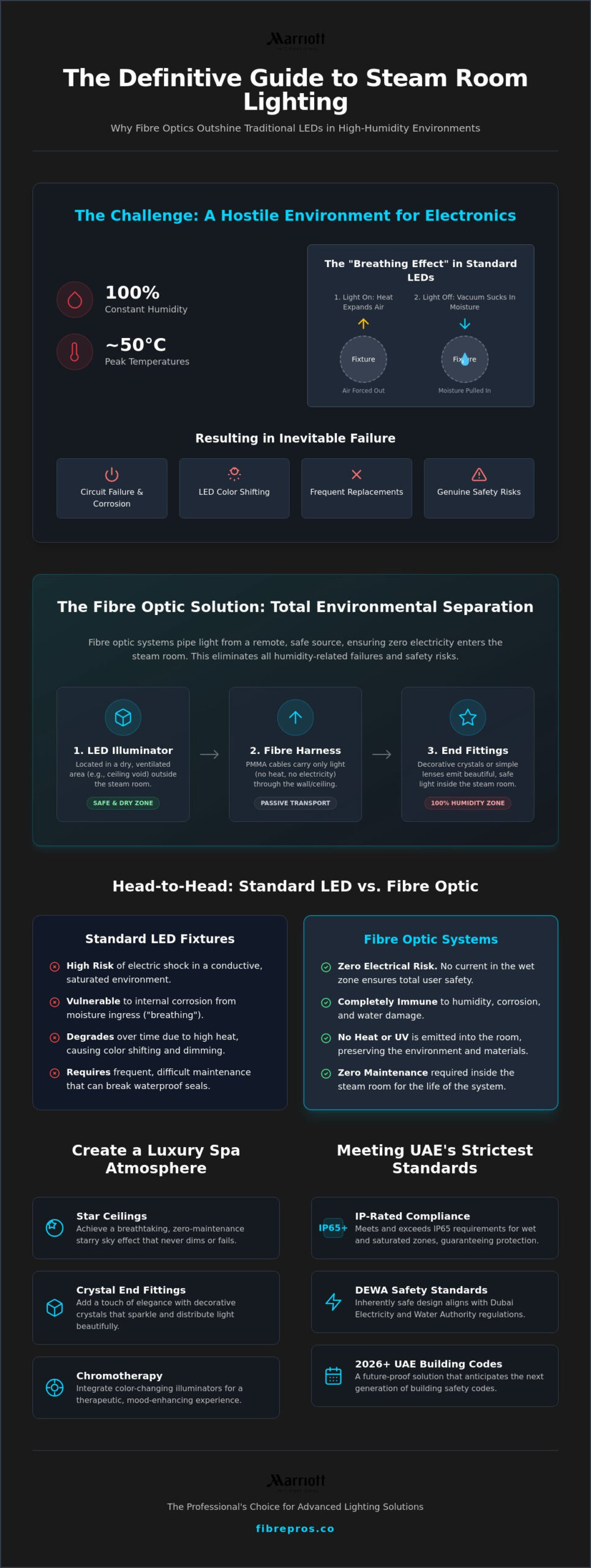
Steam rooms are designed for relaxation, but for electrical systems, they represent a hostile environment. Unlike a standard bathroom, a steam room maintains 100% humidity and temperatures that frequently peak at 50°C. Understanding the history and design of steam baths reveals that while the therapeutic benefits are timeless, the technical requirements for modern steam room lighting solutions have evolved significantly. Standard fixtures simply aren’t built to withstand these specific atmospheric pressures over the long term.
The primary cause of failure in standard LED fixtures is a phenomenon known as the “breathing” effect. During operation, the air inside a fixture heats up and expands, forcing its way out through gaskets or seals. When the light is turned off, the unit cools and creates a vacuum, sucking moisture-laden air back inside. Over time, this cycle compromises even IP67-rated seals. Once moisture enters the housing, it triggers internal corrosion and immediate circuit failure. It’s a technical inevitability for electronics trapped in a sealed, humid box.
Maintenance in these environments is also a major operational hurdle. Replacing a failed bulb or driver often requires breaking waterproof seals or accessing tight, tiled ceiling voids that weren’t designed for frequent entry. In a commercial spa or a high-end Dubai residence, this downtime is more than just an inconvenience; it’s a failure of the luxury experience. You don’t want a technician climbing into a finished steam room every few months to fix a flickering light.
Heat vs. Humidity: The Silent Killers of Electronics
High temperatures accelerate the degradation of LED phosphor, which leads to permanent color shifting. A once-warm white light can quickly turn a sickly blue or green as the internal components bake. Humidity penetrates the protective coatings on circuit boards, causing microscopic short circuits that degrade performance. Standard gaskets made of rubber or silicone often become brittle under constant thermal expansion, losing their ability to keep the internal components dry and functional.
Safety Regulations for Wet Area Lighting in the UAE
Dubai Municipality and DEWA enforce strict standards for wet area installations, categorizing spaces into Zones 0, 1, and 2 based on water exposure. While many installers suggest low-voltage LED systems as a safety measure, even 12V or 24V circuits carry risks in a saturated, conductive environment. Water is an excellent conductor; a small leak in a fixture can electrify the entire steam-filled room. This is why non-conductive steam room lighting solutions, like fibre optics, are becoming the preferred standard for luxury projects. They remove the electrical source from the wet zone entirely, ensuring total compliance and user safety.
Why Fibre Optic Technology is the Safest Lighting Solution
The fundamental safety advantage of fibre optic technology lies in its physics. It doesn’t use the wet environment as a housing for electrical components. Instead, it pipes light from a remote source into the room. This effectively bypasses the risks of short circuits and electrical leakage discussed previously. While OSHA lighting safety standards focus heavily on grounding and moisture protection for traditional systems, fibre optics eliminate the need for these precautions within the steam zone by removing the current entirely. It’s the most robust way to implement steam room lighting solutions in high-stakes environments.
By using fibre, you ensure that the only thing entering the high-humidity area is light itself. There are no wires to corrode and no heat-generating diodes to fail inside the ceiling. The system is inherently safe; even if a fibre cable is cut or submerged, there’s no risk of shock to the user. This makes it the only logical choice for luxury environments where liability and user safety are paramount. It’s about providing a worry-free experience for both the property owner and the guest.
The Anatomy of a Steam Room Fibre Optic System
A complete system consists of three distinct parts that work together to deliver safe illumination. The LED illuminator, often called the “light engine,” sits in a dry, ventilated cupboard or ceiling void outside the steam room. This unit generates the light and any color-changing effects. The fibre harness, made of high-grade PMMA, carries that light through the wall or ceiling. Finally, end fittings or lenses distribute the light inside the room. This modular design means that if the light source ever needs maintenance, it’s done in a dry area without disturbing the steam room’s waterproof envelope.
Mitsubishi ESKA: The Gold Standard for Durability
Not all plastic optical fibre is equal. Architects in the UAE specifically request Mitsubishi ESKA Plastic Optical Fibre because it’s engineered to resist the yellowing and brittleness caused by extreme thermal cycles. In a steam room, where temperatures fluctuate rapidly, inferior fibres often lose their clarity and become “cloudy,” which significantly reduces light output. ESKA maintains its optical efficiency for decades, ensuring your spa remains as bright on day 1,000 as it was on day one. For those designing bespoke wellness spaces, sourcing these high-performance components from a dedicated fibre optic specialist ensures the longevity of the installation.
Because the fibre itself is passive, it outlasts any in-situ LED fixture. While an integrated LED might last 20,000 hours before heat kills the driver, a fibre optic harness can last the lifetime of the building. You simply swap the illuminator’s LED module every few years if needed. This makes it a sustainable, long-term solution for sophisticated interiors that values uptime and technical precision above all else.
Designing the Aesthetic: Star Ceilings, Crystals, and Chromotherapy
Technical safety provides the necessary foundation, but the aesthetic execution defines the luxury of a wellness space. Modern steam room lighting solutions must do more than simply illuminate; they must create an immersive environment that supports relaxation. By utilizing fibre optic components, designers can achieve visual effects that are physically impossible with traditional LED fixtures due to the extreme moisture levels. The goal in 2026 is layered lighting, where ambient, task, and accent elements combine to form a cohesive, spa-like retreat.
The Starry Sky Effect in Steam Rooms
The most sought-after feature in luxury Dubai spas is the celestial ceiling. Achieving a realistic “Starry Sky” requires more than just random light points. Professional star ceiling kits allow for the use of varying fibre diameters, typically ranging from 0.75mm to 1.5mm. This variation creates a sense of depth, with larger fibres appearing as “near” stars and smaller ones receding into the distance. For the ultimate relaxation, we recommend static light or very slow-moving twinkle wheels. Rapid flickering can be distracting in a meditative environment. During installation, it’s vital to use specialized epoxy resins to seal the fibre penetrations through the waterproof ceiling membrane, ensuring the room’s structural integrity remains uncompromised.
For those seeking a more structured elegance, crystal end fittings can be added to the fibre terminations. These precision-cut glass fixtures refract the light, casting decorative patterns across the steam-filled air. Unlike metal fixtures that may tarnish, these crystal and stainless steel components are impervious to the 100% humidity levels found in steam environments.
Architectural Highlighting with Side-Glow
Beyond the ceiling, architectural lighting defines the room’s geometry. Side-glow fibre is an excellent alternative to LED strips for highlighting the edges of benches, niches, or skirting lines. Standard LED strips often suffer from “dotting” or visible hotspots, and their adhesive backings frequently fail in high-heat cycles. Side-glow fibre provides a perfectly uniform, linear light source that can be tucked into joinery or recessed channels. This technique improves safety by clearly defining floor levels and seating edges without the glare of direct overhead lighting.
Integrating Chromotherapy through RGBW illuminators adds a final layer of sophistication. Color therapy is a significant trend in 2026 wellness design, with users seeking specific hues to influence their mood. Soft blues and greens promote calm, while warmer ambers can feel grounding. Because the colour mixing happens in the remote illuminator, the transition between shades is seamless and flicker-free, ensuring the sensory experience remains uninterrupted.
Technical Specifications: Choosing Illuminators and Fibre Types
The success of high-performance steam room lighting solutions depends on the technical synergy between the light source and the delivery medium. While the previous sections established why fibre is the safest choice, selecting the correct hardware ensures the system delivers the intended lumen output and longevity. The “engine” of your system is the LED illuminator. You must select a unit with sufficient wattage to drive light through the entire harness length without overheating. High-grade LED illuminators designed for the UAE market often feature advanced thermal management to handle the ambient heat of mechanical rooms.
Control integration is a critical specification for luxury projects. Modern systems support DMX512 protocols, allowing the steam room lighting to synchronize with the wider home automation or spa management system. If a dedicated control desk isn’t used, Bluetooth and RF (Radio Frequency) interfaces provide users with app-based control over color cycles and dimming levels. When calculating the fibre harness sizing, you must match the port capacity of the illuminator to the total number of light points. Overcrowding the common end of a harness leads to “hot spots” and reduced efficiency; precision sizing is the only way to ensure uniform brightness across every star or fixture.
Illuminator Placement and Ventilation
The illuminator stays outside the steam zone, typically in a dry cupboard, a ventilated ceiling void, or an adjacent equipment room. This placement is vital for maintenance access and heat dissipation. In luxury home spas, fan noise from the illuminator’s cooling system can ruin the tranquil atmosphere. We recommend placing the light engine at least three to five metres away from the steam room entrance or using whisper-quiet cooling modules. Ensure the location remains accessible; you don’t want to remove decorative tiling just to access a control dip-switch or replace a module in ten years.
Fibre Count and Diameter Selection
Technical precision extends to the diameter of the fibre itself. For a realistic star ceiling, we typically use a blend of 0.75mm and 1.0mm fibres to create depth. If you’re using crystal end fittings or task lighting, a 1.5mm or 2.0mm fibre is necessary to provide a punchier, more functional beam. Keep in mind that light intensity drops over distance. While high-quality PMMA fibre can run up to 15 metres, keeping runs under 8 metres ensures maximum brilliance. For complex layouts, custom-tailored harnesses are superior to off-the-shelf kits as they eliminate excess fibre “spaghetti” and ensure every point receives equal light. To ensure your project meets these technical benchmarks, consult with a specialist who understands the specific demands of Dubai’s luxury infrastructure.
Implementing Professional Steam Room Lighting in Dubai
Dubai’s luxury market demands more than just aesthetics; it requires technical solutions that survive the region’s aggressive environmental factors. High salinity and ambient heat can accelerate the failure of poorly specified steam room lighting solutions. Working with a local specialist ensures that every component, from the fibre harness to the illuminator, is engineered for the Middle East’s specific climate. Integration with MEP (Mechanical, Electrical, and Plumbing) contractors is the most critical phase of the installation. Early coordination allows for the correct routing of fibre conduits before the waterproofing and tiling phases begin. This proactive approach prevents the need for costly retrofits and ensures the primary waterproof membrane remains intact.
Luxury spas across the GCC, from Riyadh to Muscat, are increasingly moving away from high-maintenance LED fixtures in favor of fibre optics. By sourcing components from a dedicated fibre optic supplier in Dubai, project managers gain access to technical support that understands local municipality regulations and DEWA standards. This regional expertise is what separates a standard bathroom renovation from a world-class wellness facility. It’s about building infrastructure that performs reliably under constant operational load.
The Fibrepros Advantage in the UAE
We maintain a robust inventory of Mitsubishi ESKA plastic optical fibre and high-output LED engines in our Dubai facility. This ex-stock availability is vital for fast-track projects where construction timelines are tight. We don’t just supply parts; we provide technical design support for architects and interior designers to ensure the lighting layout complements the architectural vision. Our regional logistics network ensures reliable shipping to job sites in Saudi Arabia, Qatar, and Oman. This makes us a dependable partner for large-scale infrastructure projects across the Gulf that require elite craftsmanship and specialized materials.
Final Checklist for Your Steam Room Project
Before finalizing your installation, conduct a rigorous review of the following technical points to ensure long-term performance:
- Verify that all underwater lighting fixtures and end fittings are made from marine-grade 316 stainless steel to prevent pitting and corrosion.
- Confirm the illuminator’s location has adequate passive or active ventilation to prevent thermal shutdown during the high-heat cycles common in the UAE.
- Perform a comprehensive “light test” on all star points and linear side-glow runs before the final sealing of the ceiling or bench cavities. Once the tiles are set and the epoxy is cured, adjustments become significantly more difficult and expensive.
Precision at this stage guarantees a zero-maintenance finish. By following these technical benchmarks, you’ll create a sanctuary that reflects the high standards of the UAE wellness industry while ensuring total safety for every guest.
Securing the Future of Your Wellness Space
Choosing the right steam room lighting solutions is a decision that balances engineering safety with high-end design. By prioritizing fibre optic technology, you remove electrical risks from saturated environments and eliminate the maintenance cycles that plague standard fixtures. We’ve explored how high-performance materials like Mitsubishi ESKA plastic optical fibre and precision LED illuminators create star ceilings and architectural highlights that withstand the UAE’s specific thermal demands. These systems provide a robust foundation for luxury spas that value both uptime and atmospheric beauty.
Fibrepros has served as a specialized partner in the region since 1995. As an official supplier of Mitsubishi ESKA POF, we provide the technical expertise and direct delivery services needed for projects across Dubai and the wider GCC. Our focus remains on delivering the components that allow architects and project managers to build with total confidence in their infrastructure’s reliability.
Request a Technical Consultation for Your Dubai Lighting Project to begin specifying a system that meets the highest standards of safety and sophistication. Your vision for a world-class wellness retreat is within reach when backed by proven technical mastery.
Frequently Asked Questions
Is it safe to have lights inside a steam room?
Yes, it’s safe if you use non-conductive steam room lighting solutions like fibre optics. These systems carry only light through the cables, keeping all electrical current and heat generation outside the wet zone. This eliminates the risk of electric shocks or short circuits in the 100% humidity environment.
Why are fibre optics better than LED strips for steam rooms?
Fibre optics are superior because they don’t have sensitive electronics or adhesive backings that fail in high heat. LED strips often suffer from the “breathing effect,” where seals fail during thermal cycles, leading to internal corrosion. Fibre cables are passive components that are immune to moisture and heat-induced electronic failure.
Where do you hide the light engine (illuminator) for a steam room?
The illuminator stays in a dry, ventilated location such as a nearby equipment cupboard, a ceiling void, or an adjacent room. This keeps the electrical components away from the steam while ensuring they remain accessible for future maintenance. Proper placement also ensures that any fan noise doesn’t disturb the tranquil spa atmosphere.
Can I change the colours of my steam room lights?
Yes, you can achieve full colour control by using an RGBW LED illuminator. These systems allow you to cycle through various hues or select a static colour to support chromotherapy sessions. Controls are typically integrated via DMX, Bluetooth apps, or dedicated remote controls for ease of use.
Do fibre optic lights require maintenance inside the steam room?
No, the light points and fixtures inside the steam room require virtually zero maintenance. There are no bulbs to change and no moving parts within the humid zone. Any necessary servicing, such as replacing an LED module, happens at the remote illuminator location without needing to enter the steam room.
How many stars do I need for a standard-sized steam room ceiling?
A density of 20 to 40 light points per square metre is usually ideal for a balanced starry sky effect. Using a mix of 0.75mm and 1.0mm fibre diameters within this density creates a realistic sense of depth. This ensures the ceiling looks sophisticated rather than overcrowded or sparse.
What is the lifespan of Mitsubishi ESKA fibre in a hot environment?
Mitsubishi ESKA fibre is engineered to last for decades, even when exposed to constant 50°C temperatures. Its high-grade PMMA construction resists the yellowing and brittleness that affect lower-quality plastics. This durability makes it the gold standard for luxury steam room lighting solutions in the UAE.
Can I install fibre optic lighting in an existing steam room?
Retrofitting is possible but requires careful coordination to maintain the room’s waterproof integrity. It’s often best achieved by installing a slim secondary ceiling panel to house the fibre harness. This approach allows you to add stunning lighting effects without breaching the original tiled ceiling or waterproof membrane.