
The safest light in a luxury smart home carries no electricity at all. While traditional fixtures often struggle with the UAE’s high humidity and intense thermal loads, fibre optic lighting for home automation systems Dubai provides an electrically inert solution that thrives where others fail. You’ve likely felt the frustration of managing a dozen different remotes or worrying about how your outdoor star-ceiling will handle the next heatwave. It’s a valid concern for any property owner prioritizing technical reliability and long-term performance.
Integrating high-end decorative lighting into a unified smart ecosystem shouldn’t be a source of technical anxiety. This 2026 guide explains how to achieve seamless control over your environment while meeting the latest Al Sa’fat green building standards. We’ll explore the precision of Mitsubishi ESKA plastic optical fibre, the durability of modern LED illuminators, and the specific protocols required to bring your entire lighting landscape under a single, authoritative interface.
Key Takeaways
- Learn how to consolidate disparate lighting zones into a single control interface using industry-standard protocols like DMX512.
- Understand why fibre optic lighting for home automation systems Dubai is the most resilient choice for high-heat environments. Its electrically inert nature ensures long-term performance.
- Discover why Mitsubishi ESKA Plastic Optical Fibre (POF) provides the necessary flexibility and durability required for complex villa installations.
- Explore automated applications for star ceiling kits and underwater lighting fixtures that sync with your home’s media and climate settings.
- Ensure your smart home remains compliant with 2026 UAE climate regulations by selecting energy-efficient LED illuminators that meet Al Sa’fat standards.
The Synergy of Fibre Optics and Home Automation in Dubai
Modern residential architecture in the UAE demands more than simple illumination. It requires a sophisticated integration where decorative elements function as part of a larger, intelligent network. High-end fibre optic lighting for home automation systems Dubai serves as the bridge between luxury aesthetics and technical reliability. Unlike standalone LED strips that often operate on independent, clunky circuits, integrated fibre optic systems are designed for centralized management. This architecture allows the light source to remain accessible in a controlled environment while the light itself is transmitted through passive strands to the most challenging areas of a villa.
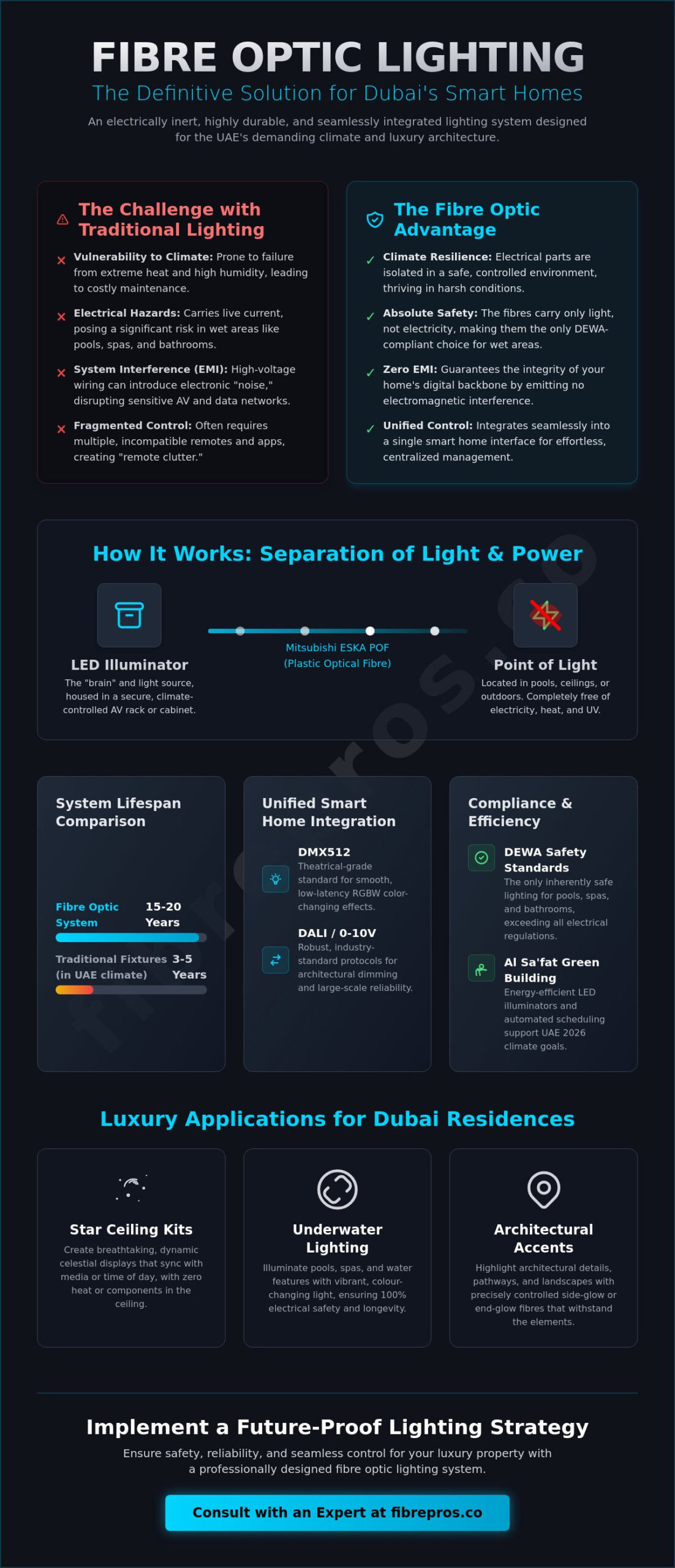
Optical fiber technology provides a distinct advantage in large-scale residences by eliminating electromagnetic interference (EMI). In villas packed with AV cabling, security sensors, and high-speed data lines, traditional high-voltage lighting can occasionally introduce noise into sensitive electronics. Fibre optics carry only light, ensuring the integrity of your home’s digital backbone. This makes it a preferred choice for project managers who value system uptime and technical precision above all else.
Safety and Reliability in the UAE Climate
Dubai’s environmental conditions place immense stress on electrical components. Extreme heat and high humidity often cause standard fixtures to fail prematurely due to thermal expansion or moisture ingress. Fibre optic systems mitigate these risks by separating the electrical components from the point of light. The heat-generating LED illuminators are typically housed in climate-controlled AV racks or ventilated cabinets, away from the ceiling or pool where the light is emitted.
This arrangement isn’t just about durability; it’s about safety. Because the fibre itself is non-conductive and carries no electricity, it’s the only logical choice for wet areas. It adheres strictly to the Dubai Electricity and Water Authority (DEWA) regulations for electrical installations, which prioritize safety in swimming pools, spas, and bathrooms. A professionally installed system can last between 15 and 20 years, far outperforming traditional lighting in harsh Middle Eastern climates.
The Aesthetic Advantage of Centralized Control
Luxury is defined by simplicity. A unified smart home interface replaces the “remote clutter” often found in less integrated properties. By connecting fibre optic illuminators to a central processor, homeowners can trigger complex “scenes” with a single command. This centralized approach offers several operational benefits:
- Synchronized transitions between indoor star ceilings and outdoor landscape accents.
- Automated dimming schedules that comply with the Al Sa’fat – Dubai Green Building System to reduce greenhouse gas emissions.
- Elimination of multiple controllers, bringing all decorative lighting under one authoritative interface.
- Energy efficiency gains through precise scheduling and sensor-based activation.
This level of control ensures that decorative lighting isn’t an afterthought. It becomes a dynamic component of the home’s atmosphere, responding to the time of day, room occupancy, or even the specific mood of a social gathering. It’s a results-oriented approach to design that prioritizes both the homeowner’s experience and the building’s operational efficiency.
Technical Integration: Protocols and Control Interfaces
Successful implementation of fibre optic lighting for home automation systems Dubai depends entirely on the LED illuminator. This device acts as the “brain” of the installation. While the fibre strands are passive, the illuminator receives commands from the central processor to manage intensity, colour, and timing. Choosing an illuminator with the correct communication protocol is the most critical decision in the design phase. It ensures that your decorative lighting behaves as a native part of the home rather than a disconnected add-on.
DMX512 remains the industry standard for high-performance colour-changing effects. Originally developed for theatrical use, it provides the low-latency response required for smooth RGBW transitions in star ceilings or side-glow accents. For projects focused on architectural dimming or commercial-grade reliability, DALI (Digital Addressable Lighting Interface) and 0-10V protocols offer robust alternatives. These systems align with home automation industry standards, providing a stable framework for large-scale Dubai villas where hundreds of lighting points must sync perfectly.
Connecting to Leading Automation Brands
Integration with premium platforms like Control4, Crestron, and Lutron is straightforward when using the right interface. For European-standard builds in the UAE, KNX integration allows the lighting to communicate directly with HVAC and security systems. Advanced illuminators often support RS232 or IP control. This bidirectional communication allows the automation system to receive real-time feedback on the illuminator’s status, such as internal temperature or lamp life. It’s a level of technical precision that ensures the system remains operational without constant manual oversight.
Addressing the Objection: Is Integration Complex?
A common misconception is that sophisticated lighting equals complicated wiring. In reality, fibre optic systems simplify the infrastructure. Instead of running high-voltage cables to every individual light point, technicians only need to provide power and a single data cable to the central illuminator location. This reduces the number of failure points and simplifies the cable management within your AV rack.
Professional commissioning is the final step that eliminates long-term maintenance headaches. By coordinating with your AV integrator early, the lighting supplier ensures that every “scene” is programmed correctly from day one. If you’re planning a new build or a major renovation, consulting with a specialist at Fibrepros can help align your lighting hardware with your chosen automation protocol. This collaborative approach guarantees that your luxury aesthetics are backed by dependable, industrial-grade technology.
Mitsubishi ESKA POF: The Hardware Foundation
The reliability of any automated lighting system is defined by its physical infrastructure. For fibre optic lighting for home automation systems Dubai, the choice of transmission medium determines whether a star ceiling or pool accent remains functional for decades or fails within years. Mitsubishi ESKA Plastic Optical Fibre (POF) has established itself as the industrial benchmark for residential automation due to its unique material properties and optical clarity.
Dubai villa construction presents specific challenges, including tight conduit runs and high ambient temperatures. POF is engineered to withstand these conditions. Its superior bend radius allows installers to navigate the complex pathways found in modern smart home designs without the risk of fibre breakage. Unlike glass alternatives, POF maintains its structural integrity even when routed through the narrow gaps required for integrated architectural lighting. This flexibility ensures that the light signal remains consistent from the illuminator to the furthest fixture in the zone.
POF vs. Glass Fibre for Home Systems
Plastic Optical Fibre is preferred for residential automation because its inherent flexibility allows for rapid, precise termination without the specialized polishing equipment required for glass variants.
From a maintenance perspective, POF offers a significant advantage over a 10-year operational cycle. Glass fibres are prone to micro-fractures caused by building settling or thermal expansion, which leads to “hot spots” or dimmed sections over time. Mitsubishi ESKA grade cables are chemically stabilized to prevent yellowing and degradation, ensuring the light output remains crisp and neutral. For large-scale architectural projects, the cost-to-performance ratio of POF is vastly superior. It provides the high-end aesthetic of glass with the ruggedness of industrial-grade plastic, reducing the need for expensive post-installation repairs.
The Role of Specialized End Fittings
The hardware foundation is completed by the components that deliver the light to the environment. High-quality crystal end fittings are essential for enhancing automated star effects. These fittings refract the light emitted from the fibre, creating a more realistic, multi-dimensional sparkle that can be precisely dimmed or pulsed via the home automation interface.
In outdoor and wet areas, the quality of the fitting is a matter of system longevity. Using stainless steel fixtures with IP68 protection is mandatory for automated water features and swimming pools. These fittings prevent moisture from entering the fibre strands while ensuring uniform light dispersion. When fitting quality is prioritized, the resulting scenes achieve a level of realism that standard LED alternatives cannot replicate. This synergy between genuine Mitsubishi ESKA fibre and precision-engineered fittings creates a lighting system that is both technically sound and visually stunning.
Automated Lighting Applications for Dubai Residences
The true value of fibre optic lighting for home automation systems Dubai is realized through specific, high-impact applications that enhance daily living. While the technical backbone ensures reliability, the programming defines the atmosphere. From private screening rooms to expansive outdoor water features, automation allows these systems to respond dynamically to environmental triggers and user preferences. This results-oriented approach transforms static lighting into a functional asset that adapts to the homeowner’s schedule.
Architectural accents also benefit from this centralized logic. Side-glow fibre, when integrated into automated path and cove lighting, provides a subtle, continuous line of light without the visible “dots” associated with standard LED strips. These accents can be programmed to follow the sun’s position, shifting from a warm morning glow to a crisp, cool white during the midday heat. For families, sensory rooms utilize automated fibre optic kits to create therapeutic environments. These systems use rhythmic colour shifts and tactile fibre strands to assist with child development and relaxation, all controlled via a secure tablet interface.
The Automated Home Cinema Experience
In luxury home cinemas, the integration of star ceiling kits with motorized screens and projectors creates a professional-grade atmosphere. When the “Play Movie” command is issued, the automation system doesn’t just lower the screen; it initiates a lighting sequence. The starfield’s “twinkle” effect can be programmed to fade out over a 10-second period, mimicking the transition in a commercial theatre. End-glow fibre installed in step nosings and aisles provides essential safety lighting that remains at a 1% dim level during playback, ensuring navigation is possible without disrupting the on-screen contrast.
Smart Pool and Spa Integration
Managing underwater lighting fixtures through a centralized controller is the only way to ensure total synchronization with the rest of the property. Because fibre optic cables carry no electricity into the water, they are the safest choice for automated pools and spas. Smart home apps can trigger colour changes based on the water temperature or the time of day, transitioning from a refreshing blue during a summer afternoon to a deep amber for evening entertaining. Side-glow fibre used for landscape borders can be synced with patio music, allowing the perimeter of the property to pulse in time with the audio system during social gatherings.
Achieving this level of technical synergy requires a partner who understands both the hardware and the software involved. If you are ready to upgrade your property with a professionally integrated system, contact Fibrepros to discuss your specific project requirements. Our team ensures that your luxury lighting applications are backed by industrial-grade reliability and precision engineering.
Implementing Your Fibre Optic Strategy with Fibrepros
Executing a flawless installation of fibre optic lighting for home automation systems Dubai requires a specialist who understands the intersection of architectural design and electrical engineering. Since 1994, our team has delivered integrated solutions for some of the most complex residences in the Middle East. We don’t just supply components; we provide a comprehensive framework that ensures your lighting investment performs reliably under the specific environmental stresses of the UAE. This results-oriented approach minimizes project delays and guarantees that the final output aligns with the initial vision.
The selection of hardware is a technical exercise. Matching LED illuminators to your chosen control protocol is essential for achieving the low-latency response times required for luxury automation. Whether your project utilizes DMX512 for dynamic effects or KNX for building-wide management, we ensure that every driver and light source is fully compatible. Our 30 years of regional experience allow us to anticipate common integration hurdles, providing a level of quiet confidence that generalist contractors cannot match.
The Fibrepros Design Process
Our process begins with detailed technical documentation. We work alongside MEP and AV consultants to provide submittals that meet DEWA regulations and Al Sa’fat green building standards. Every villa layout in Dubai is unique, so we offer customized kit assembly. This includes pre-cut Mitsubishi ESKA fibre lengths and factory-tested illuminators. This precision-engineered approach simplifies the physical installation, allowing your on-site team to focus on the final aesthetic details without worrying about hardware failure.
Next Steps for Your Smart Home Project
Moving from a conceptual design to a functional automated system is a structured process. When planning fibre optic lighting for home automation systems Dubai, the consultation phase is where the technical foundation is laid. You can request a technical submittal that outlines the specific hardware and wiring requirements for your project. This ensures your AV integrator has the necessary data to program your lighting scenes correctly from day one.
We also encourage scheduling a visit to our showroom. This allows you to see integrated control interfaces and various fibre optic effects in a live environment. Seeing the hardware in action helps decision-makers grasp the scope of expertise required for a successful build. If you’re ready to secure a reliable infrastructure for your property, contact the Fibrepros team for a custom automation lighting quote. We provide the specialized mastery needed to turn technical complexity into a seamless luxury experience.
Securing a Reliable Lighting Infrastructure
Integrating high-performance lighting into a smart ecosystem requires more than just high-end fixtures; it demands a technically sound foundation. By utilizing fibre optic lighting for home automation systems Dubai, property owners ensure their decorative elements remain safe, electrically inert, and fully responsive to central commands. We’ve explored how the durability of Mitsubishi ESKA POF and the precision of DMX-controlled illuminators create a system that thrives in the UAE’s unique environmental conditions.
Since 1994, Fibrepros has served as a pioneer in UAE fibre optics, acting as an official distributor of Mitsubishi ESKA Plastic Optical Fibre. Our expertise extends to specialized high-IP rated underwater fittings and complex villa integrations that meet the highest industrial standards. This commitment to technical excellence ensures your automated star ceilings and pool features operate with total reliability for years to come. It’s a results-oriented approach that turns technical complexity into a seamless luxury experience.
Request a Technical Consultation for Your Smart Home Project to align your lighting strategy with the latest 2026 integration standards. Your vision for a sophisticated, unified home is achievable through specialized engineering and professional coordination.
Frequently Asked Questions
Can I control my fibre optic star ceiling with a mobile app?
Yes, mobile app control is achieved by connecting the LED illuminator to your home’s central processor. Whether you use a dedicated smart home platform or a standalone wireless bridge, the interface allows for real-time adjustments of brightness and colour. This is a standard feature for fibre optic lighting for home automation systems Dubai, providing homeowners with intuitive control from any smartphone or tablet.
Does fibre optic lighting require a special type of smart home hub?
It doesn’t require a proprietary hub, but the illuminator must support the communication protocol used by your existing system. Most high-end residences in the UAE utilize DMX512, DALI, or 0-10V standards. By selecting an illuminator with the correct interface, you ensure the lighting integrates seamlessly into your established automation network without needing redundant hardware.
How do I integrate RGBW colour changes with my Control4 system?
Integration is managed through a DMX gateway and a specific software driver within the Control4 ecosystem. This setup allows the automation system to treat the illuminator as a native RGBW fixture. You can then program complex scenes, such as a “Cinema Mode” where the star ceiling fades to a deep indigo as the movie begins, all through the standard Control4 interface.
What happens if the light source (illuminator) fails in an automated system?
If an illuminator fails, only the light source needs attention; the Mitsubishi ESKA fibre strands remain untouched in the ceiling or pool. Because the illuminator is typically located in an accessible AV rack or cabinet, technicians can perform repairs or replacements without disrupting the building’s structure. This separation of components is a primary reliability advantage of fibre optic systems.
Is fibre optic lighting compatible with KNX automation standards used in Dubai?
Yes, fibre optic systems are fully compatible with KNX, which is widely used in European-standard developments across Dubai. By using a KNX-to-DMX gateway, the lighting becomes a functional part of the building’s logic. This allows for advanced automation, such as triggering specific lighting moods based on occupancy sensors or time-of-day schedules programmed into the KNX backbone.
Can I automate my pool lights to change colour with my outdoor music?
You can synchronize your underwater lighting fixtures with outdoor audio by using a central controller that supports sound-to-light mapping. The automation system receives the audio signal and translates it into DMX commands for the illuminator. This creates a rhythmic, multi-sensory experience where the pool’s side-glow fibre and underwater accents pulse in time with your patio music.
Are there energy-saving benefits to automating fibre optic lights?
Automating your system provides measurable energy-saving benefits by ensuring lights only operate when needed. Precise dimming and automated scheduling help villas comply with the Al Sa’fat – Dubai Green Building System. By reducing the operational hours and intensity of the LED illuminators, you decrease energy consumption while extending the lifespan of the hardware.
How long does the integration process take for a typical Dubai villa?
The physical installation of fibre optic lighting for home automation systems Dubai usually occurs during the MEP phase of construction or renovation. While the fibre routing takes several days depending on the villa’s size, the technical integration and programming are typically completed in a few hours during the final AV commissioning. Early coordination with your architect ensures a streamlined delivery.