
You might assume those fading points of light in your theater room mean the individual fibers have reached the end of their life, but the reality is often found in the hardware behind the scenes. It’s frustrating to watch a high-end interior lose its impact as the brilliant glow of a star ceiling fades into a dull, inconsistent glimmer. You’ve invested in a luxury aesthetic, and seeing it dim can lead to the stressful fear that expensive ceiling demolition is the only way to fix the issue.
This guide provides a professional framework for troubleshooting dim star ceiling lights Riyadh property owners face, ensuring you can restore that original luster through technical precision. We’ll identify why cheap LED illuminators often fail in the intense Riyadh heat and how specific components like Mitsubishi ESKA plastic optical fibre maintain performance over time. You’ll learn a clear diagnostic path to restore brightness and ensure your installation remains compliant with SBC 401 standards for long-term reliability. We will cover everything from light source coupling to the impact of thermal cycling on your system’s output, giving you the expertise needed to protect your architectural investment.
Key Takeaways
- Identify whether light loss is uniform or localized to determine if the failure originates in the LED illuminator or the fibre optics.
- Master a systematic framework for troubleshooting dim star ceiling lights Riyadh property owners use to avoid costly demolition and restore peak brightness.
- Learn how to mitigate the impact of Riyadh’s dust and extreme thermal cycles on the common end of your fibre optic bundle.
- Understand the technical advantages of upgrading to professional grade LED illuminators and Mitsubishi ESKA plastic optical fibre for lasting performance.
- Establish a maintenance and airflow strategy that aligns with Saudi Building Code standards to ensure long-term system reliability.
Understanding Why Star Ceiling Lights Dim in Riyadh
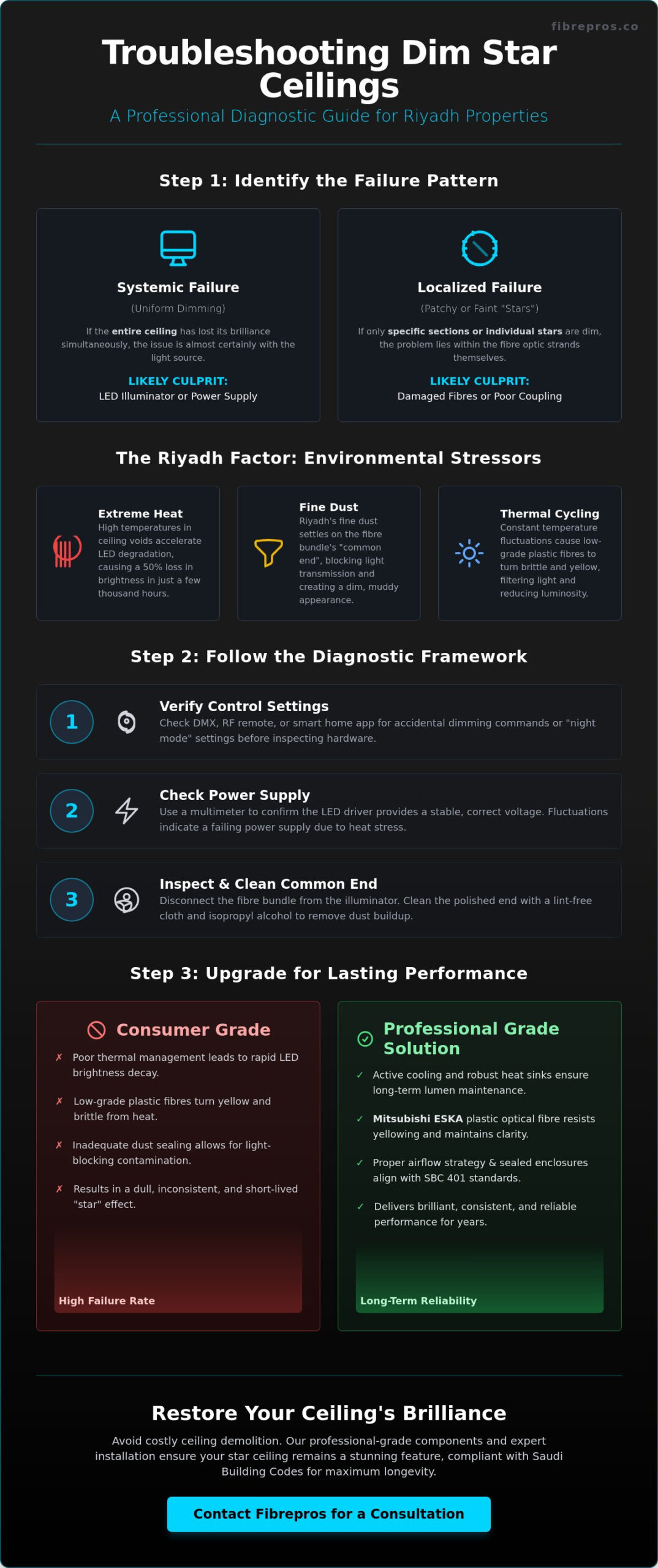
A functional star ceiling is a complex assembly consisting of two primary components: the LED illuminator and the optical fibre bundle. When you begin troubleshooting dim star ceiling lights Riyadh installations often present, you must first determine if the issue is systemic or localized. A systemic failure occurs when the entire ceiling loses its brilliance simultaneously, which almost always points to a fault in the LED illuminator or its power supply. Localized dimming, where only certain sections or individual “stars” appear faint, typically indicates physical damage to the fibre strands or poor light coupling at the source.
The science behind these systems involves Optical fiber technology, which relies on total internal reflection to transport light from a central engine to the ceiling surface. In a perfect environment, these fibres lose very little light over long distances. However, the high ambient temperatures found in Riyadh ceiling voids can reach levels that exceed the operating parameters of standard consumer-grade components. This thermal stress doesn’t just affect the electronics; it can physically degrade the connection point where the light enters the fibre bundle.
The Role of the LED Illuminator
Think of the LED illuminator as the engine of your lighting system. It houses the LED chip, the cooling fan, and the control circuitry. In the harsh climate of Saudi Arabia, poor ventilation in a ceiling plenum causes heat to build up rapidly around the illuminator. When an LED chip operates above its rated temperature, it suffers from accelerated degradation. Lumen maintenance is the ability of an LED to retain its brightness over time. Without proper thermal management, an illuminator that was once vibrant can lose 50% of its output in just a few thousand hours, leaving your star ceiling looking dull and lifeless.
Fibre Optic Integrity and Light Loss
The quality of the material used in your ceiling determines its long-term clarity. Low-grade plastic fibres often turn brittle or yellow when exposed to the heat cycles common in Riyadh villas. This discoloration acts as a filter, blocking specific light wavelengths and reducing overall luminosity. Utilizing high-fidelity Mitsubishi ESKA Plastic Optical Fibre provides a significant advantage because it’s engineered to resist this environmental yellowing. Additionally, dust is a major factor in the region. Fine Riyadh dust can penetrate the illuminator housing and settle on the common end of the fibre bundle. This microscopic layer of debris creates a barrier that prevents light from entering the fibres, resulting in a dim, muddy appearance across the entire display.
A Step-by-Step Diagnostic Framework for Dim Star Lights
Restoring a failing star ceiling requires a methodical approach to isolate hardware failure from environmental interference. When troubleshooting dim star ceiling lights Riyadh homeowners often face, the process begins with the most accessible components before moving to the ceiling void. Start by verifying the DMX or RF control settings. It is common for accidental dimming commands or “night mode” settings to be triggered via remote or smart home interfaces, which mimics a hardware failure. If controls are set to 100% and the ceiling remains faint, proceed to the physical hardware.
The second priority is the power supply. Use a multimeter to check the voltage output from the LED driver to the illuminator. A fluctuating or low voltage reading suggests the driver is failing, often due to the thermal stress of Riyadh’s climate. If power is stable, disconnect the fibre bundle from the illuminator port to inspect the “common end.” This is the point where all fibres meet the light source. You will often find a thick layer of fine Riyadh dust here. This accumulation is significant; research into the effect of dust on light output confirms that even microscopic debris can drastically reduce lumen transmission. Clean this surface with a lint-free cloth and isopropyl alcohol to immediately improve light entry.
Isolating the Light Source
To determine if the LED engine is the culprit, test the illuminator port without the fibre bundle attached. You can use a smartphone lux meter app for a basic comparison against the manufacturer’s original specifications. If the light appearing at the port is visibly yellow or dim, the LED chip has likely reached its end-of-life or suffered phosphor degradation. Don’t ignore the cooling fan. A seized fan leads to rapid thermal accumulation, which permanently damages the internal electronics. If your diagnostic reveals a terminal hardware failure, replacing the light engine with high-performance LED Illuminators is the most efficient path to restoration.
Evaluating the Fibre Bundle Condition
Physical damage within the ceiling void can also cause significant light loss. Inspect the fibre ends for “melt-back,” a condition where the plastic tips have charred or deformed due to excessive heat at the port. This is a hallmark of low-quality kits that lack proper IR filtering. Additionally, check for sharp bends in the bundle. Plastic optical fibre has a minimum bend radius; exceeding this causes light to leak out of the cladding rather than reaching the ceiling surface. High-quality materials like Mitsubishi ESKA are more resilient, but even the best fibre will fail if the installation violates basic physics or SBC 401 electrical standards.
The Riyadh Factor: Heat, Dust, and Thermal Management
Many marketing brochures label star ceilings as “maintenance-free” installations. While the fibres themselves don’t have filaments to burn out, the system’s longevity in Saudi Arabia depends entirely on environmental control. When troubleshooting dim star ceiling lights Riyadh specialists often find that the local climate has bypassed the system’s thermal thresholds. High-end property owners frequently encounter dimming because the hardware wasn’t specified for the unique atmospheric demands of the Nejd region. A system that works perfectly in a temperate climate will often fail when subjected to the stagnant heat of a Saudi villa ceiling void.
Riyadh’s summer temperatures present a significant engineering challenge. Standard consumer kits often claim operational stability up to 45°C. However, stagnant air in a Riyadh villa’s ceiling plenum frequently exceeds 60°C during peak summer months. This excessive heat causes thermal runaway in the LED chip, leading to permanent lumen loss. Choosing high-performance LED illuminators designed for high-ambient environments is essential for maintaining brightness. Without proper thermal management, even the most expensive installation will lose its luster within two to three years.
Dust ingress is the second environmental hurdle that compromises illumination. Riyadh’s fine, silty sand can bypass the seals of standard illuminator housings. Once inside, this dust settles on the internal lenses and the common end of the fibre bundle, creating an opaque film that absorbs light. For properties in particularly dusty areas, selecting IP-rated components ensures the optical path remains sealed against external contaminants. This proactive hardware selection prevents the gradual “muddying” of the star effect that occurs when light must fight through layers of silt.
Ventilation Strategies for KSA Interiors
Placing an illuminator in a sealed gypsum box is a frequent cause of premature failure. Professional light engines require at least 15 to 20 centimeters of clearance on all sides to allow the internal fans to move air effectively. If your ceiling design is tight, the most reliable solution is remote-locating the illuminator. Placing the engine in an AC-controlled closet or an accessible service corridor ensures it operates within its ideal temperature range. This setup also makes future maintenance or troubleshooting dim star ceiling lights Riyadh properties require far simpler, as it eliminates the need to open the ceiling.
Dust Mitigation for Fibre Ports
Cleaning the fibre optic ferrule is a delicate but necessary task. When sand penetrates the housing, it acts as an abrasive that can scratch the polished ends of the fibres. Use only optical-grade isopropyl alcohol and lint-free swabs for cleaning. Avoid household chemicals or window cleaners; these often leave a residue that bakes onto the fibre ends under the heat of the LED. Establishing a semi-annual cleaning protocol for the common end of the bundle can restore up to 30% of lost brightness in systems that haven’t been serviced in years.
Professional Solutions: Upgrading Your Star Ceiling
When troubleshooting dim star ceiling lights Riyadh projects often reveal that the original installation relied on 5W or 6W hobbyist kits. These low-wattage engines are designed for compact spaces like vehicle interiors, not the expansive, high-ceiling rooms found in Riyadh villas. Upgrading to 45W or 75W professional LED illuminators provides the necessary punch to push light through hundreds of fibre strands without losing intensity. Professional engines also utilize mechanical twinkle wheels. Unlike software-pulsed LEDs that can appear jittery or artificial, a mechanical wheel creates a fluid, organic shimmer that mimics the natural night sky with higher reliability.
A frequent question during the restoration process is whether to replace the entire system or just the light engine. If your existing fibres are still flexible and clear, swapping a failing driver for a high-output engine is the most cost-effective path. However, if the fibres have become brittle or yellowed due to years of heat exposure, a full replacement using professional star ceiling kits is the only way to ensure long-term performance. Investing in superior hardware now prevents the cycle of frequent repairs that plagues lower-tier installations.
The Mitsubishi ESKA Advantage
The core of any high-end lighting system is the medium that carries the light. Low-grade PMMA fibres often suffer from rapid transmission loss as they age in high-ambient temperatures. Mitsubishi ESKA Plastic Optical Fibre stands as the industry benchmark because it maintains 90% light transmission over a 20-year lifespan. This material is engineered to resist the yellowing and micro-cracking that cause generic fibres to dim. Its superior flexibility also allows for tighter routing in complex ceiling voids without the risk of light leakage at the bends.
High-Output Illuminator Features
Modern Riyadh smart homes require lighting that integrates seamlessly with centralized control systems like KNX or Control4. Professional LED engines equipped with DMX512 protocols allow for precise dimming and color synchronization across multiple zones. These units also feature advanced heat sinking and high-static pressure fans to move air even in restricted spaces. For a truly realistic effect, ensure your replacement engine uses RGBW technology. The dedicated white chip provides a crisp, natural star color that standard RGB chips cannot replicate. If you are ready to restore your ceiling’s performance, explore our range of professional LED Illuminators designed for high-performance environments.
Restoring Brilliance: Next Steps with Fibrepros
Troubleshooting dim star ceiling lights Riyadh properties encounter often reveals a need for technical mastery rather than just a quick fix. When a high-end interior loses its brilliance, the aesthetic value of the entire space is compromised. At Fibrepros, we position ourselves as the specialist partner for luxury lighting across the GCC. We understand that restoring these systems requires a balance of high-fidelity materials and precise engineering. A professional audit of your existing installation is the most efficient way to identify whether the failure is environmental or a result of aging hardware.
Beyond the light engine and the fibre itself, the termination point plays a critical role in visual quality. Utilizing crystal end fittings is a professional standard for enhancing star definition. These fittings act as miniature lenses, focusing the light into a crisp point while adding a layer of protection to the fibre ends. This upgrade is particularly effective in large theater rooms where standard fibres might appear too soft or diffused. By concentrating the output, these fittings can make even a slightly aged system feel significantly more vibrant.
Maintenance in the KSA region isn’t a suggestion; it’s a requirement for system longevity. Troubleshooting dim star ceiling lights Riyadh installations requires checking for hidden bottlenecks, such as heat-damaged ports or dust-clogged fans. By establishing a protocol that includes regular cleaning of the common end and airflow verification, you ensure your investment remains a centerpiece of your property for decades. We focus on providing solutions that resist the intense thermal cycles of the region, ensuring that your ceiling’s luster doesn’t fade after just a few seasons.
Our Professional Supply Process
Our supply process is built on technical precision and regional responsiveness. We ship specialized Mitsubishi ESKA components to Riyadh and Dammam, ensuring that local contractors have access to the world’s highest standard in plastic optical fibre. We don’t just supply parts; we offer comprehensive technical support to interior designers and MEP teams, guiding them through the nuances of SBC 401 compliance. Whether you need a small kit or a custom bundle for a 100-square-meter ballroom, our configurations are optimized for maximum lumen delivery and long-term durability.
Contacting a Specialist
Restoring your ceiling’s brilliance starts with a simple conversation. We invite you to provide photos of your current LED engine and any visible symptoms of failure for a remote technical review. Our 30-year history in the Middle East lighting sector provides us with the specialized knowledge to diagnose issues that generalist electricians might overlook. We take pride in building infrastructure that lasts and delivers consistent performance. Contact Fibrepros for a Star Ceiling Upgrade and let our experts return your installation to its original, brilliant state.
Restoring Your Architectural Vision with Technical Precision
A star ceiling should remain a permanent centerpiece of your property’s interior design. Troubleshooting dim star ceiling lights Riyadh properties require involves moving beyond superficial fixes to address the core issues of thermal management and optical integrity. You’ve seen how isolating failures in the LED driver and keeping the fibre bundle free from dust avoids the high costs of structural demolition. Selecting professional-grade components is the only way to ensure your system survives the extreme heat cycles of the Nejd region.
As a Mitsubishi ESKA Gold Standard Dealer, Fibrepros provides specialized, climate-resilient lighting designed for the Middle East’s unique demands. We offer expert technical support for Riyadh luxury villas, ensuring your installation meets the highest performance standards. Whether you need to replace a failing light engine or upgrade your entire system with high-fidelity kits, we provide the specialized mastery required for a successful restoration. Upgrade your Riyadh star ceiling with professional components from Fibrepros and bring lasting brilliance back to your home. Your luxury interior deserves a sky that never fades.
Frequently Asked Questions
Can I replace just the LED illuminator without changing the fibres in my ceiling?
Yes, the LED illuminator is an independent light engine that can be replaced without disturbing the fibre optic strands embedded in your ceiling. If your diagnostic shows the fibres are still clear and flexible, swapping a dim or failed engine for a high-output model is the most efficient way to restore brightness. You must ensure the new illuminator’s port size matches your existing fibre bundle diameter to maintain a secure and efficient light coupling.
How long should a professional star ceiling last in the Riyadh climate?
A professional system using Mitsubishi ESKA fibres and high-grade LED illuminators should maintain peak performance for 15 to 20 years. While the fibres are essentially permanent, the LED engine may require a driver replacement or cleaning every 5 to 7 years depending on dust exposure. Systems specified for the Middle East’s thermal demands significantly outlast generic hobbyist kits that often fail within 24 months due to heat stress.
Why are some of my stars brighter than others in the same room?
Uneven brightness is usually caused by using different fibre diameters or physical damage at the common end of the bundle. Professional designs often mix 0.75mm and 1.5mm strands to create a realistic “near and far” effect. If the dimming is unintentional, it may indicate that some fibres have slipped away from the light source or have been bent too sharply during installation, causing light to leak out before reaching the tip.
Does dust really affect the brightness of my fibre optic lights?
Yes, fine Riyadh dust is a primary cause of systemic dimming because it settles on the coupling point between the light engine and the fibres. This microscopic layer acts as a physical barrier, absorbing lumens before they can enter the optical strands. Cleaning this common end with optical-grade isopropyl alcohol is a critical step when troubleshooting dim star ceiling lights Riyadh property owners perform to restore original clarity and brilliance.
Is it possible to upgrade my star ceiling to be controlled by my phone?
You can easily upgrade your system to smartphone control by replacing your current engine with a Wi-Fi or Bluetooth-enabled LED illuminator. Many modern professional engines also support DMX512 protocols, allowing them to integrate with luxury smart home platforms used throughout Saudi Arabia. This allows you to adjust brightness, color, and twinkle speed directly from a central interface or a dedicated mobile application.
What is the best wattage for a star ceiling in a large villa master bedroom?
A 45W to 75W LED illuminator is the professional standard for large residential spaces to ensure the stars remain visible against ambient light. While 5W or 16W kits are common in retail markets, they lack the intensity required to illuminate hundreds of strands across a wide ceiling area. Higher wattage engines also feature superior heat sinking and more robust cooling fans, which are vital for long-term reliability in the Riyadh climate.
Can heat in the ceiling void cause the fibre optic cables to melt?
Excessive heat can cause “melt-back” at the port if the system uses low-quality PMMA fibre or lacks an infrared filter. Cheap light engines often generate significant heat at the focal point, which can deform the plastic tips of the fibres over time. Professional-grade Mitsubishi ESKA fibre is engineered with higher thermal resistance, but proper ventilation in the ceiling void remains essential to prevent material degradation and maintain light transmission.
How do I know if my fibre is Mitsubishi ESKA or a generic brand?
Mitsubishi ESKA fibre is identifiable by its superior flexibility and high-clarity cladding, though a definitive check often requires looking at the original spool markings or procurement documentation. Generic fibres tend to yellow and become brittle much faster when exposed to the heat cycles of the Middle East. If you’re unsure, a specialist can perform a light transmission test to determine if the material meets professional performance benchmarks for your property.