
What if your retail window display could achieve a brilliant, high-end glow without generating a single degree of heat inside the glass? In Jeddah’s intense climate, traditional lamps often act like heaters, fading expensive fabrics and driving up cooling costs. You’ve likely noticed that maintaining a luxury image is difficult when dust and UV exposure constantly degrade your storefront. Finding the right retail shop window lighting Jeddah retailers can trust means moving beyond generic LED tracks that struggle in high temperatures.
We understand that uptime and merchandise protection are your top priorities. This guide outlines how to transform your storefront with heat-free fibre optic technology that meets the new SASO 2902:2018/AMD2:2023 standards effective June 1, 2026. You’ll learn how to achieve the mandated 120 lumens per watt efficacy while eliminating the “generic” look of standard lighting. We’ll preview the technical advantages of Mitsubishi ESKA plastic optical fibre and show how remote LED illuminators create a zero-heat, high-impact display that stops foot traffic along Jeddah’s expanding luxury precincts. By separating the light source from the display, you can finally achieve a world-class aesthetic with significantly reduced maintenance frequency.
Key Takeaways
- Learn how remote-source lighting eliminates heat damage and UV fading to protect high-value merchandise in Jeddah’s climate.
- Discover the operational benefits of placing LED illuminators in accessible locations to reduce maintenance downtime in busy retail environments.
- Understand how premium retail shop window lighting Jeddah systems achieve SASO 2902 compliance while delivering superior visual fidelity.
- Gain a practical framework for mapping fibre runs and selecting illuminator capacities based on your specific storefront dimensions.
- Identify why technical-grade Mitsubishi ESKA components are the industry standard for reliability in high-ambient light luxury districts.
The Jeddah Retail Landscape: Why Lighting is Your Competitive Edge
Jeddah’s retail sector is undergoing a massive transformation. With the city’s total retail space projected to reach 3.3 million square meters by 2026, competition for foot traffic has never been higher. High-end districts like Tahlia Street and the Mall of Arabia have evolved from simple shopping destinations into experiential hubs where the storefront is the primary brand ambassador. In these environments, retail shop window lighting Jeddah isn’t just a utility. It’s a strategic asset that defines your brand’s prestige before a customer even walks through the door.
Luxury shoppers are naturally drawn to visual depth and contrast. Static, flat lighting fails to capture the eye when it’s surrounded by the intense ambient light of a modern Saudi mall. Instead, premium brands utilize “sparkle” and “shimmer” to create a sense of movement and high-value allure. This localized, high-intensity light creates a theatrical effect that stops shoppers in their tracks. It’s about precision. By highlighting the textures of a luxury handbag or the facets of a timepiece, you communicate quality through visual clarity.
Standing Out in Jeddah’s Premier Malls
Red Sea Mall and other premier locations are saturated with visual noise. To break through this clutter, your storefront needs high-contrast illumination. We’re seeing a decisive shift away from uniform LED panels that wash out a display. While LEDs are energy efficient, they often lack the punch and directional control needed for high-fidelity retail displays. The move toward “theatrical” retail reflects a broader Saudi Vision 2030 goal of creating world-class, immersive shopping experiences. Understanding how optical fibers work allows designers to place light points with surgical accuracy without the bulk of traditional fixtures.
The Cost of Poor Lighting: Fading and Heat Damage
Jeddah’s climate presents unique operational challenges. High humidity and external temperatures already strain building HVAC systems. Adding high-wattage lamps to a sealed window display creates a greenhouse effect that destroys merchandise. Traditional halogen bulbs and even low-grade LED tracks generate significant heat that damages delicate leather, silks, and luxury textiles.
- UV Degradation: Irreversible fading of high-ticket merchandise reduces your inventory’s value.
- Operational Expenses: Increased AC load is required to counter the heat generated within the display case.
- Material Fatigue: Physical degradation of glues and finishes on premium accessories due to constant thermal cycling.
Protecting your inventory is as important as presenting it. Professional lighting solutions must provide total UV protection and zero heat emission at the point of display. This ensures your products look as pristine on the shelf as they do in the window, maintaining your brand’s reputation for excellence.
What is Fibre Optic Lighting for Retail? (And Why It’s Different)
Fibre optic lighting operates on a remote-source principle. Unlike standard fixtures, the light is generated in an LED illuminator placed in a ventilated, accessible location. It’s then transmitted through flexible strands to the display. This physical separation is why it’s the superior choice for retail shop window lighting Jeddah projects. Because the light source isn’t inside the display case, you eliminate the three primary enemies of retail displays: heat, ultraviolet (UV) radiation, and electrical current at the point of light emission.
A single high-output LED illuminator can power hundreds of individual light points. This efficiency is vital when adhering to the SASO 2902:2018/AMD2:2023 standards, which require a minimum efficacy of 120 lumens per watt by June 2026. Beyond compliance, the emotional impact is significant. According to scientific research on store illumination, the way a product is lit directly influences a shopper’s emotional state and purchase intent. Fibre optics allow for precise control over that emotional journey without compromising product integrity.
The Components: Illuminators and Fibres
The system consists of two main parts: the illuminator and the fibre harness. Modern LED illuminators are engineered for maximum brightness and color accuracy, often exceeding the CRI 80 requirement for Saudi retail spaces. For the fibre itself, Mitsubishi ESKA plastic optical fibre (POF) is the global benchmark. Unlike glass fibre, which can be brittle and difficult to install in tight cabinets, PMMA plastic fibre is durable and flexible. It maintains high-fidelity light transmission over long runs, ensuring your “hero” products receive the full 500 lux required for professional showrooms. If you’re looking for specialized components, exploring the range of high-performance LED illuminators is a critical first step in your design process.
End-Glow vs. Side-Glow: Creative Applications
Designers use two primary types of fibre to create depth. End-glow fibre emits light only at the tip. It’s perfect for creating “starry” backgrounds or pinpoint spotlights that highlight the fine details of jewelry or luxury watches. Side-glow fibre emits light along its entire length. It creates a neon-like effect that’s ideal for architectural accents or framing display shelves. You don’t need high-voltage transformers for these effects, making them safer and easier to maintain in dusty environments. By combining both types, you can build a layered, 3D environment that makes small window spaces feel expansive and high-end.
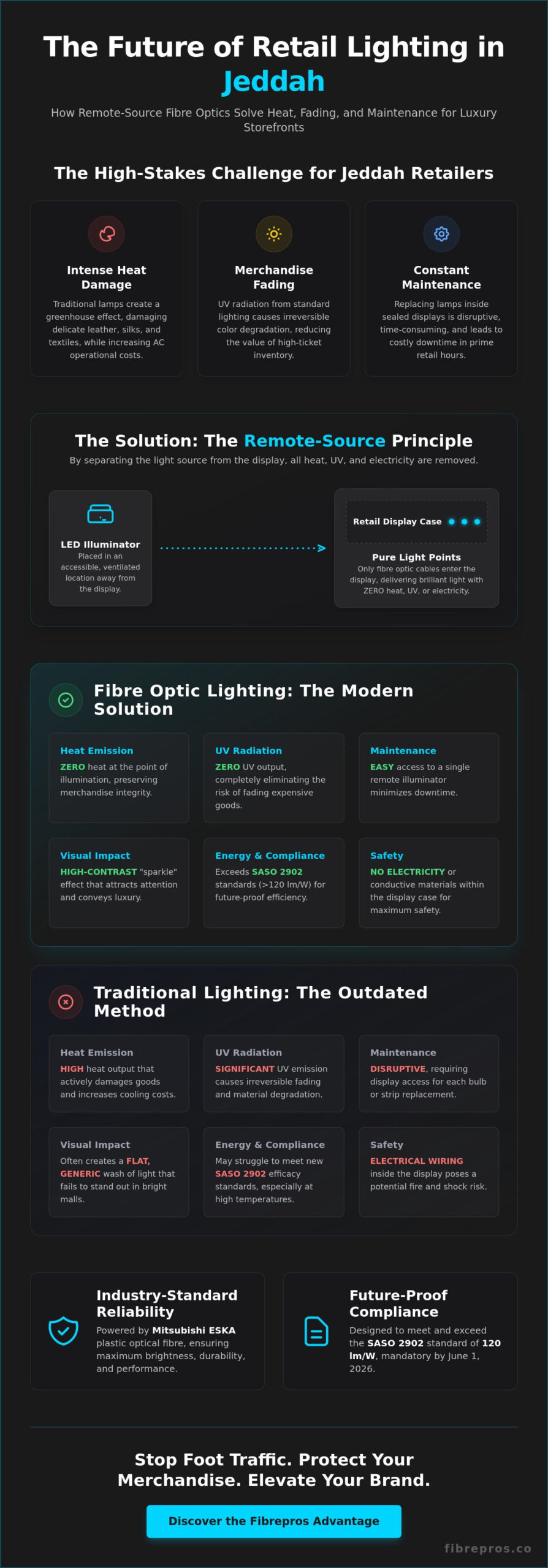
Fibre Optics vs. Traditional LED: The Jeddah Retail Comparison
While many consider LEDs the modern standard, they present distinct limitations in a specialized setting like a high-end Jeddah storefront. The primary differentiator is heat management. Standard LED fixtures generate heat directly at the point of light emission. In a sealed window display, this creates a thermal build-up that stresses delicate materials. Fibre optics, by contrast, keep the heat source in a remote, ventilated location. This technical separation is the most effective way to implement retail shop window lighting Jeddah retailers can rely on for long-term product protection.
Longevity is another critical factor. Traditional LED drivers and chips are sensitive to the high ambient temperatures found in Saudi Arabia. When these components are trapped in a display case, their lifespan drops significantly. Fibre optic strands contain no electronic components. They’re immune to the thermal stress and humidity that cause traditional fixtures to fail. This makes them a more reliable investment for 24/7 retail environments where uptime is non-negotiable.
The Maintenance Advantage in Saudi Arabia
Dust is a persistent challenge for retail operations in Jeddah. Traditional track lighting collects fine particles on lenses, reducing efficacy and requiring frequent cleaning. Because the light source in a fibre optic system is housed in a remote, dust-free cabinet, the window display itself remains “zero-maintenance.” You don’t need ladders or window-stripping during store hours. This operational efficiency keeps your display pristine with minimal staff intervention.
Visual Quality: CRI and Colour Consistency
Maintaining a high Color Rendering Index (CRI) is essential for luxury retail. Current research on lighting and consumer behavior demonstrates that high-contrast, color-accurate illumination is a primary driver of customer engagement. Fibre optic systems ensure perfect color consistency across dozens of points of light. Unlike individual LED fixtures that shift in color temperature as they age, every fibre strand delivers the exact same light quality. Using crystal end fittings can further amplify this effect, creating a brilliant “sparkle” for jewelry and high-end watches.
The versatility of fibre optics also allows for lighting in tight corners where traditional fixtures simply won’t fit. You can illuminate delicate shelving or intricate architectural details with surgical precision. This level of detail is what separates a standard storefront from a luxury destination. By choosing a system designed for the specific rigors of the retail shop window lighting Jeddah market, you ensure your brand remains the focal point, regardless of external environmental factors.
Designing Your Window: A Step-by-Step Implementation Guide
Executing a world-class display requires a structured technical approach. It’s not just about placing lights; it’s about engineering a visual experience that remains consistent over years of operation. For retail shop window lighting Jeddah projects, the process begins with identifying your “hero” products. These are the high-margin items that require the highest lux levels to draw the eye. You must define these focal points early, as they dictate the density of your fibre harness and the placement of your illuminators.
Once your focal points are set, you need to calculate the exact fibre run lengths and illuminator capacity. The illuminator’s port size determines how many individual fibre tails it can power. In a high-impact window, you might require hundreds of points of light. Ensuring the harness is correctly sized prevents light loss and ensures every “star” or spotlight delivers the required 500 lux. You’ll then choose between subtle accents, using end-glow fibres for depth, or bold architectural statements that utilize side-glow fibre to frame the display’s perimeter.
The final technical stages involve integration and aiming. Connecting your system to smart controls like DMX or Bluetooth allows for dynamic effects that can be adjusted via a smartphone. Professional installation concludes with “aiming” the fibres. This is a precision task where each light point is adjusted to hit the product at the perfect angle, eliminating harsh shadows and maximizing the “shimmer” effect on premium surfaces.
Integrating with Smart Retail Systems
Jeddah’s premier malls operate on strict schedules, and your lighting should adapt accordingly. Smart retail systems allow you to program “day-to-night” transitions automatically. During peak evening hours in Mall of Arabia, you can increase intensity or trigger colour-changing sequences for seasonal sales. Syncing these sequences with in-store music or digital signage creates a cohesive brand environment that engages multiple senses simultaneously. This automation ensures your display remains impactful without requiring daily manual adjustments from store staff.
Working with Specialists in the GCC
Navigating mall regulations is a complex part of any Jeddah or Riyadh project. Local expertise is essential for ensuring compliance with electrical safety and fire codes, which vary between developments. Specifying the right Mitsubishi ESKA Plastic Optical Fibre is a key part of this process. It provides the durability and clarity required for long-term ROI in the Kingdom’s luxury sector. If you’re ready to begin your technical design, you can consult with our specialist engineers to ensure your project meets all regional standards and performance benchmarks.
Fibrepros: Elevating Jeddah’s Retail Standards
Fibrepros brings over 30 years of specialized expertise to the Middle Eastern lighting market. Since our founding in 1995, we’ve focused on high-stakes projects where precision and reliability are mandatory. We aren’t generalists. We are technical specialists who understand the unique environmental pressures of the Kingdom. Our role as direct suppliers of Mitsubishi ESKA plastic optical fibre and high-output LED illuminators ensures that every component in your system meets elite craftsmanship standards. We provide the technical backbone for retail shop window lighting Jeddah projects that require both high performance and long-term durability.
Our team provides end-to-end support, moving from initial design to final technical commissioning. This local presence across Saudi Arabia ensures rapid delivery and immediate technical advice when you need it most. As Jeddah’s retail market expands toward a projected 3.3 million square meters by 2026, the demand for sophisticated, energy-efficient solutions has never been higher. Whether you’re managing a boutique on Tahlia Street or a flagship unit in Jawharat Jeddah, we provide the infrastructure necessary for a world-class visual presentation that stands up to the city’s climate.
Our Boutique Portfolio
Our work with high-end brands focuses on achieving a completely ‘fixture-free’ aesthetic. By removing bulky lamps from the display area, we allow the merchandise to remain the sole focus. This is especially critical for diamond and watch boutiques where visual clarity is paramount. We’ve seen significant success using crystal end fittings to amplify the natural brilliance of gemstones. These fittings act as precision lenses, focusing light with a level of clarity that standard LEDs cannot replicate. Our portfolio includes diverse retail projects across Jeddah and Riyadh, each tailored to solve specific thermal and aesthetic challenges while maintaining the highest standards of light transmission.
Ready to Transform Your Storefront?
Architects and visual merchandisers require technical accuracy to realize their creative visions. We offer comprehensive consultation services to help you navigate the complexities of retail shop window lighting Jeddah regulations, including the latest SASO efficacy requirements. Selecting the right LED illuminators is the first step in ensuring your window has sufficient punch to overcome mall ambient light levels. We invite you to request a bespoke quote for your specific retail unit. Our team will analyze your window dimensions, product types, and control requirements to deliver a solution that maximizes both visual impact and operational efficiency. We take pride in building the vital infrastructure that powers Jeddah’s most captivating storefronts.
Securing Your Storefront’s Future in Jeddah’s Luxury Market
Transitioning to fibre optic technology is a strategic investment in both brand image and operational reliability. By moving the heat and maintenance requirements away from the display case, you ensure your merchandise remains pristine while reducing the long-term costs of lamp replacement and cooling. This specialized approach to retail shop window lighting Jeddah allows your storefront to meet the 2026 SASO efficacy standards without sacrificing the high-contrast “sparkle” that luxury shoppers expect.
Since 1995, we’ve served Jeddah, Riyadh, and the wider GCC as an authorized Mitsubishi ESKA distributor. We specialize in providing technical, heat-free lighting for luxury goods, ensuring that your inventory is showcased under the highest professional standards. Our team is focused on delivering accurate, results-oriented infrastructure that stands up to the region’s unique environmental challenges. We take pride in building the vital systems that protect your most valuable retail assets.
Request a Professional Lighting Consultation for Your Jeddah Retail Project
Your storefront is your most powerful invitation to the world. We’re ready to help you make it unforgettable with precision lighting that performs as beautifully as it looks.
Frequently Asked Questions
Why is fibre optic lighting better than LED for retail windows in Jeddah?
Fibre optic lighting is superior because it separates the light source from the display area. Traditional LED fixtures emit heat and UV radiation directly onto your merchandise, which can cause fading and material degradation in Jeddah’s climate. Fibre optics deliver “cold” light, ensuring your high-value items remain protected while keeping the internal display temperature stable and reducing the load on your cooling systems.
Does fibre optic lighting require a lot of electricity?
No, fibre optic systems are highly energy-efficient. A single high-output LED illuminator can power hundreds of individual light points through a single cable harness. This centralized approach often consumes less power than a traditional array of individual LED tracks. It allows retailers to achieve the high lux levels required for luxury showrooms while remaining compliant with local energy efficiency standards and tiered electricity tariffs.
Can fibre optic lighting change colours for different seasonal displays?
Yes, modern LED illuminators provide full color-changing capabilities. By using RGBW LED sources and DMX controllers, you can program specific sequences or static colors for National Day, seasonal sales, or brand launches. You can manage these transitions through a central building management system or a simple smartphone interface, providing a dynamic visual experience that standard static lighting cannot match.
Is it possible to retrofit fibre optics into an existing shop window?
Retrofitting is a common and effective way to upgrade retail shop window lighting Jeddah without a complete storefront renovation. The flexible nature of Mitsubishi ESKA plastic optical fibre allows it to be routed through small apertures or hidden within existing joinery. Because the fibres are thin and require no electrical conduit at the point of light, they can be integrated into tight spaces where traditional fixtures won’t fit.
How do I maintain a fibre optic system in a dusty environment like Jeddah?
Maintenance is centralized and simplified. You only need to service the LED illuminator, which is typically housed in an accessible, dust-free cabinet away from the window. This eliminates the need for ladders or window-stripping to clean individual bulbs or fixtures. Occasionally cleaning the illuminator’s air filter ensures the system runs at peak efficiency, keeping your display pristine with minimal operational downtime.
What is the lifespan of a Mitsubishi ESKA fibre optic system?
The Mitsubishi ESKA fibre itself is incredibly durable and can last for decades because it contains no electronic components. The LED illuminators powering the system typically have a rated lifespan of 50,000 hours or more. This longevity makes it a superior long-term investment compared to traditional fixtures that suffer from thermal stress and component failure in high-ambient temperature environments.
Do I need a special electrician to install fibre optic lighting?
A standard electrician can handle the power supply for the illuminator, but the fibre harness installation requires a specialist technician. Professional installers ensure that each fibre is correctly cut, polished, and terminated to prevent light loss. They also handle the precision “aiming” of the light points to ensure your hero products are illuminated with the correct contrast and intensity for maximum visual impact.
Can fibre optic lighting be used for outdoor storefront signage?
Yes, fibre optics are excellent for outdoor applications. Side-glow fibre can create neon-like outlines around signage, while end-glow fibre can be used for “sparkle” effects in external facades. Since the fibre strands carry only light and no electricity, they’re immune to moisture and humidity. This makes them a safe, low-maintenance alternative to traditional gas-filled neon or high-voltage exterior LED strips.