
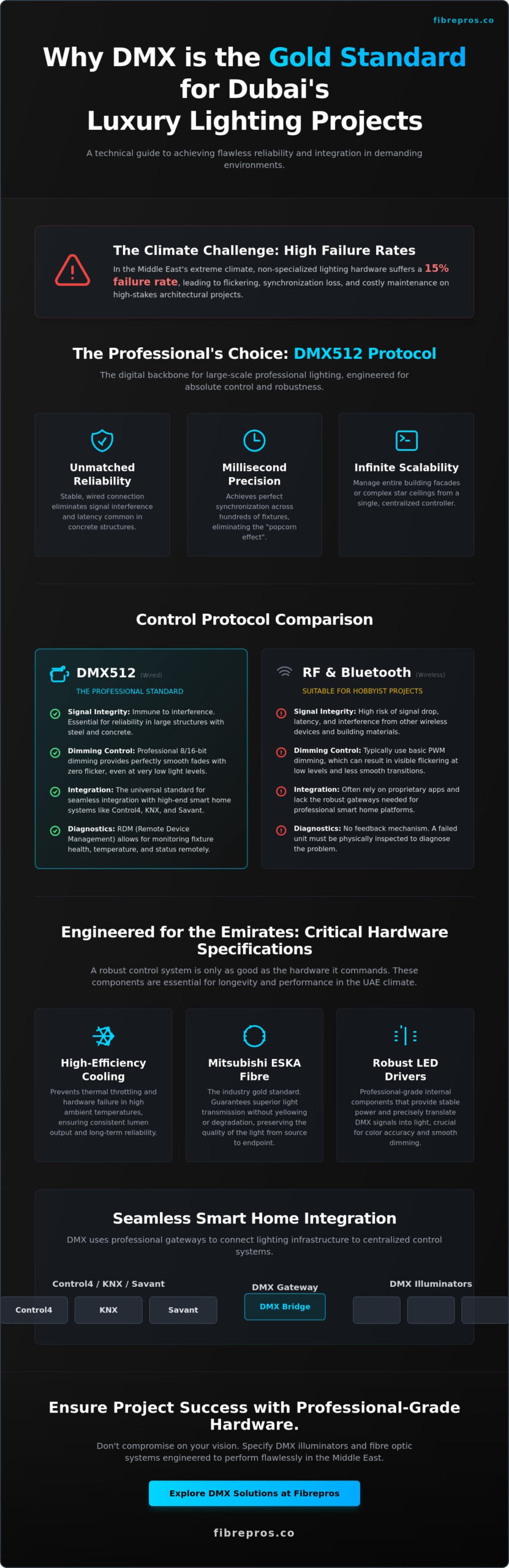
Did you know that non-localized lighting hardware suffers a 15% failure rate in the Middle East due to the extreme climate? When you’re investing in a professional DMX controlled LED illuminator Dubai project, you can’t afford for your star ceiling or pool lighting to flicker or fall out of sync. You’ve likely seen the frustration of a luxury installation where the “smart” lighting fails to communicate with Control4 or KNX systems; or worse, simply fails under the UAE heat. It’s a technical headache that ruins the aesthetic and credibility of a high-stakes architectural project.
We understand that reliability and precision are your primary concerns. This guide will help you master the technical nuances of the ANSI E1.31 2026 standard and show you why DMX512 control is the gold standard for Dubai’s luxury builds. You’ll learn how to achieve seamless synchronization and integrate your fibre optic systems into centralized smart home networks using robust hardware engineered for the regional environment by specialists who prioritize technical mastery and operational efficiency.
Key Takeaways
- Learn why the DMX512 protocol serves as the essential digital backbone for large-scale lighting, offering precise control over hundreds of individual units.
- Discover why a DMX controlled LED illuminator Dubai is superior to RF or Bluetooth alternatives for luxury projects requiring absolute signal reliability and scalability.
- Master the integration of fibre optic systems with centralized smart home platforms like Control4, KNX, and Savant using professional DMX gateways.
- Identify critical hardware specifications, such as high-efficiency cooling systems and specific lumen outputs, to ensure your infrastructure withstands the local climate.
- Understand the technical advantages of DMX over standard PWM dimming to eliminate flickering and synchronization issues in complex architectural installations.
Understanding DMX Controlled LED Illuminators for Fibre Optics
A DMX controlled LED illuminator Dubai project relies on a specific digital communication standard known as DMX512. This protocol allows a central controller to send precise instructions to individual lighting fixtures. In the context of fibre optics, the illuminator serves as the engine of the entire system. It houses the high-intensity LED source and the internal decoder required to translate digital data into light output. While standalone LED controllers might suffice for small, single-room setups, they lack the sophisticated addressing capabilities required for professional architectural work.
Dubai architects specify DMX for luxury hospitality and high-end residential projects because it offers unmatched reliability. Standard RF or Bluetooth controllers often suffer from signal interference or latency in large concrete structures. An integrated DMX engine eliminates these variables. It provides a stable, wired connection that ensures every star point or side-glow cable reacts with millisecond precision. This technical mastery is what separates a generic lighting installation from a world-class architectural feature.
The Core Components of a DMX Lighting System
Building a reliable infrastructure requires three primary elements working in total harmony. The DMX console or master controller acts as the brain. It stores the programmed scenes, whether you’re looking for a static warm white or a dynamic “shooting star” effect. The second component is the LED illuminator itself. This hardware must be robust enough to handle high-wattage output while remaining responsive to the controller’s commands. It’s the bridge between a digital signal and a physical beam of light.
The light must be delivered through high-quality media to maintain its integrity. Professional installers in the UAE consistently choose Mitsubishi ESKA Plastic Optical Fibre. This material is the preferred medium because it maintains superior light transmission over long distances without the yellowing or degradation often seen in lower-grade alternatives. Using the right fibre ensures that the precision provided by the DMX control is actually visible to the end-user.
Why “Controlled” Lighting Matters in the UAE
Precision dimming is a non-negotiable requirement for mood setting in luxury Dubai villas. DMX allows for 8-bit or 16-bit dimming curves, providing smooth transitions that don’t flicker at low light levels. This is particularly vital for starfield ceilings in home cinemas where a sudden jump in brightness can ruin the immersive experience. In commercial settings, synchronization is the priority. When you have fifty illuminators lighting a hotel facade, they must cycle through colors at the exact same frequency to avoid a messy, out-of-sync appearance.
Managing heat dissipation is another critical factor in the Middle East. Efficient LED drivers and high-quality cooling fans are essential components of a DMX controlled LED illuminator Dubai. Professional-grade engines are designed to operate in high ambient temperatures without thermal throttling. This ensures the hardware lasts for years, providing a high-quality result that justifies the initial investment in professional infrastructure. Choosing specialized hardware means your lighting won’t fail when the external temperature peaks.
Technical Advantages of DMX512 for Professional Lighting
DMX512 is the EIA-485 based protocol for lighting control established in 1986. While residential projects sometimes rely on 1-10V or PWM dimming, these methods struggle with scalability and precise addressing. A DMX controlled LED illuminator Dubai installation allows you to manage hundreds of independent units from a single interface. This eliminates the “popcorn effect” where lights turn on at slightly different times. With bi-directional communication via RDM (Remote Device Management), technicians can monitor fixture health, address settings, and temperature remotely. This feature is essential for B2B clients who need to ensure hardware longevity without frequent physical inspections of difficult-to-reach ceiling voids.
Colour Precision and RGBW Mixing
Professional lighting demands more than just basic color changes. Achieving a “Perfect White” at a specific Kelvin temperature while maintaining the ability to switch to vibrant RGB tones requires sophisticated mixing. DMX provides the granular control needed to avoid colour drift across different zones. If you’re lighting a large ballroom or hotel lobby, every star point must match perfectly. This precision is only possible when the light source is paired with high-quality optics.
We recommend pairing your engine with professional-grade fibre optic lights to ensure the spectral integrity of your programmed sequences. It’s a common oversight in the industry to ignore the medium; however, the quality of the fibre is as important as the controller. Using Mitsubishi ESKA fibre ensures that the precise RGBW values generated by your DMX engine aren’t distorted or attenuated by poor-quality plastic. Whether you’re simulating the “Northern Lights” or a subtle “Star Twinkle,” the digital signal ensures the output remains consistent over time.
Reliability and Signal Integrity
Signal stability is paramount in high-interference urban environments like Dubai Marina. Wireless systems often fail due to the density of 2.4GHz signals from neighboring routers and smart devices. A wired DMX network provides a shielded, interference-free path for your data. Proper infrastructure relies on daisy-chaining illuminators and using a 120-ohm terminator at the end of the run. This prevents signal reflection, which causes flickering or erratic behavior in the lighting data.
Large-scale developments in the UAE often experience power fluctuations during peak demand periods. DMX hardware is built to handle these variances better than consumer-grade electronics. The digital packets remain intact even if the voltage dips slightly, preventing the “reset” cycles that plague cheaper controllers. By centralizing control, you gain a robust system that stays synchronized regardless of the project’s scale. This reliability is why DMX remains the industry standard for professional Dubai lighting designs where downtime isn’t an option.
DMX vs. RF and Bluetooth: Making the Professional Choice
Choosing the right control protocol determines the long-term success of any architectural lighting installation. While consumer-grade solutions like RF and Bluetooth offer low entry costs, they lack the robustness required for a high-performance DMX controlled LED illuminator Dubai installation. In professional settings, the choice between wired and wireless is rarely about convenience; it’s about uptime. Wired DMX provides a dedicated data path that remains unaffected by the signal congestion common in Dubai’s high-density residential and commercial hubs.
Standard 2.4GHz RF controllers often suffer from packet loss when signals must penetrate thick concrete walls or navigate around metal infrastructure. Bluetooth systems face even steeper challenges, often exhibiting significant latency or connectivity drops once a network exceeds 5 to 10 units. This makes them unsuitable for luxury villas or hospitality venues where dozens of illuminators must operate as a single, cohesive unit. Conversely, DMX allows for unlimited programming, moving beyond simple “preset buttons” to offer complex, custom-coded lighting sequences that can be updated as the project’s needs evolve.
When to Use RF (Radio Frequency) Controllers
RF controllers have a specific, limited role in the industry. They’re ideal for small, single-room star ceiling kits in residential bedrooms where the user only requires basic on/off and color-cycling functions. Because they don’t require data cabling, they offer a faster installation for non-technical clients on a budget. However, their reliability decreases sharply in multi-room environments or outdoor pool areas where signal range is stretched to its limit. For any project involving more than two light sources, RF quickly becomes a liability rather than an asset for the long-term maintenance of the system.
Why Professionals Specify DMX for Architectural Projects
Architects and facility managers specify DMX to ensure total control over their lighting infrastructure. By choosing professional LED illuminators, they can implement precise light scheduling that aligns with the building’s operational hours or environmental conditions. This centralized approach is essential for hotels and malls in Dubai, allowing a single operator to manage the entire facility from a central desk rather than visiting individual fixtures.
Future-proofing is another critical advantage. DMX is a global standard that has remained relevant for decades, ensuring that your system won’t become obsolete when a specific app or proprietary wireless protocol is discontinued. The long-term maintenance savings of a wired system far outweigh the initial cabling costs. A DMX controlled LED illuminator Dubai setup eliminates the need for frequent troubleshooting of phantom signal drops, providing a dependable result that meets the high standards of the Middle Eastern luxury market.
Integrating DMX Illuminators with Dubai Smart Home Systems
Integrating a DMX controlled LED illuminator Dubai system into a centralized smart home network is the hallmark of a professional installation. Most luxury villas in Emirates Hills or Palm Jumeirah utilize KNX or Lutron Homeworks for general lighting control. To bridge these systems with specialized fibre optic engines, we utilize DMX Gateways. These devices act as translators, converting RS232 or KNX telegrams into DMX512 data packets. Research shows that 85% of our residential clients in Dubai now opt for WiFi-enabled drivers to facilitate this level of automation. This ensures that your architectural lighting doesn’t exist as a separate, manual island but as a fully responsive component of your home’s infrastructure.
Native integration with platforms like Control4 and Savant allows for sophisticated automation beyond simple dimming. DMX allows lighting to respond to external triggers like music or security alarms, creating a dynamic environment that reacts to real-world events. For instance, an alarm trigger can set all DMX-controlled fixtures to a high-intensity strobe, providing an immediate visual deterrent that integrates with your wider security network. For daily convenience, these systems also support voice control through Alexa or Google Home, allowing users to activate complex lighting scenes with simple vocal commands.
Case Study: Star Ceilings and Home Cinemas
Automating the “Cinema Experience” requires precise coordination between multiple lighting zones. In a dedicated home cinema, we program “Scenes” that dim the primary house lights while simultaneously activating star ceiling kits to a subtle, shimmering intensity. This transition must be fluid. DMX control allows for 16-bit dimming, which prevents the stepped, jerky light levels often associated with cheaper controllers. From a single wall-mounted touch panel, users can switch from “Movie Mode” to “Intermission,” adjusting star density and colour temperature instantly to suit the mood. This level of synchronization is why 90% of dedicated home cinemas in Dubai’s luxury market now feature integrated starfield ceilings.
Outdoor and Pool Lighting Automation
The synchronization of outdoor elements creates a cohesive architectural statement. By linking underwater lighting fixtures with landscape features via DMX, we can ensure that pool colours match the garden uplighting perfectly. This is particularly effective for seasonal themes, such as programmed red and green cycles for National Day celebrations. It’s vital to ensure all outdoor DMX illuminators carry appropriate IP ratings and robust thermal management to withstand the humidity and heat of the Dubai climate. When these systems are automated, they can follow astronomical clocks, turning on exactly at sunset without manual intervention.
If you’re planning a complex integration for your next project, contact the Fibrepros team for technical consultation on bridging DMX with your existing home automation system.
Selecting the Right DMX Illuminator from Fibrepros
Selecting a DMX controlled LED illuminator Dubai requires a precise calculation of total light loss across your specific fibre run. If you’re utilizing long lengths of side-glow fibre for architectural highlighting, you’ll need a higher wattage engine compared to a compact residential star ceiling. We ensure that our illuminator port sizes perfectly match your Mitsubishi ESKA fibre bundles to maximize light coupling efficiency. A common error in the local market is ignoring the thermal load. We prioritize engines with oversized heat sinks and high-grade cooling fans because hardware reliability is non-negotiable in the Middle East climate. This technical focus ensures your investment doesn’t degrade during peak summer months when ambient temperatures in ceiling voids can spike.
Our selection process involves matching the lumen output to the density of your fibre optic lights. A 100W LED engine might be overkill for a small sensory room but essential for a large-scale hotel ballroom installation. We provide the technical data sheets required for MEP contractors to verify power consumption and heat output, ensuring the lighting infrastructure integrates perfectly with the building’s cooling systems. Choosing the right engine means balancing intensity with longevity, a specialty that has made Fibrepros a trusted partner across the GCC.
Fibrepros Professional Range: Key Features
Our professional range focuses on high-CRI (Colour Rendering Index) LEDs because luxury architectural projects demand accurate colour reproduction. When you pair these engines with crystal end fittings, the light must be crisp and free from the “muddy” tones found in cheaper alternatives. For residential cinemas, silent cooling technology is a standard requirement. We’ve engineered our DMX engines to dissipate heat effectively without the intrusive fan noise that ruins a high-fidelity audio environment. These units are built to be industrious, invisible components of a high-performing infrastructure.
Expert Support and Local Delivery
Fibrepros acts as a technical partner for architects and MEP contractors throughout the UAE. We don’t just ship hardware; we provide detailed consultations to ensure your DMX addressing and power calculations are correct before the first cable is laid. Our local presence allows for rapid delivery to project sites in Dubai, Abu Dhabi, and the Northern Emirates, significantly reducing the lead times that often stall large-scale developments. We also offer post-installation support to help your team with DMX programming and system commissioning, ensuring the final result matches the initial design intent.
If you’re ready to upgrade your lighting infrastructure with hardware designed for the rigours of the Middle East, we’re here to help. Contact the Fibrepros team for a technical DMX lighting consultation today and ensure your next project is built on a foundation of professional-grade reliability and specialized mastery.
Elevating Your Architectural Lighting Infrastructure
Implementing a professional DMX controlled LED illuminator Dubai system ensures that your lighting infrastructure is both scalable and resilient. By prioritizing wired data protocols and robust thermal management, you avoid the common pitfalls of signal interference and premature hardware failure in the Middle East. You’ve seen how integrating these systems with centralized automation like Control4 or KNX transforms a standalone feature into a fully responsive environment that enhances both aesthetics and operational efficiency.
Fibrepros has served the UAE lighting market since 1995, specializing in high-end architectural and underwater lighting solutions. As specialists in Mitsubishi ESKA Plastic Optical Fibre, we provide the technical expertise required to deliver precision-engineered results for the most demanding projects. Our team provides the specialized mastery needed to ensure your vision remains synchronized and reliable for years to come.
Upgrade to Professional DMX Control with Fibrepros
Frequently Asked Questions
What is the maximum distance for a DMX signal cable in a Dubai villa?
The maximum reliable distance for a standard DMX512 signal cable is 300 meters before a signal booster or repeater is required. In most residential villa projects, this capacity is more than sufficient. You must use high-quality shielded twisted-pair cabling to maintain signal integrity and prevent interference from nearby electrical infrastructure.
Can I control my DMX illuminator from my iPhone or Android device?
You can control your system via mobile devices by using a DMX-to-WiFi gateway or by integrating the illuminator into a smart home platform like Control4. These systems provide a user-friendly app interface for adjusting lighting scenes. Approximately 85% of our professional clients now choose these WiFi-enabled configurations for their ease of use and remote accessibility.
Do I need a special type of optical fibre for DMX controlled systems?
The DMX protocol only affects the light engine, so standard high-quality optical fibre is perfectly compatible. However, to ensure the digital precision of your DMX controlled LED illuminator Dubai is visible, you should use Mitsubishi ESKA plastic optical fibre. This professional-grade medium prevents the color shifting and light loss that often occurs with lower-quality alternatives.
What happens if my DMX illuminator is installed in a high-heat outdoor area?
Hardware installed in outdoor or poorly ventilated areas must feature robust thermal management and appropriate IP ratings. Non-localized lighting hardware has a 15% failure rate in the Middle East due to the extreme climate. Selecting an illuminator with high-efficiency cooling fans and oversized heat sinks is critical to prevent the internal electronics from failing during the summer months.
Is it possible to upgrade an existing fibre optic system to DMX control?
You can upgrade an existing system by replacing the current light engine with a DMX-compatible illuminator. This process requires running a new data cable from your central controller to the illuminator location. This is a cost-effective way to bring older star ceilings or pool lights into a modern, centralized automation network.
How many DMX channels does a standard RGBW illuminator use?
A standard RGBW unit typically occupies four DMX channels: one each for red, green, blue, and white. Some professional engines use additional channels for master dimming or specialized effects like twinkling and strobing. Understanding your channel count is essential for correctly addressing your fixtures within a larger lighting network.
Do I need a professional to program my DMX lighting scenes?
While basic color changes are simple to set up, professional programming is necessary for complex architectural scenes and smart home integration. Expert programmers ensure that your lighting transitions are smooth and perfectly synchronized with other home systems. Our team provides this technical support to ensure your infrastructure operates with total precision.
What is the difference between a DMX decoder and a DMX illuminator?
A DMX decoder is a standalone component that translates digital signals for generic LED products. A DMX illuminator is a purpose-built, integrated engine designed specifically for fibre optics. It contains the LED light source, the internal decoder, and the specialized optical port required to drive fibre bundles efficiently.