
What if you could illuminate a 50-meter luxury pool or a high-rise facade without ever running an electrical current through the structure itself? Understanding how do fiber optic lights work is the first step in mastering a lighting system that thrives where others fail. In Dubai, where external temperatures frequently hit 48 degrees Celsius, the thermal management of traditional LEDs becomes a liability. Fiber optics solve this by moving the heat and electricity away from the point of light.
You’ve likely seen the difference between a flickering, low-quality installation and the crisp, steady glow of a professional-grade system. This guide clarifies the science of Total Internal Reflection and explains how professional POF infrastructure delivers durability in the harshest Middle Eastern climates. We’ll examine the technical specifications of light engines, the critical grading of optical fibers, and the installation standards required to ensure your architectural project remains maintenance-free for years.
Key Takeaways
- Master the physics of Total Internal Reflection to understand how light is efficiently channeled through flexible architectural conduits.
- Learn exactly how do fiber optic lights work by examining the technical synergy between the high-output illuminator engine and the delivery cable.
- Distinguish between data-grade glass and Plastic Optical Fiber (POF) to select the correct materials for high-end decorative finishes.
- Explore why fiber optics are the preferred solution for Dubai’s demanding environments, providing safe and durable illumination for luxury pools and star ceilings.
- Ensure long-term project reliability by utilizing professional-grade Mitsubishi ESKA fibers for superior light transmission and consistent performance.
The Physics of Light: Understanding Total Internal Reflection (TIR)
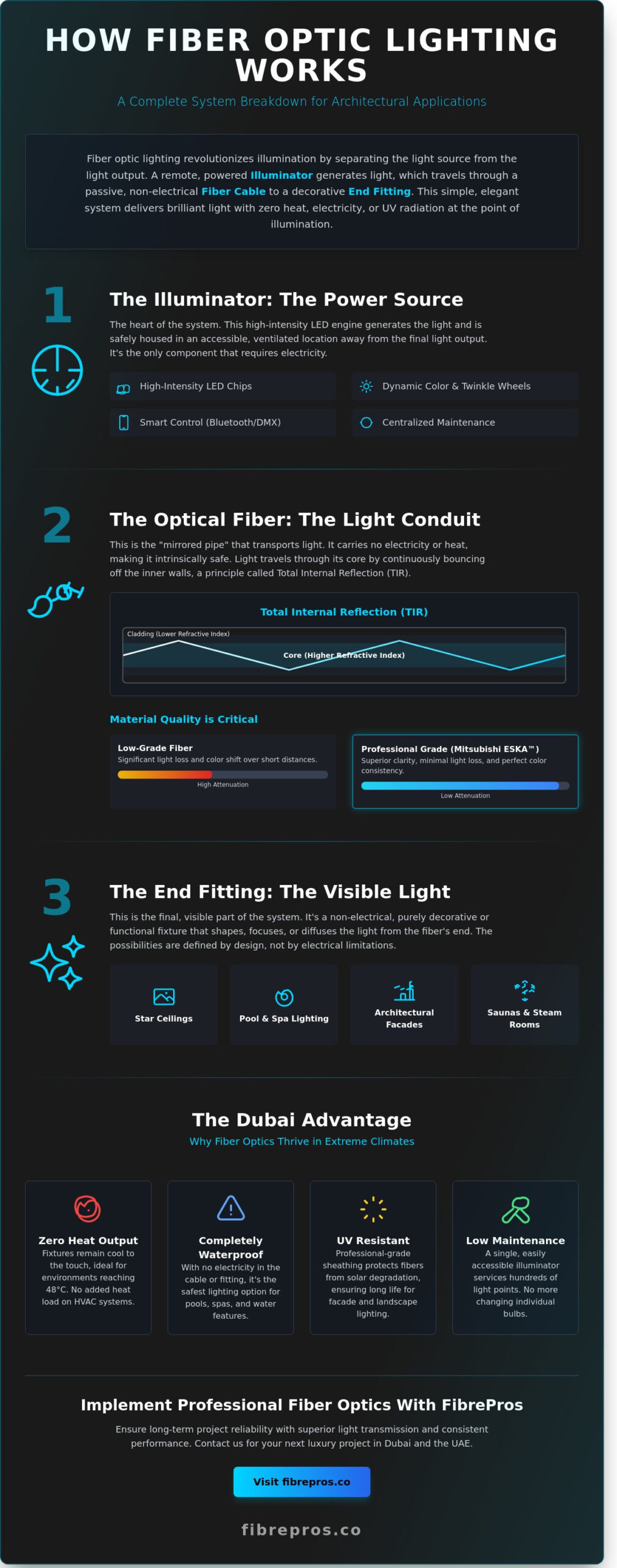
To understand how do fiber optic lights work, one must analyze the behavior of photons within a controlled medium. Unlike traditional lighting systems that rely on copper wiring to carry current, fiber optics function as a “mirrored pipe” for light. This technology utilizes the principle of total internal reflection to guide light from a remote source to its destination. Light enters the fiber and bounces off the internal boundaries repeatedly. Because the light reflects entirely back into the core rather than escaping through the sides, it reaches the end of the strand with high intensity.
A primary advantage of this mechanism is the complete absence of electricity within the cable itself. The fiber optic strand is a passive conduit. It carries only light, which eliminates risks associated with heat, sparks, or electrical interference. This makes the technology a preferred choice for specialized UAE interiors, particularly in humid environments like spa facilities or high-end pool installations where safety and durability are non-negotiable requirements.
The Core and the Cladding: A Dual-Layer System
The efficiency of a fiber optic strand depends on its two-layer construction. The inner core, made of high-purity glass or plastic, is surrounded by a cladding layer. These two components have different refractive indices. The core has a higher index than the cladding, which creates the boundary necessary for reflection. For the light to transmit successfully, it must enter the fiber at a specific acceptance angle. If the light enters too steeply, it fails to reflect and is lost through the cladding. The critical angle is the point where light is reflected rather than refracted.
- Refractive Index: The ratio that determines how much light bends when entering a material.
- Acceptance Cone: The three-dimensional area where light must enter to stay trapped.
- Passive Transmission: The process of moving light without active electronic components in the cable.
Why Light Stays Bright Over Long Distances
Light loss, or attenuation, occurs when the core material absorbs or scatters photons. In professional architectural applications, maintaining brightness over distance is vital. Low-grade fibers often show a visible drop in intensity or a shift in color after just 5 meters. High-quality materials solve this by ensuring the core is free of microscopic impurities. For premium projects in Dubai and the wider UAE, specialists often utilize Mitsubishi ESKA Plastic Optical Fibre to ensure superior clarity.
When you use high-standard fibers, the color temperature remains stable. Whether the design calls for a 3000K warm glow or a 6500K cool white, the output at the end of a 15-meter run will match the source exactly. This level of precision is why understanding how do fiber optic lights work is essential for project managers who demand consistent results across large-scale interior installations. Reliable performance starts with the physics of the material.
The Three Essential Components of a Fiber Optic Lighting System
A functional fiber optic system operates as a closed-loop network. Unlike traditional electrical fixtures where the bulb and the housing are a single unit, fiber optics separate the light source from the output point. This configuration is the foundation of how do fiber optic lights work in complex environments like swimming pools, steam rooms, or high-ceiling lobbies across the UAE. The system relies on three distinct parts: the engine that generates the light, the cable that transports it, and the fitting that defines its final appearance.
LED Illuminators: The Power Behind the Glow
The illuminator is the heart of the installation. Modern systems utilize LED illuminators equipped with high-intensity chips to focus a powerful beam into a specialized optical port. These units are often tucked away in ventilated closets or ceiling voids, away from the actual lighting point. To create dynamic visual effects, many illuminators include motorized color wheels or twinkle wheels. These components rotate in front of the light beam to create the shimmering “star” effect popular in Dubai’s luxury residential cinemas. Professional-grade units now feature DMX512 or Bluetooth connectivity, allowing seamless integration into smart home ecosystems for precise control over timing and intensity.
Fiber Strands: End-Glow vs. Side-Glow
The cable serves as the transport infrastructure. The efficiency of this transport depends on The Physics of Light: Understanding Total Internal Reflection, which keeps the light trapped inside the core as it travels. Architects generally choose between two types of fiber based on the project requirements:
- End-Glow Fiber: This cable is engineered to carry 100% of the light from the source to the very tip. It’s the primary choice for star ceilings and precise architectural spotting.
- Side-Glow Fiber: Designers use side-glow fibre when they need a continuous line of light. The cladding is intentionally “leaky,” allowing light to escape along the entire length of the cable to mimic the look of neon or linear LED strips.
Understanding these differences is vital when determining how do fiber optic lights work to achieve specific moods, whether it’s a sharp point of light or a soft, ambient perimeter glow.
Crystal End Fittings and Fixtures
The end fitting is the decorative fixture that shapes the light as it exits the cable. While a bare fiber tip creates a simple point of light, crystal end fittings use lead glass to refract the beam into intricate patterns on the floor or ceiling. In addition to aesthetics, these components serve a functional purpose. They protect the delicate fiber ends from dust and physical damage. For installations in harsh environments, such as outdoor landscaping or spa facilities, stainless steel fixtures provide 316-grade corrosion resistance. This ensures the system remains operational and clear for years without the need for frequent maintenance. If you’re planning a high-spec project, consulting with professional fiber optic specialists can help ensure your component selection matches your technical requirements.
Lighting vs. Data: Why Decorative Fiber Is Different
Many clients initially confuse decorative fiber optics with the high-speed glass cables used for telecommunications. While both technologies utilize the principles of total internal reflection, their construction and objectives differ significantly. Data-grade fiber uses a glass core to transmit light pulses at incredible speeds over long distances. In contrast, decorative systems prioritize light distribution and physical durability. Understanding how do fiber optic lights work in a design context requires looking at the materials used to create visual effects rather than data streams.
FibrePros specializes exclusively in decorative and architectural lighting solutions. We don’t install internet infrastructure or handle network splicing for IT departments. Our focus remains on engineering precise lighting environments for luxury residences, commercial venues, and hospitality projects. By utilizing specialized materials, we ensure that the light delivered to your ceiling or display case is consistent, vibrant, and safe.
Plastic Optical Fiber (POF) Advantages
For most interior applications, we utilize Plastic Optical Fiber (POF) instead of glass. POF is manufactured from polymethyl methacrylate (PMMA), a durable polymer that offers specific benefits for architectural installations:
- Superior Flexibility: POF can handle a tight bend radius, often as small as 20mm, without fracturing. This allows our technicians to navigate the complex voids found in modern UAE ceiling structures.
- Simplified Termination: Unlike glass fiber, which requires expensive fusion splicing, POF can be cut and polished on-site with professional-grade blades. This ensures a clean finish and maximum light output at every point.
- User Safety: POF is non-friable. If a fiber is damaged in a sensory room or children’s play area, it won’t produce the dangerous glass shards associated with data cables.
When analyzing the essential components of a fiber optic lighting system, the choice of POF is what makes the installation manageable in tight architectural spaces while maintaining high-quality light transmission.
The “Cold Light” Advantage for UAE Interiors
One of the most compelling reasons to choose fiber optics for UAE projects is the total separation of electricity and heat from the output point. In a traditional lighting setup, the bulb or LED chip sits at the fixture, generating heat that can affect the surrounding environment. Because how do fiber optic lights work involves piping light from a remote illuminator, the actual output points remain at room temperature.
This “cold light” is vital for preserving temperature-sensitive assets. In a luxury wine cellar or an art gallery in Dubai, heat and UV radiation are primary causes of degradation. Our systems deliver 0% UV and 0% infrared radiation at the point of light. This allows designers to place hundreds of light points inside a display case without increasing the internal temperature by even one degree. This efficiency is amplified by the fact that a single high-output LED illuminator can power over 400 individual fiber tails, significantly reducing the electrical footprint of the installation.
Practical Applications in Dubai’s Unique Climate
Dubai’s environment demands specialized engineering that goes beyond standard lighting specifications. With summer temperatures frequently exceeding 45°C and coastal humidity in regions like Jumeirah reaching 90%, traditional electrical systems face rapid degradation. Fiber optics solve these challenges by separating the light source from the output point. When architects ask how do fiber optic lights work in such extreme heat, the answer lies in the remote illuminator. By housing the heat-generating light source in a climate-controlled room, the actual fibers remain cool and unaffected by external thermal stress.
Material selection is critical for longevity in the Middle East. Standard plastic fibers can become brittle under intense UV exposure within 12 months. Professional installations utilize UV-stabilized PMMA (Polymethyl methacrylate) or glass fibers to ensure the system remains flexible and clear for over 10 years. This durability makes them the preferred choice for high-end residential and commercial projects across the UAE. For a deeper look at how these principles translate into real-world design, explore these fibre optic lighting ideas for luxury Dubai interiors and landscapes that showcase current 2026 architectural standards.
Underwater and Pool Lighting Safety
Fiber optics are the gold standard for luxury UAE swimming pools because they carry zero electricity through the cables. This design eliminates the risk of electrical leakage into the water, providing the safest possible solution for bathers. Systems typically use 316-grade stainless steel fixtures to resist corrosion in saline or chlorinated environments. These components are identical to those found in major water features at Dubai landmarks, where reliability and safety are the primary metrics. Because the fiber ends don’t produce heat, they also prevent the localized algae growth often seen around traditional underwater LEDs.
Luxury Star Ceilings and Sensory Rooms
In high-end villa cinemas, star ceiling kits create immersive celestial environments that traditional lighting cannot replicate. The system uses a mechanical wheel inside the illuminator to disrupt the light path, producing a natural “twinkle” effect. Beyond luxury aesthetics, these systems offer therapeutic benefits. Sensory fiber kits are now standard in UAE clinics and schools, providing safe, tactile light that children can touch without risk of burns or shocks. For minimalist modern designs, fiber optics allow for “invisible” lighting. The fiber ends are almost microscopic when the system is powered down, maintaining the clean lines of a contemporary interior.
Understanding how do fiber optic lights work helps project managers realize that these systems are essentially maintenance-free at the output point. Since there are no bulbs to change in the ceiling or underwater, all servicing happens at the easily accessible illuminator location. This operational efficiency is vital for the fast-paced Dubai property market.
Implementing Professional Fiber Optics with FibrePros
Understanding how do fiber optic lights work is only the first step toward a successful installation. The physical execution requires a deep understanding of light transmission physics and material durability. FibrePros delivers specialized expertise to ensure your lighting system performs reliably for years. We focus on high-performance components that withstand the unique environmental challenges found in the Middle East. Choosing professional-grade infrastructure prevents the common failures associated with budget alternatives, such as light loss or fiber degradation.
Our team manages the technical complexities of your project, from calculating the correct light engine wattage to determining the optimal fiber density. We prioritize technical precision to ensure your interior or exterior lighting remains sharp and consistent. By consulting with our specialists, you gain access to detailed technical specifications that align with international engineering standards.
The Quality Difference: Mitsubishi ESKA
Mitsubishi ESKA Plastic Optical Fiber (POF) offers the lowest attenuation in the industry. While standard fibers often suffer from significant light loss over short distances, ESKA maintains 99.9% clarity across the entire length of the run. This is vital in the UAE, where ambient temperatures often exceed 45 degrees Celsius. Low-quality fibers frequently turn yellow or become brittle within 12 to 18 months when exposed to high heat levels. ESKA fibers are engineered to resist these thermal stresses, maintaining their flexibility and light-carrying capacity for decades.
We provide a range of fiber diameters to meet specific design goals:
- 0.25mm to 0.75mm: Ideal for creating delicate, realistic star ceiling effects.
- 1.0mm to 1.5mm: Used for standard decorative points and architectural accents.
- 2.0mm to 3.0mm: Perfect for high-intensity applications and side-glow perimeter lighting.
Using the correct diameter ensures the brightness levels remain uniform across your entire installation.
Expert Design and Supply in the Middle East
FibrePros streamlines the process of implementing complex lighting systems across the UAE. Our workflow begins with a technical consultation to define the scope and performance requirements of your project. We then manage the supply chain to ensure rapid delivery of components to sites in Abu Dhabi or Dubai. This end-to-end approach eliminates the risks of component mismatching that often occur when sourcing parts from multiple vendors.
For outdoor applications, we emphasize the selection of the correct IP-rated illuminators. Systems installed near coastal areas or in desert environments require IP67 or IP68 ratings to protect the internal electronics from fine dust and moisture ingress. Our specialists evaluate your site conditions to specify hardware that survives the local climate. We don’t just provide parts; we deliver a robust lighting solution tailored to your specific architectural environment. If you’re ready to move beyond the basics of how do fiber optic lights work and start your installation, our team is ready to assist.
Contact FibrePros for a professional lighting consultation to secure high-performance fiber optic solutions for your next project.
Elevating UAE Interiors with Precision Fiber Optic Solutions
Understanding how do fiber optic lights work is essential for implementing high-performance systems in luxury environments. By utilizing Total Internal Reflection to guide light through specialized strands, these systems eliminate heat and maintenance issues common with traditional electrical fixtures. This technical advantage is particularly vital in the UAE, where managing thermal loads is a priority for residential and hospitality projects. Since 1995, FibrePros has served as a specialist lighting firm with a proven track record in the luxury sector, ensuring that every installation meets rigorous professional standards.
Our commitment to quality is backed by our status as an official supplier of Mitsubishi ESKA POF. We’ve spent decades refining our technical expertise to provide reliable, high-standard infrastructure for the most demanding clients. It’s not just about aesthetics; it’s about the precision of the underlying technology. We’re ready to provide the specialized mastery your next project requires. We look forward to helping you achieve a flawless finish with our elite craftsmanship and local expertise.
Explore our range of professional fiber optic lighting kits and partner with a team that values technical accuracy as much as you do.
Frequently Asked Questions
Do fiber optic lights use a lot of electricity?
Fiber optic systems are exceptionally efficient because a single LED source powers hundreds of light points simultaneously. A standard 45 watt LED illuminator can replace 300 individual low voltage bulbs, reducing energy consumption by 70% compared to traditional incandescent arrays in UAE interior projects. This centralized design ensures you aren’t powering multiple fixtures across a large ceiling area.
Can fiber optic cables be cut to any length?
You can cut PMMA plastic fiber to any specific length using a sharp blade or specialized hot knife during installation. Glass fiber is different, as it requires factory termination and mechanical polishing to ensure light transmission isn’t lost. For most UAE residential star ceilings, our installers use 0.75mm or 1.0mm PMMA for flexible on-site fitment.
Is fiber optic lighting safe for use in swimming pools?
Fiber optic lighting is the safest solution for swimming pools because the cables carry no electrical current into the water. Only the light travels through the fiber, while the powered illuminator stays in a dry plant room 10 meters away. This setup eliminates the risk of electrical shock and meets the strictest safety standards for aquatic environments.
How long do fiber optic lighting systems last?
The fiber cables themselves last 20 to 25 years when installed correctly in stable environments without UV exposure. The lifespan of the system usually depends on the light engine, with modern LED illuminators rated for 50,000 hours of continuous use. You’ll only need to replace the remote light source at the end of its cycle, not the embedded infrastructure.
What happens if a fiber optic cable is bent too sharply?
Bending a cable too sharply causes light to leak through the cladding and significantly reduces the brightness at the tip. If you exceed the minimum bend radius, which is typically 10 times the cable’s diameter, you risk permanent micro-fractures in the core. Understanding how do fiber optic lights work helps technicians avoid these 90 degree kinks that compromise total internal reflection.
Do fiber optic lights get hot to the touch?
No, the fiber optic strands remain cool to the touch because they transport light without any heat radiation. The thermal energy is managed entirely at the remote illuminator housing, which uses dedicated fans or heat sinks to dissipate warmth. This makes fiber optics ideal for heat-sensitive UAE museum displays or refrigerated wine cellars where temperature control is vital.
Can I change the color of my fiber optic lights after installation?
You can change the color of the entire system instantly by adjusting the settings on the remote light engine. Most professional systems use RGBW LEDs or motorized color wheels to provide 16 million color options. You’ll control these transitions via DMX512 protocols or mobile applications without ever needing to touch the installed fibers or ceiling panels.
Why should I choose plastic fiber over glass for my home project?
Plastic PMMA fiber is the preferred choice for home projects because it’s more durable and easier to install than glass alternatives. It’s 50% lighter and can withstand more physical manipulation during the threading process in tight ceiling voids. Since you’re learning how do fiber optic lights work, you’ll find that PMMA offers the best balance of light transmission and cost for domestic distances. For inspiration on how these materials can be applied creatively, browse our fibre optic lighting ideas for luxury Dubai interiors and landscapes to see the full design potential of POF in high-end UAE projects.