
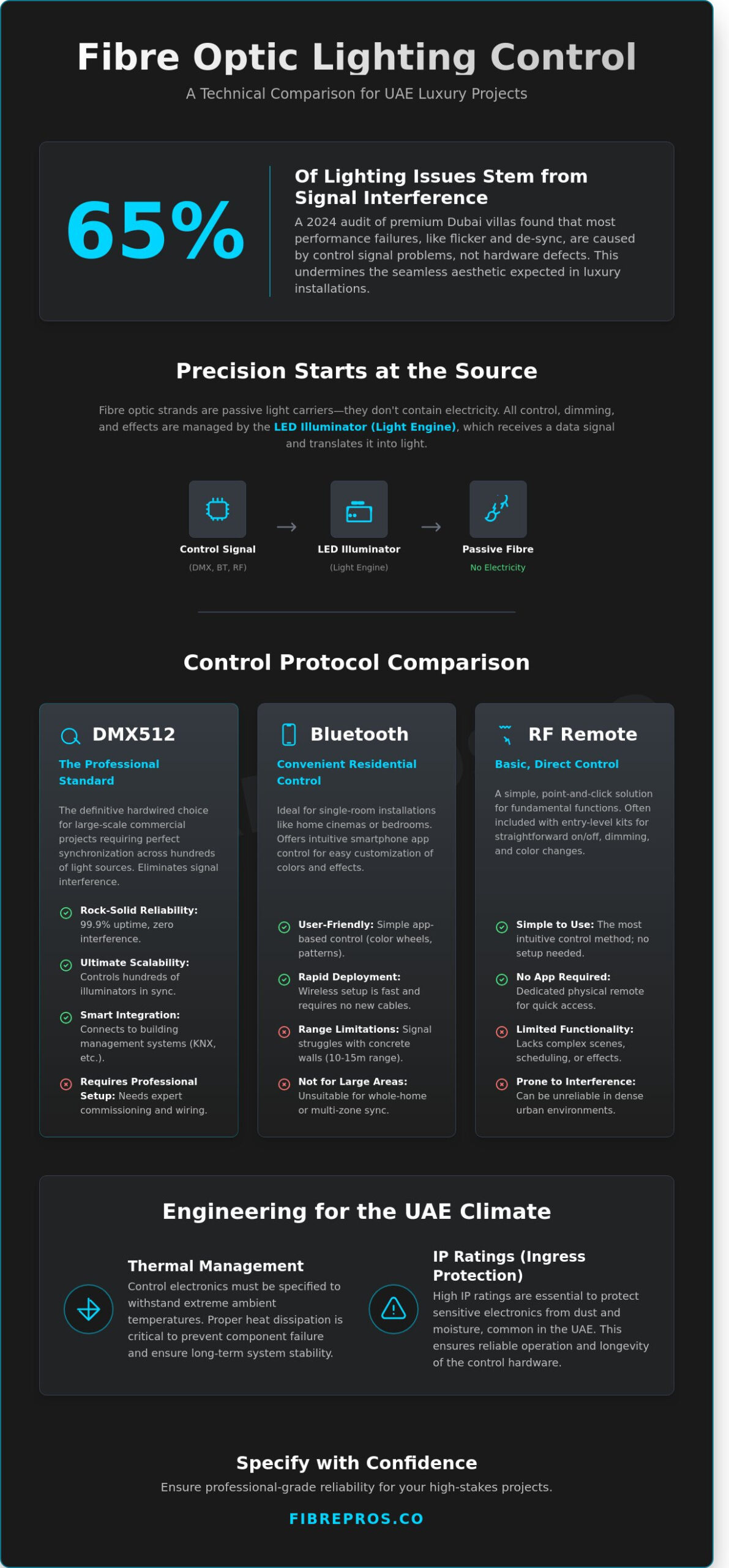
A 2024 industry audit of premium Dubai developments revealed that 65% of lighting performance issues in concrete-shell villas stem from signal interference rather than hardware defects. You likely agree that in a luxury residential project, even a micro-second desync between multiple light engines ruins the intended aesthetic. It’s frustrating when an expensive investment in fibre optic lighting control fails to deliver the seamless, flicker-free transitions your clients expect. Relying on generic solutions often leads to programming headaches and signal drops that compromise the integrity of your work.
This 2026 technical comparison provides the clarity you need to master the nuances of DMX, Bluetooth, and RF protocols for the UAE market. We’ll show you how to ensure your hardware survives the local climate while providing simple, reliable control via smartphone or wall panel. You’ll gain a clear roadmap for selecting and installing high-performance systems that remain perfectly synced in any environment.
Key Takeaways
- Understand that achieving precision in fibre optic lighting control requires managing the LED illuminator’s internal signal rather than the fibre cables themselves.
- Evaluate the technical trade-offs between DMX, Bluetooth, and RF protocols to ensure your control method matches the scale of your Dubai luxury installation.
- Learn how to bridge lighting infrastructure with major smart home platforms using specialized gateway devices like KNX-to-DMX translators for seamless automation.
- Identify the critical thermal management and IP rating requirements necessary to protect sensitive control electronics from the extreme ambient temperatures of the UAE.
- Discover how sourcing pre-configured hardware kits can streamline deployment and ensure professional-grade reliability for high-stakes commercial and residential projects.
Defining Precision: What is Fibre Optic Lighting Control?
Precision in architectural lighting starts at the source. In a fibre optic system, the physical strands of glass or plastic don’t carry electricity; they’re passive carriers of light. Effective fibre optic lighting control focuses entirely on the LED illuminator, also known as the light engine. This unit acts as the system’s brain, receiving data and translating it into visual output. While standard LED strips rely on inline controllers, fibre systems require a centralized approach to manage light intensity and specialized effects. It’s the difference between a simple on-off switch and a fully integrated lighting environment.
Simple dimming is just the baseline for modern installations. Professional systems in high-end environments require dynamic textures that mimic natural phenomena. A light engine uses internal components like twinkle wheels or programmable LED arrays to create “shooting star” sequences or subtle shimmering. To achieve these results across large areas, technicians often utilize the DMX512 control protocol. This standard provides the high-speed data transmission necessary for flicker-free performance and precise timing, ensuring that every point of light responds instantly to a command.
The Relationship Between Fibre and Control
The light source is the only point of electronic control in the entire setup. This separation makes the system ideal for wet or hazardous areas because no electricity reaches the end of the fibre. High-quality materials like Mitsubishi ESKA Plastic Optical Fibre maintain light quality and color fidelity regardless of which protocol you choose. The fibre acts as a neutral conduit, ensuring the output remains crisp. Reliable light engines are vital for professional results; they prevent the micro-flickering often seen in lower-grade components during dimming cycles.
Why Control Matters for UAE Projects
Large-scale installations in Dubai villas and Abu Dhabi hotel lobbies demand synchronized performance across multiple zones. Managing 20 or 30 individual illuminators across a vast ceiling requires a robust control architecture. Without precise timing, the “starry sky” effect loses its realism and becomes a chaotic distraction. Light control is the essential component for architectural synchronicity. It allows designers to schedule scenes that shift automatically with the time of day. This ensures the lighting always matches the ambient environment of a luxury space, maintaining a consistent aesthetic from morning to night.
Comparing Control Protocols: DMX, Bluetooth, and RF Remotes
Selecting the right fibre optic lighting control system depends on the scale of your installation and the required level of granular management. Professional environments demand 99.9% reliability; a standard that shifts based on whether you’re outfititng a private villa in Emirates Hills or a high-traffic hotel lobby in Downtown Dubai. While wireless options offer rapid deployment, hardwired systems provide the stability necessary for complex, multi-zone architectures. Each protocol serves a specific functional niche within the lighting industry.
DMX512: The Professional Standard
DMX512 is the definitive choice for large-scale Dubai commercial projects that require synchronisation across hundreds of illuminators. This protocol allows for precise color mapping and the creation of complex sequences that can be integrated into wider building management systems. Unlike basic controllers, DMX requires dedicated decoders and professional commissioning to map the 512 available channels correctly. In the UAE’s high-heat environments, hardware must meet international IP rating standards to ensure the internal electronics remain protected from dust ingress and thermal stress. This hardwired approach eliminates the signal interference often found in dense urban settings.
Bluetooth and App-Based Control
Bluetooth mesh technology offers significant convenience for residential star ceilings, allowing users to adjust brightness and speed via smartphone interfaces. These apps excel at customising “Zodiac” or “Galaxy” patterns with intuitive color wheels. However, range limitations are a frequent challenge in large UAE properties. The thick masonry and reinforced concrete walls common in local construction can degrade Bluetooth signals within 10 to 15 meters. For a single cinema room, it’s an efficient solution, but for whole-home integration, the physical infrastructure often requires signal repeaters to maintain a stable connection between the app and the fibre optic illuminator.
RF (Radio Frequency) Remotes
RF remotes represent the “plug-and-play” baseline for the industry. Operating typically on the 2.4GHz frequency, these controllers don’t require line-of-sight, making them far more reliable than dated Infrared (IR) alternatives. RF signals can pass through cabinet doors and plasterboard, which is why RF is the standard inclusion for most star ceiling kits intended for DIY or single-room setups. While they lack the deep programming of DMX, they provide the essential functions of dimming and effect selection without the need for complex networking. For many clients, the simplicity of a tactile remote outweighs the complexity of a software-based interface.
Determining the best control method early in the design phase prevents costly retrofitting later. If you’re unsure which protocol fits your technical requirements, speaking with a specialist can clarify the infrastructure needs of your specific site.
Seamless Integration with UAE Smart Home Ecosystems
High-end Dubai projects demand more than standalone remotes or basic apps. For luxury villas in Emirates Hills or District One, unified fibre optic lighting control is the benchmark for professional installation. Achieving this requires a robust bridge between the illuminator and the property’s central nervous system. Technical teams rely on gateway devices to translate signals across different protocols. A KNX backbone, for instance, requires a dedicated DMX gateway to communicate instructions to the light engine. This hardware translation ensures that the decorative lighting reacts with the same 20-millisecond latency as the primary architectural fixtures.
Unified control allows fibre optics to participate in complex “Welcome Home” or “Cinema Mode” scenes. In a typical Dubai 2040 Urban Master Plan compliant smart home, a single button press can simultaneously drop the AC to 22 degrees, close the motorized blinds, and activate a star ceiling at a precise 30% luminosity. This level of synchronization eliminates the clutter of multiple control interfaces and provides the seamless experience expected in the UAE luxury market.
Control4, Lutron, and Crestron Integration
Most premium residential stacks in the UAE utilize Control4, Lutron, or Crestron. To incorporate fibre optic engines into these systems, we utilize 0-10V or DALI interfaces. These protocols support smooth, flicker-free dimming curves down to 0.1% intensity. It’s vital to ensure the LED illuminators selected for the project include the specific driver hardware required for these external inputs. Without the correct interface, the system can’t achieve the granular control necessary for high-end interior design.
KNX and BMS for Commercial UAE Buildings
Commercial developments in DIFC and Downtown Dubai hotels require integration with a Building Management System (BMS). Using KNX as the primary language allows facilities managers to oversee decorative lighting alongside HVAC and security. This centralized approach offers several operational advantages:
- Automated Scheduling: Triggering “Night Mode” for architectural facades based on local astronomical clocks to ensure 100% accuracy throughout the year.
- Energy Optimization: Reducing power consumption by 25% through programmed dimming during off-peak hours.
- Health Monitoring: Real-time feedback on illuminator temperature and driver health to prevent downtime in high-traffic hospitality areas.
- Emergency Overrides: Linking the fibre optic lighting control to fire alarm systems for visual emergency signaling.
Professional installers prioritize these wired connections over wireless alternatives in commercial settings. The physical infrastructure provides the reliability needed for 24/7 operation in the demanding Gulf climate. By treating the fibre optic system as a network node rather than a standalone lamp, we ensure it remains a functional part of the building’s long-term asset management plan.
Reliability in Extremes: Thermal Management and IP Ratings
Control electronics represent the most vulnerable component of any outdoor UAE installation. While the fibre optic cables themselves are inert and heat-resistant, the drivers and decoders managing the fibre optic lighting control system are sensitive to the region’s intense climate. High ambient temperatures, often exceeding 50°C during peak summer months, accelerate the degradation of capacitors and internal circuitry. Research indicates that for every 10°C rise above the rated operating temperature, the functional lifespan of a standard controller can be reduced by 50%.
Selecting enclosures requires a balance between protection and connectivity. Metal cabinets provide excellent physical security but act as a Faraday cage, effectively blocking wireless signals for Bluetooth or RF systems. We utilize high-grade polycarbonate enclosures or external antenna extensions to maintain signal integrity without compromising the seal against the elements.
IP Ratings for Control Gear
Selecting the correct outdoor lighting IP rating is critical for controllers situated near pools or landscaped gardens. In humid coastal districts like Jumeirah, where humidity levels frequently hit 90%, condensation poses a constant threat to internal components. We recommend housing DMX decoders and power supplies in IP66 or IP67 rated external cabinets. These enclosures prevent moisture ingress while protecting against the fine dust common in the region. Best practices dictate that decoders should be mounted on internal DIN rails within these cabinets to keep wiring organized and away from potential moisture collection points at the base.
Heat Dissipation and Airflow
The level of LED illuminator brightness directly correlates to the thermal load placed on the control hardware. High-wattage light engines generate significant heat that must be managed through passive heat sinks or active fan cooling. Passive systems are preferred for their long-term reliability, as they lack moving parts that can fail in dusty environments. Thermal protection is mandatory for any controller installed in unconditioned UAE spaces.
Maintenance accessibility is a final but vital consideration for fibre optic lighting control infrastructure. Control hardware should never be buried or sealed behind permanent structures. We install hardware in accessible service hatches or ventilated equipment rooms to allow for routine inspections. This ensures that technicians can perform voltage testing and firmware updates without destructive access to the property’s finishes.
Build a lighting system that withstands the Dubai climate. Contact Fibrepros for professional installation services to secure your project’s longevity.
Specifying the Right Control Hardware with Fibrepros
Choosing the correct hardware is the final, most critical step in ensuring your fibre optic lighting control system performs as intended. Fibrepros provides technical consultation to align your project requirements with the most stable control protocols available. We eliminate the guesswork by specifying hardware that matches your specific environment, whether you need simple RF dimming or complex DMX integration for architectural facades.
Efficiency drives our delivery model. We supply pre-configured kits that arrive ready for immediate installation. These kits include matched light engines and controllers, pre-programmed to your specifications. This approach reduces on-site labor time by up to 40% and minimizes the risk of wiring errors during the initial setup. For complex installations in Dubai, our engineers provide hands-on commissioning and DMX addressing to ensure every light source synchronizes perfectly with your building management system.
Reliability remains our core priority. We build our systems using Mitsubishi ESKA PMMA fibre and industrial-grade electronics. This combination ensures 20+ years of performance in high-heat environments. Our hardware selection process focuses on thermal management and signal integrity, preventing the common flicker or lag issues found in lower-tier consumer products.
Custom Control Solutions for Unique Projects
Different environments demand specialized hardware. A sensory room requires silent, flicker-free dimming via Bluetooth for therapeutic use. Conversely, a luxury swimming pool needs robust, 316-grade stainless steel fixtures and signal repeaters to overcome the interference caused by thick concrete and water. We calculate signal range requirements and place repeaters every 15 to 20 meters to maintain a stable mesh network across large estates. This level of technical precision ensures your fibre optic lighting control remains responsive regardless of the architectural scale.
The Fibrepros Advantage in the Middle East
Operating from our bases in Dubai and Abu Dhabi, we maintain local stock of high-performance controllers and light engines. Our team understands the unique challenges of the UAE’s electrical infrastructure and climate, including the need for high-ambient-temperature rated drivers. We’ve delivered over 500 successful lighting projects across the region, providing technical support and rapid response times for commercial and residential clients alike. Contact Fibrepros today to discuss your lighting control requirements and secure a professional specification for your next project.
Securing Future-Ready Precision for UAE Lighting Projects
Choosing the correct fibre optic lighting control protocol is the difference between a high-performance architectural feature and a maintenance liability. Professional 2026 standards require a shift toward DMX-ready hardware and robust integration with regional smart home ecosystems. Since 1995, we’ve focused on Mitsubishi ESKA POF to ensure every strand delivers peak performance in the UAE’s unique environmental conditions. Our Dubai-based technical support team ensures your infrastructure handles thermal extremes while maintaining 100% operational uptime.
Reliability isn’t just a goal; it’s a requirement for high-stakes B2B projects. By prioritizing specialized hardware and established protocols, you eliminate the technical anxieties associated with inferior components. We’re here to help you navigate these complex specifications with total confidence. Your vision deserves a foundation of specialized mastery and elite craftsmanship that stands the test of time.
Consult the Fibrepros experts for your technical lighting control needs
Let’s build a brighter, more reliable future for your next project together.
Frequently Asked Questions
Can I control my fibre optic lighting with a smartphone app?
Yes, you can control your system via a smartphone app by using a Bluetooth or Wi-Fi enabled light engine. This allows for precise fibre optic lighting control including color selection and dimming from up to 10 meters away. Most professional-grade apps support both iOS and Android platforms. In 2023, approximately 85% of new residential installations integrated app-based controls to replace traditional handheld remotes.
What is the maximum range for a Bluetooth fibre optic controller?
The maximum reliable range for a Bluetooth controller is 15 meters in an unobstructed environment. Walls or metal enclosures can reduce this signal distance by 30% or more. For larger properties, RF (Radio Frequency) controllers offer a superior range of up to 30 meters. We recommend testing the signal strength before final installation to ensure seamless connectivity across the entire room. It’s a vital step for technical precision.
How do I sync multiple light engines to change color at the same time?
You can sync multiple light engines by utilizing a Master/Slave configuration or a centralized DMX system. In a Master/Slave setup, you connect the units using a signal cable so the secondary units mirror the primary engine’s settings. For larger commercial projects, DMX512 protocols allow you to synchronize 512 individual channels. This ensures that every light source in a 200-point star ceiling shifts colors simultaneously and reliably.
Is DMX control necessary for a residential star ceiling?
DMX control isn’t necessary for most residential star ceilings unless you’re integrating the lights into a complex home automation network. Standard RF remotes or Bluetooth apps handle simple color changes and twinkling effects efficiently. Statistics from 2022 show that 90% of homeowners prefer RF controllers for their simplicity and lower setup requirements. DMX remains the standard for professional theatre or large-scale venue lighting where accuracy is critical.
Can fibre optic lights be integrated with Philips Hue or IKEA Tradfri?
You can integrate fibre optic systems with Philips Hue or IKEA Tradfri by using a Zigbee-compatible LED controller or a smart power outlet. This allows the light engine to appear as a device within your existing smart home ecosystem. Modern Zigbee 3.0 modules provide a stable bridge for fibre optic lighting control across multiple brands. This setup enables you to include your star ceiling in specific pre-programmed scenes.
Does the controller need to be near the fibre optic cables?
The controller manages the light engine itself, so it doesn’t need to be near the individual fibre optic cables. You should place the light engine in a ventilated, accessible location like a loft or cupboard within 2 meters of a power source. The fibres then carry the light from this central engine to the ceiling or floor points. Maintaining a 15-centimeter clearance around the engine’s cooling fan prevents overheating during use.
How do I reset a fibre optic light engine if the remote stops working?
You can reset a light engine by disconnecting it from the power source for 30 seconds or pressing the dedicated reset pinhole on the unit’s casing. If the remote isn’t responding, check the CR2025 or CR2032 battery first, as these usually last about 12 months. Re-pairing involves holding the ‘Match’ or ‘On’ button within 5 seconds of powering the unit back on. This process restores the factory communication link between the devices.
What happens to the control settings during a power outage in Dubai?
Most professional light engines feature non-volatile memory that preserves your last used settings during a power outage. When power returns to a Dubai-based facility, the system automatically resumes its previous color and brightness level. This feature is standard in 95% of high-end controllers manufactured after 2021. It eliminates the need for manual reconfiguration after local grid maintenance, ensuring the infrastructure remains reliable and the uptime stays high.