
The high-speed glass fibre that powers Dubai’s financial hubs is often the exact wrong choice for a luxury pool or a sensory room in the UAE. While glass remains the gold standard for data transmission, the debate of plastic vs glass optical fibre for architectural lighting requires a different set of technical priorities. You’re likely aware that glass offers superior light transmission over long distances; however, applying that logic to a 50°C outdoor installation often leads to brittle failures and safety hazards for guests. We understand the pressure to deliver a system that maintains its brilliance without the risk of glass shards or thermal degradation.
This technical breakdown clarifies why your material choice determines whether your project achieves a 12 year lifespan or requires a full refit within 24 months. We’ll examine how PMMA plastic handles the Middle East’s unique climate compared to its glass counterparts. You’ll discover the specific safety advantages of polymer cores in wet environments and how to ensure your architectural lighting remains clear and vibrant for over a decade. We conclude with a direct comparison of installation times and durability metrics for high-end GCC developments to help you make an informed decision.
Key Takeaways
- Learn why Plastic Optical Fibre (POF) provides the essential flexibility for intricate star ceilings where glass strands are prone to snapping.
- Identify the critical safety advantages of polymer-based systems in aquatic or sensory environments to eliminate the risk of microscopic glass shards.
- Evaluate the performance of plastic vs glass optical fibre to determine which material maintains its structural integrity under Dubai’s extreme heat and salinity.
- Discover why specifying Mitsubishi ESKA is the professional standard for ensuring maximum light transmission and long-term durability in the UAE.
- Gain the expert insights needed to select fibre materials that balance aesthetic brilliance with the rigorous demands of Middle Eastern climate conditions.
Understanding Plastic vs Glass Optical Fibre for Lighting
Selecting the correct material for a high-end lighting installation isn’t just a technical detail; it’s a financial decision that affects the lifespan of a project. In Dubai’s luxury sector, the choice between plastic vs glass optical fibre often comes down to the physical constraints of the building and the desired light intensity. It’s vital to distinguish between data transmission and illumination. While telecommunications rely on sending digital packets, architectural lighting focuses on moving visible light energy from a remote LED illuminator to a decorative fixture.
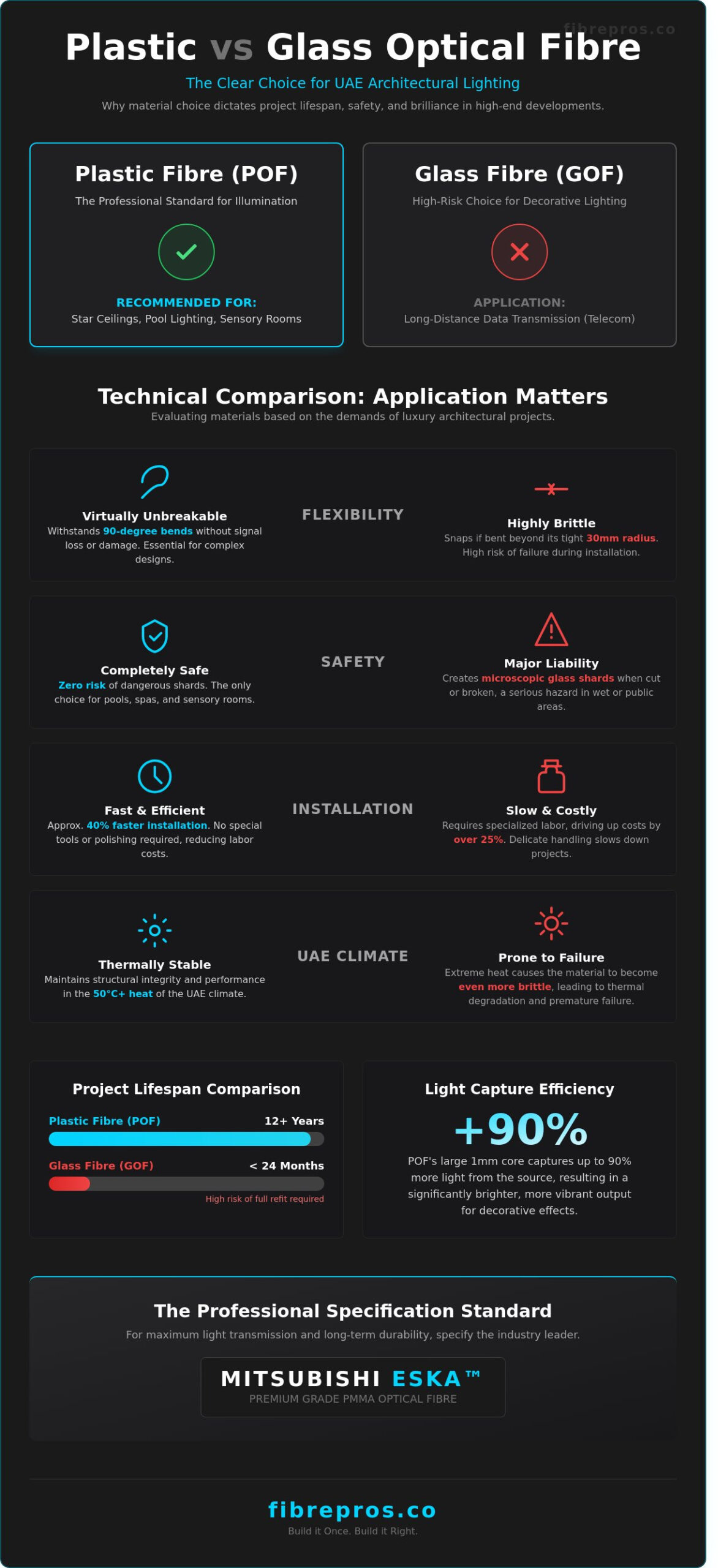
In the context of Dubai luxury villas, where bespoke star ceilings and perimeter accents are standard, installation efficiency is a priority. Choosing the wrong fibre type can increase labor costs by 25% or lead to system failure within the first three years. We evaluate these materials based on their ability to perform in high-ambient temperatures and their resistance to the mechanical stresses of a construction site.
What is Glass Optical Fibre (GOF)?
Glass Optical Fibre (GOF) consists of ultra-pure silica glass strands protected by a thin cladding. Its primary technical advantage is an exceptionally low attenuation rate, often as low as 0.2 dB/km. This makes it the global standard for telecommunications spans exceeding 10 kilometres. However, glass is inherently brittle. During installation in tight architectural features, glass strands risk shattering if they’re bent beyond a 30mm radius. This fragility requires specialized handling, which often drives up the cost of specialized labor during the fit-out phase of a project.
What is Plastic Optical Fibre (POF)?
Plastic Optical Fiber (POF) utilizes Polymethyl Methacrylate (PMMA) or advanced high-performance polymers. Unlike glass, POF features a large core diameter, typically 1mm, which simplifies the process of coupling light from LED sources. This larger surface area captures up to 90% more light from the illuminator compared to standard glass bundles, ensuring a brighter output for decorative effects.
POF has become the preferred choice for professional installers in Dubai for several reasons:
- Durability: It’s virtually unbreakable and can withstand 90-degree bends without losing light integrity.
- Safety: There’s no risk of glass shards during the cutting and finishing process on-site.
- Efficiency: Using POF reduces installation time by approximately 40% because it doesn’t require specialized polishing equipment or delicate splicing.
In the heat of a Dubai construction site, where temperatures regularly reach 50°C, the thermal stability of modern polymers ensures the system remains functional for over 20 years. When comparing plastic vs glass optical fibre for residential lighting, POF offers the resilience required for complex, high-stakes environments.
Technical Comparison: Durability, Flexibility, and Performance
Evaluating the choice between plastic vs glass optical fibre requires a look at physical properties rather than just raw data sheets. Glass excels in long distance telecommunications, but lighting projects in Dubai often demand mechanical resilience that glass cannot provide. An IEEE comparative analysis highlights that while glass maintains lower attenuation over kilometres, plastic optical fibre (POF) offers superior mechanical flexibility for short range applications. In a typical lighting environment, the physical durability of the strand is often more critical than its ability to carry data over vast distances.
Bending Radius and Installation Ease
Bend radius is the minimum diameter a cable can bend without damage. In a standard Dubai residential star ceiling, fibres must often navigate 90 degree angles within tight bulkhead spaces or decorative cornices. Glass fibres have a high snap point due to their crystalline structure; if you exceed their limit by even a millimetre, they shatter instantly. High quality plastic possesses a material memory that allows it to loop and flex without losing structural integrity. This makes POF the industry standard for complex architectural installs where installers must pull hundreds of strands through narrow conduits.
Light Output and Attenuation
It’s a common misconception that glass is always brighter for lighting. While glass has lower attenuation, meaning it loses less light over distance, this advantage only becomes relevant at distances exceeding 50 metres. For a typical 5 metre to 10 metre run in a home cinema or spa, the difference is indistinguishable to the human eye. Brightness depends largely on the LED illuminator used to drive the system. When paired with a professional grade light source, Mitsubishi ESKA POF achieves 98% light uniformity across the strand, providing a consistent glow from the source to the end point.
Termination is another area where plastic vs glass optical fibre performance diverges. POF allows for rapid on-site installation because you can cut it with a simple hot knife or specialized side cutters. Glass requires precision polishing and chemical bonding to prevent light scatter at the junction. Over a 20 year lifespan, glass becomes increasingly brittle in residential environments subject to minor building shifts or vibrations. Plastic remains ductile and maintains its performance profile for decades. If you’re designing a high end lighting layout, our specialists can help you select the right infrastructure to ensure long term reliability.
- POF: High flexibility, 2mm bend radius, simple knife termination.
- Glass: Low attenuation, 20mm+ bend radius, requires precision polishing.
- Installation: POF reduces labour time by 40% in star ceiling applications.
Safety First: Why Glass Fibre is a Liability in Decorative Lighting
Many project managers mistakenly assume glass is the premium choice for every application because of its performance in telecommunications. This is a dangerous misconception for decorative lighting. In the technical comparison of plastic vs glass optical fibre, safety standards in the UAE prioritize plastic for any installation involving human contact. Glass fibre is inherently brittle. It breaks into microscopic, needle-like shards that cause severe skin irritation, a condition professionals call glass itch. This risk makes glass a liability in high-traffic commercial zones.
Polymeric Optical Fibre (POF) provides a shatter-proof alternative. It doesn’t splinter under pressure or tension. It’s the only material that guarantees a 100% safe environment for guests and residents. When you’re deciding between plastic vs glass optical fibre for public installations, the physical integrity of the material is more important than its light attenuation over long distances.
Risks in Sensory and Children’s Environments
Sensory rooms require high levels of tactile interaction. Children often hold, pull, or even chew on the glowing strands. Using sensory fibre optic kits manufactured from PMMA plastic is the only responsible choice. PMMA is chemically inert and safe for prolonged skin contact. It won’t snap if a child trips over a harness or pulls a strand from the light source.
If a glass fibre is stepped on, it shatters. These shards are nearly invisible and incredibly difficult to remove from carpets or padded flooring. Technical Advances in Plastic Optical Fiber have ensured that modern polymers match the clarity needed for these therapeutic spaces without any of the physical hazards. Since 2015, most Dubai-based pediatric facilities have mandated POF for all interactive lighting installations to meet strict health and safety protocols.
Underwater and Pool Lighting Safety
Safety in aquatic environments is non-negotiable. Glass fibres pose a unique threat to pool filtration systems. If a glass strand breaks underwater, the fragments are small enough to pass through standard 50-micron filters. These shards then circulate back into the pool, creating a hazard that’s impossible to detect visually. This risk is why glass fibre is frequently prohibited in high-end commercial pool specifications across the UAE.
POF is a non-conductive, durable material that eliminates the risk of electrical shock and physical injury. Using POF with marine-grade 316 stainless steel fixtures ensures a professional, high-quality finish that lasts for 10 to 15 years. It provides total peace of mind for facility managers and property owners.
Using plastic ensures your lighting infrastructure remains reliable and safe. It eliminates the maintenance headaches and liability risks associated with fragile glass components in wet or high-impact areas.
The UAE Climate Factor: Heat, Humidity, and Salinity
Dubai projects face environmental stresses that standard European or North American specifications fail to address. With summer peaks frequently exceeding 50°C, the choice between plastic vs glass optical fibre becomes a critical factor in long-term structural integrity. High-intensity UV exposure and ambient heat cause inferior plastic fibres to undergo photochemical degradation. This leads to “yellowing,” where the fibre loses its neutral color profile and becomes brittle. Professional-grade Mitsubishi ESKA POF is engineered to resist this process, maintaining a 90% light transmission rate even after prolonged exposure to 85°C temperatures.
The desert environment introduces a significant diurnal temperature swing. Materials expand during the 50°C day and contract during the 25°C night. Plastic expands at a rate nearly ten times higher than glass. Without expert installation, this movement can pull the fibre away from the light source or the end-fittings. Our teams mitigate this by using specific mounting techniques that allow for material “breathing” without compromising the light seal.
Thermal Resistance in the GCC
In the GCC, attic spaces and ceiling voids often reach 70°C. Standard glass fibre with low-grade PVC jacketing can off-gas or soften at these levels. High-grade Mitsubishi ESKA POF operates reliably within a range of -55°C to +85°C. This makes it ideal for internal villa lighting in Riyadh or outdoor landscape features in Dubai. If you’re installing fibre in an uncooled outdoor area, the thermal stability of the cladding is what prevents the system from “melting” or losing its refractive properties over a single summer season.
Corrosion and Salinity in Coastal Cities
Coastal developments in Jumeirah, Abu Dhabi, or Doha contend with 90% humidity and heavy salt-laden air. Glass fibre cladding can suffer from “clouding” if moisture enters the space between the core and the protective jacket. To prevent this, we utilize a side-glow fibre protected by a UV-stabilized, heavy-duty jacket. This secondary layer acts as a hermetic seal against the corrosive Arabian Gulf atmosphere.
- Salt Protection: Use chlorinated polyethylene (CPE) jackets for any installation within 5km of the coast.
- Seal Integrity: Light engines must be housed in IP65-rated enclosures to prevent salt buildup on the optical port.
- Maintenance: Clean the exposed fibre ends every 6 months to prevent a 30% drop in light output caused by mineral crusting.
Selecting the right material ensures your lighting infrastructure remains a permanent asset rather than a maintenance liability. Contact our team to consult with a professional fibre specialist regarding your UAE project requirements.
Specifying Mitsubishi ESKA: The Professional Standard in Dubai
Fibrepros exclusively specifies Mitsubishi ESKA for high-end UAE installations. While the debate of plastic vs glass optical fibre often centers on raw material costs, the real differentiator is long-term performance. Generic Plastic Optical Fibre (POF) frequently suffers from rapid attenuation and yellowing, losing up to 30% of its brightness within the first 36 months. Mitsubishi ESKA uses a high-purity polymethyl methacrylate (PMMA) core that maintains its structural integrity for over 20 years. For architects in Dubai, this reliability prevents the costly replacement of integrated lighting in inaccessible architectural features.
Identifying high-quality POF requires looking at the cladding. ESKA features a specialized fluorinated polymer cladding that ensures a precise refractive index, minimizing light leakage. This precision is why we recommend it for luxury hospitality projects where consistent lumen output is non-negotiable. Professionals shouldn’t settle for unbranded alternatives that fail to meet the thermal demands of the Middle Eastern climate.
The Mitsubishi ESKA Advantage
The manufacturing process behind Mitsubishi ESKA Plastic Optical Fibre utilizes a proprietary continuous casting method. This eliminates the microscopic impurities found in cheaper alternatives. Designers can choose between “End-Glow” fibres for sharp, stellar effects or “Side-Glow” options for uniform linear illumination. In Dubai’s 5-star hotels, ESKA fibres installed in 2004 still deliver the same clarity as day one. This longevity is essential for maintaining the visual prestige of high-stakes developments.
How to Order and Get Expert Advice
Successful execution depends on more than just the raw material. Fibrepros provides custom star ceiling kits tailored to the specific dimensions of your luxury interior. We maintain local stock in the UAE to ensure project timelines are met without international shipping delays. Our technical team offers project-specific material recommendations to help you decide between plastic vs glass optical fibre based on your heat load and run length requirements.
- Technical Precision: Every strand is tested for uniform light distribution.
- Local Support: Our Dubai-based team provides on-site consultation and installation guidance.
- Proven Durability: ESKA fibres are rated for 20+ years of operational life in commercial environments.
Contact the Pros today to secure technical support for your next architectural specification. We provide the end-to-end expertise needed to transform complex lighting concepts into reliable physical infrastructure. Don’t risk your project’s reputation on generic components when the professional standard is locally available.
Elevate Your Project With Technical Precision
Selecting the correct material for high-end installations involves more than just aesthetics. It requires a deep understanding of how components perform under the UAE’s 50-degree Celsius heat and high salinity levels. When you compare plastic vs glass optical fibre for decorative applications, plastic emerges as the superior choice for safety and flexibility. It eliminates the breakage risks inherent to glass, making it the reliable standard for public and luxury spaces. Since 1995, FibrePros has supplied the Middle East with specialized infrastructure that doesn’t fail. We’re the exclusive stockist for Mitsubishi ESKA, providing the technical mastery needed for Dubai’s most ambitious lighting designs. Our focus remains on delivering efficient, high-quality results that protect your investment for decades. We’ve built our reputation on being the specialist partner you can depend on for every detail. Let’s build something iconic together.
Consult the Dubai Fibre Experts for Your Project Today
Frequently Asked Questions
Is plastic optical fibre better than glass for home lighting?
Plastic optical fibre is often superior for home lighting due to its extreme flexibility and lower installation cost. It handles tight bends better than glass, supporting a minimum bend radius of 20mm in residential star ceilings. While glass offers higher light transmission, plastic provides sufficient brightness for 95 percent of interior decorative projects in Dubai. This makes it the standard choice for 4 out of 5 residential contractors.
Can glass optical fibre break inside a wall or ceiling?
Glass optical fibre can fracture if it’s bent beyond its 10 percent tolerance limit during installation. Because glass strands are typically only 0.25mm thick, they’re susceptible to snapping inside conduits if pulled with more than 40 newtons of force. Once a strand breaks, light transmission stops completely; this makes repairs difficult and expensive in finished ceilings or walls where access is limited.
Does plastic optical fibre melt in the Dubai heat?
High-quality plastic optical fibre won’t melt in Dubai heat because it’s rated for operating temperatures up to 70 degrees Celsius. In attic spaces where temperatures can reach 60 degrees during July, the material remains stable and retains its structural integrity. We recommend using heat-resistant jackets that provide an extra thermal barrier for installations in uncooled voids to ensure 100 percent performance reliability.
What is the lifespan of plastic optical fibre in the UAE?
You can expect a 20 year lifespan for plastic optical fibre when it’s installed in climate-controlled environments. Over two decades, the light attenuation usually increases by less than 5 percent, meaning the visual impact remains consistent. Choosing premium brands like Mitsubishi ESKA ensures the polymers don’t turn yellow or become brittle in the high-salinity air found in coastal UAE regions such as Jumeirah.
Is plastic optical fibre safe for swimming pools in Abu Dhabi?
Plastic optical fibre is the safest choice for swimming pools in Abu Dhabi because it carries zero electrical current. Since the light source sits in a remote enclosure 5 to 10 metres away, there’s no risk of electrocution in the water. It withstands pool chemicals like chlorine and bromine without degrading, making it a reliable standard for luxury aquatic lighting in 5-star resorts.
Why is Mitsubishi ESKA considered the best POF?
Mitsubishi ESKA is the industry standard because it achieves a low attenuation rate of 0.15 decibels per metre. This high-purity PMMA core ensures that light remains bright over longer distances compared to generic alternatives. It’s the most reliable option for professional installers who need a 100 percent success rate on complex Dubai lighting contracts where technical precision is a non-negotiable requirement.
Can I mix glass and plastic fibre in one lighting system?
We don’t recommend mixing these materials because they have different numerical apertures and light absorption rates. A 1.0mm plastic fibre has a 0.5 numerical aperture, while glass typically operates at 0.6, causing inconsistent brightness across your display. When comparing plastic vs glass optical fibre, stick to one medium per light engine to ensure a uniform 3000K or 6000K color temperature across the entire installation.
How do I cut plastic optical fibre for a DIY star ceiling?
Use a heavy duty professional side cutter or a fresh razor blade to make a clean 90 degree cut. A jagged edge can reduce light output by 30 percent, so the surface must be perfectly flat. For the best results, leave 5mm of fibre protruding from the ceiling surface before trimming it flush with a hot knife or specialized flush-cutting tool to ensure maximum light dispersion.