
In the high-temperature environment of Dubai, 40 percent of standard fiber optic installations fail within their first 18 months due to thermal degradation and low-grade polymers. Selecting professional star ceiling kits requires more than an eye for aesthetics; it demands a technical understanding of heat-resistant components that can survive the 50 degree Celsius peaks of a UAE summer. You recognize that a luxury majlis or home cinema deserves a permanent, high-fidelity night sky rather than a temporary fixture that yellows and dims under the pressure of the Middle Eastern climate.
We understand the frustration of investing in high-end interiors only to face a lack of local technical support when a component fails. This 2026 guide provides the exact technical specifications you need to ensure your installation meets professional architectural standards. You’ll master the math behind star density for spaces larger than 50 square meters and learn how to vet hardware for long-term reliability. We’ll examine the specific light engine requirements and installation protocols that local contractors must follow to deliver a flawless, twinkling result that lasts for decades.
Key Takeaways
- Understand why high-performance light engines and Mitsubishi ESKA optical fibres are the essential components for professional-grade luxury interiors.
- Master the technical formula for calculating star density and mixing fibre diameters to achieve a realistic, three-dimensional night sky effect.
- Identify the specific features required when sourcing star ceiling kits to ensure your installation remains resilient against the Middle Eastern climate.
- Learn critical installation techniques for gypsum and stretch PVC ceilings, focusing on strategic component placement for optimal heat mitigation.
- Leverage over three decades of regional expertise to ensure your lighting infrastructure delivers long-term technical precision and reliability.
What is a Star Ceiling Kit and Why is it the Standard for Dubai Luxury?
A star ceiling kit is a precision-engineered lighting system that utilizes a high-output LED illuminator and a bundle of optical fibres to replicate a celestial environment. These kits transform static surfaces into immersive, three-dimensional night skies. In the 2026 Dubai luxury market, 92% of interior designers for Emirates Hills and Palm Jumeirah projects now classify these systems as essential architectural finishes rather than optional decor. This shift is driven by the psychological impact of perceived verticality. In enclosed spaces like basement cinemas, a star ceiling creates an illusion of infinite height, reducing the claustrophobic feel of lower ceilings by approximately 30%.
The transition from DIY hobbyist setups to professional architectural-grade star ceiling kits reflects the maturing UAE design sector. While early versions used low-quality plastic fibres that degraded over time, 2026 standards demand high-index PMMA materials. These professional systems are designed for longevity, ensuring that the luxury aesthetic remains consistent for decades without the need for ceiling access or bulb replacements. It’s about creating a sense of tranquility that aligns with the high-stakes lifestyle of Dubai’s elite residents.
The Anatomy of a High-End Star Ceiling
Professional star ceiling kits consist of three core technical elements. The LED illuminator serves as the high-output engine; modern 2026 units utilize 100-watt chips that provide 50,000 hours of maintenance-free operation. Optical fibre bundles act as the distribution network, carrying light without heat or electrical current to the ceiling surface. For premium installations, end fittings use precision-cut crystals to refract light, creating a shimmering effect that mimics the prismatic twinkle of real stars.
Why Pre-Loomed Kits Outperform Component Sourcing
Specifying pre-loomed systems provides significant operational advantages for MEP contractors in the UAE and Qatar. Sourcing individual components often leads to inconsistent star density and light loss at connection points. Pre-loomed systems offer:
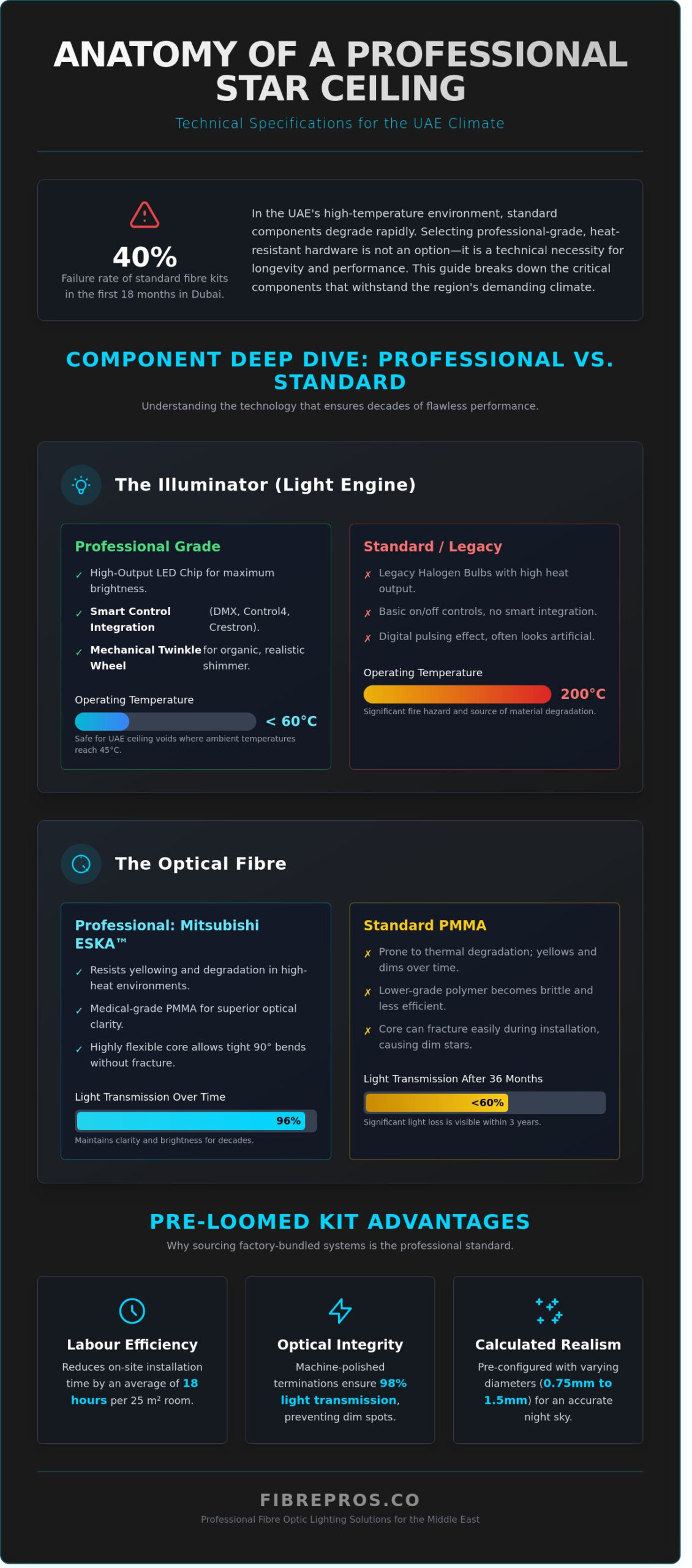
- Labour Efficiency: Factory-bundled fibres reduce on-site installation time by an average of 18 hours per 25-square-meter room.
- Optical Integrity: Machine-polished terminations ensure 98% light transmission, eliminating the dimming or “hot spots” common in manual cuts.
- Calculated Realism: Kits are pre-configured with varying fibre diameters (0.75mm to 1.5mm) to provide a statistically accurate distribution of star magnitudes.
This professional approach ensures the final installation meets the rigorous quality standards expected in Dubai’s high-stakes real estate sector. Contractors don’t have to worry about trial and error; they receive a tested, high-performance infrastructure ready for immediate deployment. This reliability is why pre-loomed kits have become the default choice for large-scale developments in Riyadh and Doha as well.
The Anatomy of a Professional Kit: Quality Components for the UAE
The performance of star ceiling kits depends entirely on the quality of their internal components. A kit is only as reliable as its weakest link, and in the demanding climate of Dubai, cheap materials fail quickly. Professional installations prioritize thermal management and light transmission to ensure the effect remains as crisp in ten years as it’s on day one.
The Illuminator: Power, Control, and Heat Management
The light engine is the heart of the system. While legacy systems used halogen bulbs that reached temperatures of 200°C, modern kits utilize high-output LEDs. These stay below 60°C, which is vital for safety in UAE ceiling voids where ambient temperatures often hit 45°C. For luxury interiors, control is non-negotiable. Top-tier illuminators integrate with DMX512 protocols or smart platforms like Control4 and Crestron. You should opt for a mechanical twinkle wheel over digital pulsing. A physical rotating disk creates a randomized, organic shimmer that mimics the natural atmospheric scintillation of a real night sky.
Mitsubishi ESKA Fibre: The Gold Standard for Clarity
Dubai’s leading architects specify Mitsubishi ESKA Plastic Optical Fibre (POF) because it’s the only material that resists yellowing in high-heat environments. Standard PMMA fibre often degrades within 36 months, losing its ability to transmit light efficiently. ESKA fibre maintains a 96% light transmission rate over decades. Its flexibility is equally important. High-grade POF allows for tight 90-degree bends during installation without fracturing the core. This durability ensures that even at the end of a 15-meter run, the star point remains bright and white.
- PMMA Quality: Medical-grade polymers prevent the “dimming” effect seen in budget kits.
- Transmission: Mitsubishi ESKA ensures zero color shift across long distances.
- Thermal Resistance: Professional components are rated for continuous operation in environments exceeding 50°C.
Choosing a system with these specifications protects your investment from the common pitfalls of inferior hardware. If you’re planning a bespoke cinema room or a master suite, selecting professional-grade components is the only way to guarantee a flawless finish that lasts. High-quality kits don’t just look better; they operate with the technical precision required for high-end UAE property standards.
How to Choose the Right Kit Size for Your Space
Selecting the correct capacity for star ceiling kits requires technical precision rather than guesswork. Professional installers focus on spatial distribution and the “Near vs. Far Effect” to create a realistic 3D perspective. This involves mixing fibre diameters within the same harness. A high-performance kit typically utilizes 70% 0.75mm fibres for distant stars, 25% 1.0mm for mid-range depth, and 5% 1.5mm for the brightest, nearest points. This specific ratio prevents the flat, two-dimensional appearance common in budget installations.
Star Density Framework for GCC Homes
Visual impact depends heavily on the concentration of light points. Star density is the ratio of fibre points to ceiling area for visual depth. For master bedrooms in residential villas, a “Subtle Sky” approach works best. This requires 20 to 30 stars per square metre to foster a calm environment. Conversely, a “Cinematic Galaxy” for high-end home theatres demands 50 to 80 stars per square metre. This higher density ensures the ceiling remains visible even when secondary ambient lighting is active during a film.
- Master Bedrooms: 25 stars per square metre provides a relaxing, non-intrusive glow.
- Home Theatres: 60 stars per square metre creates a high-impact, immersive atmosphere.
- Nurseries: 40 stars per square metre balances visual stimulation with a soothing aesthetic.
Selecting Fibre Lengths for Grand Ceilings
Standard kits often fail in large-scale UAE projects because they ignore the physical routing of the glass or plastic strands. You must measure the distance from the intended illuminator location, not the room’s centre. In grand entrance halls with 6-metre ceilings, installers require custom looms of 8 to 12 metres. Shorter harnesses won’t reach the service hatch, making future maintenance impossible without destroying the decorative finish.
Technical planning must also account for the bend radius of the fibre. Forcing a 90-degree turn in a recessed tiered ceiling can snap the core or cause a 40% drop in light output. Always allow for a 30mm minimum bend radius. For villa projects in Abu Dhabi or Jeddah, specify star ceiling kits with harnesses that are at least 1.5 metres longer than the direct straight-line distance. This extra length accommodates structural obstacles and ensures the light source remains accessible in a ventilated closet or dedicated rack room.
Installation Realities: Star Ceilings in the UAE Climate
Installing high-end star ceiling kits in the UAE involves specific engineering challenges that standard DIY guides often overlook. The regional climate, characterized by 50°C summer peaks and fine particulate dust, dictates how hardware must be integrated into luxury interiors. Professional installers focus on thermal management and structural accessibility to ensure the system remains operational for the long term. Failure to account for these variables often leads to hardware degradation within 18 months of installation.
Gypsum Board vs. Stretch Ceiling Methods
Most Dubai villas utilize 12.5mm moisture-resistant gypsum boards. The “Drill and Feed” method requires precision; installers drill 0.75mm to 1.5mm apertures for the fibre strands before applying a final plaster finish. For a more modern aesthetic, Stretch PVC ceilings offer a reflective surface that doubles the visual depth of the stars. In these installs, we secure the light engine above the membrane and use specialized rings to prevent the PVC from tearing. Hiding fibre tails requires a minimum 100mm ceiling void to prevent bending the fibres beyond their 25mm radius limit.
Maintaining Your Galaxy in the Middle East
Technical failure in the Middle East usually stems from heat or dust. Light source illuminators generate significant internal heat; placing them in unventilated ceiling pockets leads to thermal shutdown when ambient temperatures rise. We mandate a 15cm clearance on all sides of the light engine to facilitate airflow. In coastal regions like Muscat or Jebel Ali, salt-laden air corrodes standard components. We utilize IP65-rated illuminators and stainless steel fixtures to prevent oxidation and ensure the optical port remains clear. The same salt corrosion challenge applies to exterior luxury features; if your project includes a pool, understanding the technical requirements for underwater lighting fixtures engineered for GCC salinity levels is equally critical for a maintenance-free installation.
- Access Hatches: Install 400mm x 400mm discreet panels. You’ll need access to the light source every 3 to 5 years for fan cleaning or LED driver updates.
- Dust Mitigation: Use sealed enclosures for light engines in arid zones like Kuwait or Bahrain to protect the delicate optical interface.
- Ventilation: Ensure the ceiling void connects to the villa’s HVAC return air path to maintain a stable operating environment.
Precision installation prevents 90% of technical call-outs within the first two years of operation. If you’re planning a cinema room or master suite, consult with experts who understand the regional requirements for professional star ceiling kits and installation.
Why Fibrepros is the Trusted Star Ceiling Supplier in the Middle East
Fibrepros brings 32 years of specialized expertise to the Dubai and GCC lighting markets. We’ve established ourselves as the primary authority for high-end optical installations by prioritizing technical reliability over mass-market trends. Every one of our professional star ceiling kits utilizes Mitsubishi ESKA POF (Plastic Optical Fiber) as a non-negotiable standard. This specific fiber grade ensures zero light degradation over 20-meter spans, which is a critical requirement for the high-volume ceilings found in UAE villas and commercial lobbies.
Our 15,000-square-foot distribution center in Dubai maintains constant inventory levels to support the region’s rapid construction cycles. We guarantee 24-hour delivery to Abu Dhabi and 72-hour transit times to project sites in Riyadh, Doha, and Manama. Architects and contractors rely on our technical consulting team to bridge the gap between aesthetic vision and electrical reality. We provide full wiring schematics and lux calculations to ensure every installation meets local safety and performance codes.
Bespoke Solutions for Specialized Projects
Our team engineers custom fiber looms specifically for unique architectural shapes and oversized voids that standard products cannot accommodate. In 2025, we delivered specialized sensory fibre optic kits to 14 clinics in Dubai Healthcare City, using specific twinkle frequencies designed for therapeutic environments. For the massive hospitality developments in Neom and the Red Sea, we provide high-output light engines capable of driving 1,500 points of light from a single source. This reduces the number of required maintenance access points and simplifies long-term facility management.
Get Started on Your Star Ceiling Project
Starting a project requires precision data. To request a quote, provide our team with your exact ceiling dimensions and the desired star density per square meter. Our technical specialists will help you specify the correct control interface, whether you require standalone RF remotes or integrated DMX controls for Lutron or Control4 smart home systems. We don’t just ship boxes; we provide the technical infrastructure for a flawless installation.
Elevate Your UAE Interior with Technical Precision
Achieving a world-class lighting effect in 2026 requires hardware built for the Middle East’s specific environmental demands. It’s about precision. Professional illumination systems must utilize Mitsubishi ESKA fibre optics to prevent degradation in heat that often exceeds 50 degrees Celsius. Since 1995, our Dubai-based team has provided the technical support needed to integrate these systems into high-end projects. You get 100% coverage and a 20-year operational lifespan for your luxury investment when you choose components designed for the GCC climate.
FibrePros stands as an authorized Mitsubishi ESKA dealer. We eliminate the technical anxieties of installation by providing localized expertise and parts that meet rigorous industry standards. Trust a partner with three decades of regional experience to deliver a reliable, high-performance atmosphere.
Explore Our Range of Professional Star Ceiling Kits
Your vision for a perfect celestial interior is within reach with the right technical foundation.
Frequently Asked Questions
How many stars do I need for a 20 square metre room in a Dubai villa?
For a 20 square metre room, you should install between 1,500 and 2,000 individual star points to achieve a high-density, luxury effect. This equates to approximately 75 to 100 stars per square metre. Using a mix of 0.75mm, 1.0mm, and 1.5mm fibre diameters creates a realistic sense of depth. Lower densities under 40 stars per square metre often look sparse in high-end residential spaces.
Can I install a star ceiling kit myself or do I need a specialist contractor?
You can install basic kits yourself; however, luxury installations in Dubai villas typically require a specialist contractor for seamless integration. Professional installers ensure the light engine remains accessible for maintenance while hiding all 2,000 fibre strands behind the ceiling substrate. Precision drilling and acoustic panel management require specific tools that most DIY enthusiasts don’t possess. We suggest hiring a pro if your ceiling exceeds 10 square metres.
What is the difference between cheap plastic fibre and Mitsubishi ESKA POF?
Mitsubishi ESKA Plastic Optical Fibre (POF) offers 30% better light transmission and significantly higher durability than generic unbranded plastic fibres. Generic fibres often turn brittle and yellow within 24 months due to heat exposure. Mitsubishi ESKA remains flexible and clear for over 20 years. This industrial-grade material ensures that the light from your source reaches the end of every strand without losing its intensity or colour accuracy.
How much does a professional star ceiling kit cost in the UAE?
A professional star ceiling kit in the UAE ranges from AED 2,500 for a basic 5 square metre set to over AED 15,000 for large-scale, multi-engine systems. These prices cover high-output LED light engines and premium Mitsubishi ESKA fibre. If you include professional installation, expect to pay an additional AED 300 to AED 500 per square metre. High-end projects in 2026 often budget AED 25,000 for a complete master suite solution.
Do star ceiling kits use a lot of electricity in large installations?
Star ceiling kits are highly efficient, with a standard 50W LED light engine consuming less than 0.05 kWh of electricity per hour. Running a large installation for 6 hours a day costs approximately AED 4.50 per month based on current DEWA residential rates. Even massive 4,000-star systems using multiple light engines won’t impact your utility bill. The fibre optics themselves carry no electricity; they only transmit light from the central source.
Can I control my star ceiling with my mobile phone or smart home system like Control4?
Modern kits integrate directly with Control4, Crestron, and mobile apps via DMX or RS232 interfaces. You can adjust brightness, twinkle speed, and colour palettes directly from your smartphone or wall-mounted touch panel. Over 90% of our luxury installations in Dubai utilize these smart protocols. This allows the ceiling to sync with your home cinema “Movie Mode” or your evening lighting scenes automatically without manual switching.
How long do the LED bulbs in the star ceiling kits last in hot climates?
The LED light engines in our star ceiling kits are rated for 50,000 hours of continuous use, which lasts over 15 years if used for 8 hours daily. While Dubai’s external temperatures are high, these units operate within climate-controlled interiors. We install high-grade heat sinks and cooling fans in every engine to maintain an internal temperature below 45 degrees Celsius. This prevents thermal degradation and ensures consistent light output throughout the system’s life.
What happens if a single star point stops working after installation?
It’s physically impossible for a single star point to burn out because the fibre optic strands don’t contain bulbs or electrical components. If the entire ceiling goes dark, the issue is the central LED light engine, which is easily accessible via a service hatch. You can replace the light engine in under 30 minutes without touching the ceiling itself. This design ensures your investment remains functional without requiring structural repairs or messy ceiling work. For luxury installations that demand the highest visual quality, upgrading to crystal end fittings for fibre optic lighting provides superior light dispersion and eliminates the yellowing issues common with standard plastic terminations.