
In the 50°C peak temperatures of a Dubai summer, the difference between a world-class architectural installation and a maintenance nightmare isn’t the light source, it’s the polymer. You’ve likely seen high-end projects where the glow fades or the fibres yellow within the first 400 days because the material couldn’t handle the thermal stress. It’s a frustrating reality for developers who invest in luxury aesthetics only to see them degrade. When sourcing the plastic optical fibre UAE developers trust for high-heat environments, technical resilience must be the starting point, not an afterthought.
We agree that a lighting system should remain as brilliant on day 1,000 as it was at the grand opening. This case study reveals why Mitsubishi ESKA plastic optical fibre is the definitive choice for the UAE’s most prestigious sensory and architectural designs. You’ll discover the specific technical data that justifies its use in professional tenders and learn how local Dubai-based expertise eliminates the risk of poor light transmission. We’re looking at the exact performance metrics and installation standards that keep high-end infrastructure vibrant for years.
Key Takeaways
- Understand why PMMA-based Mitsubishi ESKA is the industry standard for maintaining high performance in extreme 50°C+ ambient temperatures.
- Examine a real-world case study of a “Starry Night” luxury hotel lobby in Dubai to see how specialized fibre manages 24/7 high-traffic demands.
- Learn how to avoid the hidden costs of generic alternatives by analyzing long-term light loss and maintenance requirements in the plastic optical fibre UAE market.
- Discover the operational advantages of partnering with a specialist supplier for end-to-end design consultation and technical support.
Understanding Plastic Optical Fibre (POF) in the UAE Market
Plastic Optical Fibre (POF) represents a specialized shift in how regional developers approach illumination. Unlike standard silica glass fibre, POF utilizes a polymethyl methacrylate (PMMA) core. This polymer construction offers a flexible, durable alternative that withstands the physical demands of high-end construction. It’s vital to distinguish between data-grade fibre and decorative plastic optical fibre UAE. While communication lines focus on signal integrity, decorative POF is engineered for light transmission, either through the tip (end-glow) or along the cable’s length (side-glow).
The UAE market has seen a 15% annual increase in fibre optic lighting specifications since 2022. This growth stems from the material’s unique performance profile in desert climates. Designers prioritize these systems for four primary reasons:
- Electrical Safety: Since the fibre carries only light and no current, it’s the standard for wet areas like luxury spas and infinity pools.
- Thermal Management: The light source, or illuminator, is housed in a remote, ventilated location. This ensures zero heat at the output point, protecting delicate architectural finishes.
- UV Stability: High-grade POF now features UV-resistant cladding that prevents yellowing for over 10 years, even in high-exposure environments.
- Mechanical Strength: The material doesn’t shatter under vibration or minor structural shifting.
The Growth of Architectural Lighting in Dubai and Abu Dhabi
Dubai’s 2026 Smart City roadmap emphasizes integrated, low-energy lighting solutions. Professional architects in the region specify plastic optical fibre UAE to achieve the “seamless glow” aesthetic found in iconic landmarks. Because POF handles ambient temperatures up to 80°C without degrading, it’s the reliable choice for exterior facades and unconditioned interior voids. Project managers in Abu Dhabi increasingly use these systems to reduce maintenance cycles; you only ever need to service the remote light engine, not the architectural feature itself.
POF vs. Glass Fibre: A Regional Perspective
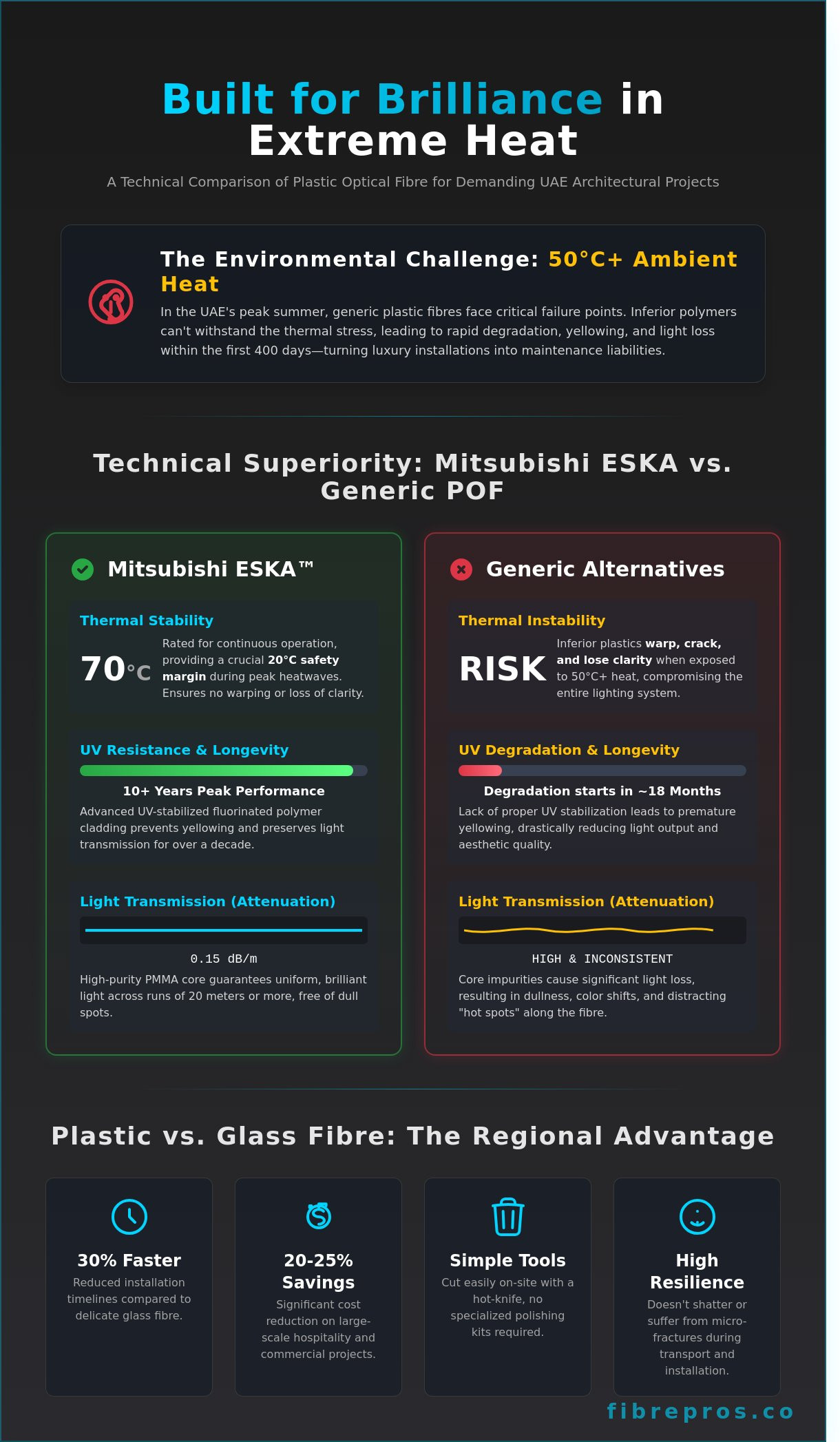
Installation efficiency is where POF outperforms glass in the GCC. Local contractors prefer plastic because it’s cut with simple hot-knives on-site, whereas glass requires precision polishing and specialized kits. This flexibility reduces installation timelines by roughly 30%. From a budget perspective, POF offers a 20% to 25% cost saving on large-scale hospitality projects. It’s also far more resilient during transport across rugged construction sites; it doesn’t suffer from the micro-fractures that compromise glass fibre’s light output over time. For a comprehensive technical comparison of plastic vs glass optical fibre for Dubai lighting projects, the material choice often determines whether your installation achieves a 12-year lifespan or requires replacement within 24 months.
Technical Superiority: Why Mitsubishi ESKA is the Industry Standard
Mitsubishi ESKA sets the benchmark for plastic optical fibre UAE projects through its advanced Polymethyl Methacrylate (PMMA) core. This high-purity polymer is engineered for maximum transparency, allowing light to travel long distances with minimal loss. While generic fibres often suffer from impurities that cause “hot spots” or dullness, ESKA maintains a consistent 0.15 dB/m attenuation rate. This precision is vital for luxury villas where architectural lighting must remain uniform across 20-meter runs.
Reliability in extreme environments is a non-negotiable requirement for regional infrastructure. Ambient temperatures in Dubai and Abu Dhabi regularly exceed 50°C, which can cause inferior plastics to warp or lose clarity. ESKA fibres are rated for continuous operation at 70°C; this provides a 20°C safety margin that protects your investment during the hottest months. This thermal stability ensures the fibre doesn’t become brittle, preserving its tight bend radius of 10 times the fibre diameter for complex star ceiling installations.
Mitsubishi ESKA Specifications for the Middle East
The durability of ESKA stems from its fluorinated polymer cladding. This outer layer protects the PMMA core while maintaining the internal reflection necessary for high-performance lighting. Unlike standard options, this cladding is UV-stabilized to prevent the yellowing effect that typically appears in lower-quality fibres after 18 months of exposure. The optimal operating range for Mitsubishi ESKA POF in UAE outdoor settings is between -55°C and +70°C. Our team at FibrePros ensures every installation adheres to these thermal limits to guarantee a 10-year peak performance window.
End-Glow vs. Side-Glow: Technical Applications
Choosing the correct fibre type determines the success of the architectural effect. End-glow fibre is the standard for star ceilings and bespoke chandeliers, as it’s designed to carry light specifically to the tip. Side-glow fibre uses a modified cladding that allows light to escape evenly along the entire length of the strand. This is the preferred choice for perimeter lighting and illuminating pool edges where a neon-like glow is required. The Pros at FibrePros specialize in matching specific fibre grades to your project requirements, ensuring the technical specifications align with the desired visual outcome.
Case Study: Lighting a Five-Star Hotel Lobby in Dubai
In early 2023, a prominent hospitality group in Downtown Dubai commissioned a 300-square-metre “Starry Night” installation for their main atrium. This project required a lighting solution capable of 24/7 operation while maintaining the elite aesthetic standards of a five-star environment. The technical team selected plastic optical fibre UAE systems to deliver light without heat or electrical conductivity at the ceiling surface. This approach solved the primary challenge of heat gain in a climate-controlled lobby where cooling efficiency is a priority.
- Project Scope: 300m² atrium ceiling with 12,000 individual light points.
- Hardware: Mitsubishi ESKA POF paired with high-output LED illuminators.
- Control System: DMX512 integration for automated scene transitions.
- Longevity: Maintenance-free installation with a projected 12-year lifespan.
Design and Specification Phase
The architectural team calculated a density of 40 fibres per square metre to create the necessary visual depth. They specified Mitsubishi ESKA POF because its flexibility allows for tight bend radii in congested ceiling voids. To prepare for 2026 energy efficiency standards, the project used 100W LED engines that produce 150 lumens per watt. These illuminators sit in remote, ventilated cabinets. This setup allows for easy access without disrupting hotel guests. DMX controls enable the lobby to shift from a warm “Golden Hour” glow at 6:00 PM to a deep “Midnight Blue” by 11:00 PM.
Installation and Performance in Dubai
Installation occurred during the 2023 summer peak, where site temperatures reached 45°C before the HVAC systems were fully operational. The durability of plastic optical fibre UAE ensured the infrastructure didn’t degrade during this high-heat construction phase. Installers fitted each fibre end with precision-cut crystal fittings to achieve a “diamond” sparkle effect that mimics a natural night sky.
The results are measurable. Post-installation audits show a 40% reduction in lighting-related energy consumption compared to the hotel’s previous halogen systems. Because the light source is remote, there’s zero heat transfer to the lobby air, reducing the load on the cooling plant. The hotel’s facility manager reports that zero ceiling-level maintenance has been required since the January 2024 launch. It’s a professional, reliable solution that meets the rigorous demands of Dubai’s luxury sector.
Comparative Analysis: Premium POF vs. Generic Alternatives
Procuring plastic optical fibre UAE projects often presents a choice between upfront savings and long-term reliability. Cheap, generic alternatives frequently suffer from rapid attenuation, where light transmission drops by as much as 40% within the first 60 months of operation. In contrast, premium PMMA (Polymethyl Methacrylate) cores maintain 95% of their initial brightness over the same period. This performance gap isn’t just aesthetic; it directly impacts the efficiency and visual impact of the entire lighting system.
Safety remains a non-negotiable factor in the UAE’s high-rise sector. Generic fibers often lack the rigorous fire ratings required by UAE Civil Defense. Premium options meet UL94-V0 flammability standards and utilize Low Smoke Zero Halogen (LSZH) jacketing. These materials prevent the release of toxic gases during a fire, which is a critical requirement for commercial installations in Dubai and Abu Dhabi where building codes are strictly enforced.
Evaluating the Total Cost of Ownership (TCO)
Luxury properties cannot afford frequent maintenance shutdowns. While generic fiber might save 15% on initial material costs, the “hidden costs” of replacement labor and scaffolding for high-ceiling installations quickly erase those gains. High-quality plastic optical fibre UAE installations typically reduce the need for corrective site visits by 70% over a ten-year cycle because the material doesn’t become brittle. Superior fiber also protects the LED illuminator; consistent light transmission prevents the heat buildup that occurs when an engine works harder to compensate for degrading fiber.
How to Spot Low-Quality Fibre in the UAE Market
Experienced contractors identify substandard fiber through simple visual checks. Low-grade material often shows a slight yellow tint or inconsistent cladding thickness, which leads to “hot spots” along the run. You should also verify that the product isn’t communications-grade fiber repurposed for lighting, as these have different spectral properties. Genuine Mitsubishi ESKA certification is the industry benchmark for architectural applications. It ensures the fiber handles the tight bend radii common in intricate luxury designs without fracturing or losing light intensity. Understanding the fundamental differences in plastic vs glass optical fibre performance in Dubai’s extreme climate helps prevent costly material failures that require complete system replacement.
Ensure your lighting infrastructure meets global standards by choosing the professional plastic optical fibre solutions offered by our specialist team.
Sourcing and Implementation: The FibrePros Advantage
Success in high-end architectural projects depends on more than just high-quality materials. It requires a technical partner who understands the environmental demands of the Middle East. FibrePros serves as the primary specialist supplier for Mitsubishi ESKA plastic optical fibre UAE, ensuring your project utilizes the world’s most reliable PMMA fibre. We move beyond simple distribution by providing comprehensive design consultation and technical support directly from our Dubai operations base. Our team assists with light engine selection and fibre sizing to ensure optimal lumen output across every run, regardless of the project scale.
Local Expertise in Dubai and the Northern Emirates
Fast-track UAE projects can’t afford the 4 to 6 week lead times often associated with international shipping. We maintain significant local stock in Dubai to support immediate site requirements. Our 32-year history in the Middle East lighting sector allows us to anticipate technical challenges before they arise on-site. We work alongside MEP contractors and specialist installers to ensure every installation meets our rigorous “Pro” standards. It’s a local presence that means technical spec sheets and project-specific advice are available in your time zone, preventing costly delays in the construction schedule.
Contact Us for Your Next Architectural Project
We supply a diverse range of configurations to suit any luxury application. This includes everything from ultra-fine 0.25mm single strands for delicate star maps to heavy-duty multi-core cables for bold architectural outlines. Our custom-engineered kits for star ceilings and sensory environments arrive pre-cut and pre-terminated to reduce on-site labor costs by up to 25%. These solutions are specifically tested for the high-ambient temperatures common in the GCC, ensuring long-term durability without yellowing or brittleness.
We provide reliable logistics across the region, serving key hubs including Abu Dhabi, Riyadh, Doha, and Muscat. Our logistics network ensures that 95% of regional orders reach their destination within 3 to 5 business days. You can consult with the FibrePros team for your UAE project today to receive a detailed quote or a technical spec sheet for your plastic optical fibre UAE requirements. Our experts are ready to transform your architectural vision into a technically sound, high-performance reality.
Future-Proof Your Architectural Lighting Strategy
Luxury architectural lighting in the Middle East demands technical endurance. Selecting high-performance plastic optical fibre UAE solutions ensures that decorative installations maintain their brilliance without the frequent maintenance cycles associated with generic alternatives. Mitsubishi ESKA remains the industry benchmark for light transmission efficiency and long-term durability. Since 1995, FibrePros has delivered these specialized solutions across the region, bridging the gap between complex engineering and high-end design. We’ve spent 29 years refining our approach to five-star hotel lobbies and landmark structures. You don’t have to settle for inferior materials that degrade under thermal stress. As an official supplier of Mitsubishi ESKA POF, we provide the precision components your project requires for 100% reliability. We’re ready to help you implement an infrastructure that stands the test of time. Let’s build a lighting system that reflects the true quality of your architectural vision. We look forward to bringing your next masterpiece to life.
Request a Technical Consultation for Your UAE Project
Frequently Asked Questions
Is plastic optical fibre safe for use in UAE swimming pools?
Plastic optical fibre is 100% safe for UAE swimming pools because the system carries zero electrical current through the water. The light source stays in a dry plant room while the fibre optics transmit pure light to the pool. This eliminates the risk of electrical shock. We use IP68-rated stainless steel fittings to ensure a watertight seal that lasts for 15 years or more in chlorinated water.
How long does Mitsubishi ESKA plastic optical fibre last in the Dubai heat?
Mitsubishi ESKA plastic optical fibre UAE installations typically last over 20 years when properly maintained. The PMMA core is rated for continuous operation at temperatures up to 70°C, which exceeds the standard 50°C peak summer heat in Dubai. Our technicians use UV-stabilized polyethylene jackets to prevent the fibre from becoming brittle. This ensures the lighting remains bright and clear for two decades.
Can I use POF for outdoor landscape lighting in Abu Dhabi?
You can certainly use POF for landscape lighting in Abu Dhabi. It’s a superior choice because the material doesn’t corrode in the high-salinity air found in coastal areas like Saadiyat Island. Unlike traditional copper wiring, POF doesn’t require heavy conduits to prevent oxidation. It handles sand abrasion effectively, maintaining its structural integrity in 100% humidity environments throughout the summer months.
What is the difference between POF and glass fibre for architectural lighting?
The primary difference is flexibility and durability during installation. Plastic optical fibre has a tight 20mm bend radius, while glass fibre is brittle and prone to snapping if bent past 45 degrees. POF is also 30% lighter and costs roughly 25% less per meter than glass equivalents. While glass offers slightly higher light transmission over 20 meters, POF is the professional choice for most architectural projects.
How much does a star ceiling kit cost in Dubai?
A professional-grade star ceiling kit in Dubai starts at AED 1,850 for a 300-point system. This entry-level price includes a 5W LED illuminator and 3 meters of varying fibre diameters to create a realistic 3D effect. High-end residential projects often require custom configurations that can reach AED 12,000. These premium systems include DMX controls and 1,000+ individual points of light for a dense galactic appearance.
Does FibrePros provide installation services for POF in the UAE?
FibrePros provides comprehensive, end-to-end installation services for all plastic optical fibre UAE projects. Our team handles everything from initial site surveys to the final light intensity testing. We employ certified technicians who specialize in precise fibre termination and splicing. Every installation comes with a 24-month warranty on workmanship, ensuring your architectural lighting system operates at peak efficiency from day one.
Can POF be used for sensory rooms in schools across the GCC?
POF is the safest and most effective solution for sensory rooms in schools across the GCC. It’s used in 55 specialized education centers across Dubai and Abu Dhabi because it emits no heat or electricity at the point of contact. Children can safely touch and hold the glowing fibres during therapy sessions. The material is non-toxic and phthalate-free, meeting the strict safety standards required for educational facilities.
What LED illuminators are compatible with Mitsubishi ESKA fibre?
Mitsubishi ESKA fibre is compatible with a wide range of LED illuminators, specifically those utilizing Mean Well drivers and Cree LED chips. We recommend units ranging from 30W to 100W for maximum brightness. These illuminators integrate seamlessly with Dali or DMX512 control protocols for complex lighting sequences. Using the correct coupling head ensures 95% light transfer efficiency into the fibre bundle, preventing heat buildup at the port.