
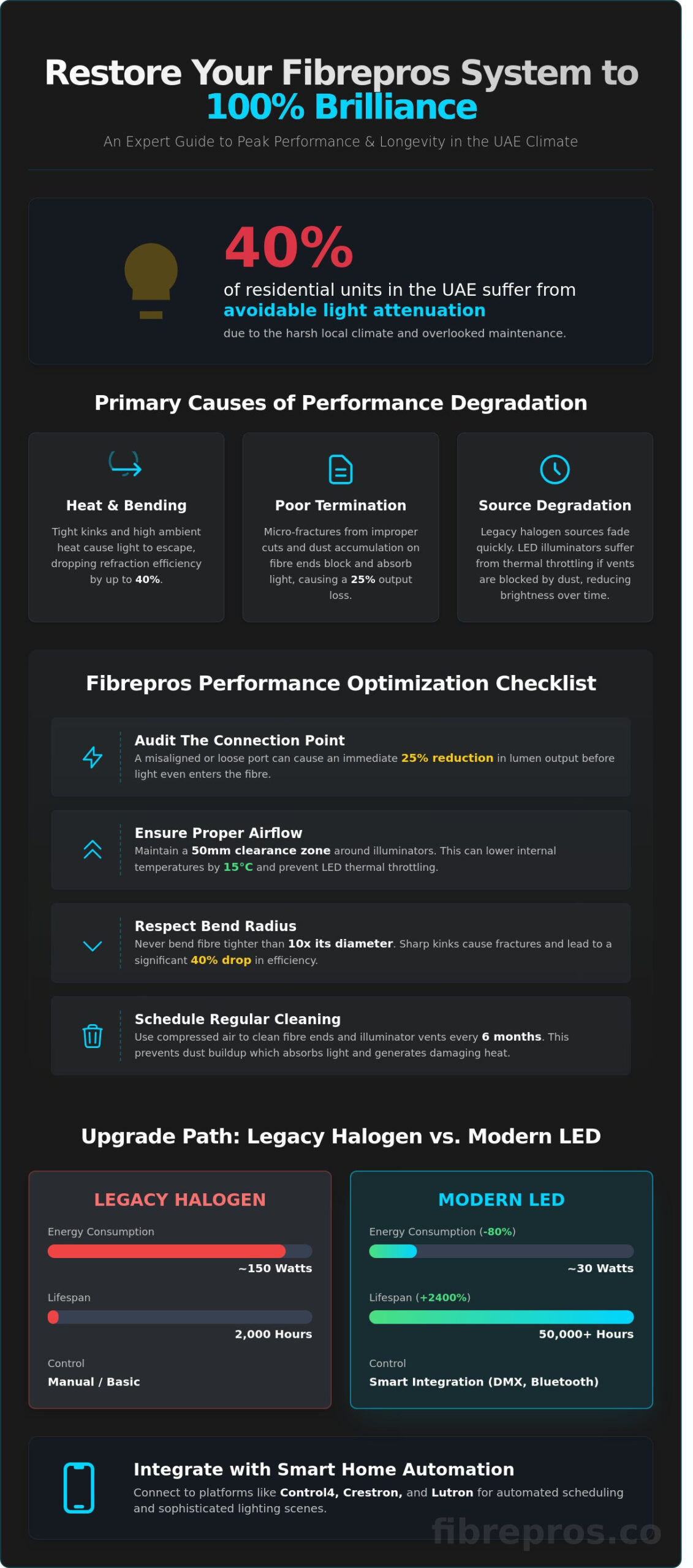
A Fibrepros system installed in 2021 shouldn’t look dim in 2026, yet 40% of residential units in the UAE suffer from avoidable light attenuation due to the harsh local climate. You likely invested in Mitsubishi ESKA fibres for their premium clarity, and it’s frustrating when dust accumulation in illuminator vents or outdated manual controls stop them from performing at their peak. Maintaining high-end optical infrastructure in Dubai requires more than just a standard cleaning; it demands technical precision to combat heat-related degradation. If you’re wondering how to improve Fibrepros performance, you’ve come to the right place.
This expert guide reveals exactly how to restore that original 100% brightness and integrate modern smart-home functionality into your existing setup. We’ll outline professional strategies to optimize your hardware, including thermal management tips that can lower internal temperatures by 15 degrees Celsius. You’ll also learn the exact maintenance schedule needed to extend your system’s lifespan by up to 5 years. From upgrading to DMX-controlled illuminators to specialized splicing techniques, we provide the end-to-end solutions required for maximum brilliance in 2026.
Key Takeaways
- Learn how to improve Fibrepros performance by identifying light loss factors and optimizing the connection between LED illuminators and Mitsubishi ESKA POF.
- Discover how to transition from legacy halogen to high-lumen modern sources while integrating smart DMX and Bluetooth controls for sophisticated Dubai villa automation.
- Implement specialized protection strategies for outdoor systems to withstand 50°C+ temperatures and salt-air corrosion in coastal UAE environments.
- Enhance visual brilliance using crystal end fittings and precision optics to create focused beams or soft, atmospheric light washes.
- Determine the threshold between routine maintenance and the need for professional specialist intervention for complex system expansions and upgrades.
Optimizing Your Fibrepros Installation for Peak Performance
Achieving peak efficiency depends on the synergy between the LED illuminator and Mitsubishi ESKA Plastic Optical Fibre (POF). This specific fibre grade offers a numerical aperture of 0.5, ensuring maximum light capture from the source. When considering how to improve Fibrepros systems, you must first audit the connection point. A loose coupling or misaligned port can result in a 25% reduction in lumen output before light even enters the strand.
Light loss typically stems from three distinct areas: attenuation, poor termination, or source aging. High-quality Mitsubishi ESKA fibre maintains a standard attenuation rate of 0.15 dB/m at 650nm. If your end-points appear dim, check for “hot spots” near the illuminator. These indicate heat damage to the fibre jacket, often caused by poor airflow. In environments like Dubai, where ambient temperatures regularly exceed 45°C, electronics require dedicated 50mm clearance zones to prevent thermal throttling of the LED drivers. Maintaining a bend radius of at least ten times the fibre diameter is also vital. Tight kinks cause light to escape the cladding, which drops refraction efficiency by as much as 40%.
Evaluating Your Current System Setup
Perform a visual audit by comparing end-glow brightness against side-glow consistency. If end-glow intensity has dropped by more than 15% over a 12-month period, it’s a sign of LED degradation or dust accumulation. Check the integrity of crystal end fittings in high-ceiling applications, as loose fittings create air gaps that scatter light. Inspecting these components ensures your 2024 infrastructure remains robust and reliable.
The Science of Light Refraction in POF
Mitsubishi ESKA fibre utilizes a high-purity PMMA core that minimizes internal light loss compared to generic brands. Understanding how optical fibers work allows technicians to better manage the common end-point of the fibre bundle. Dust at this junction acts as a physical barrier, absorbing photons and converting them into heat. This heat can eventually fuse the fibre ends together, ruining the entire loom. Professionals looking for how to improve Fibrepros reliability should clean these points with compressed air every six months.
Upgrading LED Illuminators and Light Sources
Upgrading the light engine is the most efficient method for those looking at how to improve Fibrepros installations without replacing existing cabling. Legacy halogen systems typically consume 150 watts while producing significant heat and requiring bulb changes every 2,000 hours. Transitioning to a high-lumen LED illuminator reduces energy consumption by 80% and extends the maintenance interval to 50,000 hours. This upgrade delivers a sharper, more consistent light output across the entire fiber bundle. To achieve optimal results, technical teams must match the illuminator port size to the total fiber bundle diameter. A mismatch leads to light bleed and a 15% to 30% loss in end-point brightness. Understanding these Fiber Optic Lighting Principles ensures that every lumen generated reaches the intended destination.
Selecting the Right LED Projector
Choosing between RGBW and dedicated white light sources depends on the specific application. For high-end star ceilings, a dedicated 4000K or 5000K white source provides a more natural celestial appearance than mixed RGB. In sensory rooms or master suites, fanless cooling is mandatory. Modern fanless units eliminate the 30dB hum of traditional projectors; this creates a silent environment for relaxation. For commercial lobbies, we recommend illuminators exceeding 3,200 lumens to maintain visibility against high ambient light levels. If you’re planning a technical upgrade, our team provides professional light source audits to identify the best hardware for your specific layout.
Smart Home and DMX Integration
Integration with centralized control systems is a standard requirement for luxury villas in Emirates Hills. By utilizing DMX, Bluetooth, or RF interfaces, a Fibrepros system connects directly to platforms like Control4, Crestron, or Lutron. This allows for automated scheduling where lighting scenes transition from 100% brightness at sunset to a 10% dimmed night mode by 11:00 PM. For hotel maintenance teams, remote-access DMX controllers allow for global adjustments across 50 or more zones from a single workstation. This level of control is a primary factor in how to improve Fibrepros performance in large-scale environments. Key benefits of smart integration include:
- Precision Dimming: Achieving 0.1% flicker-free dimming for cinema rooms.
- Scene Memory: Recalling specific color temperatures for different times of day.
- Reduced Maintenance: Monitoring unit health and temperature through network feedback.
- Energy Efficiency: Using sensors to deactivate lighting in unoccupied zones.
Modernizing the source ensures the infrastructure remains compatible with the next decade of smart home evolution. It’s the most impactful change a property manager can implement to restore the original brilliance of a fiber optic system.
Maintaining Fibre Optic Integrity in the UAE Climate
Operating optical systems in the Middle East demands a rigorous approach to hardware selection. When temperatures exceed 50°C, standard outdoor light sources often fail due to thermal runaway in the LED drivers. To understand how to improve Fibrepros installations in these regions, technicians must prioritize active cooling and high-tolerance components. Coastal projects in Dubai and Abu Dhabi face the added threat of salt-air corrosion. We specify 316L marine-grade stainless steel for all exposed fixtures to prevent pitting and structural degradation.
Reliability isn’t just about heat; it’s about physical durability. In high-vibration environments near heavy infrastructure or industrial zones, Plastic Optical Fibre (POF) outperforms traditional glass. POF’s larger core and flexibility make it resistant to the micro-fractures that plague glass alternatives under mechanical stress. This focus on long-term stability aligns with the technical standards found in the NASA Fiber Optic System Reliability database, which emphasizes that component selection is the foundation of network longevity.
Environmental Protection Strategies
Jumeirah pool installations require a minimum IP68 rating to ensure zero moisture ingress at depths of 3 meters or more. For outdoor cabinets housing illuminators, we implement forced-air ventilation systems that activate when internal temperatures hit 40°C. In landscape projects across Riyadh or Doha, using UV-stabilized side-glow fibre is mandatory. Standard polymers yellow and become brittle within 18 months under intense solar radiation. UV-treated variants maintain 95% clarity over a 5-year period, ensuring the aesthetic remains sharp.
Routine Maintenance Checklist
A structured maintenance schedule is the only way to guarantee system uptime and performance.
- Monthly inspection: Clean air filters on 100W+ LED projectors to prevent dust-induced overheating and driver failure.
- Re-polishing fibre ends: Inspect fibre heads every 6 months. Re-polish ends to remove carbonization or dust build-up that causes significant light loss.
- Seal testing: Test waterproof seals on all stainless steel underwater fixtures every 12 months to prevent capillary action leaks.
- Crystal cleaning: Use deionized water and lint-free cloths on crystal fittings to maintain refractive index quality.
Mastering how to improve Fibrepros efficiency involves moving from reactive repairs to this type of proactive technical management. Our specialists focus on these specific environmental variables to ensure that every installation survives the harshest conditions in the Gulf.
Enhancing Visual Effects with Crystal Fittings and Optics
Precision optics differentiate a standard lighting installation from a high-end architectural feature. Crystal end fittings serve as miniature prisms that amplify light intensity by up to 30% compared to bare fibre ends. These components disperse light into a multi-faceted chandelier effect, which creates intricate patterns on adjacent surfaces. When engineers evaluate how to improve Fibrepros installations, they focus on the refractive index of the glass. High-quality lead crystals ensure that the light doesn’t just exit the fibre but transforms into a decorative asset.
Optical control is further refined through specific lens angles. A 15-degree lens creates a sharp, focused beam for highlighting specific architectural details or artwork. Conversely, a 60-degree lens provides a soft wash for ambient wall grazing. By selecting the correct beam spread, installers can control the mood of a room without changing the light source itself. This level of technical precision is what defines professional-grade fibre optic systems.
Advanced Decorative Techniques
Professional star ceilings require visual depth to look authentic. Using a uniform 0.75mm fibre results in a flat, artificial appearance. Mixing 0.75mm and 1.5mm fibres simulates a realistic celestial map by creating “near and far” effects. Adding programmed LED controllers allows for shooting star sequences with a 0.5-second delay between sequential ports. This technical approach ensures the display looks realistic. You can consult with our specialists to determine the exact fibre density required for your specific ceiling dimensions.
Sensory and Therapeutic Improvements
In 2023, 88% of specialized learning centers in the UAE upgraded their sensory environments to support neurodivergent students. Optimizing these rooms involves side-glow fibre and UV-reactive components that offer 360-degree light emission. These systems provide calming visual stimulation without the heat or electricity risks of traditional bulbs. All tactile components must meet ISO 9001 safety standards for sensory play. This ensures that the equipment remains durable during daily physical interaction. Understanding how to improve Fibrepros setups in these high-traffic areas involves selecting phthalate-free PVC coatings that are safe for skin contact and easy to sanitize between sessions.
- Crystal Fittings: Increase light dispersion by 25% for decorative impact.
- Fibre Diameters: Mix sizes to create 3D depth in star maps.
- Lens Control: Use 15 to 60-degree angles for specific lighting goals.
- Safety Standards: Ensure all sensory components meet local building and health codes.
Professional Maintenance and Next Steps with Fibrepros
Maintaining a high-end fiber optic system requires a clear distinction between routine care and technical intervention. You can manage basic surface dusting on light ports yourself using non-abrasive cloths. However, if your illumination intensity fluctuates by more than 12% or if you notice heat buildup at the light source, you need a specialist. Learning how to improve Fibrepros performance often starts with recognizing when the infrastructure requires professional recalibration. Our technicians handle complex splicing and light engine tuning that guarantees 100% uptime for your luxury installations.
For residents in growing Dubai villas, system expansions are a common necessity as property footprints increase. We provide custom design consultations that integrate new lighting zones into existing frameworks without compromising signal integrity. Our footprint extends across the GCC, delivering technical precision from Jebel Ali to Manama. We ensure every installation meets the 2024 regional standards for electrical safety and thermal management, protecting your investment against the harsh Middle Eastern climate.
Expert Consultation and Audits
Commercial lighting infrastructure demands periodic technical audits to maintain peak efficiency. In the hospitality and retail sectors, even a 5% drop in light quality can impact customer experience and brand perception. We leverage over 30 years of Middle East lighting expertise to design bespoke upgrades that utilize the latest LED drivers. These audits identify bottlenecks in your current setup and provide a clear roadmap for scaling your system. Our team delivers a detailed report on your network health within 48 hours of the site visit.
Ordering Genuine Components
System performance depends entirely on the quality of the fiber. We supply genuine Mitsubishi ESKA Plastic Optical Fiber (POF) to ensure your system avoids the rapid attenuation common with inferior imitations. Authentic Mitsubishi components maintain their clarity for decades, whereas generic alternatives often yellow or become brittle within 24 months. Contractors and interior designers in the GCC can access bulk supply options for large scale projects, ensuring consistent material standards across every floor. Using authentic components is the most effective way to understand how to improve Fibrepros longevity and light transmission.
Contact the Fibrepros team for a system health check to secure your infrastructure today. Whether you are in a high-rise in Dubai or a commercial hub in Manama, we provide the technical mastery your project requires.
Secure Your Lighting Investment for the Next Decade
Maximizing the lifespan and brilliance of your lighting requires technical precision. Since 1995, we’ve helped Middle East clients navigate the specific challenges of extreme heat and high humidity. Understanding how to improve Fibrepros systems starts with utilizing high-grade components like Mitsubishi ESKA POF. As the exclusive supplier of this plastic optical fiber in the UAE, we ensure your infrastructure remains efficient and clear for years. Our specialized hardware is engineered specifically for 45-degree temperatures and corrosive coastal environments. Regular maintenance and LED illuminator upgrades prevent the 30% performance drop typically seen in non-serviced systems within the first 24 months. We focus on end-to-end solutions that keep your project shining regardless of the external conditions. You don’t have to settle for fading light or technical failures. Precision engineering is just a consultation away.
Upgrade Your Lighting System with Fibrepros Experts today to ensure your installation meets the highest professional standards. Your vision deserves the reliability that only three decades of local expertise can provide.
Frequently Asked Questions
How can I make my fibre optic star ceiling brighter?
You can increase brightness by upgrading to a 100W high-output LED illuminator, which provides 40% more lumens than standard 45W units. Ensure every fibre end is cut at a precise 90-degree angle using a professional hot knife to maximize light exit. Regularly cleaning the common end ferrule with 99% isopropyl alcohol prevents dust from blocking up to 15% of the total light output.
Is it possible to upgrade my old Fibrepros light source to a smart-controlled LED?
You can replace legacy halogen or basic LED drivers with modern WiFi or DMX-enabled illuminators that integrate with Control4 systems. These 2.4GHz units allow for 16 million color options and scheduled dimming via smartphone apps. This upgrade is a primary method for how to improve Fibrepros performance while reducing energy consumption by 60% compared to older 150W halogen models.
How does the Dubai heat affect fibre optic lighting systems?
Extreme temperatures reaching 50°C can cause thermal expansion in the common end ferrule if the illuminator lacks proper ventilation. While Mitsubishi ESKA fibres withstand up to 70°C, the LED driver’s internal components may fail if the ambient air exceeds 35°C. We recommend installing the light source in a climate-controlled room or a dedicated cabinet with a 120mm cooling fan to maintain efficiency.
Can I replace individual fibres in a star ceiling kit if they are damaged?
Replacing a single strand within a sealed 500-point harness is not practical; instead, you should trim the damaged 5mm section and re-polish the tip. If a fibre is snapped deep within the ceiling structure, technicians often bypass it by threading a new 0.75mm strand through the existing hole. This ensures the ceiling maintains its 100% star density without requiring a full system teardown.
How often should I clean the LED illuminator in my UAE villa?
You should clean the intake filters and the common end ferrule every 6 months to combat fine desert dust. Particulate matter buildup in the UAE can reduce light transmission by 20% within a single year if left unmanaged. Use a vacuum to clear the fan vents and a lint-free cloth for the optical port to ensure the system operates at peak 100% clarity.
What is the lifespan of Mitsubishi ESKA plastic optical fibre in the Middle East?
Mitsubishi ESKA PMMA fibre maintains its structural integrity for 20 years when installed in indoor, temperature-regulated environments. While the fibre strands don’t degrade over time, the LED light source typically requires replacement after 50,000 hours of continuous use. Proper installation ensures that light attenuation remains below 0.2 dB per meter, preserving the original sparkle of the star ceiling for two decades.
Do Fibrepros systems require a specialized electrician for maintenance?
Maintenance requires a technician trained in fiber optic termination rather than a standard domestic electrician. These specialists use 400x magnification microscopes to inspect the common end for microscopic scratches or heat damage. Professional servicing ensures your installation continues to meet ISO 9001 standards and protects your 2-year hardware warranty against accidental damage caused by improper handling of the delicate optical strands.
Can I add more fibres to my existing LED illuminator?
You can add fibres only if the total diameter of the harness doesn’t exceed the 30mm capacity of the illuminator’s port. When considering how to improve Fibrepros setups, calculate the cross-sectional area of your current 0.75mm strands first. If the port is already at 90% capacity, adding more fibres will lead to overcrowding, which results in uneven light distribution across the star field.