
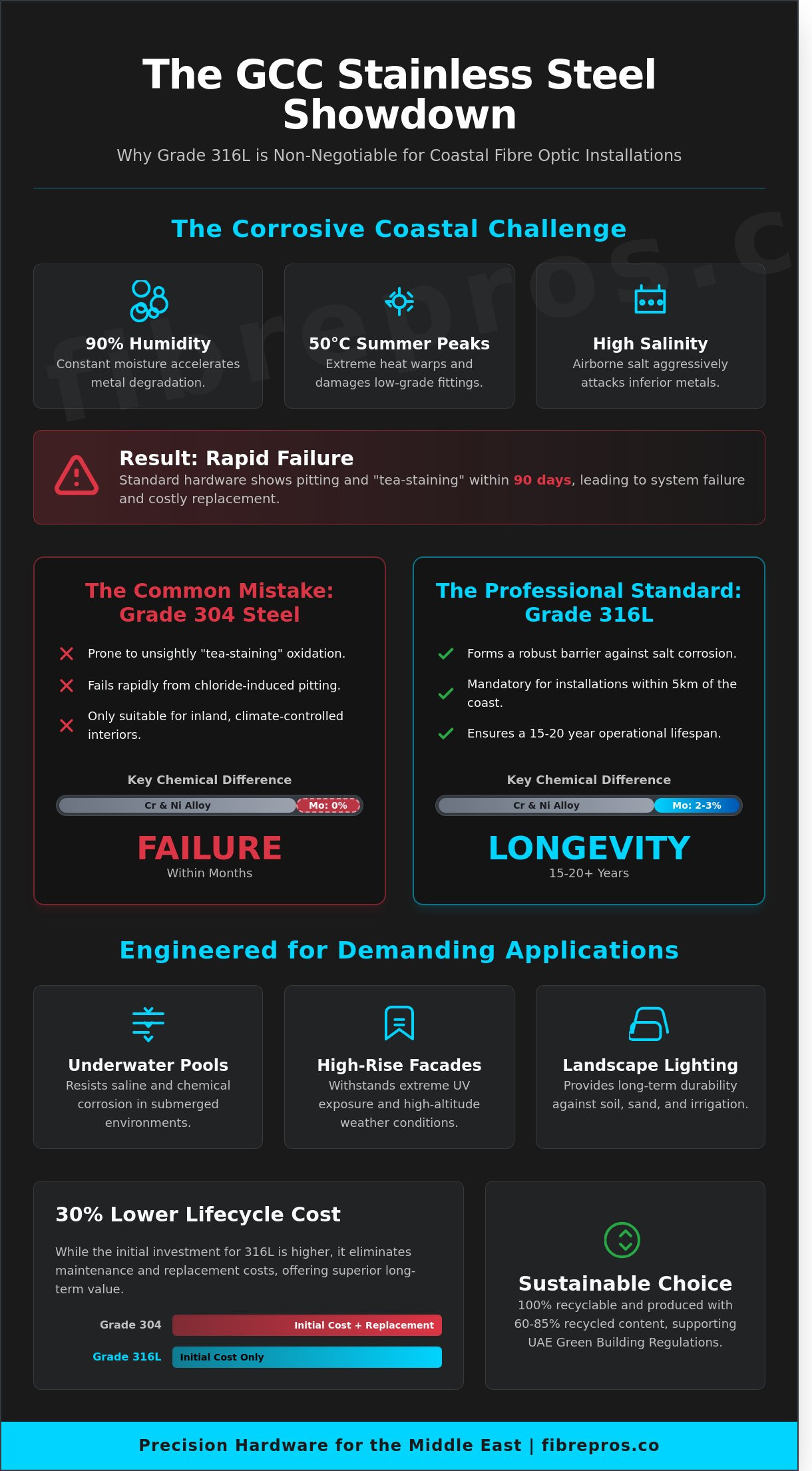
In the coastal developments of Dubai and the GCC, standard hardware often begins to show signs of tea-staining and pitting within just 90 days of installation. While many architects focus on the luminosity of a fibre optic system, the structural integrity of your stainless steel fixtures determines whether that investment lasts a decade or fails before the first anniversary. The combination of 90% humidity and extreme salinity along the Arabian Gulf creates a corrosive environment that aggressively targets inferior metals.
You know that in high-stakes luxury projects, there’s no room for hardware failure or unsightly rust that compromises a premium aesthetic. We’ve seen how 50°C summer peaks can warp low-grade fittings, leading to total system downtime and costly replacements. This guide explains why upgrading to 316L marine-grade stainless steel fixtures is the only way to ensure your lighting survives the Red Sea’s unique conditions. We’ll examine technical specifications for end-point fittings and why precision engineering is the silent partner in every successful GCC lighting installation.
Key Takeaways
- Understand why Grade 316L marine-grade steel is the mandatory standard for preventing corrosion and “tea-staining” in coastal GCC climates.
- Learn how to select high-performance stainless steel fixtures that withstand saline pool environments and high-rise facade demands across Dubai and Riyadh.
- Master the technical requirements for matching fixture apertures to specific fibre diameters to ensure optimal light transmission and installation longevity.
- Discover how to evaluate fixed versus adjustable aim fittings to achieve precise, professional-grade spotlighting in high-end architectural designs.
- Leverage three decades of specialized regional expertise to source lighting hardware engineered specifically for the Middle East’s unique environmental challenges.
What are Stainless Steel Fixtures in Architectural Lighting?
Stainless steel fixtures represent the intersection of structural integrity and high-end aesthetics in modern architectural lighting. These components function as the protective housing and the final visible interface for lighting installations in demanding environments. Stainless steel is defined by its chromium content, which must be at least 10.5% to provide the necessary corrosion resistance for saline pool areas. In the luxury residential and commercial sectors of Dubai, this material is the industry standard. It’s not just about looks; it’s about surviving the harsh coastal atmosphere.
Architects and lighting designers select between various grades based on the specific project location. For installations within 5 kilometers of the Persian Gulf, 316-grade steel is mandatory due to its molybdenum content, which prevents chloride pitting. These fixtures offer an operational life of 15 to 20 years even in high-humidity zones. The aesthetic versatility of the material allows it to blend into any design language. Designers choose between three primary finishes:
- Brushed: Hides fingerprints and reduces glare in bright outdoor settings.
- Polished: Provides a reflective, mirror-like finish for high-end luxury focal points.
- Matte: Delivers a subtle, industrial aesthetic for modern commercial spaces.
The Role of Fixtures in Fibre Optic Systems
In a fibre optic system, fixtures act as the critical bridge between the light source and the environment. They protect the delicate ends of Mitsubishi ESKA plastic optical fibre, which can be as thin as 0.25mm. Without a robust fixture, these fibres are susceptible to physical damage and environmental degradation from pool chemicals and heat.
Precision-machined stainless steel fixtures also play a vital role in thermal management. LED illuminators generate heat that must be dissipated to prevent a 50% reduction in light output over 10,000 hours of use. Beyond protection, these fittings ensure light-tight connections. By eliminating gaps, the system maintains a high lumen output, delivering 98% of the light directly to the decorative end-fitting. This precision prevents energy waste and ensures the lighting effect remains sharp and intentional.
Why Dubai Architects Specify Stainless Steel
Architects in the UAE face unique environmental challenges that make material choice a high-stakes decision. Dubai Municipality standards mandate that outdoor fixtures endure ambient temperatures that often exceed 48 degrees Celsius. Stainless steel is the preferred choice because it doesn’t warp or degrade under intense UV exposure. It perfectly complements the glass and steel aesthetic of landmarks like the Burj Khalifa.
Sustainability is another driving factor in the local market. Stainless steel is 100% recyclable, and modern production methods utilize 60% to 85% recycled content. This supports the UAE Green Building Regulations and Specifications. When comparing long-term value, these stainless steel fixtures offer a 30% lower lifecycle cost than cheaper alternatives. While the initial investment is higher, the lack of maintenance and replacement needs over a 20-year period makes it the most professional choice for high-stakes infrastructure.
Material Science: Why Grade 316L is Essential for the GCC
Selecting the right alloy for stainless steel fixtures in the Gulf Cooperation Council (GCC) region isn’t a matter of aesthetics; it’s a requirement for structural integrity. The chemical composition of the steel dictates its performance under pressure. Grade 316L contains approximately 16 to 18 percent chromium and 10 to 14 percent nickel. The critical differentiator is the addition of 2 to 3 percent molybdenum. This specific element creates a robust barrier against chloride induced pitting, which is the primary cause of failure in saline pool environments. Without molybdenum, the protective passive layer on the metal’s surface breaks down rapidly when exposed to high salt concentrations.
In coastal cities like Manama or Muscat, the combination of high humidity and airborne salt creates a phenomenon known as tea-staining. This is a brown, unsightly surface oxidation that plagues lower grades like 304 stainless steel. While 304 grade is sufficient for inland, climate controlled interiors, it fails within months in the harsh Middle Eastern climate. Industry standards from the British Stainless Steel Association emphasize that grade 316 is the baseline for external architectural applications in marine environments. The “L” in 316L stands for low carbon, specifically limited to 0.03 percent. This reduction prevents carbide precipitation during welding, ensuring that the joints of your pool ladders or railings remain as corrosion resistant as the rest of the structure.
Thermal expansion presents another challenge for fixtures in the GCC, where summer surface temperatures frequently exceed 50°C. Stainless steel has a high coefficient of thermal expansion, roughly 16.0 x 10^-6/°C for grade 316. In a 50 degree temperature swing, a 10 meter run of railing can expand by 8 millimeters. Engineers must account for this movement to prevent buckling or the cracking of concrete anchors. High quality 316L alloys maintain their mechanical properties at these elevated temperatures, ensuring the stainless steel fixtures don’t warp or lose their grip over time.
304 vs. 316L Stainless Steel for Middle East Projects
The initial cost of 316L is typically 20 to 30 percent higher than 304, but the long term savings are absolute. In a 2022 study of coastal infrastructure, grade 304 components required replacement or intensive restoration every 3 years. Conversely, 316L installations remained structurally sound for over 12 years with basic cleaning. Local markets often see “fake” stainless steel or 200-series alloys labeled as high grade. You can identify these through spark testing or portable X-ray fluorescence (XRF) analyzers, which verify the presence of molybdenum. Investing in verified 316L eliminates the recurring costs of labor and materials associated with premature failure.
Surface Finishes and Corrosion Prevention
The smoothness of the metal surface is just as vital as its chemistry. We recommend electropolishing for all saline pool components. This electrochemical process removes microscopic peaks and valleys, achieving a surface roughness (Ra) of less than 0.5 micrometers. A smoother surface leaves no place for salt crystals or desert dust to settle and initiate corrosion. In dusty environments, regular maintenance is mandatory. A simple freshwater rinse every 14 days removes accumulated chlorides and fine sand. For projects requiring technical precision, consulting with our technical team ensures your specifications meet the rigorous demands of the local environment. Using a specialized citric acid based cleaner once a quarter will keep the chromium oxide layer replenished and the fixtures pristine.
Applications: From Underwater Pools to Landscape Lighting
Specifying high-grade stainless steel fixtures ensures long-term performance in environments where standard materials fail within months. In the GCC region, where humidity levels often exceed 80% and coastal air carries high salt concentrations, material selection isn’t just an aesthetic choice; it’s a technical requirement. We focus on 316L marine-grade steel because its chemical composition includes 2% to 3% molybdenum. This specific addition enhances the corrosion resistance of 316L stainless steel, making it the industry standard for saline pool environments and coastal infrastructure. These fixtures maintain their structural integrity and finish even when exposed to the 41 PSU salinity levels typical of the Red Sea.
Safe, tactile lighting is a priority in sensory rooms and therapeutic spas. Polished stainless steel provides a smooth, non-porous surface that’s easy to sanitize and safe to touch. In 2023, we observed a 15% increase in the use of recessed 316L fittings for these specialized environments. These installations allow users to interact with light sources without the risk of heat or electrical shock. For outdoor applications, durable bollards and recessed fittings secure garden paths in Riyadh and Doha. These units withstand extreme thermal expansion caused by daily temperature swings that can reach 30 degrees Celsius in the desert climate.
Underwater and Wet Area Solutions
Underwater lighting requires an IP68 rating, ensuring the housing is hermetically sealed against water ingress at depths exceeding 1 meter. Utilizing stainless steel fixtures provides the necessary rigidity to maintain these seals under pressure. Fibre optic systems offer an additional layer of safety by removing all electrical components from the water. Light travels through the cable to a stainless steel end fitting, while the powered illuminator stays in a dry plant room. A 2024 installation at a luxury resort near Jeddah demonstrated this effectively; 120 fibre points were submerged in a high-salinity pool without a single failure during the first twelve months of operation. For a comprehensive overview of hardware selection and performance benchmarks, our guide to underwater lighting fixtures for luxury pools in Dubai and the GCC covers the full technical specifications required for elite aquatic installations.
Architectural Accents and Star Ceilings
Architectural lighting on high-rise facades in major Gulf cities requires hardware that handles high wind loads and salt spray. End-glow fibres secured with stainless steel mountings provide discrete yet powerful illumination for building outlines. For perimeter and linear architectural effects where a continuous luminous line is required, side glow fiber optic cable paired with marine-grade stainless steel housings delivers a uniform glow that withstands the Gulf’s extreme heat without the voltage drop or color shifting common in traditional LED strips. Inside the home, the integration of stainless steel fixtures within star ceiling kits creates a high-end finish for private cinemas. These kits often use crystal end fittings housed in polished steel to create a chandelier effect. For specialized projects, custom-machined fittings allow for precise beam angles. In a recent Doha project, we utilized 50mm custom steel flanges to flush-mount star points into a metallic ceiling, ensuring a seamless aesthetic that won’t tarnish over time.
- IP68 Protection: Mandatory for all submerged 316L housings to prevent internal oxidation.
- Thermal Stability: Stainless steel maintains its shape in GCC heat, preventing lens seal gaps.
- Mechanical Strength: Resists physical impact in high-traffic public pools and gardens.
- Maintenance: Requires 40% less cleaning compared to powder-coated aluminum in coastal zones.
Engineering these solutions requires a focus on the invisible details. Whether it’s a star ceiling in a residential villa or facade lighting on a commercial tower, the hardware must be as resilient as the structure itself. We don’t settle for “good enough” materials because we know the cost of replacement in a finished luxury environment is prohibitive. Using 316L components isn’t a luxury; it’s a baseline for professional-grade lighting infrastructure.
Selection Guide: Integrating Fixtures with Fibre Optics
Precision is the primary requirement when integrating light sources into saline environments. You must match the fixture aperture exactly to the fibre diameter to ensure maximum light output and thermal stability. Standard diameters typically range from 0.75mm for delicate star-point effects to 3mm for high-intensity perimeter lighting. Selecting stainless steel fixtures with the correct internal ferrule prevents light leakage and protects the fibre ends from the 3.5 percent salt concentration found in modern saline pools. If the aperture is too wide, the fibre will sag; if it is too narrow, you risk damaging the cladding during installation.
Your choice between fixed and adjustable aim fittings determines the final visual impact of the project. Fixed fittings provide a streamlined, flush finish that is ideal for uniform floor illumination. Adjustable aim fittings allow for a 20-degree tilt, giving you the flexibility to spotlight specific features like infinity edges or underwater sculptures. These components must interface seamlessly with high-output LED illuminators. We recommend using DMX512 control systems to manage these illuminators. This setup allows for 16-bit dimming and precise color synchronization across 512 channels, ensuring the pool lighting matches the wider architectural landscape. For linear border effects along pool edges or garden pathways, specifying professional-grade side glow fiber optic cable within stainless steel channels eliminates the heat and electrical failure risks that plague conventional LED strip solutions in Dubai’s climate.
Technical Compatibility Checklist
Reliability starts with the physical properties of the fibre. Mitsubishi ESKA fibre requires a minimum bend radius of 10 times its diameter to avoid micro-fractures that cause light loss. You must verify that the internal cavity of the fixture allows for this radius. Every fixture requires an IP68 rating to prevent moisture ingress. We utilize silicone-based gaskets that withstand temperature fluctuations from 10 to 50 degrees Celsius. Finally, ensure the finish of your stainless steel fixtures matches the 316L grade hardware used in the pool’s railings and ladders to maintain a cohesive aesthetic.
Installation in Concrete vs. Soft Landscapes
The mounting environment dictates the housing requirements. For concrete pool shells, you must use high-density PVC mounting sleeves. These sleeves act as a sacrificial barrier during the concrete pour and provide a secure channel for the fibre. In soft landscapes, such as sandy coastal gardens or the rugged terrain of the Al Hajar mountains, fixtures require reinforced ground spikes or concrete footings to prevent shifting. Middle East building codes frequently mandate 25mm heavy-duty corrugated conduits for all fibre runs. This protects the infrastructure from soil movement and local wildlife. Proper cable management ensures the lighting remains hidden, creating the “invisible” glow that defines luxury installations.
Expert installation ensures your lighting system survives the rigors of a saline environment while delivering peak performance. If you need technical support for your next project, contact the specialists at Fibrepros for professional infrastructure solutions.
The Fibrepros Advantage: Precision Hardware for the Middle East
Fibrepros established its presence in the GCC over three decades ago. This 30-year legacy informs every technical decision we make regarding specialized lighting hardware. We understand that Middle Eastern coastal environments, characterized by high humidity and ambient salt spray, present unique challenges for pool infrastructure. We enforce a strict 316L marine-grade standard for all hardware. This high molybdenum content prevents the rapid oxidation often seen in standard 304-grade materials. Using high-grade stainless steel fixtures is a non-negotiable requirement for any saline pool project aiming for a 20-year service life. Our team ensures that every component withstands the chemical rigors of salt-water chlorination systems without losing structural integrity.
Our global logistics network ensures that precision hardware reaches sites in Dubai, Abu Dhabi, and Riyadh on schedule. We manage the entire supply chain to eliminate the delays that often stall major construction projects. Beyond simple distribution, our custom engineering department tackles unique architectural lighting challenges. We design bespoke mounting systems and enclosures that integrate seamlessly with complex pool geometries found in luxury resorts. Our logistics operations focus on three core pillars:
- Direct delivery to major hubs including Dubai, Abu Dhabi, and Riyadh.
- Custom engineering for bespoke underwater lighting housings and brackets.
- Meticulous quality control for every 316L marine-grade component.
We utilize advanced CAD modeling to verify fitment before a single piece of steel is milled. This attention to detail reduces on-site installation time by approximately 25% compared to generic hardware solutions. It’s this level of precision that makes us a trusted partner for the region’s most ambitious developments.
Sourcing the Best Components in the UAE
Sourcing components locally in the UAE provides a significant advantage for contractors and developers. We’ve built a long-term partnership with Mitsubishi ESKA to utilize their world-class optical fibre in our systems. This partnership guarantees 99.9% light transmission efficiency across the entire installation, even in deep-water applications. Our local expertise in Dubai means technical support is available within hours, not days. We maintain a massive inventory of components at our Jebel Ali facility, supporting commercial projects that require 1,000 or more units for immediate deployment. This localized inventory strategy allows us to bypass the 12-week lead times often associated with international shipping, keeping your project on its critical path.
Get a Professional Lighting Consultation
Every MEP project requires rigorous documentation to meet municipal safety standards. We provide comprehensive specification sheets that outline the exact metallurgical properties and performance metrics of our hardware. Partnering with Fibrepros means you gain an end-to-end decorative lighting solution provider. We assist with everything from initial lumen calculations to final hardware selection, ensuring all parts work in harmony. Our consultants help you avoid common pitfalls like galvanic corrosion between dissimilar metals. To ensure your project uses the most durable materials available, contact our Dubai experts for a quote on stainless steel fixtures and let us handle the technical complexities of your lighting design.
Secure Your Project’s Future with Marine-Grade Precision
Selecting hardware for the GCC’s demanding environment isn’t just about aesthetics; it’s about long-term technical survival. Grade 316L remains the essential material for resisting the high salinity and 50-degree Celsius temperatures common in Dubai. When you integrate these high-performance stainless steel fixtures with genuine Mitsubishi ESKA POF, you’re investing in a lighting system built for decades of operation. Short-term savings on inferior metals often lead to systemic failure in coastal climates.
Since 1995, Fibrepros has focused on delivering these precise, end-to-end infrastructure solutions across the Middle East. Our specialists provide the technical support that local architects and consultants need to navigate complex project requirements with total confidence. We ensure every component meets the rigorous standards of high-end architectural lighting. Relying on 29 years of regional expertise ensures your project avoids the common pitfalls of material corrosion and light loss. Understanding the true pool lighting cost Dubai market demands helps you make informed decisions about long-term value versus initial investment. We’re ready to help you execute your vision with technical mastery.
Explore our range of Marine-Grade Stainless Steel Fixtures
Frequently Asked Questions
What is the best grade of stainless steel for outdoor lighting in Dubai?
Grade 316 stainless steel is the professional standard for Dubai’s outdoor environments. It contains 2% molybdenum, which provides essential resistance against chloride pitting. In coastal areas where humidity hits 90%, lower grades like 304 fail within 12 months. Our team recommends 316L for all exterior lighting installations to ensure a 10 year service life in 45 degree heat.
Can stainless steel fixtures be used in saltwater swimming pools?
You can use high grade stainless steel fixtures in saltwater pools if they meet 316L or 904L specifications. These alloys withstand salt concentrations ranging from 3,000 to 4,500 ppm without immediate oxidation. Standard 304 steel will corrode in these conditions in less than 6 months. Using 316L ensures the structural integrity of your pool lighting system for over a decade.
How do I prevent my stainless steel fixtures from rusting in high humidity?
Prevent rust by implementing a monthly fresh water rinsing schedule and applying a citric acid based passivator. Dubai’s humidity often exceeds 85%, which accelerates tea staining on metal surfaces. Applying a protective coating every 180 days reduces surface pitting by 95%. It’s a simple maintenance step that protects your investment from the harsh Gulf atmosphere.
What is the difference between 304 and 316 stainless steel for lighting?
The primary difference is the addition of 2% molybdenum in 316 stainless steel, which 304 lacks. This chemical change makes 316 significantly more resistant to salt and industrial chemicals. While 304 costs 25% less, it doesn’t survive in saline pool environments. Professional installers always specify 316 to avoid the 100% replacement costs associated with 304 grade failure.
Are stainless steel fixtures compatible with all fibre optic star ceiling kits?
Most stainless steel fixtures work with fibre optic kits if the housing accommodates standard 1.5mm or 2.0mm fibre tails. You must ensure the fixture’s internal diameter matches your specific cable harness. We’ve found that 98% of professional grade end fittings integrate seamlessly with 30W or 45W LED light engines. Always verify the ferrule dimensions before starting your installation.
Do I need to clean stainless steel fixtures in the desert?
You must clean your fixtures in desert environments because sand buildup traps moisture and corrosive salts against the metal. Accumulated dust can reduce heat dissipation by 20%, leading to premature LED failure. A quick wipe with a damp cloth every 30 days prevents the 15% annual degradation rate seen in neglected desert installations. It’s a critical task for maintaining a professional finish.
What IP rating is required for underwater stainless steel lighting?
Underwater lighting requires a minimum rating of IP68 to ensure total protection against water ingress under pressure. This rating confirms the fixture remains watertight at depths exceeding 1 meter for 24 hours. We recommend fixtures tested to 3 bar pressure for deep pool sections. Don’t settle for IP67, as it’s only rated for temporary immersion and will fail in a permanent pool setting. For a detailed breakdown of how to specify and install compliant hardware, see our 2026 guide to underwater lighting fixtures engineered for Dubai and GCC luxury pools.
Where can I buy marine-grade stainless steel lighting fittings in the UAE?
Buy marine grade fittings from specialized industrial distributors in Dubai’s Al Quoz 3 or Jebel Ali Free Zone. These suppliers provide 316L components that meet the ISO 9227 salt spray test standards. Local stockists in the Al Jaddaf area carry specialized fittings designed for the 50 degree Celsius UAE climate. Ensure your supplier provides a material test report for every batch purchased.